
Rock Paper Scissors is a game where two players simultaneously pick one of the three things in the title. Rock beats Scissors, Scissors beats Paper, Paper beats Rock, and if both players pick the same thing they tie. Rock Paper Scissors is important in game theory, because it is a toy model that helps understand a much broader class of games.
To understand the correct strategy in Rock Paper Scissors, we must understand the difference between pure strategies and mixed strategies. A pure strategy is deterministic, where a mixed strategy is random. There are only three possible pure strategies: pick Rock, pick Paper, and pick Scissors. There are infinitely many mixed strategies available, for example assigning 50% probability to Rock, 25% to Paper, and 25% to Scissors.
Intuitively, among pure strategies, there is no “best” strategy. Let’s say I use the pure strategy of picking Rock. You can beat that with another pure strategy, picking Paper.
But among mixed strategies, there is a “best” strategy. Just assign equal probability to each of the three.
This raises the question of what it means for a strategy to be “best”. If I’m playing against someone who just always picks Rock, then the most reliable way to win is not to mess around with probabilities, it’s to pick Paper.
And in practice, humans are not very good at being random number generators, and this could be exploited. For example, if a human is not paying attention, they might overly avoid choosing the same thing twice in a row. So, if instead of splitting your probabilities equally, you adjust your strategy to take advantage of this, you may win more often. On the other hand, if you try to exploit your opponent’s strategy, then you yourself are vulnerable to exploitation. So an opponent could win by tricking you into a certain strategy, and then punishing it.
So what does it mean to say that picking each thing with equal probability is the “best” strategy? In game theory, this is what’s called the Nash equilibrium. A Nash equilibrium is a pair of strategies (one per player), such that neither player can improve their position by changing their own strategy. If I follow the “best” strategy, where I choose each item with equal probability, then there is nothing an opponent can do to improve their chance of winning. In other words, the Nash Equilibrium strategies are the strategies that are not vulnerable to exploitation.
Not all games have a Nash equilibrium, and some may have more than one. For instance, if we constrain ourselves to pure strategies, then Rock Paper Scissors has no Nash equilibrium. However, if we allow mixed strategies, there is a theorem asserting that finite games always have at least one Nash equilibrium.
A simple variant
Now the problem with Rock Paper Scissors is that it’s maybe a bit too intuitive. Of course you assign equal probabilities to each choice, the three choices are symmetrical! So, in order to better understand the game, I’m going to introduce a small asymmetry.
So imagine we have a fighting game. Both players pick one of three actions, and it all happens faster than human reaction speed so it’s effectively simultaneous. The three actions are: 1. Attack. 2. Block and punish. 3. Grab and throw. According to video game logic, blocking beats attacking, attacking beats grabbing, and grabbing beats blocking. However, they don’t do equal amounts of damage. Let’s suppose that grabbing is most powerful, and does twice as much damage.
The way to visually represent this is with a payoff matrix. Player 1 picks the row (A = Attack, B = Block, G = Grab), and Player 2 picks the column. The two numbers in the resulting cell represent the payoff for player 1 and 2 respectively.
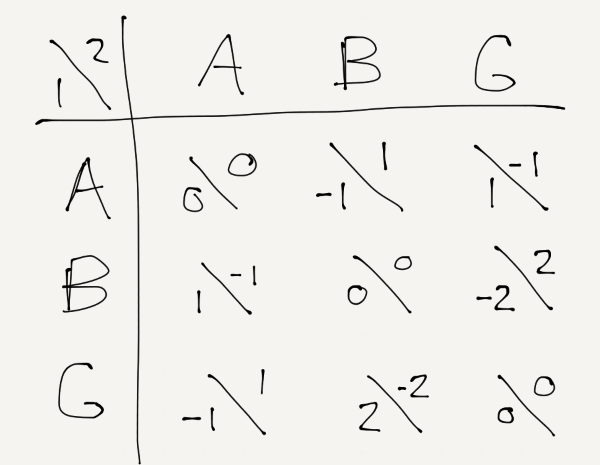
Attack/block/grab payoff matrix.
Let’s imagine you’re player 1 and you’re trying to follow the Nash equilibrium strategy. Your strategy consists of three probabilities a, b, and g, which must obey the constraint that a+b+g=1.
Fortunately, this game is still symmetrical in the sense that both the players are in identical situations. So we’re going to look for a Nash equilibrium where both players are following the same strategy. In this equilibrium, the average payoff to each player is zero.
Since it’s a Nash equilibrium, it should not be possible for Player 2 to pick any strategy against yours that will do better than zero. So imagine player 2 switches to a pure strategy, always picking A. Their expected score will be -b+g, which must be less than or equal to 0.
We can repeat this analysis for each of the three pure strategies, producing three inequalities.
Player 2 picks A: -b+g ≤ 0
Player 2 picks B: -2g+a ≤ 0
Player 2 picks G: -a+2b ≤ 0
These equations have a unique solution, with b=g=0.25 and a=0.5.
So in a fighting game where grabbing is more powerful, the “optimal” strategy involves more attacking. This may be intuitive or counterintuitive, depending. The way I think of it, if grabbing is so strong, then you have to discourage it by frequently choosing the move that punishes grabbing.
Solving Rock Paper Scissors
Every variant of Rock Paper Scissors can be solved this way, with some caveats. The first caveat, is that the math can get hard. It’s not hard to solve a system of 3-4 equations, but if you had a Rock Paper Scissors variant with like 20 different choices that’s another story.
The second caveat is that in order to solve the equations, I treated the inequalities as equalities. That made it a lot easier to solve! But you cannot do it in general. Here is a simple counterexample.
– B beats A. A and B are the only two choices.
If we transform this into a system of inequalities, we get:
-b ≤ 0
a ≤ 0
So obviously the solution is to always pick B. So we have b = 1, a = 0. So the first inequality can’t be treated like an equality.
Here’s a nontrivial counterexample. The solution is left as an exercise to the reader.
– A beats B, C, and F.
– B beats C and D.
– C beats D, E, and F.
– D beats A and E.
– E beats A, B, and F.
– F beats B and D.
The harder question is, can we heuristically solve complex Rock Paper Scissors games? How do we build intuition for Rock Paper Scissors games without going through a bunch of math? These are difficult questions beyond my knowledge.
Leave a Reply