From rq, click for full size!


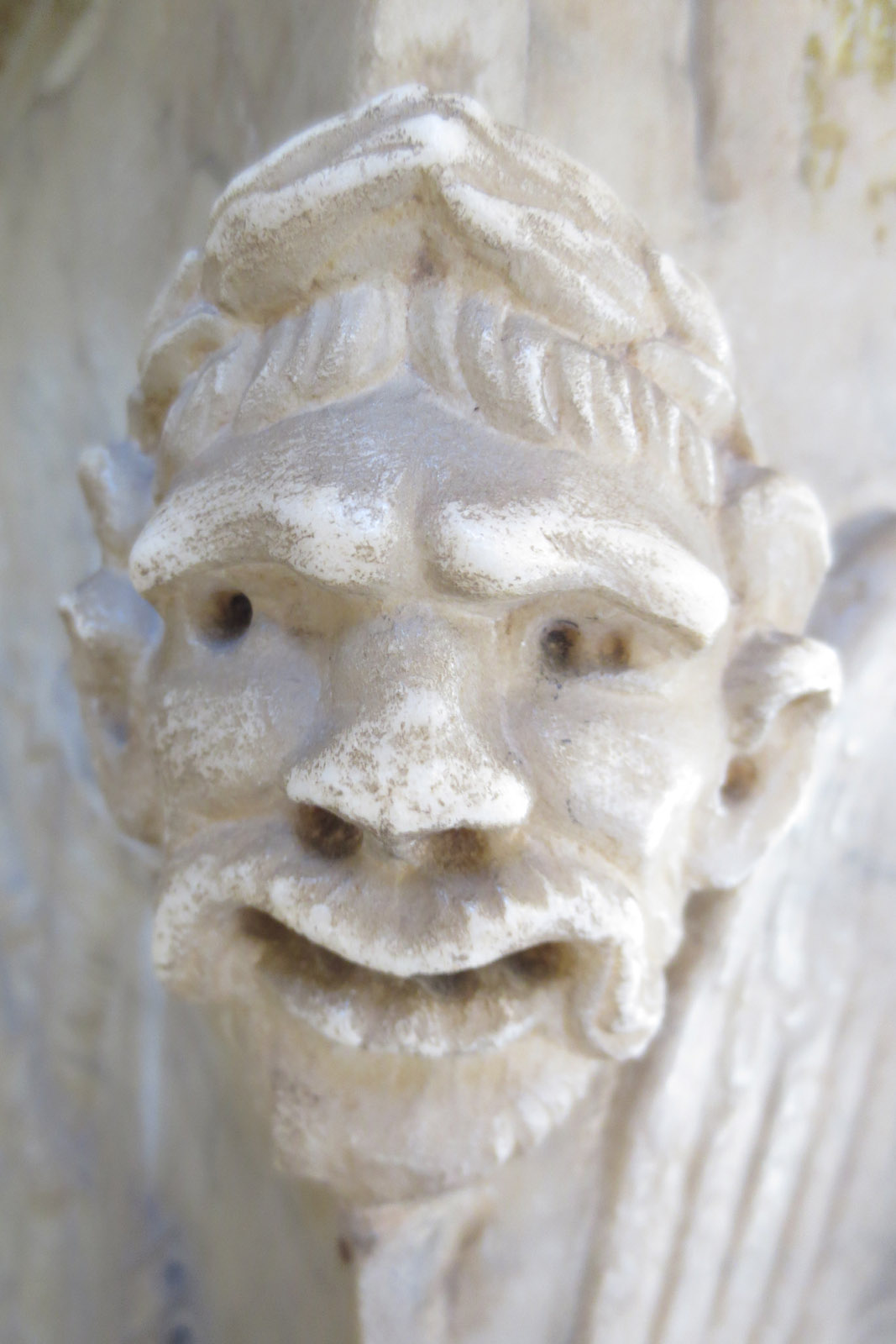
© rq, all rights reserved.

From rq, click for full size!
© rq, all rights reserved.
The most prestigious cemetery in Russia lies on the other side of Lenin’s tomb, directly in the Kremlin wall necropolis. That is where the greatest of Russians lie. There you will find Stalin, Brezhnev, Chernenko and astronaut Yuri Gargarin. Very few are up to this highest of honors, though, so where do the rich and famous of Russia go when they die? The answer is likely the Novodevichy Cemetery in Moscow.
The cemetery is large and active with many visitors, some to visit specific graves and others to view the entire site as an outdoor gallery filled with history and graced by the best of Russian art. Despite large numbers of people the cemetery maintains a quiet, reflective quality. Some graves have small chairs for guests. Many graves have small offerings of fruit or sweets. Many more have fresh flowers and there is, conveniently, a florist’s shop at the front gate. There are several graves that I photographed that I was unable to locate information about. They are so beautiful that I include them anyway. I really wish I’d had more time here. Lots more time. What a very special place. (I apologize about the quality. My real camera broke and I was using an old spare)
First, I’ll start with the well-known graves.

Boris Yeltsin

Nikita Krushchev
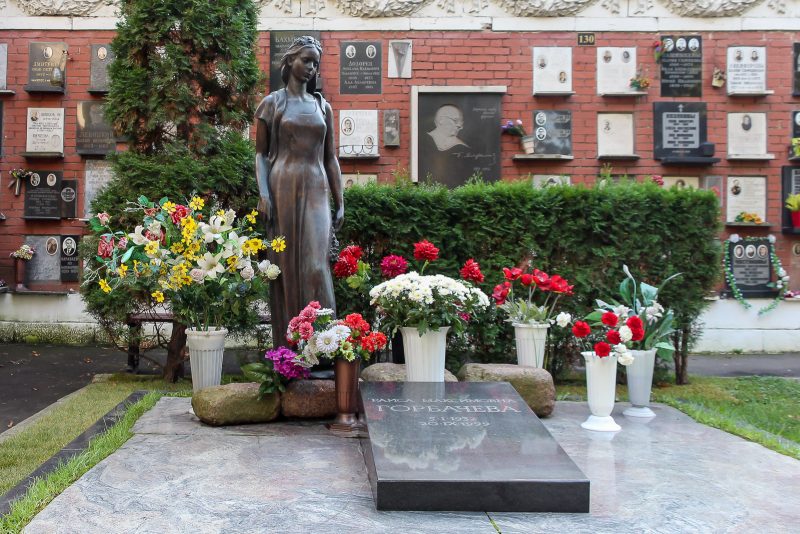
Raisa Gorbechov, wife of Mikhail Gorbachov

Anton Checkov

Yuri Nikulin, beloved actor and clown with his dog

General A Lebed
And now for the beautiful graves I could not identify. The last is my favourite. But first, the flower shop. (note: some names have been added to the original post. See below.)

Florist, Novodevichy Cemetery

Russian entertainer Boris Brunov

Cat lover Valentina Reinholdovna Gliere

Come and sit

Russian singer

Someone to keep watch, Yelizaveta Kairova

Agony

Young lovers

Living tree
©voyager, all rights reserved
Edit note: Thanks to meaderborn and Ice Swimmer for helping me fill in a few names on my unidentified list. I have added their names in respect.
Link to previous Post – Russia – The Novodevichy Nunnery
I’m skipping down happy street today. The sun is shining, the air is warm (12°c!) and Jack and I even found some colour in the landscape.
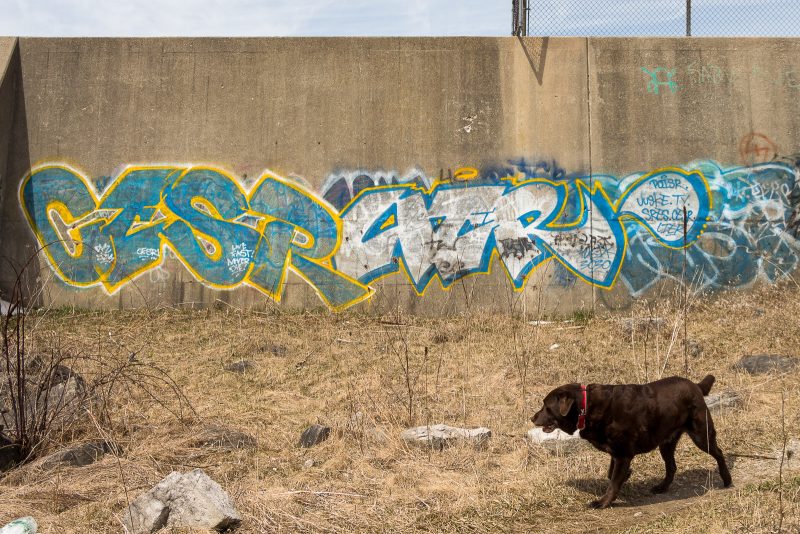
©voyager, all rights reserved
Å.
Å is Swedish for river. These pictures are from the two biggest rivers flowing in Helsinki. Vantaanjoki (Vantaa river, the Swedish name is Vanda å) and Mätäjoki (rotten river, the Swedish name is Rutiån). Mätäjoki was the original channel through which Vantaanjoki flowed into the sea, west of Helsinki peninsula, but about 3000 years ago, Vantaa changed its course eastward and started to flow into the sea east of the peninsula.
Mätäjoki is more like a brook, even though it’s called a river, a few kilometers long, flowing in its oversized channel. Vantaanjoki, on the other hand is 101 km long and a proper river.
The first two pictures are from Vantaanjoki at the Vanhankaupunginkoski (old town rapids, the modern Swedish name is Gammelstadsforsen). The city of Helsinki was originally sited near the rapids at the moutgh of the river in Helsinge parish (the name is a Swedish name, the population was mostly Swedish speaking).
The third is a picture of Mätäjoki flowing through a park in Pitäjänmäki, Helsinki.
The fourth is Vantaanjoki a bit upriver from Vanhankaupunginkoski.
The fifth is from the same park as the third and the sixth is a bit upriver from the park, Mätäjoki is flowing between a street and a residential area.
In the seventh and eighth it is again Vantaanjoki at Vanhankaupunginkoski. There’s an island in the river at the rapids. The western channel has been dammed and there’s a power station there (nowadays a museum, but it produces electricity), but the eastern channel has been restored closer to the natural state and the salmon and trout can swim through the eastern channel upriver to breed in the river.
The letter Å is one of the so called Scandinavian letters. It originates from late medieval Swedish and is nowadays used in Danish and Norwegian as well. It is used in words which used to have long a A in Old Norse but the pronunciation changed to an O (think of Latin or Standard German wovel sounds, not English).
More photos under the fold, click for full size!

A leafhopper from Lofty, click for full size. Now that’s a Spring Green!

© Lofty, all rights reserved.
From Nerd of Redhead, flowers are popping!
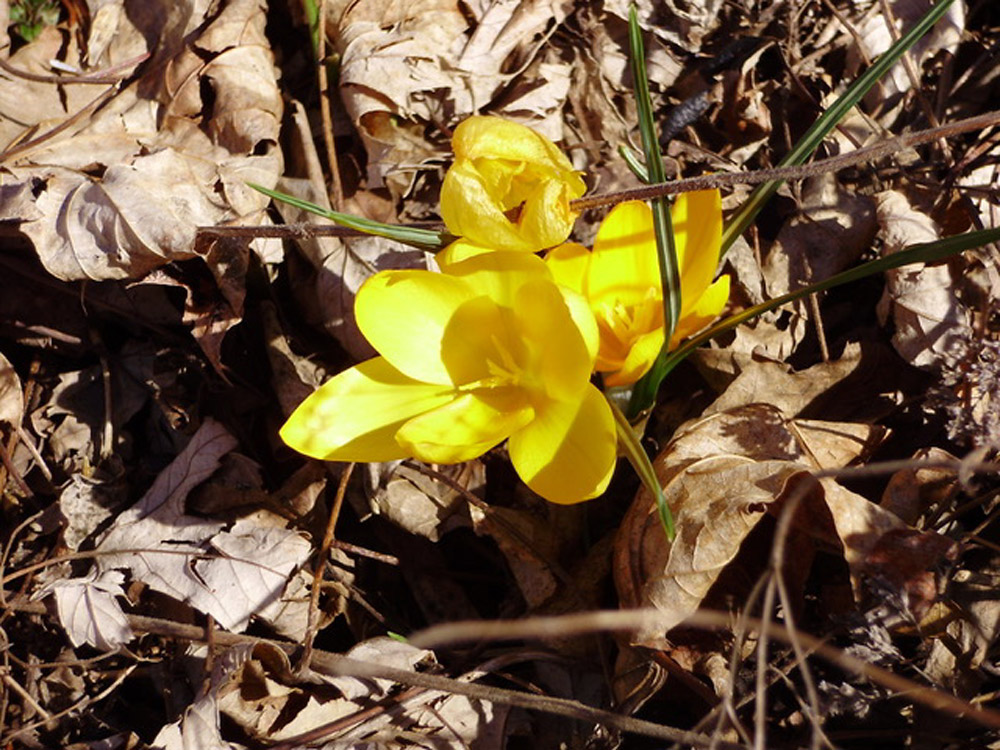
OLYMPUS DIGITAL CAMERA
© Nerd of Redhead, all rights reserved.
It was bloody cold this morning on our walk, but they promise 11°c by this afternoon. I hope they’re right because I’m losing my patience with this continuous cold.

©voyager, all rights reserved
Revisiting the original crew, they were 16 days old in these photos. I’ll try to name as best I can. And today’s music is something of a tie-in. :D

The front, l-r, Gytha, Oliver, Chester, Beatrice. At the very back, Giles, Agnes, Amelia, and Vasco, who are sitting on top of Neville. I think.

Basil. I think.

l-r, Giles, Agnes, Vasco, and the last two could be Oliver, Chester, Theo, Neville, or Dexter.

l-r, Amelia and Beatrice. Amelia was cute overload from the start.

Chester and Amelia.
© C. Ford, all rights reserved.
Zuge.
Zuge is Helsinki slang for a train. In standard Finnish train is juna and in standard Swedish tåg. The z is pronounced ts in Finnish, like in German, but a bit more lazily.
Helsinki slang takes its vocabulary from many sources. Some words come from Swedish, English or Russian. Zuge comes probably from the German word for train, Zug. Old Helsinki slang was to a great extent a mixture of Finnish and Swedish, which was understood by both Finnish and Swedish speaking working-class youth. Now the slang is much more influenced by English.
I’m not really in the slang speaking demographic, being a bit too old and not born and raised in Helsinki.
All the train pictures here are electric multiple unit trains, with no locomotive. Except for the Pendolino high-speed train leaving Helsinki Central Railway station in a cloud of snow, all are regional trains operating in the Capital Region and its surroundings. The Pendolino is a long-distance train with a somewhat troubled history. The Italian technology has had a lot of problems with snow and frost.
The red train is an old Sm2 regional train made by Valmet Lentokonetehdas (Valmet Airplane Factory). The other train photographed from the same place on the Linnunlaulu bridge is a Sm4 regional train used for longer regional lines. In the summer picture from Vantaankoski station in Vantaa, the train is a Sm5, which is used for the shorter lines in the Capital Region.
Click for full size!


© Ice Swimmer, all rights reserved.
Here we are, down by the river, and this is the moment just before Jack dives in.

©voyager, all rights reserved

© Nicolas Bruno, all rights reserved.
The matters of our psyche and our dreams, in particular, permeate the work of Nicolas Bruno not only as a phenomenon but moreover as the articulation of personal experience. The allusive, surreal and haunting works he creates are embodiments of the state in between waking and sleeping. They are an effect of the artist’s torment; the situation in which he is constrained to embrace the subconscious and its perils while being paralyzed in bed. Although the works of Nicolas Bruno are quite personal and might seem hush, bizarre and even violent, they are explicitly suggestive and are calling the observer to participate in the sense of enrolling their own associations or perhaps dealing with their own anxieties and fears.
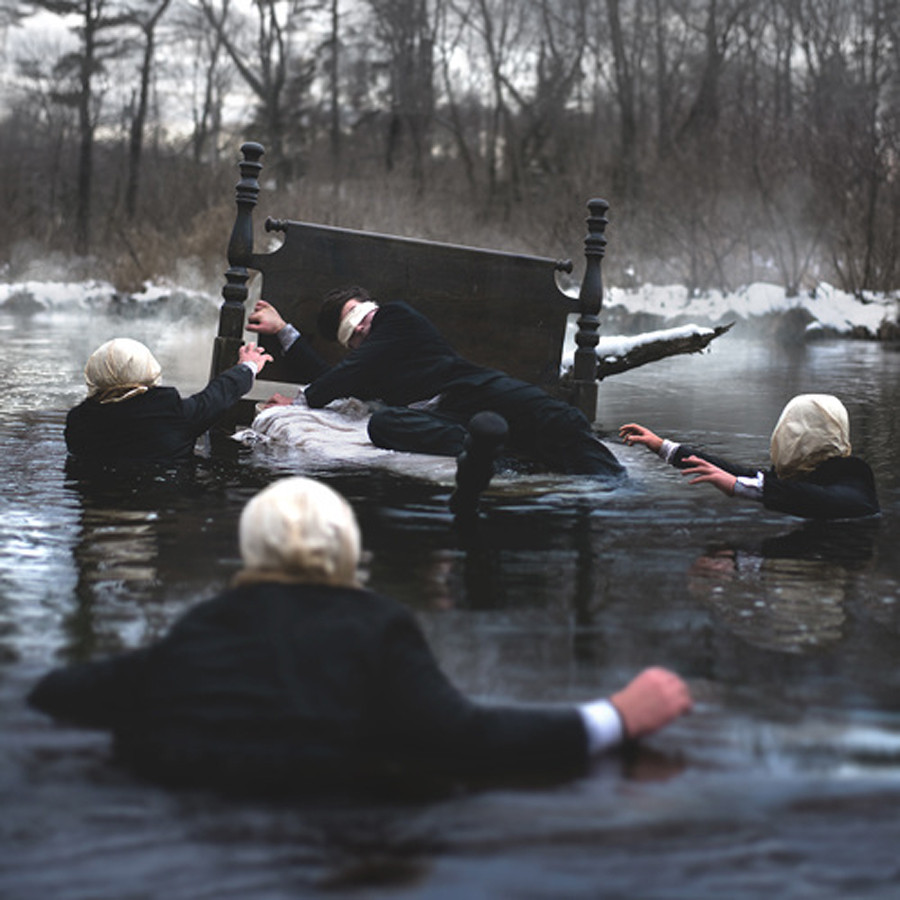
© Nicolas Bruno, all rights reserved.
Photography As Therapy.
Nicolas Bruno was born in 1993 in Northport, New York, a small harbor community located on Long Island. He studied at Purchase College and received his BFA in Photography in 2015. His studio is located in Northport, so practically all of the preparations for the shoots are taking place there, as well as postproduction. Since all of his practice is very much devoted to the symbolic of dreams, the artist keeps the dream journal and starts each new series by analyzing previous experiences. As a matter of fact, his creative process begins with in-depth planning, but the very shoot is far more spontaneous and open to experimentation.

© Nicolas Bruno, all rights reserved.
The Sleep Paralysis of Nicolas Bruno.
The foundation of his photographic experimentation lays in Bruno’s struggle with the sleep paralysis, from which he has been suffering for almost ten years. It is a common phenomenon occurring in between wakefulness and sleep, in which the body becomes immobile and it often causes severe hallucinations. This state of inescapability forced Nicolas Bruno of finding some sort of solution and with the advice of a therapist he found it through creative expression. Therefore, he started working on surreal self-portraiture as a therapeutic translation of night tremors in order to cope with these fears and simultaneously share these familiar emotions of anxiety, suspense, uncertainty, and danger.

© Nicolas Bruno, all rights reserved.
Nicolas Bruno’s works are haunting, evocative, and terribly poignant. They not only express the explicit fears brought to Mr. Bruno in his paralyzing sleep, they also express implicit fears and anxiety of people in general. Each photograph is a masterpiece of unspoken fear, and when viewing, you simply cannot help but to feel, in a very small way, what the night and sleep is like for Mr. Bruno. Sleep Paralysis is not common, and unfortunately, not well understood either. Many people do have an isolated incident of sleep paralysis. I had a period in my teens into my early twenties of sleep paralysis, and it’s terrifying, to say the very least. Nicolas Bruno has come up with a unique way of dealing with it, and I think he deserves a much wider audience for this amazing work.
You can read and see more of Mr. Bruno’s bio here, and his portfolio here. There’s also this all too brief video:
Yachting.
This sailing boat was on the sea in May 2016. I took he photo on an evening sightseeing cruise to the Helsinki Archipelago.
The bonus picture is about the long off-season for yachting. These boats must have been sitting in the dry from late autumn. The sea ice could have broken them so they had to be lifted from the sea. The photo was taken in late March 2018.
Click for full size!


© Ice Swimmer, all rights reserved.


