From Nightjar…
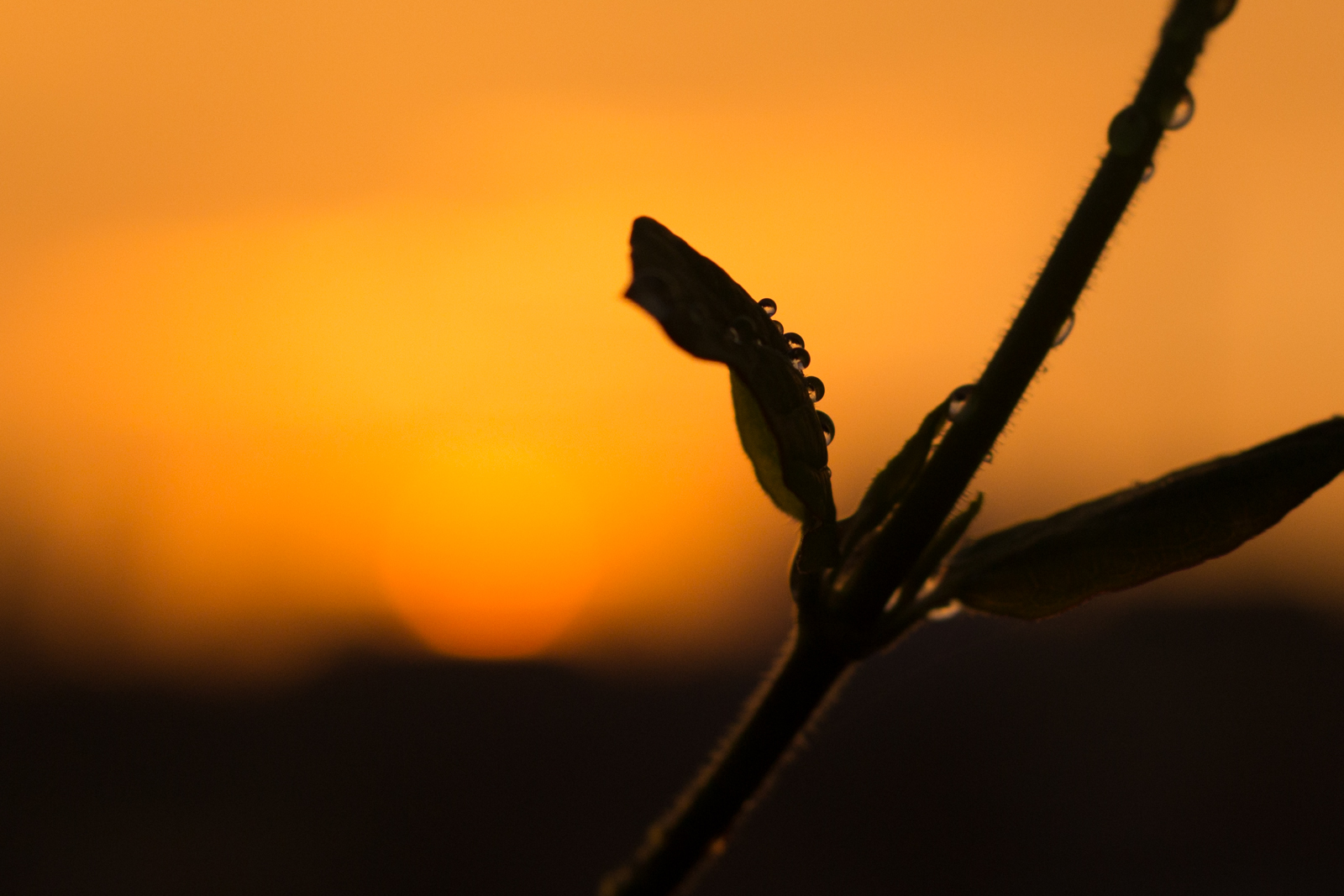
A is for Amber ©Nightjar, all rights reserved
Amber.
The name comes from the fossilized tree resin, but I found the color amber all over the sky.

From Nightjar…
A is for Amber ©Nightjar, all rights reserved
Amber.
The name comes from the fossilized tree resin, but I found the color amber all over the sky.

Madeline Brandeis. Little Anne of Canada. New York, Grossett and Dunlap, 1931.
Happy Canada Day!
via: Abe books
Nightjar has been hard at work on a project…
Ten months ago it occurred to me that doing an alphabet round based on colors could be a fun challenge. I was going through a difficult phase at the time and needed something to keep me distracted, so I had this idea of picking a color for each letter of the alphabet, trying to find it in nature and capturing it in a photo. Easier said than done, it turns out! For many letters there aren’t that many (or any) options available and some colors can be difficult to interpret and capture. I tried to stay away from silly color names and stick to the natural world as a source of inspiration. Those were the only rules. It was a fun and instructive exercise and I’m excited to finally share the results. I hope you enjoy it. But before we get to the letter A I thought I’d start with an introduction to the theme of colors in nature: a close-up of a rainbow!

©Nightjar, all rights reserved
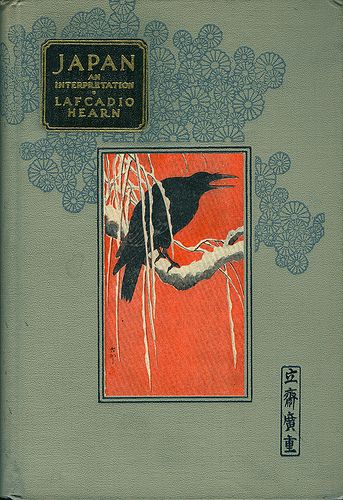
Lafcadio Hearn. Japan an Interpretation. McMillen Co., 1924. – source
Photo by Public Library of Cincinnati & Hamilton County on flickr
It’s that wonderful time of the month when Nightjar shares her portraits of light.
In the month of the Summer Solstice sunlight is brighter than ever and nature is bracing for the dry season. Many wildflowers have gone to seed and are drying out already (some are doing weird stuff like the wild chive in the last photo… perhaps confused by the unstable weather?) and bugs are very busy. Backlighting is trickier this time of the year but I tried to play with June Light from all angles and I think it was worth it.

©Nightjar, all rights reserved
I had all my abrasives in one big plastic case, some further sorted in smaller containers, but the abrasive papers and pads were just one huge pile. So now that my workshop is in a state when it is actually possible to do actual work again, I have decided before I start to make knives again to sort out my abrasive materials for good (again, so in reality until the next stack overflow).
For the papers I have made a little portable shelf where I could sort them out from the coarsest (40 Grit) to the finest (7000 Grit) with some room to spare for clean paper sheets and carbon paper sheets – those come in handy sometimes in the shop, so why not. I still have three slots to fill, which is a good sign. It is a lot heavier than I thought it will be, partly because that is a lot of MDF and particle boards packed into small space, and partly because that is a lot of abrasive paper – and that is heavy, of course, it is covered in sand after all.

Abrasive papers, sorted and ready to deploy.
Precision is of the essence in such an endeavor, as is the quality of used materials of course. That is why I cobbled it all together from scraps of old furniture – 1 cm particle board from an old bed for the frame and 3 mm MDF stripped from an old bathroom door. And I took the time – about 2 hours. Joking aside, I could, of course, buy completely new MDF and have it precisely cut beforehand in the shop, but waste not, want not. I never got used to throwing money at something that will work just fine when made from scraps that I have at hand (my shop looks the part), and I certainly am not going to do that when I just quit a job and am about to lose reliable income.
Now the case could be filled again with remaining polishing and abrasive materials, in a more orderly fashion – polishing wheels, pads, polishing pastes, etc. It is just as full as it was before – which is not good – but it is all a lot less cluttered.
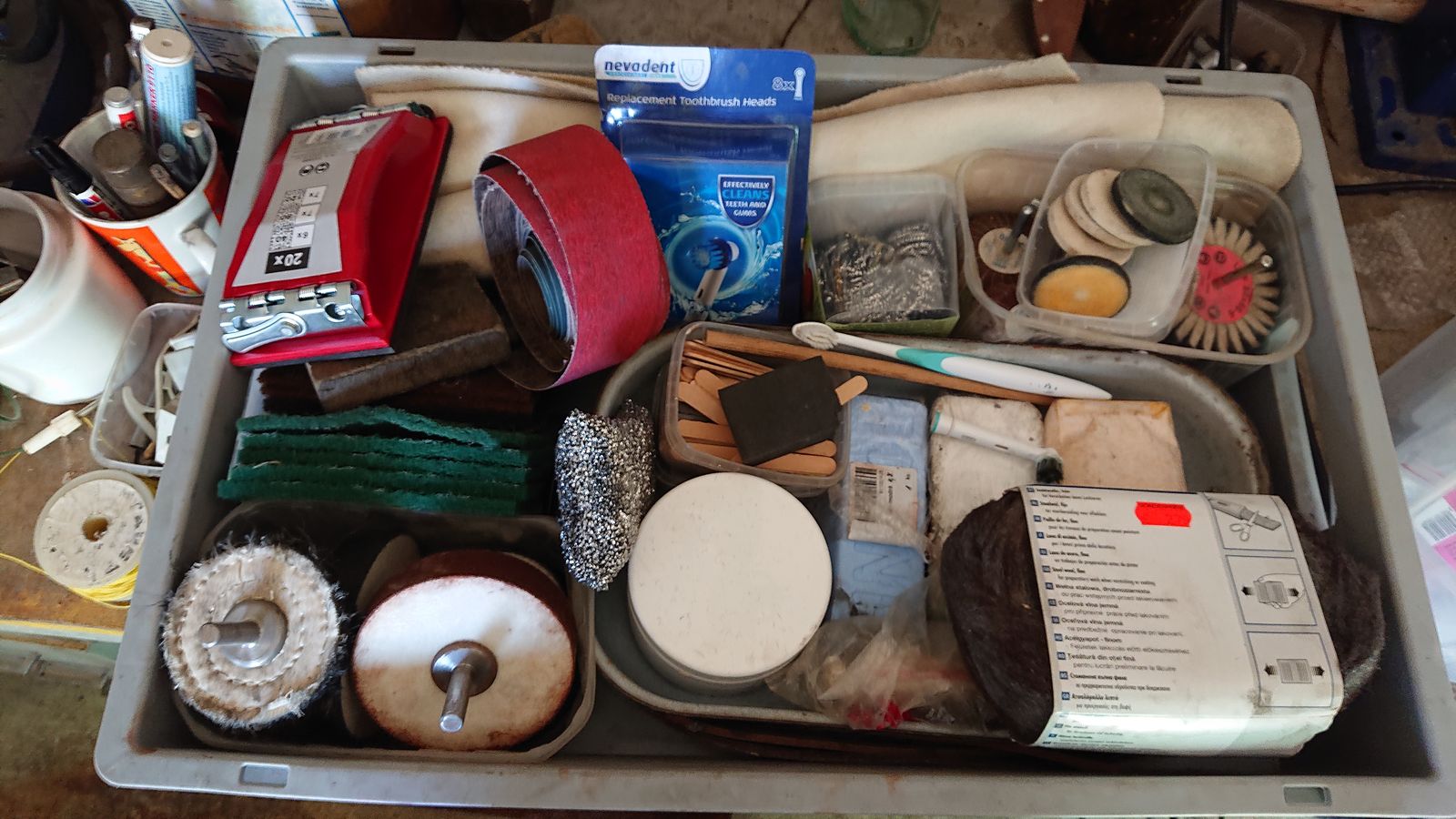
A lot of felt and fat and various odds and ends.
I will probably have to figure out something better for the steel wool, it tends to rust and crumble before I get to actually using most of it. But, as it is, it is a significant improvement.
I no longer have to take a pitchfork in order to get to the bottom of the case and find the grit I need. Today afternoon I will make some improvements to my belt sander and after that, hooray – I will start to make knives again!

Arabian Nights. Edited by Hildegard Hawthorne, illustrated by Virginia Frances Sterrett. Philadelphia, The Penn Publishing Company, 1928.
Arabian Nights is the last book illustrated by Virginia Sterrett before her death in 1931 at the age of 30. It was a huge undertaking for Sterrett who was quite sick with tuberculosis and living in sanatorium at the time. The artist was able to work for only brief periods each day and the book took a total of 3 years to complete. Sterrett experienced a brief improvement in her health in 1929 and was able to return home for a time. She even began work on a new book for Penn Publishing in 1930 – Myths and Legends – but she was unable to complete the work. Many people consider Arabian Nights to be the finest work that Sterrett produced. Enjoy!

©voyager, all rights reserved
Our weather has finally warmed up and the past few days have been pleasantly warm and summer-like. Unfortunately, that isn’t the case for many of our readers, especially those across Europe who are enduring a heat wave. Jack and I hope you find ways to stay cool, safe and hydrated. Jack says all you need is water – drink, splash, swim and stay cool. I say a little air-conditioning might be a good thing, too.
A small bit of fun(gi) from Avalus,
Alien like spires of fungus and algae, covered in morning dew.

alichens 1, ©Avalus, all rights reserved

alichens 2, ©Avalus, all rights reserved

Pain, Barry. Stories and Interludes. New York, Harper & Brothers, 1892
It’s batty, but I like the heart-shaped heads set against a fingerprint moon.
via: The Internet Archive

Martin Doyle. The Illustrated Book of Domestic Poultry. Philadelphia, Porter & Coates, 1892.
Because chickens are beautiful. And it’s what’s for dinner tonight.

Black Breasted Malay

Ghou Rook Rumple (Silk Fowl Chicken)
via: The Internet Archive, where you can view all the illustrations, including the ducks and geese.
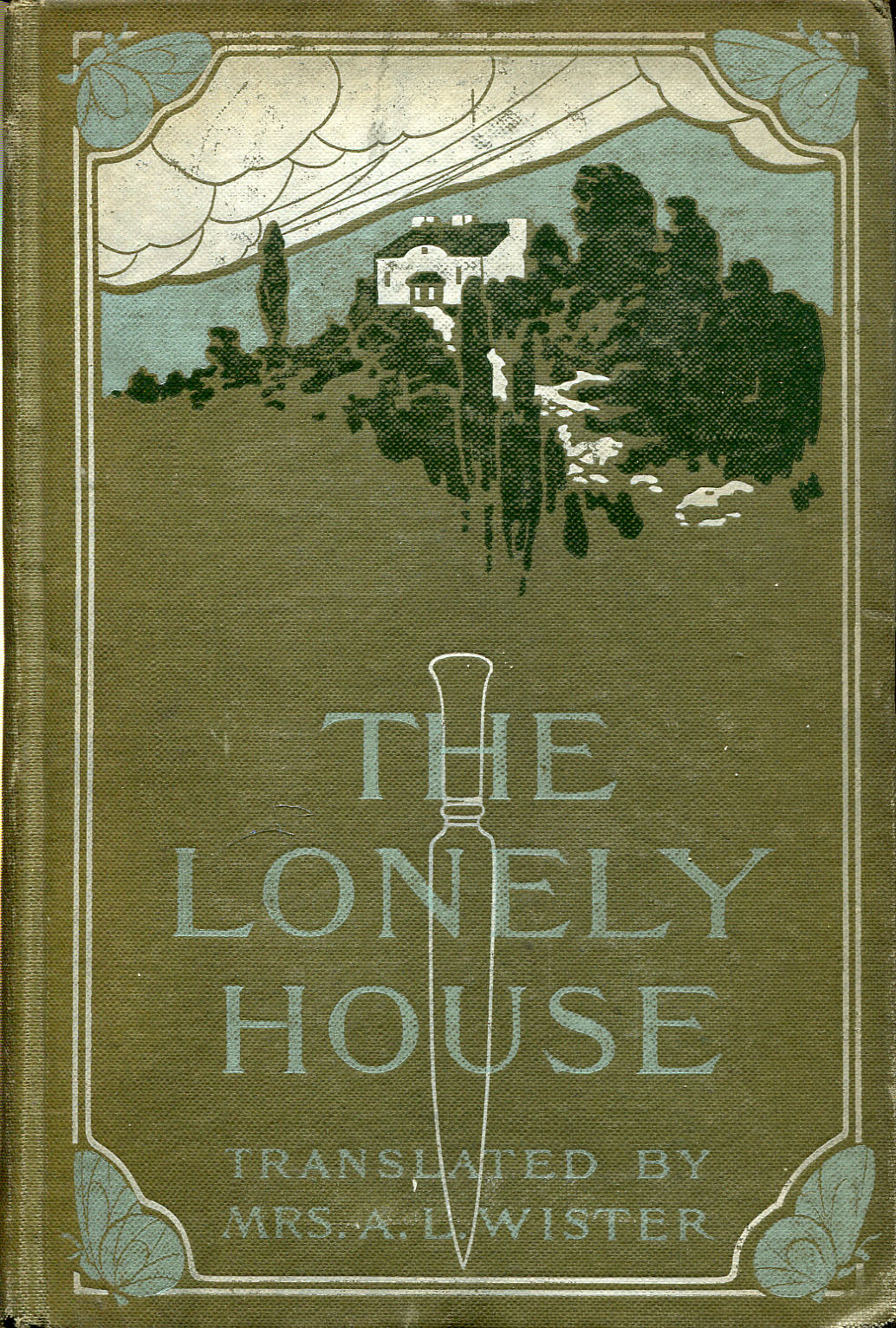
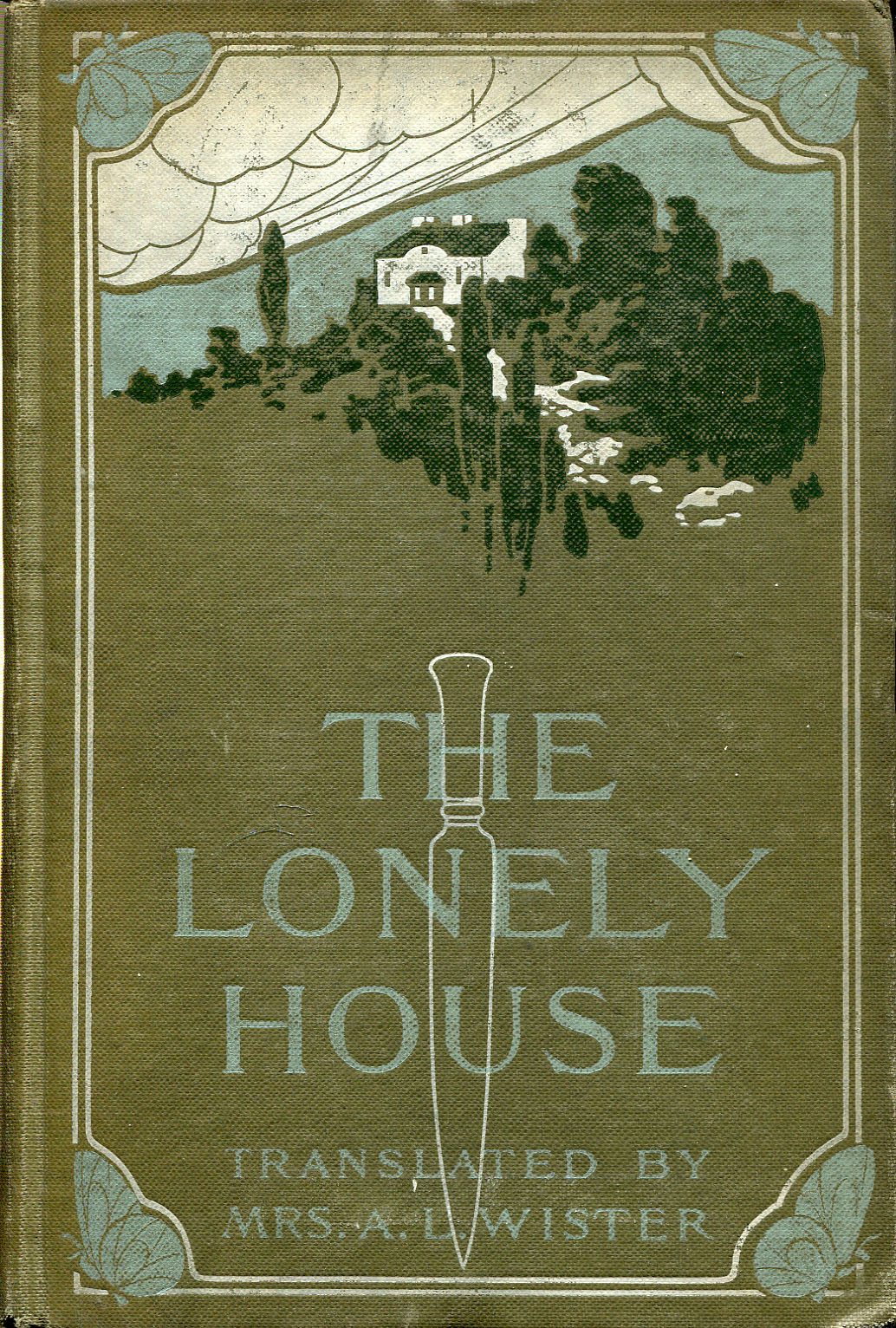
Adolph Strekfuss. The Lonely House. Translated from German by A.L. Wister. Philadelphia, London : J.B. Lippincott Company, 1907. – source
via: The Internet Archive

J. Rothschild, editor. Les Papillons de France. Paris, Institut National de la Recherche Agronomique (INRA), 1880