Symmetry: Behind the laws of nature from The Royal Institution on Vimeo.

Installation view, Brian Belott’s Dr. Kid President Jr. at Gavin Brown’s Enterprise. (Images courtesy the artist and Gavin Brown’s Enterprise.)
…She went around the globe collecting kids’ art, so a lot of the art in this show is international. We have art here from Switzerland, from India, from Egypt, from Tibet. What she found was that no matter where finger painting went on across the globe, kids were essentially drawing the same stuff. In Hero with a Thousand Faces, Joseph Campbell compared creation myths, showing the common thread through seemingly disparate cultures. Rhoda was finding the same thing, but in children’s scribbles. She was going into this nexus of gobbledygook and nonsense, with very little support, and she winds up finding that within scribbles are repeating shapes, like the mandala or the Greek cross. What she’s also seeing bubbling up from this is the beginning of all language – the alphabet.
NR:But it’s a graphic language, as opposed to an alphabetic one, so it exists apart from a specific language or nation?
BB: Absolutely. There are certain things the body loves to do, like making a cross, or an X, or a loop-de-loop. These actions are born in the time of early childhood. What’s wild, too, about this practice is that, for the kids, it’s akin to running around on the playground, because kids are only half of the time thinking deeply about what they’re doing. It’s more about motor action and covering a surface.
That’s part of an interview with artist Brian Belott about his latest exhibition, which focuses on the art of children. I was quite struck by the last sentence in the quote above: “It’s more about motor action and covering a surface.” That’s exactly what I’m doing with the Tree Quilt. My fingers go to work, while my mind wanders afar. I surface now and then, to see what my fingers have been doing, then wander off again. I’ve noticed during the time I’ve worked on the tree quilt, that anytime I’m actually focused on it, and thinking about it, I just can’t get anything to work, at all. I end up having to tuck it away. When I’m not paying attention, but my body is singing with energy, and there are a million other things to occupy my mind, the shapes and colours which form are strange, happily organic, and very pleasing to me. Maybe that’s why I’m stretching out the work time on it so much – not just that I have to walk away when I’m in ‘adult’ mode, but at its core, it’s a childish scribble, one which makes me quite happy.
The full interview is at Hyperallergic.
The Postal Museum Opening July 2017 from The Postal Museum on Vimeo.
During the First World War, in order protect art treasures from German attack, English museum administrators worked with the country’s national postal service to store precious artworks in a network of subway tunnels 70′ below street level. Now, you can take a ride through the historic Mail Rail when you buy tickets to London’s Postal Museum opening July 28th.
Roughly 100 years ago, the Post Office in London started utilizing a secret labyrinth of narrow tunnels, 6.5 miles long, to safely transport letters, parcels, and postcards through the city. At its peak, the Mail Rail system operated 22 hours a day and employed 220 staff that moved more than four million letters daily. The network of tunnels criss-crossed tube lines and linked six sorting offices with mainline stations at Liverpool Street and Paddington. The underground Mail Rail operation was so covert that museums like the Tate, British Museum and National Portrait Gallery deemed it safe enough to store their most precious artworks. According to representatives for the Postal Museum, the British Museum once even used the tunnels to store the Rosetta Stone.
There’s more at The Creators Project and The Postal Museum.
At The Bushwick Collective block party early in June, Ashleigh Alexandria, who goes by The Virgin Artiste, body painted a model live against a brick wall covered with a graffiti painting of a skull, the work of eight-year-old street artist Ethan Armen. As Ashleigh was photographing her work on top of Armen’s work, a cop walked by. “I found the imagery of a nude, Black model covered in paint close to a police officer to be ironic,” Alexandria tells Creators, “due to the recent police killings of Black men and women.”
Sometimes Alexandria’s subjects are painted to blend into their backgrounds, but more often than not, her subjects stand out from their environment while still remaining a part of it. A lifelong New Yorker, Alexandria is a portrait artist and a body painter whose work plays with the practice of body paint blending made famous by artists like Liu Bolin, in which subjects are made to disappear into their surroundings. While Bolin is an important influence, Alexandria’s practice is a reinterpretation of this concept. “My use of women of color as subjects shows how these women can be blended into the background of American society,” she explains.
You can see and read much more at The Creators Project.
Ghastly, ghostly, and gory, Neill Blomkamp’s new sci-fi short Firebase is set in a Vietnam War haunted by more than just post-traumatic stress disorder and political unrest. While the latter are resolutely present, soldiers on the front lines face a supernatural force so powerful and destructive they refer to it as “The Devil.” Obviously the CIA is involved, which is why the details of this faux documentary aren’t in our modern day history books.
“Volume 1” of the District 9 and Chappy director’s latest introduces us to the second cinematic universe by Oats Studio, his new independent venture invoking the power of fandom with a “pay-if-you-can” business model. The first in the series is Rakka, an allegory for military occupation in which a human resistance led by Sigourney Weaver fights a brutal alien race equipped with powerful weapons and mind control. Firebase turns inward, examining the destructive force of trauma through the lens of American troops invading Vietnam. Warning, this film is bloody.
If you want to find out what happens next, you can support Oats Studio by purchasing the film on Steam.
You can read more about this at The Creators Project.
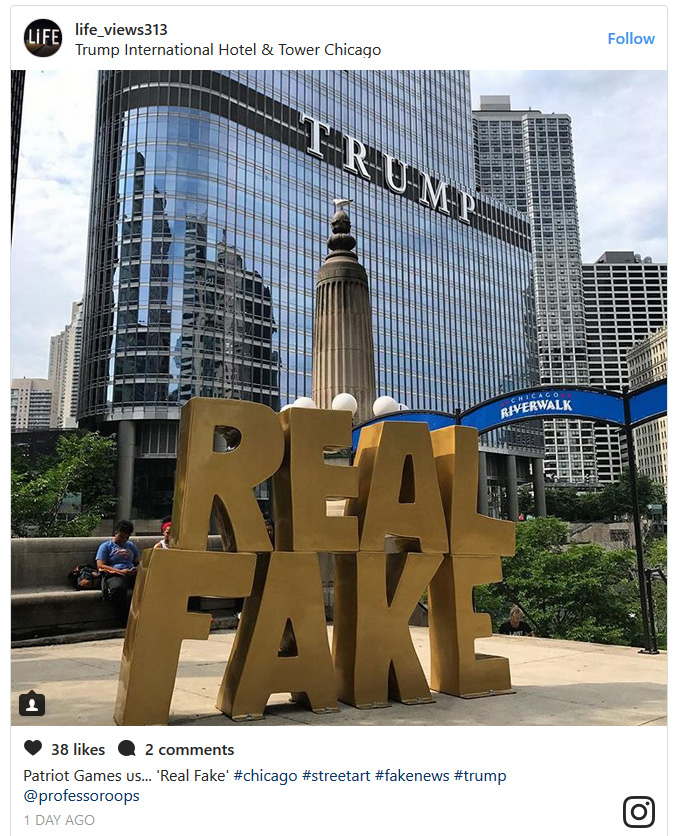
Is the City of Chicago trolling the 45th president of the United States? A gleaming, six-foot-tall sculpture that appeared this week near the downtown Trump International Hotel and Tower certainly suggests so, spelling out just two words in thick, golden letters: “REAL FAKE.”
The quip appeared on Monday evening, installed by the Chicago Department of Cultural Affairs and Special Events (DCASE) as part of a new installation of public art along the Chicago Riverwalk. Simply titled “Real Fake,” the 350-pound fiberglass work, coated in metallic paint, appears as a direct dig at President Trump and his endless dismissal of the media’s criticisms as “fake news” while leading a life of fraudulence himself. But the piece, created by local artist Scott Reeder, was actually first installed in 2013 as part of Art Basel Miami Beach, where it loomed on the grassy knoll of Collins Park. It’s on loan to the city now by Reeder’s gallery, Kavi Gupta.
Hyperallergic has the full story on Real Fake!
A fascinating look at the landscape photographers of the 1960s and 1970s, the refusal to romanticize the landscape, and the intertwining of art and environmentalists. Full story here.
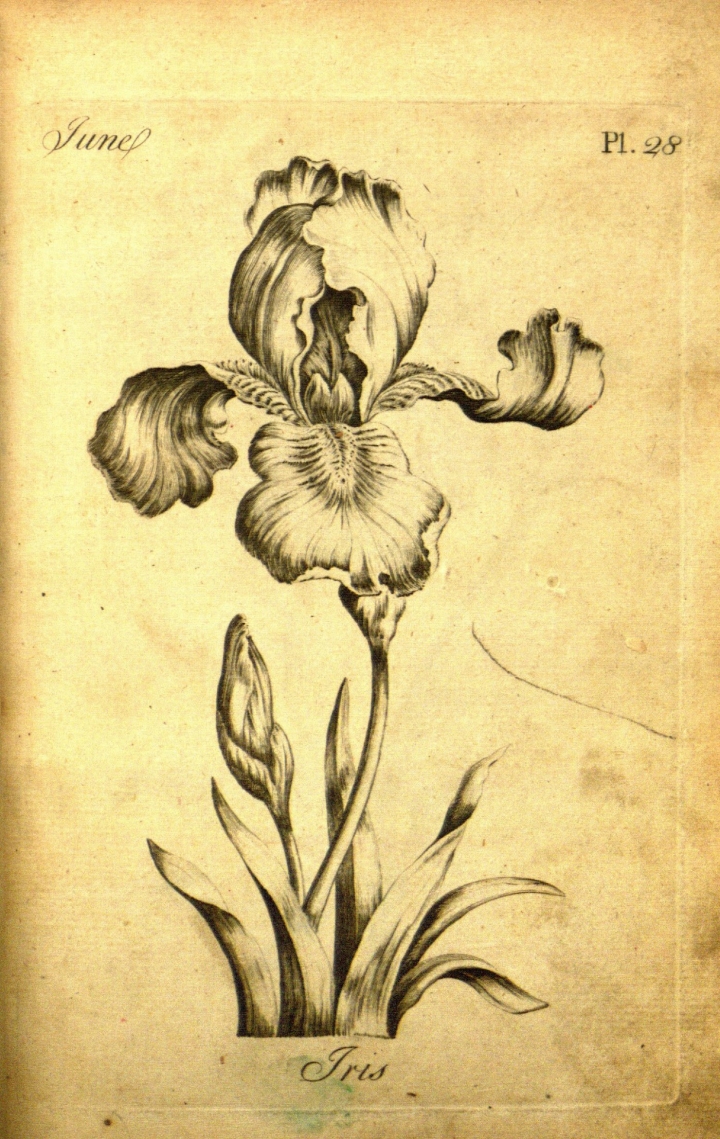
The Florist, printed in 1760, was a colouring book for adults, and one for serious colourists with watercolour experience.
The Florist was intended, as its title page relays, “for the use and amusement of Gentlemen and Ladies.” But, unlike most contemporary coloring books, it wasn’t meant to soothe the mind or encourage limitless creativity; rather, it served more as a manual for those seeking to sharpen their artistic skills. The Florist was for serious adult colorists only, filled with detailed instructions on how to paint each flower strictly according to its natural colors. (Yes, paint — this was the pre-crayon and -colored pencil era, so aspiring artists would have used watercolors.) See the directions, for instance, for a gladiolus:
This flower is crimson, inclining to purple; begun with a string layer of carmine, and neatly shading with a mixture of carmine and prussian blue. The bottom of the flower is white, shaded with a greenish tinge, by a mixture of Indian ink and sap-green; neatly blending the carmine by it, by fine strokes of each color. The leaves and stalk, from the beginning of the flowers of the top, are a brown, made with sap-green and carmine.
You can read all about The Florist, and see more, at Hyperallergic.

Toe prosthesis of a female burial from the Theban tomb TT95, early first millennium BCE (all photos by Matjaž Kačičnik, © University of Basel, LHTT).
About 3,000 years ago, a woman from Upper Egypt had her right big toe removed. Her anatomical anomaly may have been lost to time, had it not been for the discovery of her mummy in 1997, with a wooden toe still attached to the skeletal foot. Smoothly sculpted and complete with a neatly trimmed toenail, the artificial toe is likely one of the oldest prosthetic devices ever made. It has resided in Cairo’s Egyptian Museum since being excavated from its owner’s tomb near Luxor, but is currently undergoing new study by researchers from the museum, the University of Basel, and the University of Zurich.
Thanks to the team’s use of microscopy, X-ray technology, and computer tomography, we now have new insight into the toe’s functionality, materiality, and fabrication process. Like today’s prostheses, it was acutely tailored to its wearer — it was even refitted for her foot several times, the researchers found. More than a cosmetic accessory, the toe consists of three sections — two of wood, one of leather — and would have helped the woman walk, which attests to the skills of an artisan with intimate knowledge of human physiognomy.
“So far no prosthetic devices are known from this period,” Dr. Susanne Bickel, an Egyptologist at the University of Basel, told Hyperallergic. “The level of sophistication makes this a unique piece.”
[…]
Aside from wood, the toe was made with leather, rope, and textile bands, which its owner would have used to attach it to her foot. As Finch described, it features holes through which a series of bands tie its pieces together; it even has a hinge, perhaps to mimic the movement of the metatarsophalangeal joints. The woman would have even been able to wear it with sandals, and while it likely would have eased her mobility, it also would have helped her foot appear natural to others, at a glance.
“Balance might indeed have been an important reason for wearing such a device,” Bickel told Hyperallergic. “The idea of having a complete body, which was central to Ancient Egyptian minds, might have been a reason for seeking an aesthetic aspect to it.”
Well, there’s scary for you. :D
Behold the BabaDong, a high quality silicone dildo. The Babadong has a sturdy base, so you can strap it on and take it anywhere! Don’t worry if it gets dirty on your adventures (which it most likely will…) because the BabaDong is dishwasher safe! The BabaDong has a length of 7.5 inches from base to tip and a girth of 5 3/4 in. around it thickest part. This campaign is for PRE-ORDERS. The BabaDong will only go into production if the minimum goal is met. IF NOT EVERYONE WILL BE REFUNDED.
If you’d like to read more about this project, and/or support it, head on over to the BabaDong gofundme page.
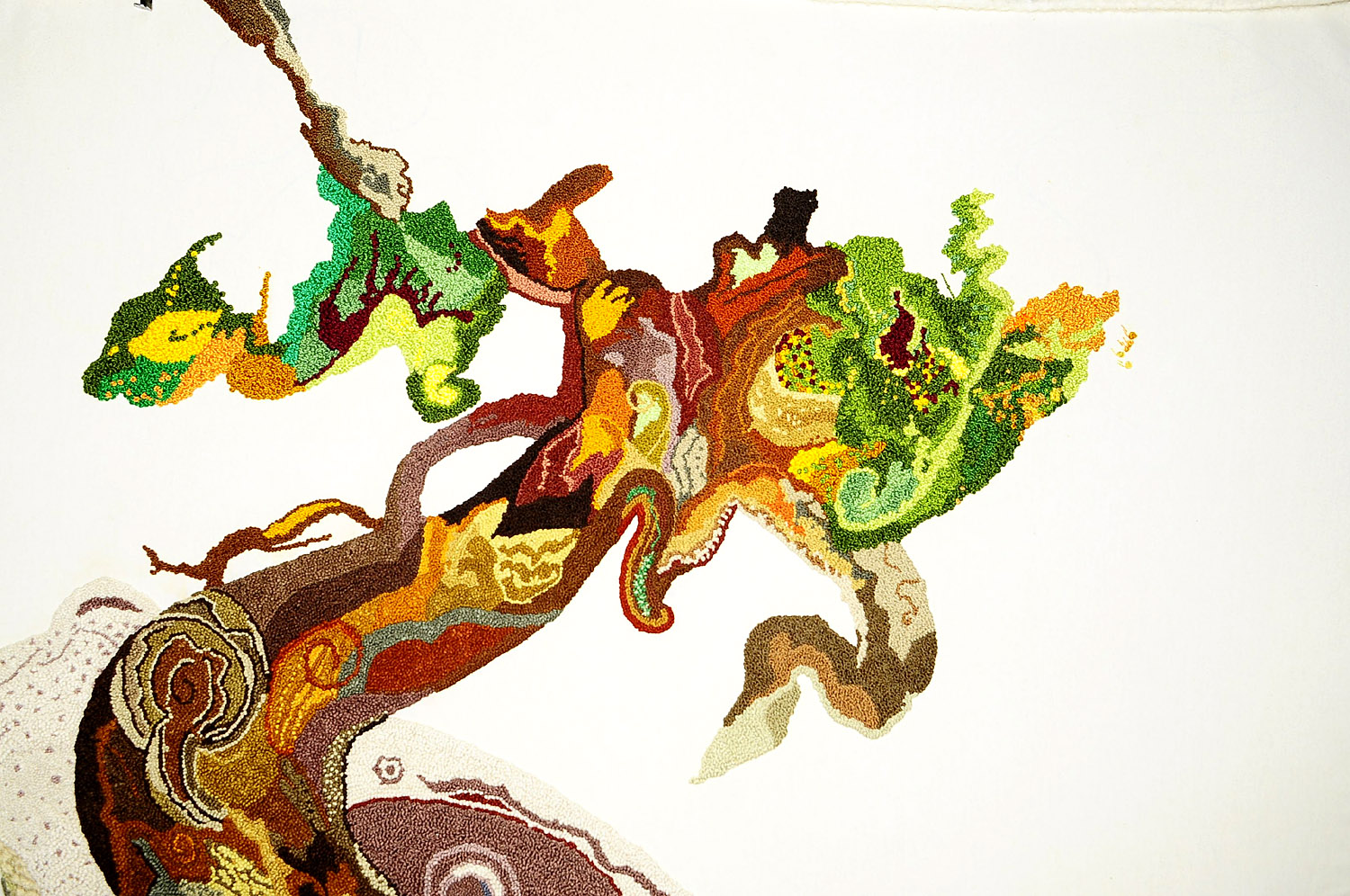
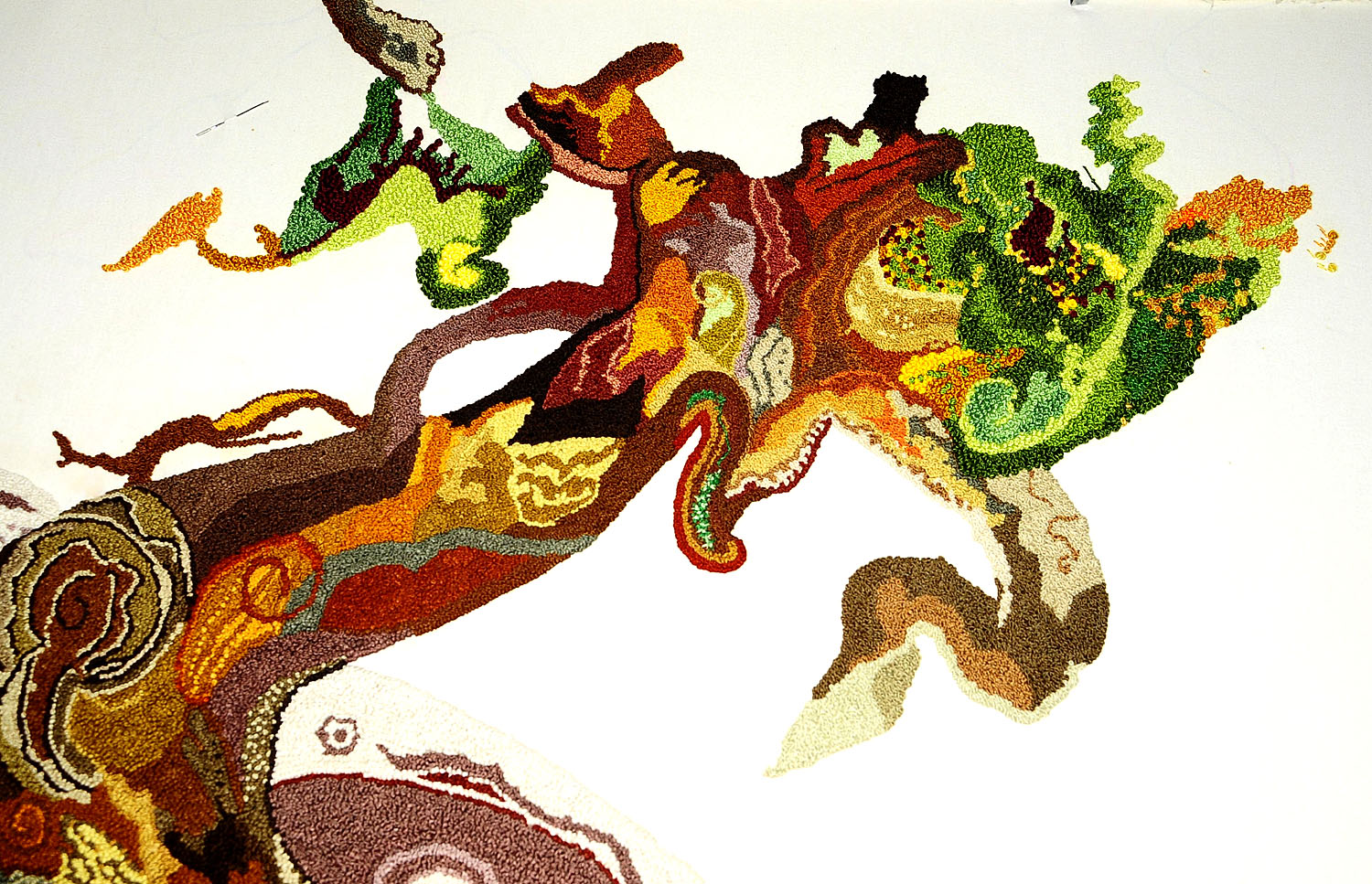
Current Hours: 1,219. Skeins Used: 191. Current hours are from yesterday, today was just too fractional, a bit here, a bit there, and I’m not aware of time enough to keep track things like ‘7 minutes’, ’22 minutes’ and the like, so I just don’t count it. Also, today, I had to spend a fair amount of time line breaking. Usually, I’m not paying attention when I’m working on the tree quilt, my mind tends to wander on to other things while the fingers work. When working on large blocks of one colour, it’s easy enough to fall into doing rows of knots, rather than random sets. I don’t want people focusing on lines or rows, so a few knots here, a few there, break up the visual line.
© C. Ford, all rights reserved.

Aidan O’Shea, Regina Strayhorn, Ayun Halliday, and Ben Watts in Faust 3: The Turd Coming, or The Fart of the Deal (all photos by Jonathan Slaff).
We do not live in a time of subtlety. If you need evidence, take a look at the news. Shaded, nuanced criticism of
PresidentDonald Trump would sound like a whisper next to a tornado. It was refreshing, then, to see a play that dispenses with elegant critique of the president in favor of a gloves-off battery. Faust 3: The Turd Coming, or The Fart of the Deal combats Trump’s logorrhea of vulgarities with its own. Trump is never actually named in the script, but the title alone tells you who it’s about, and the text gives plenty of indications. It is replete with scatological jokes; the story tells of a society that makes a Faustian pact to choose a king who will supposedly better their lives, but then shits on all of his subjects. Having made this deal, the citizens are forced not only to live under the shitty reign (and rain) of this despot, but also to pretend they love it, even as the king ends the world in nuclear war. To describe this play as a scathing satire of Trump would be putting it mildly.[…]
In addition to adopting the rhetorical position of Biblical prophecy, it also plays with Biblical material in clever ways. Jesus’s lines from the Gospels are articulated as ironically inverted versions that resemble Trump’s likely misinterpretations of them, such as: “Whosoever shall seek to save his life shall save it, and whosoever shall lose his life is a loser and deserves it.”
[…]
The piece is not subtle, and that’s probably fitting. When the president of the United States of America has condoned sexual assault, has publicly said that he would date his own daughter were they not related, has boasted about the size of his penis during a debate, and has both said and tweet-spewed other horrors too numerous to name here (I won’t even go into policy), comparing him to Caligula and Nero doesn’t seem so far-fetched. A play like this would have been too heavy-handed if it were directed at any other recent president, but these days, the rules of public discourse seem to have been thrown out. Now is not the time for art to play nice.
Performances of Faust 3: The Turd Coming, or The Fart of the Deal continue through June 26 at Judson Memorial Church (55 Washington Square South, Greenwich Village, Manhattan).
John Sherer’s full review is at Hyperallergic, and well worth reading.
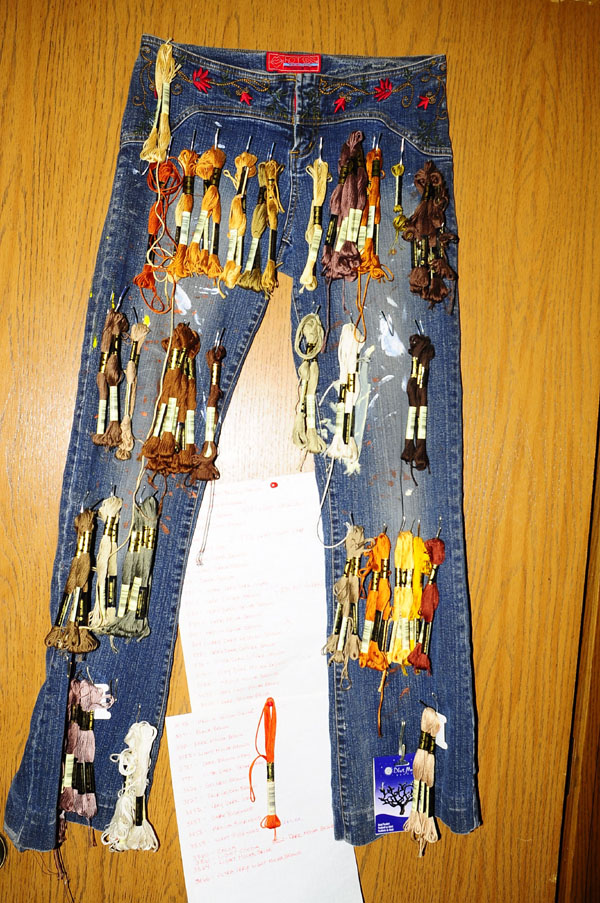
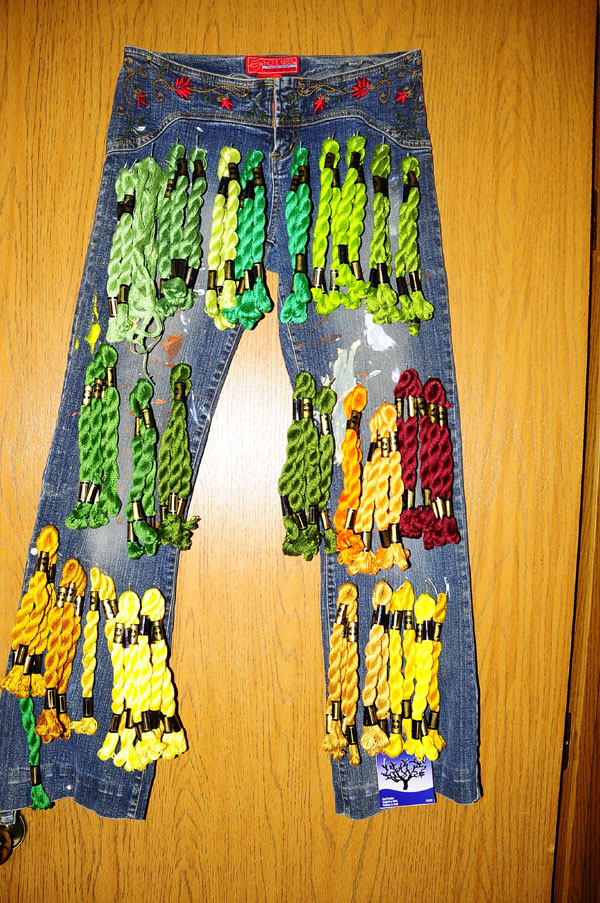
Having gotten thoroughly confused over just which green I had been using, it called for a changing of the thread. Down with the tree thread, up with the foliage thread. Some of the greens, I’m down to 3 skeins, and it doesn’t take much to go through a skein. Others I have a great deal of, so I need to do larger blocks with those particular colours.
© C. Ford.
Oh, the vintage pistachio Perles (light and medium, 320 and 368), holy fuck, do they ever taste nasty. If you’re wondering why I know what they taste like, it’s because I stick one end in my mouth to get it nice and wet, so it can be easily flattened for threading. I won’t be doing anymore of that with these particular threads. I don’t think these are nearly old enough to have employed arsenic, but who the fuck knows? Even cinnamon mouth wash isn’t getting rid of it. Yikes.
© C. Ford.
This is a wonderful series, from Nina Röder:
Berlin-based artist Nina Röder’s series “A little deeper than you thought” explores the meaning of existence through a series that captures the relationship between humans and the natural environment.
Inspired by Jean Paul Sartre’s exploration of existentialism as propounded in “Nausea”, the series explores the nuances of human existence, focussing on the chasm between presence and absence, being and nothingness. Shot across the rugged landscapes of Iceland, Ireland, Spain and the Harz Mountains, the images evoke a sense of mystery, inviting contemplation on the nature of our existence. “Ancestry, gender, education, religion – all are factors with an invisible influence on our existence,” explains the artist in a statement. To make such factors visible, we need images to expose what determines our fate and creates a distance between ourselves and our personae.”
Have a wander through a bit of Nina Röder’s world. Via iGNANT.