Public and Private Life of Animals.

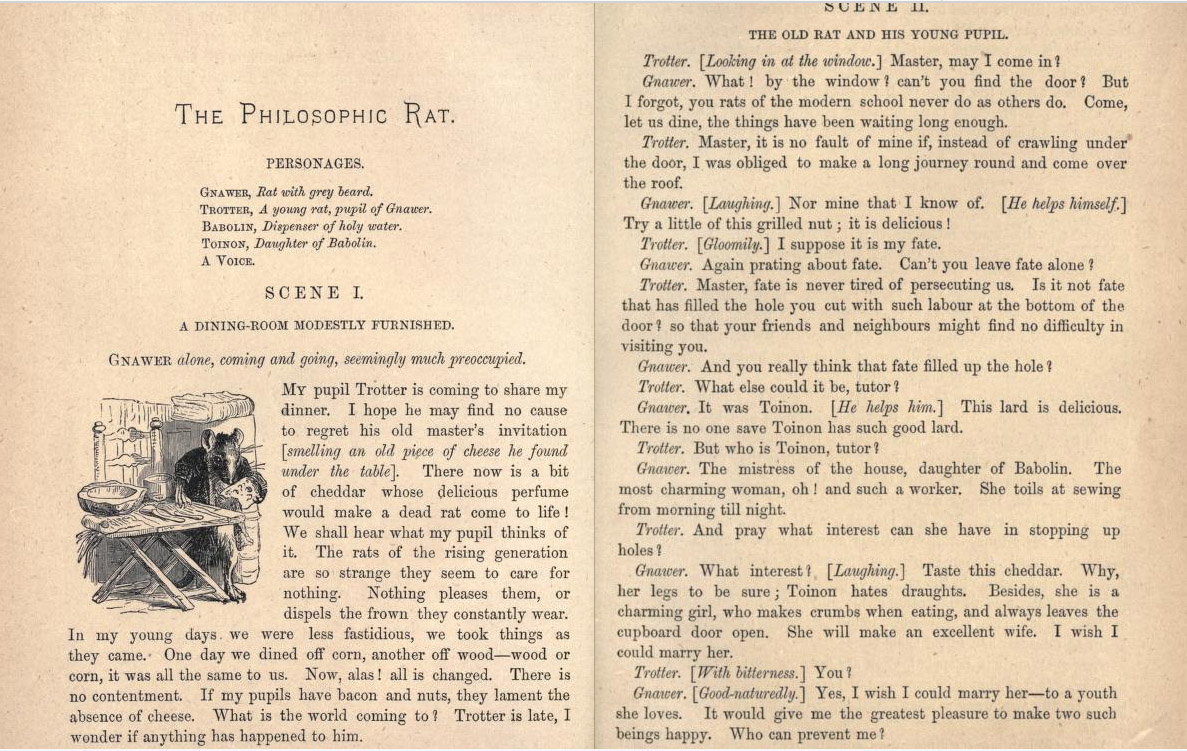
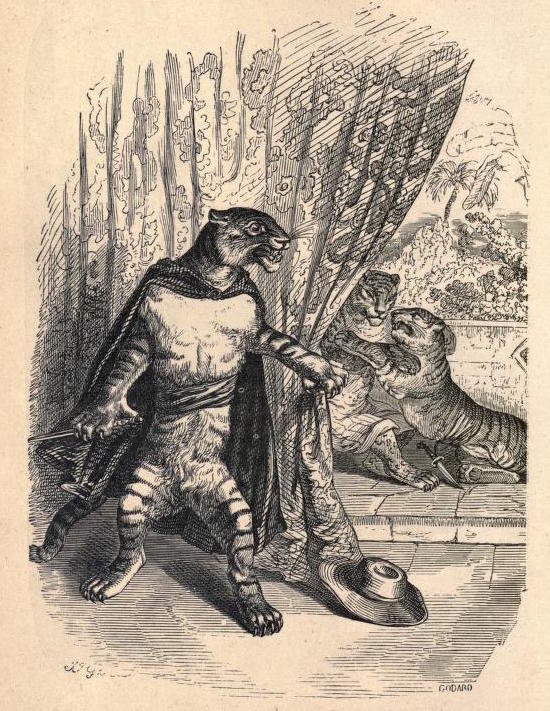
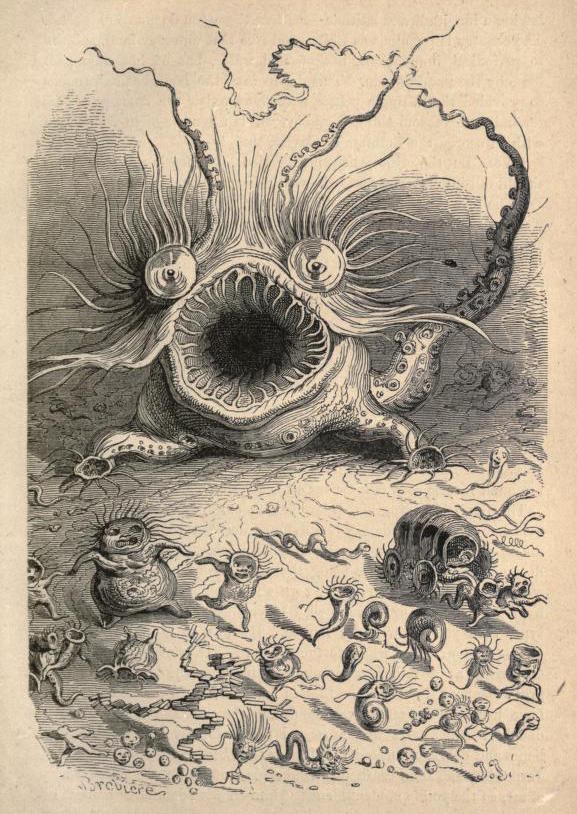
This collection of acerbic animal fables, originally published in 1842 as Scènes de la vie privée et publique des animaux, boasts among its contributors some of the finest literary minds of mid 19th-century France, including Honoré de Balzac, George Sand, and the publisher Pierre-Jules Hetzel (under the pseudonym of P. J. Stahl). The book is also home to some of the finest work (some featured below) by the caricaturist J. J. Grandville, drawings in which we can see the satirical genius and inventiveness that would be unleashed in full glory just two years later with the publication of his wonderful Un autre monde.

So far, I have only read The Philosophic Rat, and it’s a wonderful tale. I have gotten this downloaded to my tablet though, and am looking forward to all the stories. The illustrations are magnificent, and you can see many of them at The Public Domain. The book can be read or downloaded here.

Just a few of the illustrations:

Fashions of the Future!

Illustrations from a delightful piece called the “Future Dictates of Fashion” by W. Cade Gall and published in the January 1893 issue of The Strand magazine. On the premise that a book from a hundred years in the future (published in 1993) called The Past Dictates of Fashion has been inexplicably found in a library, the article proceeds to divulge this book’s contents – namely, a look back at the last century of fashion, which, of course, for the reader in 1893, would be looking forward across the next hundred years into the future. In this imagined future, fashion has become a much respected science (studied in University from the 1950s onwards) and is seen to be “governed by immutable laws”.

The fashions run from 1900 to 1993. You can see all of them here, and read the full original piece from The Strand here. The 1950s tickle me the most, it has to be those rather fab pirate/cavalier boots. And I’m a sucker for capes and cloaks. The 1970s were never that fabulous. :D


Adobe Researches Digital Colour Mixing.

Researchers at software brand Adobe have developed a prototype tool that allows users to mix colours on screen as if they were working in real paint.

Playful Palette offers artists and illustrators an alternative to the standard colour picker that most graphics software, such as Adobe Photoshop, relies on. Users would be able to blend colours more easily and compare different shades.

The tool is based on research into the ways artists work in traditional media – and the shortcomings they experience with digital counterparts.

The Adobe Research team set out to create a user interface that could replicate the variations of a physical palette, with the ability to mix colours and compare combinations of shades.

“Choosing and composing colours is a critical part of any painting process,” the Adobe Research team of Maria Shugrina, Jingwan Lu and Stephen Diverdi wrote in a paper on the subject.

“We conducted a pilot study that found artists interact with their palette several times a minute, and many of the interactions, such as exploring harmonising colours, are not well supported by digital colour pickers.”

Playful Palette is designed in contrast to the usual sliders or swatches that many apps rely on. Instead, it allows dabs of colour to be added, moved, blended with other colours or completely deleted. Blobs are moved by touching and dragging, to recall the tangibility of real paint and paper.

A ring surrounds the palette and records a history of shades used – allowing the user to easily return to them. Entire colours can also be selected and swapped out for new ones, allowing the details of an image to be updated all at once. Playful Palette can also record an infinite number of “dishes”.

Dezeen has the full story.  One of the commenters linked a petition to Adobe to place a reasonable price on their products for students. I’d say how about a reasonable price for everyone? There’s a reason I still run pshop 6. The amount of money adobe wants for pshop is piracy, especially when you consider how many people buy at least one or more programs from them. I would love a current edition of pshop, but there are a lot of people who are not walking around with a spare $400 to $800 bucks in their pocket. It’s not like Adobe really cuts the price all that much for upgrades, either. I think they have enough money that they could easily pull the price into a much more reasonable range for all people. That said, playful palette sounds great!

On Bathing…

I’ve never been one for taking baths, I didn’t even like them as a child, and couldn’t wait until I was allowed to shower instead. If I could get this sort of treatment, though:

If people could afford a to have private bath – and not many could – they would use a wooden tub that could also have a tent-like cloth on top of it.  Attendants would bring jugs and pots of hot water to fill the tub. In John Russell’s Book of Nurture, written in the second half of the fifteenth-century, he advises servants that if their lord wants a bath they should:

hang sheets, round the roof, every one full of flowers and sweet green herbs, and have five or six sponges to sit or lean upon, and see that you have one big sponge to sit upon, and a sheet over so that he may bathe there for a while, and have a sponge also for under his feet, if there be any to spare, and always be careful that the door is shut. Have a basin full of hot fresh herbs and wash his body with a soft sponge, rinse him with fair warm rose-water, and throw it over him.

He adds that if the lord has pains or aches, it is good to boil various herbs like camomile, breweswort, mallow and brown fennel and add them to the bath.

I might well change my mind.

Via Medievalists.net.

Doug Wheeler: PSAD Synthetic Desert III.

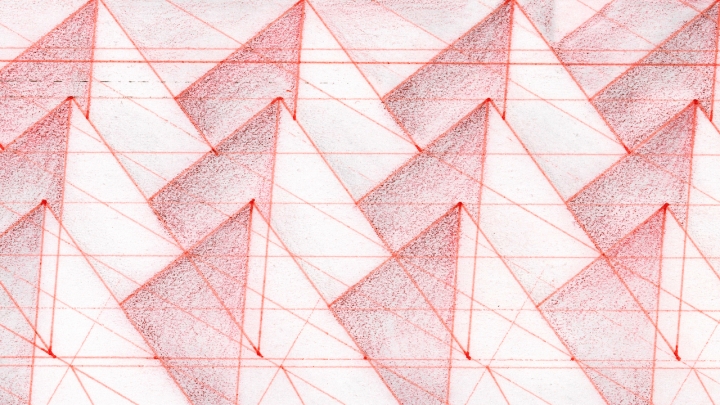
Doug Wheeler, “PSAD Synthetic Desert III” (1971) (detail), ink on paper, 61.1 x 91.4 cm.

Wheeler’s groundbreaking experiments with perception make him one of the best-known artists of the Light and Space movement that originated in Southern California in the 1960s. He grew up in the mountains of Arizona and, following in the footsteps of his parents, earned his pilot’s license.

The inspiration for Synthetic Desert came in the early 1970s, when he landed a plane on a dry lake bed in the Mojave Desert. Once the sounds of the engine were extinguished, an all-encompassing auditory experience began. “I began to hear sounds that came very disembodied,” he said, “so that there was no kind of definitive way to say what that was and how it got to you, because it came in such an unusual way. For me it was really profound, because it was like I’m hearing distance. I’m seeing distance.”

Wheeler created a series of drawings at that time, sketching out his vision for Synthetic Desert, but the Guggenheim installation marks the first time the piece has been realized. Created with support from a curator at the museum, a conservator from the Panza Collection, and sound engineers from Arup, Synthetic Desert is a monument to Wheeler’s ambitious undertakings and exacting standards.

Doug Wheeler, PSAD Synthetic Desert III (1971, realized in 2017), reinforced fiberglass, anechoic absorbers, neon, sound equipment, room: 5.8 x 17.2 x 8.1 m, installation view, Solomon R. Guggenheim Museum (photo by David Heald; all images © Doug Wheeler).

Visiting Synthetic Desert requires an timed ticket, and only five people are allowed in the installation at once for 10- or 20-minute periods. A guide joins each group and provides strict instructions: no talking, no phones, no bags, no touching the art. After passing through a set of doors into one chamber, visitors then pass through another, ascending a ramp and emerging onto a platform surrounded by rows and rows of foam pyramids bathed in a purplish-gray light.

The traffic of New York City, the din of the museum, the chaotic noise of everyday life — it all evaporates. The enclosed environment absorbs every one of those sounds, making you acutely aware of their absence. Synthetic Desert is a semi-anechoic chamber, meaning it is echo-free. To avoid the feeling of claustrophobia, Wheeler installed a subtle sound element, so the room hums at the frequency of pink noise, which is lower than its white counterpart. Meanwhile, every small noise within the space is magnified, from the rustle of clothing to the gurgle of a belly. Within the quasi sci-fi setting of Synthetic Desert, it is the humans who feel like aliens.

The pyramids, with their rigorous pattern and distinct gradient hues, evoked the feeling of being inside a semi-abstract landscape painting of a mountain range. In an interview with the New York Times, Wheeler spoke of such desert mountains, saying, “When you’re that far out, the mountains are just hazy shapes — they could be 60 miles away or hundreds.”

[…]

Doug Wheeler: PSAD Synthetic Desert III continues at the Guggenheim Museum (1071 Fifth Avenue, Upper East Side) through August 2.

You can see and read much more at Hyperallergic. I think this would be absolutely fascinating to experience, and I wish I could. If you are, or are going to be in the area, consider grabbing a ticket and having one interesting experience!

A Man and His Castle.

per rq: This retired man always wanted to live in a castle. The ‘blockhouse’ (direct translation, really just an apartment building) as shown in the photo is one of those common across the entire former Soviet territory. There’s jokes and movies about how similar cities look due to masses and masses of these buildings (they also used to be identical on the inside). Anyway, this guy is individualizing the stairwell in the most fantastic manner. I’d like to live in a castle, too, just maybe not so blue. Anyroad, this is most impressive!

Aģentūra “REX Features” vēsta par Vladimiru Čaiku, kurš sava nama kāpņu telpai licis izskatīties pēc aizvadītajos gadsimtos celtas pils.

Aizvadītās desmitgades sākumā viņš saņēmis akceptu no kaimiņiem, ar ko dalījis kāpņu telpu, un ķēries pie darba. Kopš aiziešanas pensijā tas kļuvis par viņa galveno aizraušanos.

You can see much more here.

Admin Stuff: Fridays.

I’ve been doing a Cool Stuff Friday post since April ‘016. Going to be a change. Fridays will be all art days, giving me a chance to cover so very many wonderful things, which I’m much happier doing anyway, rather than dealing with all the upsetting stuff in reality land. This will give me the opportunity to stay happily under my rock for a day as well as indulge in sharing so many things I love and find fascinating. Hopefully, people who are kind enough to stop by Affinity will find much to love and interest them, too. There’s just so much to share, and there never seems to be enough time. In over a year, I haven’t found time to share one thing from The Public Domain Review, one of my favourite places to get lost. Here’s a small sample of why I like to get lost there:

Gynecological Gymnastics from Outer Space. (1895)

Aratea: Making Pictures with Words in the 9th Century.

Geographical Fun: Being Humourous Outlines of Various Countries. (1868)

So, starting tomorrow, Fridays will simply be mostly fun, sometimes serious, and I hope, always informative.

Ritchelly Oliveira.

© Ritchelly Oliveira.

Ritchelly Oliveira is a Brazilian visual artist, predominantly working in the realm of portraiture. His images depict emotive studies of usually male figures, sometimes layered with natural imagery of flowers and birds. The characters are seen to both ignore and interact with the other components in the frame, and Oliveira creates playful areas of negative space that enhance the emotions perceivable in the drawings. Particularly in his portrait series ‘Lacunas’ (translating to ‘hiatus’ or ‘gap’), the pieces present an exploration of love and desire, offering a personal insight to the artist’s belief that “love can transform people in a way that is beautiful to capture.”

Beautiful, poignant work. You can see more at iGNANT.

Time for Goop.

No, not that goop. The real stuff. As every needlesmith and other handcrafter knows, hand care is extremely important. You can’t have rough bits of skin snagging expensive materials and so forth. So, goop. When your skin reaches a too rough to work point, spoon a bit of sugar (couple tablespoons) and the oil of your choice, whisk it up, and have a good, long hand scrub. Most artists have their own formula, some prefer specific sugars, or coarse salt, and the oil choice varies quite a bit. I usually go with olive oil. I don’t use coarse salt, because I can always be counted on to have small nicks on my hand somewhere.

How Hummingbirds Work. WOW.

Hummingbirds often brave downpours to gather the nectar needed to avoid starvation. This Anna’s hummingbird shakes off rain as a wet dog does, with an oscillation of its head and body. According to researchers at UC Berkeley, each twist lasts four-hundredths of a second and subjects the bird’s head to 34 times the force of gravity. Even more remarkable: Hummingbirds can do this in flight as well as when perched.
SOURCES: VICTOR ORTEGA-JIMENEZ AND ROBERT DUDLEY. Photographs by Anand Varma / National Geographic.

I am just filled with awe after watching this:

Space may be the final frontier, but scientists have found plenty of head-scratchers right here on one of Earth’s zippiest creatures, the humble hummingbird. The July issue of National Geographic Magazine includes stunning photography by Anand Varma of ornithologist Christopher Clark’s experiments studying how the Anna’s hummingbird sees, moves, and eats.

Clark recreated studies from UC Berkeley and the University of British Colombia that use smoke, optical illusions, and specially-created tools in conjunction with high-speed cameras to reveal hummingbirds’ strange body parts. For example, the reason they can hover is because their unique bone structure allows them to create lift on the upswing, as well as the downswing of their wings.

You can see and read more about this at The Creators Project. I might have to put that video on a loop.