Flowers For The Tiny Tyrant.

From Lizania Cruz’s series Flowers for Immigration.

From Lizania Cruz’s series Flowers for Immigration.

From Lizania Cruz’s series Flowers for Immigration.

A stunning project, so eloquent and poignant.

“Say it with flowers,” the expression goes. So, to communicate the thoughts that immigrants harbor about President Trump, artist Lizania Cruz decided to invite some of them to create bouquets for him. Her ongoing photo series Flowers for Immigration documents the resulting arrangements — quiet, beautiful manifestations of opinions that are often unspoken or silenced.

All are the creations of undocumented immigrant bodega workers who spend their days helping New Yorkers express themselves through flowers. Cruz, wanting to see the florists do the same for their own feelings, launched the project last November. Since then, she’s recruited 11 flower sellers to participate in the project. Not everyone she approached took her up on the offer, with some disagreeing with her objective and others refusing out of concern for their status. But providing a platform for those whose lives are at the center of current debates over immigration is precisely the goal of Cruz, who herself came to the city after being born and raised in the Dominican Republic.

“I hope viewers will be able to connect with the beauty and humanity of these undocumented workers and that their voices are amplified,” she told Hyperallergic. “Undocumented workers can’t go out and protest because of fear of facing legal actions. So I hope this project allowed them to have an opinion.” The participants, whom she paid for their involvement, are identified only by first names.

You can read much more about this project, and see much more at Hyperallergic, or visit Flowers for Immigration.

The Cultural Force of Science Fiction.

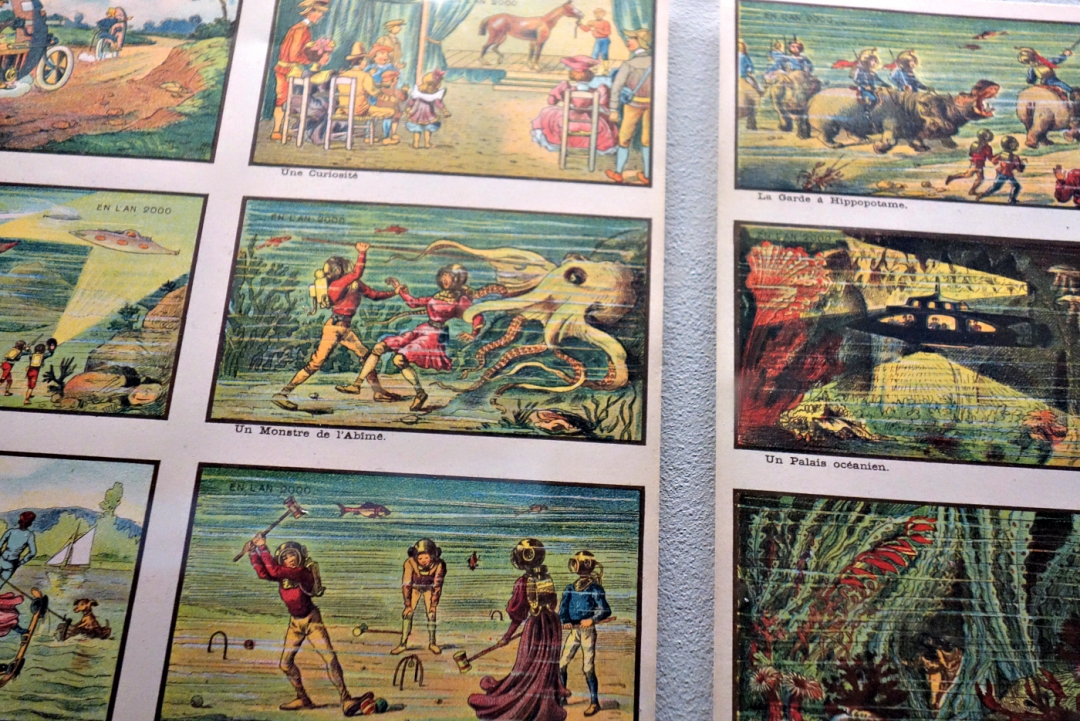
“L’an 2000” (“The year 2000,” 1901), print on cardboard; a collection of uncut sheets for confectionery cards showing life imagined in the future (photo by the author for Hyperallergic). Click for full size.

LONDON — The 1982 film Blade Runner imagined 2019 Los Angeles as a dystopia of noirish neon and replicants, robots sent to do hard labor on off-world colonies. It’s a future in which engineered beings are so close to humans as to make the characters question the very nature of life. We’re now just a couple of years from this movie’s timeline, and although our robots are still far from mirroring humanity, our science fiction continues to envision giant leaps in technology that are often rooted in contemporary concerns of where our innovations are taking us.

Patrick Gyger, curator of Into the Unknown: A Journey through Science Fiction at the Barbican Centre, told Hyperallergic that, for him, science fiction “allows creators to look beyond the horizon of knowledge and play with concepts and situations.” The exhibition is a sprawling examination of the genre of science fiction going back to the 19th century, with over 800 works. These include film memorabilia, vintage books, original art, and even a kinetic sculpture in a lower-level space by Conrad Shawcross. “In Light of The Machine” has a huge, robotic arm twisting within a henge-like circle of perforated walls, so visitors can only glimpse its strange dance at first, before moving to the center and seeing that it holds one bright light at the end of its body.

[…]

The exhibition shows, but does not dwell on, who has been left out of a history mostly shaped by white men (there are rare exceptions on view, like the “Astro Black” video installation by Soda_Jerk that muses on Sun Ra’s theories of Afrofuturism). It would be worthwhile to spend more time on figures who broke through these barriers, such as author Octavia Butler. As discussed on a recent podcast from Imaginary Worlds, her black characters were sometimes portrayed as white on her book covers to make them more appealing to science fiction readers. The exhibition could also have a deeper context for why certain veins of science fiction are prominent in particular eras, and perhaps question why we don’t have a lot of science fiction narratives on current crises like climate change. For instance, the much smaller 2016 exhibition Fantastic Worlds: Science and Fiction 1780–1910 from the Smithsonian Libraries compared milestones like Mary Shelley’s 1818 Frankenstein; or, The Modern Prometheus with physician Luigi Galvani’s “animal electricity” experiments on animating dead frog legs, and highlighted how Jules Verne channeled the doomed Franklin expedition in his 1864 book The Adventures of Captain Hatteras.

Nevertheless, having an exhibition like Into the Unknown at a mainstream space like the Barbican is significant, showing the art world appreciates science fiction beyond kitsch. And science fiction continues to be one of our important portals for thinking about the ramifications of our technological choices, and where they might take us.

You can read and see much, much more at Hyperallergic. Fascinating!

History of Four-Footed Beasts and Serpents.

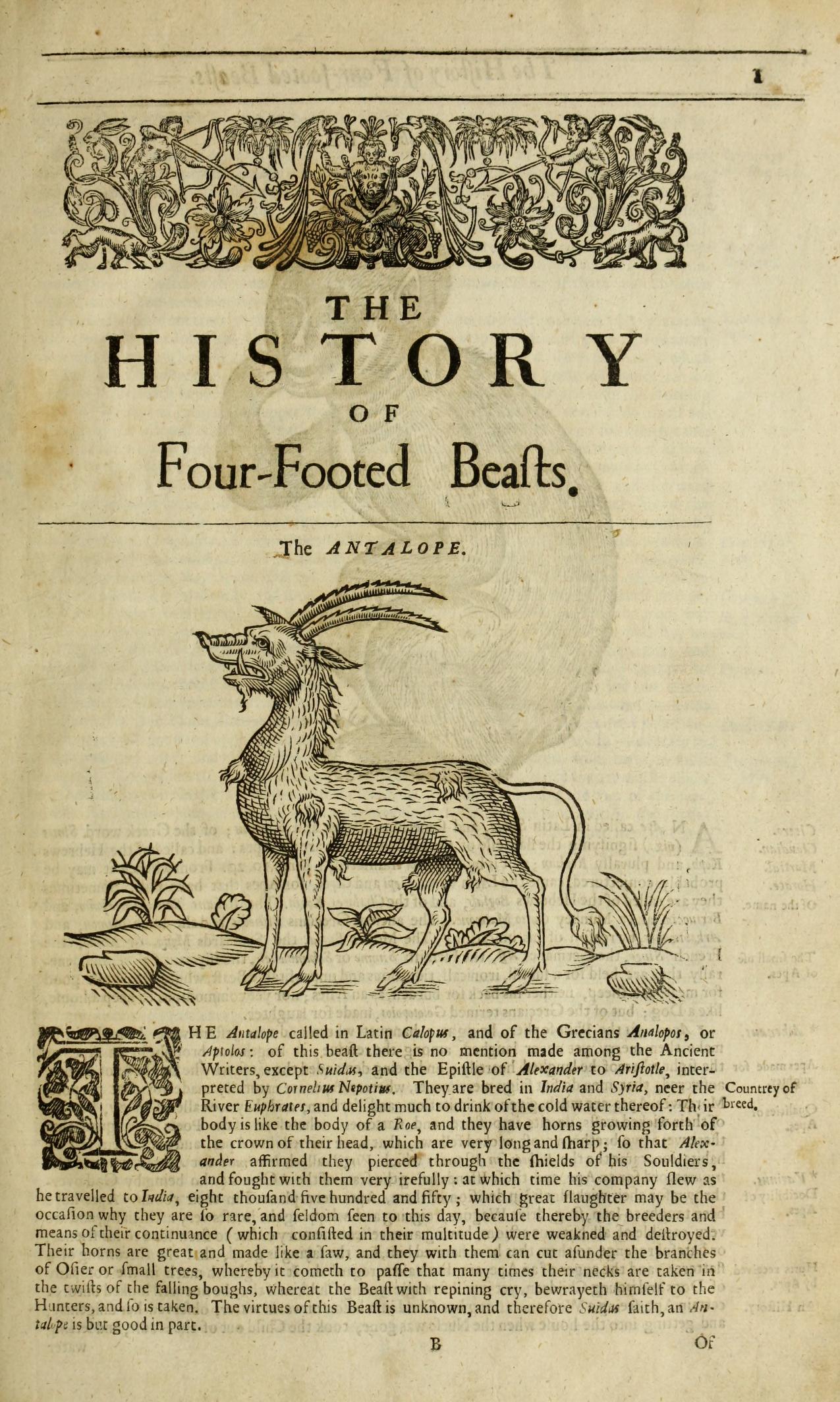
Published in 1658, more than thirty years after his death, this book brings together Edward Topsell’s The History of Four-footed Beasts (1607) and The History of Serpents (1608). Totalling more than 1000 pages, this epic treatise on zoology explores ancient and fantastic legends about existing animals, as well as those at the more mythic end of the spectrum, including the “Hydra” (with two claws, a curled serpent’s tail, and seven small mammalian heads), the “Lamia” (with a cat-like body and woman’s face and hair), and the “Mantichora” (with lion’s body and mane, a man’s face and hair, and a grotesquely smiling mouth). Topsell was not a naturalist himself (he in fact was a clergyman) and so relied heavily on the authority of others, in particular Konrad Gesner, the Swiss scholar who was also behind many of the brilliant illustrations which adorn the volume, and Thomas Moffett. On his utilising others for his work Topsell writes “I would not have the Reader,… imagine I have … related all that is ever said of these Beasts, but only so much as is said by many”. This approach leads him to repeat some wonderfully fantastic claims: elephants are said to worship the sun and the moon with their own rituals, apes are terrified of snails, and “…the horn of the unicorn … doth wonderfully help against poyson”. Although it is abound with such fanciful ideas, Topsell’s work, as John Lienhard explains “was actually an early glimmer of modern science. For all its imperfection, it represents a vast collection of would-be observational data, and it even includes a rudimentary rule for sifting truth from supposition.”

This is a grand look at early ideas of the natural world, and all the people busy trying to figure it all out. The artwork is marvelous, and retains much of that early Medieval illuminated flavour. Creatures real, and not real inhabit the pages, along with many grand, if terrifying remedies such beasties can provide for many an ill.

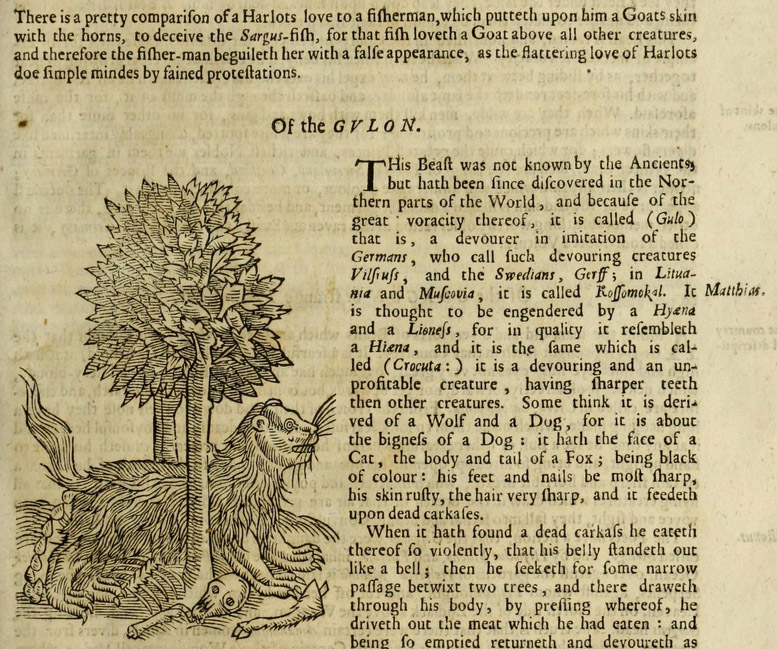
Gulon.

Some remedies utilising goat bits, particularly their dung.

A beautiful badger.

Cures which can be effected by use of badger bits.

Squirrels are depicted as dangerous and bloodthirsty. Appropriately, as Iris would say.

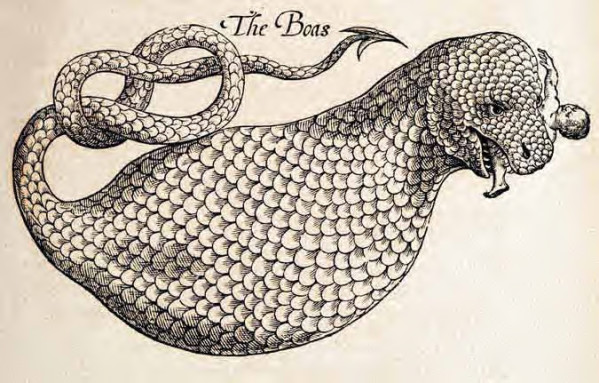
The book includes serpents and insects.

The whole book is available here, and select images here.

Via The Public Domain.

On Being Arrested in Japan.

English cards translated from Japanese by Rachel Mimms.

Getting arrested is a scary experience in every country, but perhaps even more so in Japan, where the conviction rate is over 99%. Last month, the Japanese government passed a new anti-terror conspiracy law that has drawn controversy among Japanese citizens who feel it is a threat to civil liberties and privacy. Artist Megumi Igarashi (pen name Rokudenashiko), famously arrested in 2014 on charges of obscenity for distributing 3D data of her genitals, is creating a set of playing cards that educate people about what it’s like to be arrested in Japan.

Critics of the anti-conspiracy law claim it is too broadly worded and contains acts that have little to no connection to terrorism, such as: copying music, picking mushrooms in conservation forests, and competing in a motor boat race without a license.

No stranger to the absurdity of Japanese law, Ms. Igarashi is responding by making a tongue-in-cheek karuta card game set depicting scenarios of arrest and imprisonment in Japan partly based on her own experiences. Each one has a drawing humorously portraying the situation described on the other side of the card. Through these “jail cards,” players can learn about Japanese prison conditions, police interrogation, and testifying in court.

She has already posted 17 of these cards to her Twitter account and says she plans to create an entire set of 50 — one for each Japanese syllable — so that anyone can print them out and play along.

You can read and see more at Spoon & Tamago. Cop shops, same all over the world.

Lauren Machen: Elemental.

© Lauren Machen.

The name of Lauren Machen’s premiere art photography series was almost Finally. As in, “I am finally addressing something that is at the very core of my being,” states the artist, who has previously worked in art direction for musicians such as St. Vincent and Rihanna. “Finally because a lot of subtle racism that people of color have had to struggle [with] are bubbling to the surface. People who aren’t of color just simply thought it didn’t exist or we were past that.”

Instead, Machen named the series Elemental, as in, “The very basis of my being. What my soul feels. My truth. Being mixed race, I was left to just sort of float in space because we didn’t really talk about race and ethnicity in my household… This is about peeling the layers away. Taking a moment to identify as I am rather than how others think I am or what I should be.”

Machen cites the 2016 election as a turning point for how she sees her racial identity, and even more specifically, Grey’s Anatomy actor Jesse Williams’s knockout acceptance speech for the BET Humanitarian Award. One of Williams’s most prominent lines from that speech was, “Just because we’re magical doesn’t mean we’re not real,” and its resonance is felt in Machen’s photos that capture surreal insertions of earthly elements into stark, honest portraits of people of color.

“I chose to incorporate the classical elements in the photographs: water, earth, fire, air, and also used falling sand as a symbol of passing time,” Machen explains. “There’s a mystery and magic to these elements, yet they are very real.

© Lauren Machen.

A brilliant series. You can read and see more at The Creators Project and Lauren Machen’s website.

Contra & Castlevania Get Design Facelifts.

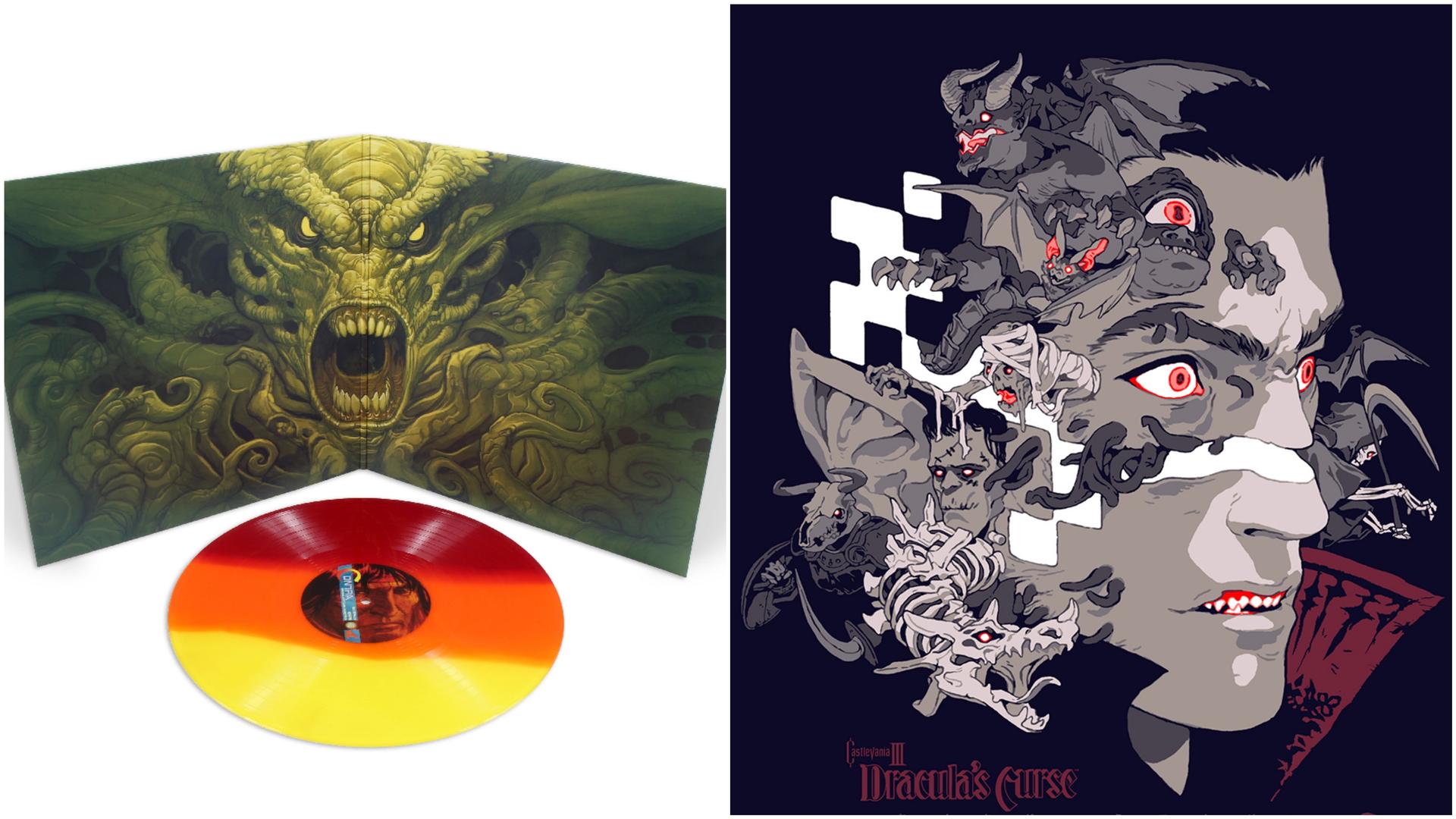
Contra and Castlevania are two of the most iconic video games in history, and both recently got brand new poster art and soundtrack LPs from Mondo, a record label and gallery that specializes in collectibles for classic and contemporary movies. As Mondo’s record label manager Mo Shafeek tells Creators, commissioning artworks for standalone screen-printed posters and the soundtracks was refreshing, given that the company has mostly worked on film and television soundtracks for many years. For Mondo, these two new sets of work are designed to appeal to anyone with a special reverence for classic video games from the 80s.

Mondo’s Creative Director Eric Garza tells Creators that the posters came about after he got a sneak peek at the soundtrack art. Garza and Shafeek, who were fans of the artists behind the soundtrack work, Eric Powell and Sachin Teng, felt it was a no-brainer that the art could translate into posters.

You can read and see more at The Creators Project.

Life of A Christian Soul.

I’m afraid the plot is boring. Very boring. These are basically the very old precursors to Chick Tracts, albeit, without the manic melodrama of Jack.

Representation of the inner state of a man, who is a servant of Sin, and suffers the devil to reign within him.

The Peacock represents Pride. The Goat, Unchastity. The Hog represents Voracity and Gluttony. The Toad, Avarice. The Snake, Envy. The Tiger, Anger. The Tortoise, Indolence.

I have a turtle tattoo on my wrist. I guess that means I’m a hopeless slave to the sin of indolence? A lover of laziness? Yeah, okay. Several panels later, we come to:


Representation of a person’s inward State who being reconciled with God, will know nothing more than the crucified Jesus.

That certainly goes a long way in explaining the willful ignorance of christians.

Via The Public Domain.

#Pimpmyfactura.

Yacarebaby’s paste ups are a common sight on the Buenos Aires streets. Photo courtesy of PMF.

Gas and electricity bills, and estimates for bricks, paint, toilets, or doors are being turned into canvases—as we speak—by the indie graphic arts scene in Argentina. Through a program called #pimpmyfactura, the underground visual arts scene scene is bailing out three community day cares by transforming their debts into artwork. Top graffiti, paste up, collage and graphic design artists are merging from diverse disciplines towards one common goal: converting those unsettled bills into marketable works of art.

Over 40 artists from Argentina, Spain, Brazil, Uruguay, the Philippines and Colombia answered #pimpmyfactura‘s call and created artworks to be sold for charity for the value of the bill turned canvas.

This Icarus is brought to you by Colombian illustrator Chaparro on a paint store estimate of 1163 Argentine pesos.

The #pimpmyfactura project emerged last year in a contest that linked a foundation involved with low income daycares to TBWA, an advertisement agency that came up with a creative and concrete way of generating funds for the foundation. TBWA copywriter Enzo Ciucci is co-creator of #pimpmyfactura, and drew a bird’s skull on a hardware store estimate.

[…]

All pieces will be on exhibition at Buenos Aires’ Centro Cultural Rojas from August 4th to the 14th. They will be for sale for the amount of the bill they are painted on, and 100% of profit goes to the debts of these daycare centers through the Publicidar foundation.

You can read and see more at The Creators Project.