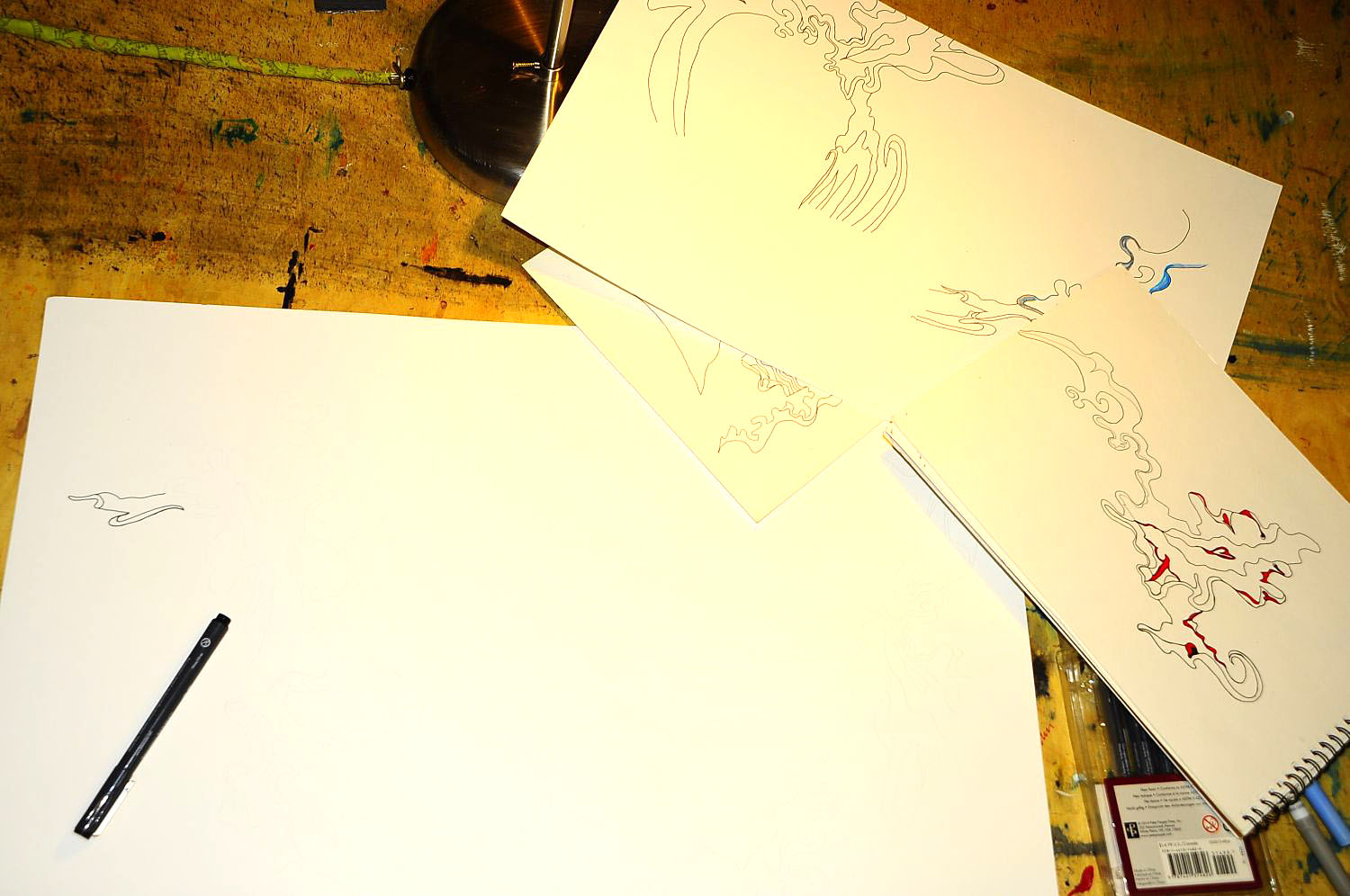
Ghosts of Love in Winter. The Title is all rq, I’m just filling it in. 19″ x 24″, markers on Bristol.
© C. Ford, all rights reserved.

Ghosts of Love in Winter. The Title is all rq, I’m just filling it in. 19″ x 24″, markers on Bristol.
© C. Ford, all rights reserved.
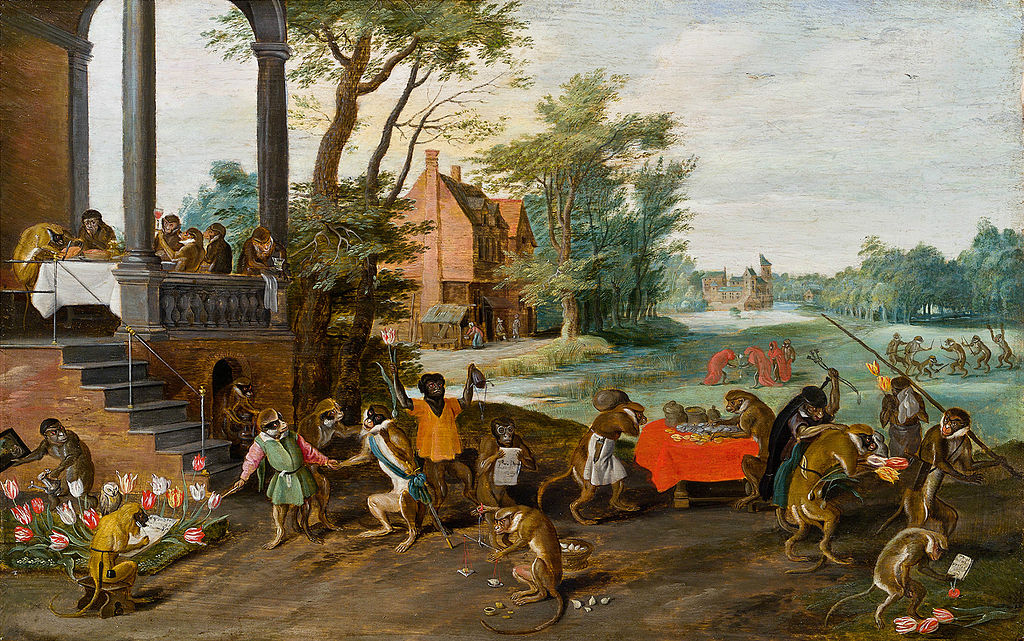
Allegorie der Tulipomanie [Allegory of Tulip Mania], by Jan Brueghel the Younger, 1640s. A satirical commentary on speculators during the time of “Tulip Mania”, an economic bubble that centered around rare tulip bulbs. — Source.
Singerie — from the French for “Monkey Trick” — is a genre of art in which monkeys are depicted apeing human behaviour. Although the practise can be traced as far back as Ancient Egypt, it wasn’t until the 16th century that the idea really took off and emerged as a distinct genre. Some of its most famous champions include the Flemish engraver Pieter van der Borcht (whose 1575 series of singerie prints were widely disseminated), Jan Brueghel the Elder, and the the two Teniers brothers, David Teniers the Younger and his younger brother Abraham Teniers. Into the 18th century the genre saw great popularity in France, particularly in the guise of the “singe peintre” (monkey painter), which offered up a perfect parody of the art world’s pomposity. With monkeys, along with apes, being our closest cognates in the animal world, they proved the perfect medium for the satirising of society, which so often thinks itself “above” the animal kingdom.

Kwakzalver [Quack], by Pieter van der Borcht (I), ca. late 16th century. A charlatan doctor sells a cure (seemingly for hangovers, though perhaps for hair loss) — Source.
Satan s’amuse (1907) Ciclo Segundo de Chomón. Magic! :D You can see Segundo de Chomón’s other films at the Internet Archive. There are a host of very interesting ones. I’ve only been able to watch a few of them so far, but I’ll get to them all eventually. If surreality is your thing, you’ll be busy for a while.
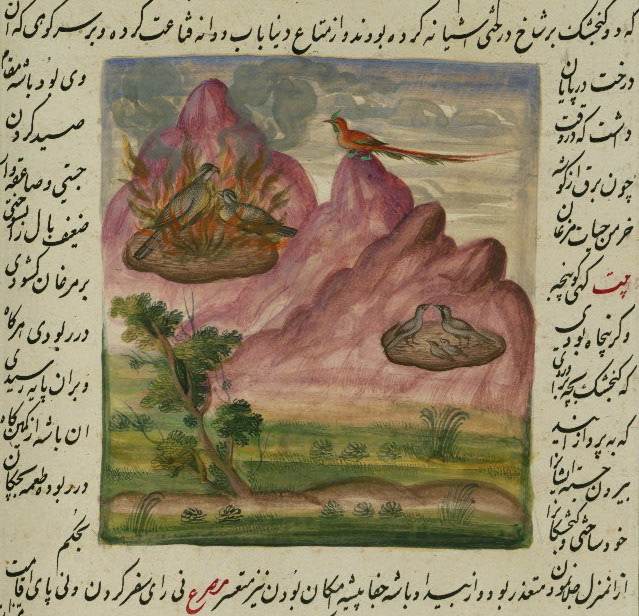
A beautiful Simurgh looks on as Phoenixes burn in their nest. This, and the images to follow, are from the beautiful Anvār-i Suhaylī or Lights of Canopus. From The Public Domain:
The Anvār-i Suhaylī or Lights of Canopus — commonly known as the Fables of Bidpai in the West — is a Persian version of an ancient Indian collection of animal fables called the Panchatantra. The tales follow the Persian physician Burzuyah on a mission to India, where he finds a book of stories collected from the animals who live there. Much like in the Arabian Nights (which actually uses several of the Panchatantra stories), the fables are inter-woven as the characters of one story recount the next, with up to three or four degrees of narrative embedding. Many of the fables offer insightful glimpses into human behaviour, and emphasise the power of teamwork and loyalty: one passage describes how a hunter catches a group of pigeons in a net, only for them to be saved by a mouse who gnaws through the rope. The version celebrated in this post hails from nineteenth-century Iran and is particularly notable for its exquisite illustrations — scenes of tortoise-riding monkeys, bird battles, conversing mice, delicate purple mountains — 123 in total. The artist behind the images is not mentioned, but the creator of the equally elegant nasta’liq style writing which they serve, is named by The Walters Art Museum (who hold the manuscript) as one Mīrzā Raḥīm.
And from The Walters Art Museum, where you can see the whole manuscript in .pdf:
Walters manuscript W.599 is an illuminated and illustrated copy of Anvar-i Suhayli (The lights of Canopus), dating to the 13th century AH/AD 19th. It is a Persian version of Kalilah wa-Dimnah (The fables of Bidpay). It was completed on 26 Jumadá I 1264 AH/AD 1847 by Mirza Rahim. The text is written in Nasta’liq script in black and red ink, revealing the influence of Shikastah script. There are 123 paintings illustrating the text. The Qajar binding is original to the manuscript.
Husayn Va’iz Kashifi (died 1504-1505) (Author)
Mirza Rahim navadah-i Mirza Amin Afshar (Scribe)1264 AH/AD 1847 (Qajar)
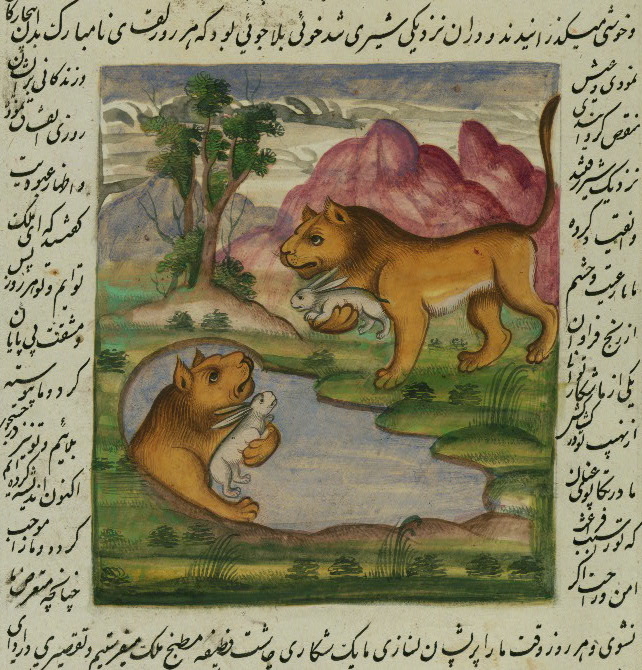
Best friends?

Oh, one of my favourite stories, and one that is much older than I thought.

Another beautiful Simurgh!

Those mice, always rescuing everyone.

Yet another rescue by a mouse. They must have been adored by everyone. :D
You can see many more images at The Public Domain, or download the .pdf of the whole manuscript via The Walters Art Museum.

Fleur D’Oranger (Orange Blossom). J.J. Grandville, Les fleurs animées.

© Jack Sjogren. Via Hyperallergic.
Scent of Geranium from Naghmeh Farzaneh on Vimeo.
Absolutely wonderful.
Immigration is a new chapter in one’s life, a chapter with unexpected events that can take one’s life down paths different from the one imagined. This film is an autobiographical account of the director’s experience with immigration.
‘Scent of Geranium’ is this week’s Staff Pick Premiere! Read more about it here: vimeo.com/blog/post/staff-pick-premiere-scent-of-geranium
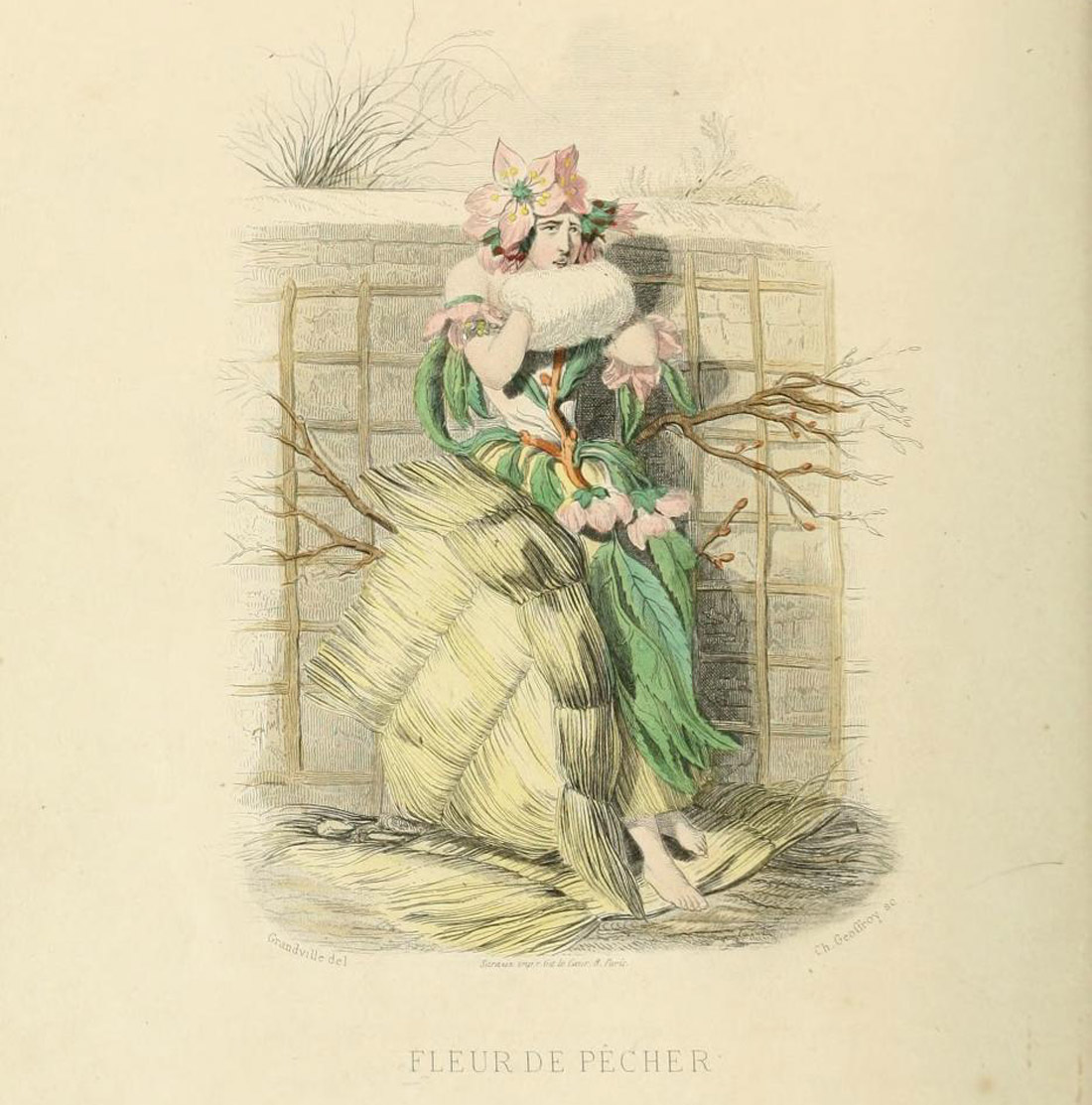
Fleur de Pêcher (Peach Blossom). J.J. Grandville, Les fleurs animées.

John Roach, Aaron Moore, Brian Chase, Victoria Keddie, Alexander Rosenberg, Ben Wright, “Frozen Words Hot Air” (2017) (courtesy the artists).
Many of us probably feel the urge, at least once each day, to smash the hateful things President Trump has said (or tweeted). On Friday, September 8, the artists John Roach, Aaron Moore, Brian Chase, Victoria Keddie, Alexander Rosenberg, and Ben Wright will use those overblown and grammatically incoherent groups of words as the basis for a multidisciplinary, poetic, satiric performance at UrbanGlass titled “Frozen Words Hot Air.” Handpainted glass objects emblazoned with words from Trump’s speeches will be blown live by Wright and Liesl Schubel, then played by Chase and Moore, while audio snippets of those same speeches are remixed and manipulated by Keddie.

John Roach, Aaron Moore, Brian Chase, Victoria Keddie, Alexander Rosenberg, Ben Wright, Frozen Words newspaper (2017) (courtesy the artists).
Inspired by the 16th-century French satirist François Rabelais’s The Life of Gargantua and Pantagruel (ca 1532–64), the performance references a particular scene from that tome. In it, the heroic giant Pantagruel crosses a sea of thawing ice that, as it melts, releases the ghostly sounds of a gruesome battle that took place there during the winter. On Friday, all the hot air blown by President Trump will be symbolically frozen, manipulated, and smashed. An accompanying artists’ newspaper to be distributed at the performance, Frozen Words, will gather the jumbled and rearranged speeches for posterity.
When: Friday, September 8, 7–8pm
Where:UrbanGlass (647 Fulton Street, Fort Greene, Brooklyn)
This sounds like a fabulous show, it’s certainly a well-inspired one, and I’d love to see this in person. If you have the opportunity, take it! Via Hyperallergic.

I realize that not everyone finds Medievalism to be as fascinating as I do, but this is really, um, fascinating!
Introduction: In the fictive landscape of the Northern Kingdoms, the character Geralt of Rivia rides on his chestnut mare clad in chainmail armour whilst sporting two-handed swords comparable to a zweihander or longsword of the late 15th century. As I encounter my second village through the third-person view of my protagonist, a short observation leaves me with the impression of a plausible society taken from the Middle Ages. Such a historically detailed environment within a fantasy game of the 21st century should be no surprise to the avid gamer, however, it raised the question of the representation of history within computer games.
[…]
This study seeks to investigate the medieval thematic in computer gaming and pursue what historical elements that persist through this relatively new medium. More distinctly, the many missions and quests experienced in the ‘The Witcher 3’ is the main object of study as they work in concert, providing both enhanced purpose for the player as well as constricting the freedom given in the open world of the Northern Kingdoms. Quests – a task or mission given by non-playable characters (NPCs) or during certain interaction with objects in the game – present a variety of impressions through participatory segments that the player encounters in the game. It is the potent meaning of said quests that this study seek to delve into in order to find, not only the historical features, but also the fascination that seems to propagate itself in games.
You can read Christer Lidén’s full thesis here. (.pdf)
Via Medievalists.net.

Hortensia, Couronne Impériale (Hydrangea, Crown Imperial). J.J. Grandville, Les fleurs animées.

Dahlia. 999miil]]]]9 (Vala decided to help me post this.) J.J. Grandville, Les fleurs animées.

Belle de Nuit (Mirabilis jalapa, Four o’clock). J.J. Grandville, Les fleurs animées.
