The Quilts of War.

Army Uniform Quilt from the Napoleonic Era by an unidentified artist (Region unknown, possibly Prussia, late 18th/early 19th century), wool, probably from military uniforms; Silesian pieced (photo by the author for Hyperallergic).

Artist unidentified, Soldier’s Hexagon Quilt (Crimea or United Kingdom, late 19th century), wool from military uniforms, 85 x 64 in (courtesy the Annette Gero Collection, photo by Tim Connolly, Shoot Studios).

…These wartime quilts are incredibly rare, and Gero states in the release that “there are fewer than one hundred of these quilts in the world, and no two are alike.” War and Pieced highlights their diversity, whether in the distinctive beadwork on quilts made by soldiers stationed in India in the 19th century, or the motifs of African shields and spears embroidered on a late 19th-century quilt, likely made in tribute to those killed in the Anglo-Zulu War. A quilt made in India between 1860 and 1870 has its beads connected to small circles of fabric, the discs probably left over from punching buttonholes into uniforms. Although the conflict may be unnamed on the quilt, the patterns, needlework, and, above all, uniform materials, can place these fabric works in time.

They’re moving relics of the bloody battles that stretched across the globe in the mid-18th to 19th centuries, from the Prussian and Napoleonic wars, when elaborate intarsia quilts featured pictorial inlays of soldiers, to the Crimean War with its dense geometries. One from that mid-19th-century engagement has a checkerboard at its center, an example of the boards made from scraps of military uniforms to fend off boredom. The spare fabric that formed the checkerboard may have been from uniforms of the dead or wounded, thus adding a somber memorial to an otherwise vibrant wool quilt.

Although there is a vision of hope in making something beautiful out of horror, there’s an eerie echo of the suturing of wounds in each stitch of the quilt. The intense labor of some of those made in convalescence — one from 1890 involves 25,000 blocks, hexagons, and diamonds — represents the incredible amount of time these men spent recovering. Viewed together, the quilts in War and Pieced are haunting reminders of the lives given and maimed in the British Empire’s global conquest, and those that continue to be lost to war.

Following the exhibition’s run in New York, it will travel to the Nebraska museum and open May 25, 2018.  You can see and read much more at Hyperallergic.

These amazing works remind me of Ernest Thesiger’s effort, after World War I, to help disabled soldiers to make a living with embroidery.

You can read about that here. (Yes, that Ernest Thesiger, aka Dr. Pretorius.)

People: Touching, Sleeping, Matching.

Stefan Drashan photographs people in museums. People Touching Artworks:

Visitor at the National Archaeological Museum in Naples, from Stefan Drashan’s Tumblr, People Touching Artworks (all photos courtesy Stefan Drashan).

Visitor at the National Archaeological Museum in Naples, from Stefan Drashan’s Tumblr, People Touching Artworks (all photos courtesy Stefan Drashan).

People Matching Artworks:

Visitor at the Musee Picasso in Paris, from Stefan Drashan’s Tumblr, People Matching Artworks.

From Stefan Drashan’s Tumblr, People Matching Artworks.

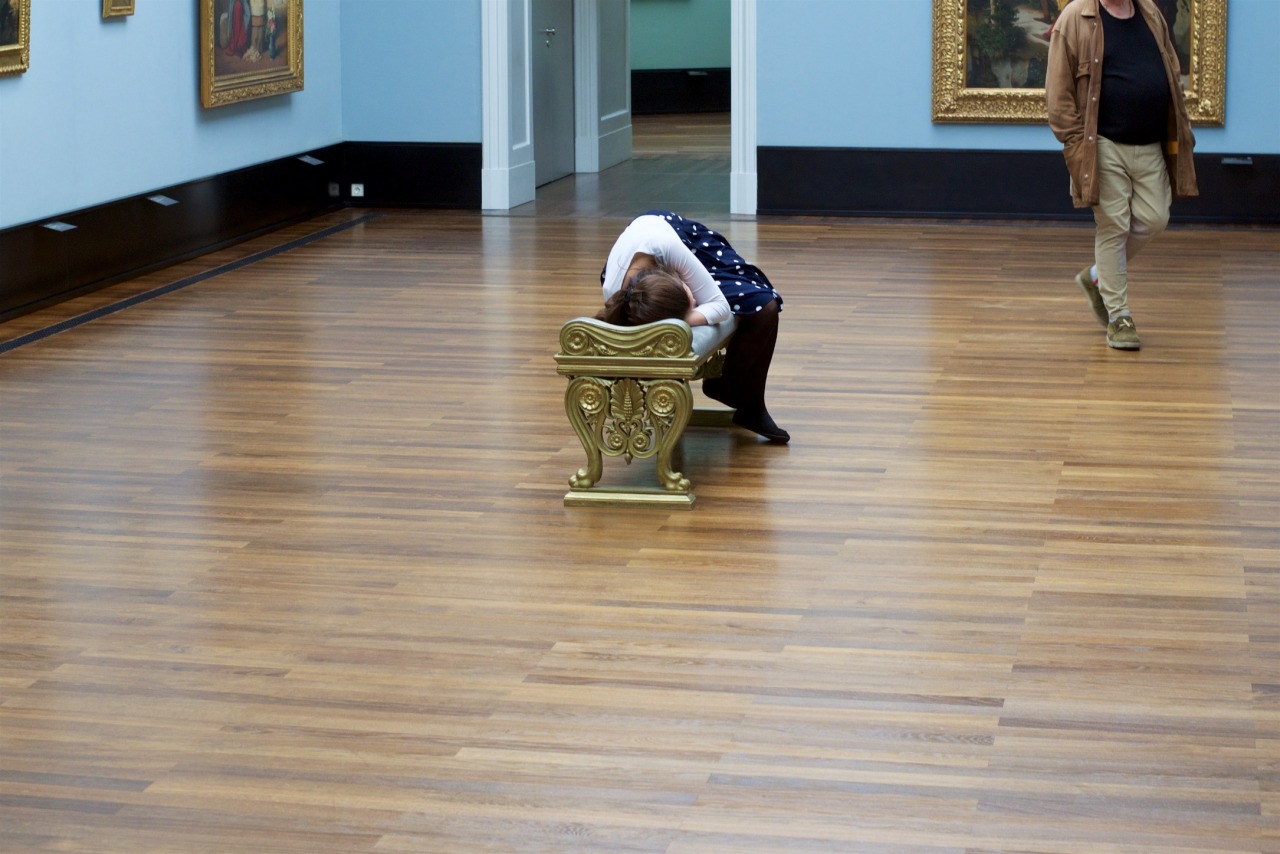
People Sleeping In Museums:

From Stefan Drashan’s Tumblr, People Sleeping in Museums.

Via Hyperallergic.

A Public Offense To Religion.

“Ecce homo erectus” (image courtesy Hogre).

“Ecce homo erectus” (image courtesy Hogre).

Anonymous artist Hogre wasn’t expecting to be arrested while checking their email at an internet café in Rome. Neither were they anticipating being charged under an archaic Italian law that punishes a public offense to religion with a fine of up to 5,000 Euros or a prison sentence of up to two years.

Hogre was one of two artists who, on June 1 of this year, placed satirical posters in bus stop advertising spaces in the Italian capital. Hogre’s poster “Ecce homo erectus” depicts Jesus with a conspicuous erection, resting one hand on the head of a praying, kneeling child. This was a response to sexual abuse charges against Cardinal Pell, the third highest-ranking Vatican official.

The other poster, “Immacolata conception in vitro,” is by Hogre’s friend doublewhY. Less obviously inflammatory, it shows two women holding a baby; one of the women is flipping off the viewer. The text and image suggest a parallel between in vitro and immaculate conception.

The moral panic that ensued was instigated by right-wing politician Fabrizio Ghera, who called for the resignation of the transport official responsible for the posters. The Italian media fanned the flames of this panic; according to Hogre in an interview with Hyperallergic,“the articles that were around looked like they were written by parrots and pigeons.”

Ads by Hogre and doublewhY at bus stop in Rome, Italy (photo courtesy Hogre).

Another lofty height achieved in the annals of pious hypocrisy. “Jesus with an erection, the whole world will fall apart!” but it’s perfectly okay for the Catholic Church to keep playing transfer the rapist, making denials, and protecting and sheltering those who sexually assault and abuse. Is that not an offense to religion? Might be nice if the church was more concerned about actual harm, rather than depiction of Jesus’s boner.

Hyperallergic has the full story.

The Legend of the White Snake.

Image from the Summer Palace, Beijing, China, depicting the legend – Wikimedia Commons.

Medievalists has a fascinating look at the Chinese legend of The White Snake, and its evolution from a cautionary tale where the monk was the good guy, to a sympathetic love story where the monk is a shit stirrer.

…This may well be the fate of Xu Xuan, Madam White’s human husband, if he is not rescued by a powerful Buddhist monk. The first written version of the White Snake legend is found in a collection of novella composed in the first quarter of the 17th century. Including forty different stories, the collection is titled ‘Stories to Caution the World’ and the White Snake tale ‘Madam White Imprisoned under the Thunder Peak Tower’ (some editions also translate the novella as ‘Eternal Prisoner under the Thunder Peak Tower’ or simply ‘The White Snake’).

[…]

…The emphasis, however, is shifted to her devotion to Xu, as well as her sympathy towards humankind. The once righteous Fahai, now entering the scene as a troublemaker who simply cannot just mind his own business, tricks her into revealing her true form to Xu.

The full story is at Medievalists.