Victorian London’s Dirty Book Trade.

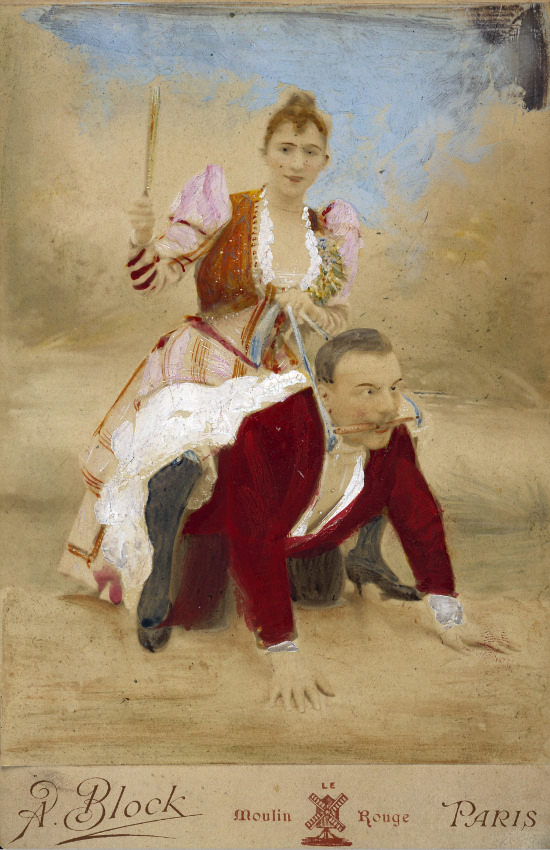
19th-century “French postcard” from the personal collection of the German-Austrian psychiatrist and early sexologist Richard Freiherr von Krafft-Ebing — Source.

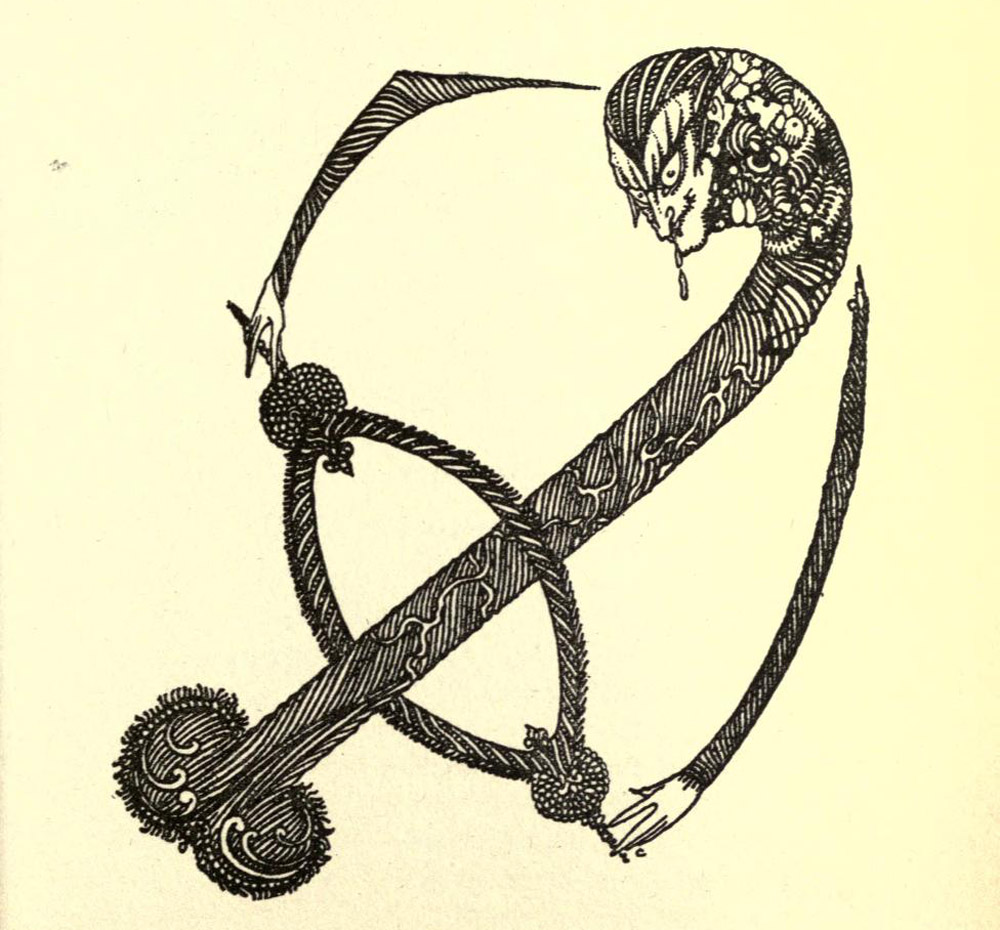
Title page to an 1891 edition of The Story of a Dildoe! — Source. The full book is available, in English.

The Public Domain has a fascinating article on Holywell Street, home of the Victorian porn trade. There’s much to see, and read.

Victorian sexuality is often considered synonymous with prudishness, conjuring images of covered-up piano legs and dark ankle-length skirts. Historian Matthew Green uncovers a quite different scene in the sordid story of Holywell St, 19th-century London’s epicentre of erotica and smut.

(Tentative warning: the essay includes some mildly explicit content, both text and image, which may not be suitable for all ages and dispositions!)*

*Having read the article, there’s some very explicit language, not all of it nice. If you’re sensitive to that sort of thing, have a care. And there are a host of pictures, lots of nudity.

Via The Public Domain.

The Intrigue of Medieval Art.

Page from the calendar of the Très Riches Heures showing the household of John, Duke of Berry exchanging New Year gifts. The Duke is seated at the right, in blue.

As is my wont, I found myself distracted by, and lost in yet another illuminated Medieval manuscript, a gorgeous Book of hours.

The Très Riches Heures du Duc de Berry (English: The Very Rich Hours of the Duke of Berry), is the most famous and possibly the best surviving example of French Gothic manuscript illumination, showing the late International Gothic phase of the style. It is a book of hours: a collection of prayers to be said at the canonical hours. It was created between c. 1412 and 1416 for the extravagant royal bibliophile and patron John, Duke of Berry, by the Limbourg brothers. When the three painters and their sponsor died in 1416, possibly victims of plague, the manuscript was left unfinished. It was further embellished in the 1440s by an anonymous painter, who many art historians believe was Barthélemy d’Eyck. In 1485–1489, it was brought to its present state by the painter Jean Colombe on behalf of the Duke of Savoy. Acquired by the Duc d’Aumale in 1856, the book is now MS 65 in the Musée Condé, Chantilly, France.

Consisting of a total of 206 leaves of very fine quality parchment, 30 cm in height by 21.5 cm in width, the manuscript contains 66 large miniatures and 65 small. The design of the book, which is long and complex, has undergone many changes and reversals. Many artists contributed to its miniatures, calligraphy, initials, and marginal decorations, but determining their precise number and identity remains a matter of debate. Painted largely by artists from the Low Countries, often using rare and costly pigments and gold, and with an unusually large number of illustrations, the book is one of the most lavish late medieval illuminated manuscripts.

After three centuries in obscurity, the Très Riches Heures gained wide recognition in the late nineteenth and twentieth centuries, despite having only very limited public exposure at the Musée Condé. Its miniatures helped to shape an ideal image of the Middle Ages in the collective imagination, often being interpreted to serve political and nationalist agendas. This is particularly true for the calendar images, which are the most commonly reproduced. They offer vivid representations of peasants performing agricultural work as well as aristocrats in formal attire, against a background of remarkable medieval architecture.

It’s two of the calendar images which caught my attention. I generally gravitate to November first, it being my birth month. Unlike most months, this had no descriptor of a place, no great estate or palace. Then I noticed February was the same. Just the name of the month. These are the two oddest of the calendar leaves, too.

©Photo. R.M.N. / R.-G. OjŽda. Click for full size.

This is November. Okay, out with the pigs hunting truffles, or just letting the pigs stuff themselves silly on whatever that is on the ground. The pigs certainly look happy over their master’s inattention, and it’s that inattention which baffles me. What in the hell is he glaring at, with such a posture? His gaze goes directly to the tree tops, where I’m afraid I can’t spy anything ominous at all. I guess this made sense way back when, but it doesn’t make sense to me.

Now we visit February, and warming genitals by the fire:

©Photo. R.M.N. / R.-G. OjŽda. Click for full size.

There’s all manner of wonderful weirdness in this one. That massive bed, for one. That seems to be unusually generous lodging for servants. Then there’s the man barely dressed out in the freezing cold; the woman and cat having a staring contest, and of course, the gigantic fire, where people are happily toasting their genitals. I’ve been cold. Very, very cold, and it’s never once occurred to me to toast the bits.

You can see much more here.

Lavender Files 27.

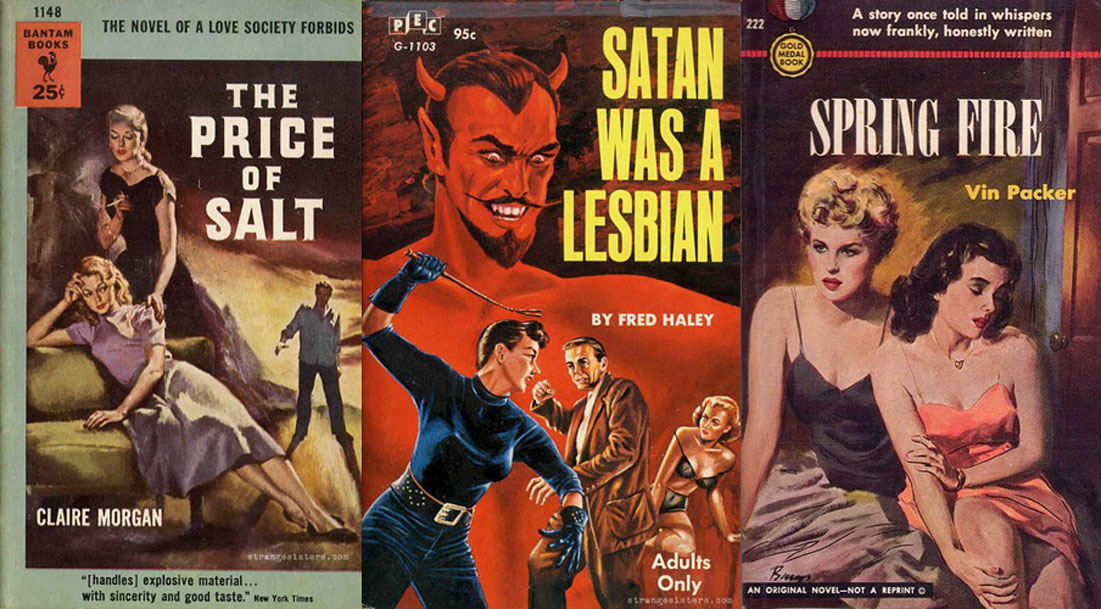
The Price of Salt and Spring Fire are both well known, especially Highsmith’s Price of Salt. Spring Fire started the Lesbian pulp genre, and the author, Marijane Meaker, was always unhappy about the forced ending she had to do. As for Satan Was A Lesbian, people may not know the story, but it’s probably one of the best known pulp covers, which has been reproduced on all manner of goods.

A Russian Art Connection.

Leonardo da Vinci, “Salvator Mundi” (c.1500), oil on panel, 25 7/8 x 18 in.(65.7 x 45.7 cm) (image courtesy Christie’s).

There was an astonishing sale at Christie’s, the last privately held da Vinci, supposedly, for an unprecedented amount of money: over $450 million dollars. The Russian connection is of interest, as is the doubtful provenance of the painting. There’s also the problem of such a painting, if it’s a true da Vinci, going into private hands. No museum could possibly have coughed up over 400 million for it.

Last night, Christie’s auction house sold “Salvator Mundi,” which it claims is the last painting by Leonardo da Vinci in private hands, for an astounding, record-setting $400M (the final price was over $450M with fees). The sale was controversial for a couple of reasons: that mind-numbing number itself, but also the fact that there are a lot of questions — and serious doubts — about the painting’s authenticity, restoration, and provenance.

One can therefore be forgiven for initially overlooking another elephant in the room — the identity of the seller. When there’s this much money involved, though, it usually pays to follow it, and here the money leads directly back to the Russian billionaire Dmitry E. Rybolovlev. Rybolovlev’s family trust sold the painting, through Christie’s, to an undisclosed buyer, but if his name sounds familiar for other reasons, that might be because in 2008 he paid (through a company he controlled) $95M to buy a Palm Beach mansion from Donald Trump.

You can read more about this at Hyperallergic, and there’s an earlier article too. The earlier article is disheartening, to say the least, as half of all the world’s wealth is in a very small circle of people, while little money ever goes to all those things which make for a healthy society. Once again, I’m reminded of A Perfect Circle’s new beatitude