Elephants.

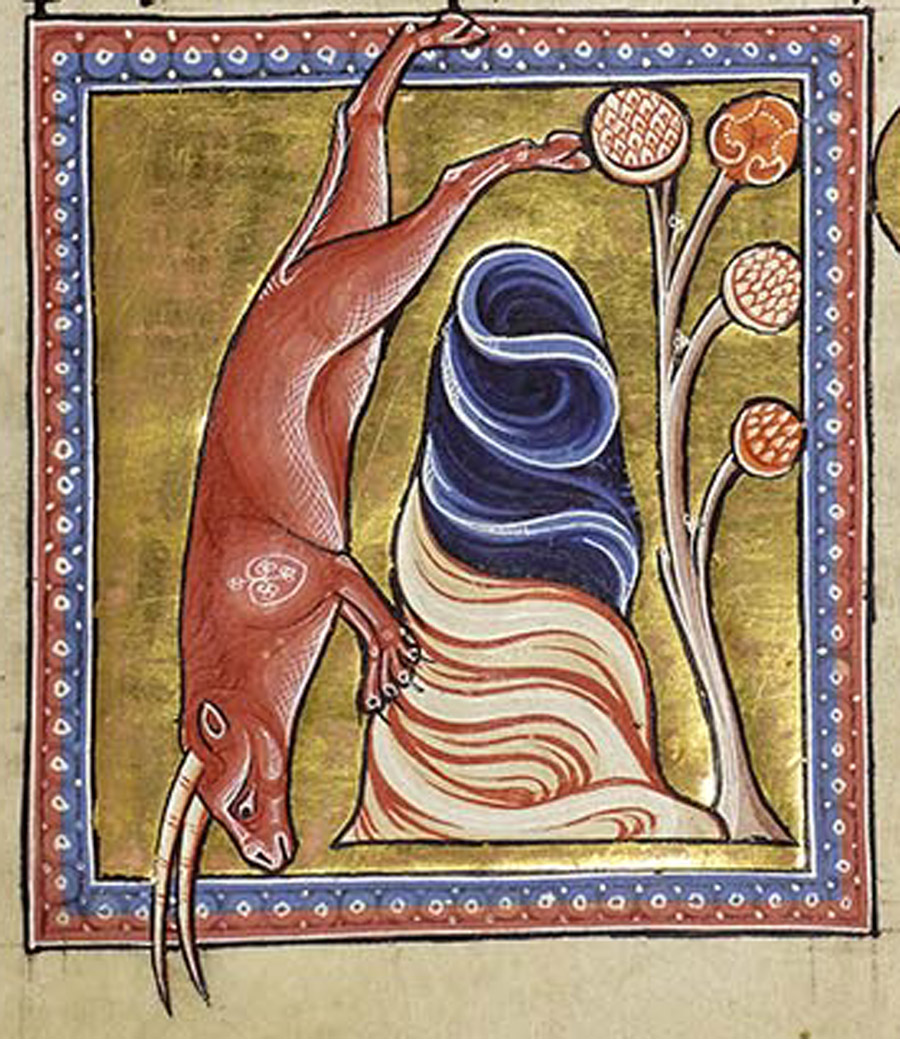
Hugh of Fouilloy (<a href="http://www.bl.uk/catalogues/illuminatedmanuscripts/record.asp?MSID=6512">SloaneMS</a>). Elephants, Dragon, and Mandragora.

Hugh of Fouilloy (SloaneMS). Elephants, Dragon, and Mandragora.

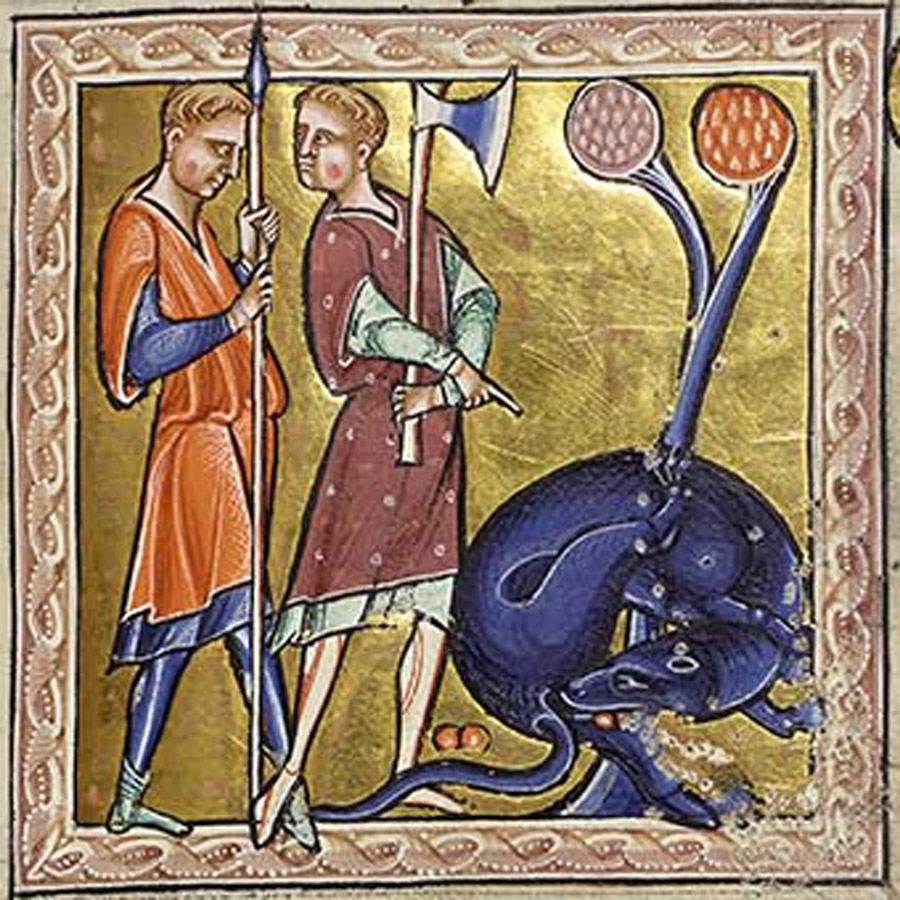
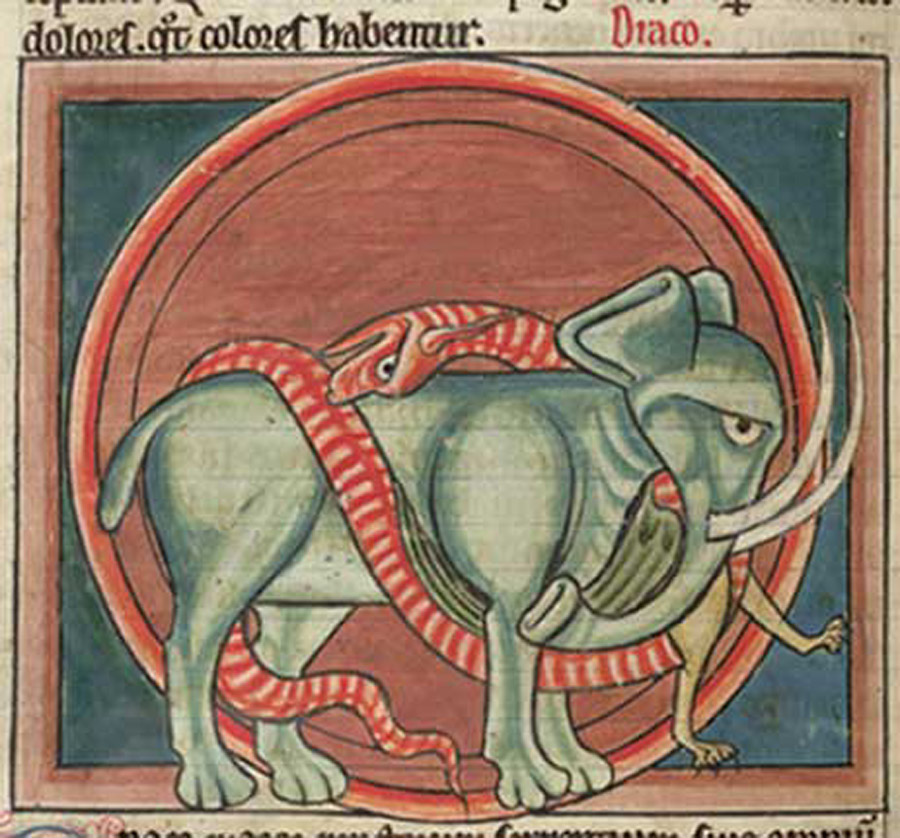
<strong>British Library, Harley MS 4751, Folio 58v. A Dragon attacking an elephant.</strong>

British Library, Harley MS 4751, Folio 58v. A Dragon attacking an elephant.

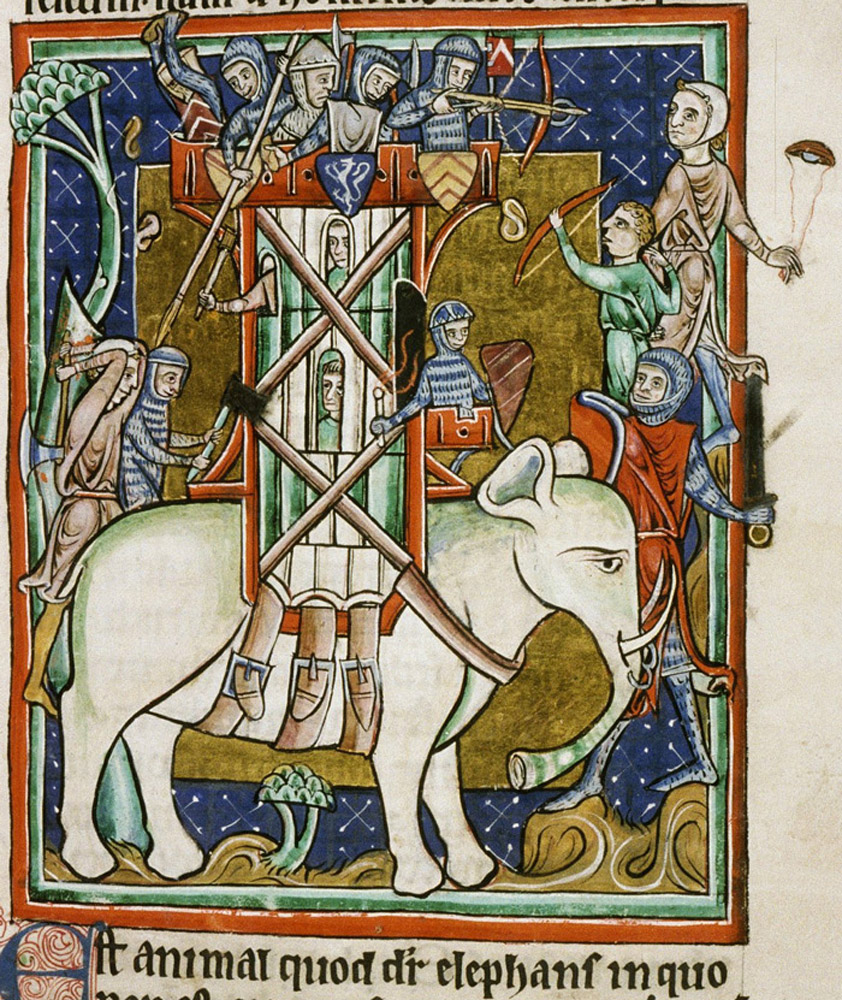
Bodleian: In India, soldiers fight from a castle mounted on the back of an elephant. The tusks of the elephant come out of its trunk rather than its mouth.

Bodleian: In India, soldiers fight from a castle mounted on the back of an elephant. The tusks of the elephant come out of its trunk rather than its mouth.

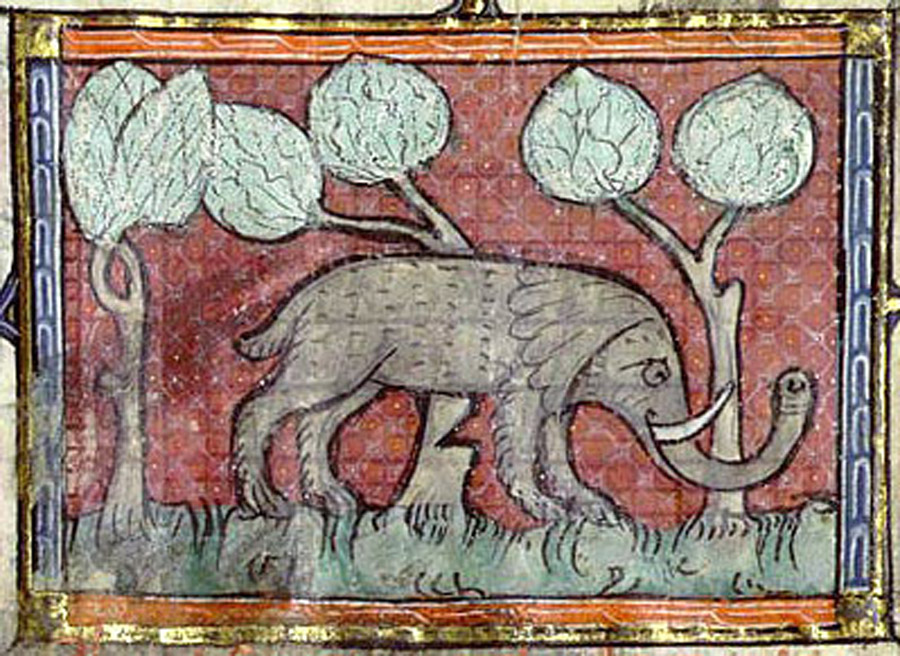
Bibliothèque Nationale de France, fr. 1951, Folio 19r. An elephant leans on a partially cut through tree.

Bibliothèque Nationale de France, fr. 1951, Folio 19r. An elephant leans on a partially cut through tree.

Text Translation:

[Of the elephant] … no larger animal is seen. The Persians and Indians, carried in wooden towers on their backs, fight with javelins as from a wall. Elephants have a lively intelligence and a long memory; they move around in herds; they flee from a mouse; they mate back-to-back. The female is pregnant for two years, and gives birth no more than once, and not to several offspring but to one only. Elephants live for three hundred years. If an elephant wants to father sons, it goes to the East, near Paradise; there the tree called mandragora, the mandrake, grows. The elephant goes to it with his mate, who first takes fruit from the tree and gives it to her male. And she seduces him until he eats it; then she conceives at once in her womb. When the time comes for her to give birth, she goes out into a pool, until the water comes up to her udders. The male guards her while she is in labour, because elephants have an enemy – the dragon. If the elephant finds a snake, it kills it, trampling it until it is dead. The elephant strikes fear into bulls, yet fears the mouse. The elephant has this characteristic: if it falls down, it cannot rise. But it falls when it leans on a tree in order to sleep, for it has no joints in its knees. A hunter cuts part of the way through the tree, so that when the elephant leans against it, elephant and tree will fall together. As the elephant falls, it trumpets loudly; at once a big elephant goes to it but cannot lift it. Then they both trumpet and twelve elephants come, but they cannot lift the one who has fallen. Then they all trumpet, and immediately a little elephant comes and puts its trunk under the big one and lifts it up. The little elephant has this characteristic, that when some of its hair and bones have been burnt, nothing evil approaches, not even a dragon. The big elephant and its mate represent Adam and Eve. For when they were in the flesh pleasing to God, before their sin, they did not know how to mate and had no understanding of sin. But when the woman ate the fruit of the tree, that is to say, she gave her man the fruit of the mandrake, the tree of knowledge, then she became pregnant, and for that reason they left Paradise. For as long as they were in Paradise, Adam did not mate with Eve. For it is written: ‘Adam knew his wife and she conceived’, (Genesis, 4:1) and she gave birth on the waters of guilt. Of this, the prophet says: ‘Save me, O God, for the waters are come in unto my soul.'(Psalms, 69:1). And at once the dragon seduced them and caused them to be outcasts from their citadel, that is, because they displeased God.

Then came the big elephant, meaning the law, and did not raise up mankind, any more than the priest raised the man who fell among thieves. Nor did the twelve elephants, that is, the company of prophets, raise mankind, just as the Levite did not raise the wounded man we spoke of. But the elephant capable of understanding, that is our Lord Jesus Christ, who, although greater than all, became the smallest of all, because he humbled himself, becoming obedient unto death that he might raise up mankind. He is the Good Samaritan who set upon his own beast the man who had fallen among thieves. For Jesus himself was wounded yet bore our weakness and carried our sins. The Samaritan also symbolises a guardian. On this subject, David says: ‘The Lord watching over the children…’ [SOURCE] Where the Lord is present, the devil cannot draw near. Whatever elephants wrap their trunks around, they break; whatever they trample underfoot is crushed to death as if by the fall of a great ruin. They never fight over female elephants, for they know nothing of adultery. They possess the quality of mercy. If by chance they see a man wandering in the desert, they offer to lead him to familiar paths. Or if they encounter herds of cattle huddled together, they make their way carefully and peacably lest their tusks kill any animal in their way. If by chance they fight in battle, they have no mean of the wounded. For they take the exhausted and the injured back into their midst.

Folio 10r – animal grandius…; the elephant [part].

Educational Gaming: The Italian Renaissance.

In an unprecedented move to bolster innovation in learning, a new course centered around a video game was launched this fall at Texas A&M University. The course uses the video game ARTé: Mecenas, developed by Triseum. It includes faculty-led lectures and immersive game play whereby students are transported to the 15th and 16th centuries to commission works of art as a Medici banker. Students can earn one credit hour for achieving 100 percent mastery in the game.

[…]

André Thomas, CEO of Triseum and a professor at Texas A&M University, spoke about the development of the game and its applications:

“ARTé: Mecenas was created out of necessity. I was approached by a faculty member at Texas A&M, Dr. Spurgeon, who was teaching Art History Survey to non-art students. In just two semesters she had to cover 5,000 years of human art history on a global scale, which is like trying to see Europe in a speed train in a week. She wanted to provide more context and deeper meaning for her students, and thought this could be accomplished through a game. Since 97% of students play games for four hours or more every week, it seemed to be an ideal way to engage students with the course content. She came to me to help design and develop an art history game that not only would teach students about the art and its relevance, but one that also would be engaging.

You can read more at Medievalists and Triseum.

Lions, Tigers, and Pards, Oh My!

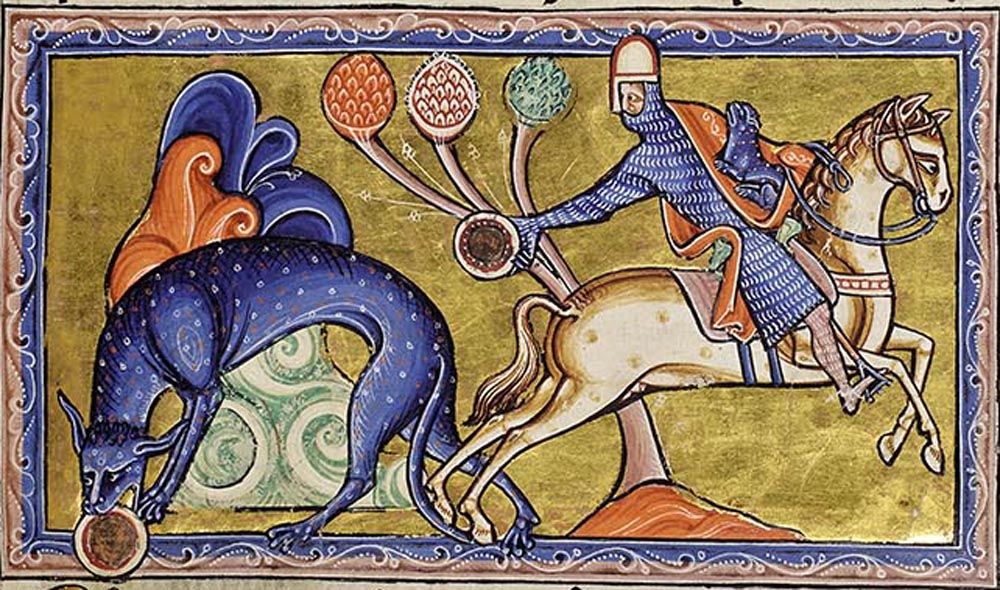
The lion's enemies. The tiger. The horseman has stolen a cub and has been pursued by the tiger. The thief can stop the tiger by a trick: he throws down a glass sphere and the tiger, seeing its own reflection, stops to nurse the sphere like a cub. She ends by losing both her revenge and her child.

The lion’s enemies. The tiger. The horseman has stolen a cub and has been pursued by the tiger. The thief can stop the tiger by a trick: he throws down a glass sphere and the tiger, seeing its own reflection, stops to nurse the sphere like a cub. She ends by losing both her revenge and her child.

The leopard is a spotted wild animal which is very swift. It is produced by the adultery between a lioness and a pard.

The leopard is a spotted wild animal which is very swift. It is produced by the adultery between a lioness and a pard.

The panther. A many coloured animal, handsome and gentle, whose only enemy is the dragon. When he roars, he exhales a sweet odour which draws all animals to him except the dragon. The dragon retreats to his hole and lies stiff with fear, as if dead.

The panther. A many coloured animal, handsome and gentle, whose only enemy is the dragon. When he roars, he exhales a sweet odour which draws all animals to him except the dragon. The dragon retreats to his hole and lies stiff with fear, as if dead.

Text Translation:

For in Greek it is leon; it is not a genuine word, because it is in part corrupted. For the Greek word for lion is translated ‘king’ in Latin, because the lion is the king of all the beasts. There are said to be three kinds. Of these, the ones which are short in stature, with curly manes, are peaceable; the tall ones, with straight hair, are fierce. Their brow and tail show their mettle; their courage is in their breast, their resolution in their head. They fear the rumbling sound of wheels, but are even more frightened by fire. The lion takes pride in the strength of its nature; it does not know how to join in the ferocity of other kinds of wild beasts, but like a king disdains the company of large numbers. Of the three main characteristics of the lion. Those who study nature say that the lion has three main characteristics. The first is that it loves to roam amid mountain peaks. If it happens that the lion is pursued by hunters, it picks up their scent and obliterates the traces behind it with its tail. As a result, they cannot track it. Thus our Saviour, a spiritual lion, of the tribe of Judah, the root of Jesse, the son of David, concealed the traces of his love in heaven until, sent by his father, he descended into the womb of the Virgin Mary and redeemed mankind, which was lost.

Not knowing of his divine nature, the Devil, the enemy of mankind, dared to tempt him like an ordinary man. Even the angels on high did not know of his divinity and said to those who were with him when he ascended to his father: ‘Who is this king of glory?’ The second characteristic of the lion is that when it sleeps, it seems to have its eyes open. Thus our Lord, falling asleep in death, physically, on the cross, was buried, yet his divine nature remained awake; as it says in the Song of Songs: ‘I sleep but my heart waketh’ (5:2); and in the psalm: ‘Behold, he that keepeth Israel shall neither slumber nor sleep’ (121: 4). The third characteristic of the lion is that when a lioness gives birth to her cubs, she produces them dead and watches over them for three days, until their father comes on the third day and breathes into their faces and restores them to life. Thus the Almighty Father awakened our Lord Jesus Christ from the dead on the third day; as Jacob says: ‘He will fall asleep as a lion, and as a lion’s whelp he will be revived’ (see Genesis, 49:9). Where men are concerned, it is the nature of lions not to grow angry unless they are harmed. An example which thoughtful men should heed; for men grow angry even when they have not been harmed, and they oppress the innocent, although Christian law bids them set even the guilty free. The compassion of lions is apparent from endless examples. They spare those whom they have brought down. They allow captives whom they encounter to return home. They vent their rage on men rather than women. They do not kill children except in time of great hunger. Equally, lions refrain from over-feeding. First, because they drink and feed on alternate days; and often, if their food remains undigested, they postpone the Next feed. Then, because they feel uncomfortable when they have devoured more meat than they should, they insert their paws in their mouth and pull the food out, of their own accord. And when they have to take flight, they do exactly the same thing if they are full. Missing teeth show that a lion is old. Lions mate face to face; and not only lions, but lynxes, and camels, and elephants, and rhinoceroses, and tigers. [Lionesses, when] they first give birth, bear five cubs.

In the years which follow, they reduce the number by one at a time. Afterwards, when they are down to one cub, the fertility of the mother is diminished; they become sterile for ever. The lion disdains to eat the Previous day’s meat and turns away from the remains of its own meal. Which beast dares to rouse the lion, whose voice, by its nature, inspires such terror, that many living things which could evade its attack by their speed, grow faint at the sound of its roar as if dazed and overcome by force. A sick lion seeks out an ape to devour it, in order to be cured. The lion fears the cock, especially the white one. King of the beasts, it is tormented by the tiny sting of the scorpion and is killed by the venom of the snake. We learn of small beasts called leontophones, lion-killers. When captured, they are burnt; meat contaminated by a sprinkling of their ashes and thrown down at crossroads kills lions, even if they eat only a small an amount. For this reason, lions pursue leontophones with an instinctive hatred and, when they have the opportunity, they refrain from biting them but kill them by rending them to pieces under their paws. The tiger is named for its swiftness in flight; the Persians and Greeks call it ‘arrow’.

It is a beast distinguished by its varied markings, its courage and its extraordinary speed. The Tygris takes its name from the tiger, because it is the fastest-flowing of all rivers. Hircania is their main home. The tigress, when she finds her lair empty by the theft of a cub, follows the tracks of the thief at once. When the thief sees that, even though he rides a swift horse, he is outrun by her speed, and that there is no means of escape at hand, he devises the following deception. When he sees the tigress drawing close, he throws down a glass sphere. The tigress is deceived by her own image in the glass and thinks it is her stolen cub. She abandons the chase, eager to gather up her young. Delayed by the illusion, she tries once again with all her might to overtake the rider and, urged on by her anger, quickly threatens the fleeing man. Again he holds up her pursuit by throwing down a sphere. The memory of the trick does not banish the mother’s devotion. She turns over the empty likeness and settles down as if she were about to suckle her cub. And thus, trapped by the intensity of her sense of duty, she loses both her revenge and her child. Of the pard The pard is a species which has a mottled skin, is extremely swift and thirsts for blood; for it kills at a single bound.

The leopard is the product of the adultery of a lioness with a pard; their mating produces a third species. As Pliny says in his Natural History: the lion mates with the pard, or the pard with the lioness, and from both degenerate offspring are created, such as the mule and the burdon. Of the panther There is an animal called the panther, multi-coloured, very beautiful and extremely gentle. Physiologus says of it, that it has only the dragon as an enemy. When it has fed and is full, it hides in its den and sleeps. After three days it awakes from its sleep and gives a great roar, and from its mouth comes a very sweet odour, as if it were a mixture of every perfume. When other animals hear its voice, they follow wherever it goes, because of the sweetness of its scent. Only the dragon, hearing its voice, is seized by fear and flees into the caves beneath the earth. There, unable to bear the scent, it grows numbed within itself and remains motionless, as if dead. Thus our Lord Jesus Christ, the true panther, descending from Heaven, snatched us from the power of the devil. And, through his incarnation, he united us to him as sons, taking everything, and ‘leading captivity captive, gave gifts to men’ (Ephesians, 4:8). The fact that the panther is a multi-coloured animal, signifies Christ, who is as Solomon said the wisdom of God the Father, an understanding spirit, a unique spirit, manifold, true, agreeable, fitting, compassionate, strong, steadfast, serene, all-powerful, all-seeing. The fact that the panther is a beautiful animal [signifies Christ as] David says of him:

‘Thou art fairer than the children of men.’ (Psalms, 45:2) The fact that the panther is a gentle animal [signifies Christ], as Isaiah also says: ‘Rejoice and be glad, daughter of Zion; shout, O daughter of Jerusalem; because your king comes to you, meek …’ (see Isaiah, 62:11; Zechariah, 9:9; Matthew, 21:5) When the panther is full, it hides [in its den and sleeps. When Christ] was sated with the mocking of the Jews, the scourgings, blows, insults, abuse, the crown of thorns, having been hung by his hands on the cross, transfixed with nails, forced to drink gall and vinegar, and pierced by a spear, falling asleep in death, he rested in the tomb and descended into hell, where he bound fast the great dragon. On the third day the panther rises from its sleep and gives a great cry, emitting a sweet odour, just like our Lord Jesus Christ, rising again from the dead; as David says: ‘He awakened as one out of sleep and like a mighty man that shouteth by reason of wine.'(Psalms, 78:65) And Christ cried out in a loud voice, so that his sound was heard throughout the land and his words at the ends of the earth (see Romans, 10:18). And just as the odour of sweetness comes out of the panther’s mouth, and all the beasts which are near and those which come from afar follow it, so the Jews, who had at some time the disposition of beasts, but were close to Christ through their observance of the law, and those from afar, that is, the races who were without the law, hearing the voice of Christ, follow him, saying with the prophet: ‘How sweet are thy words unto my taste! yea, sweeter than honey to my mouth.’ (Psalms, 119:103) And again of Christ: ‘Grace is poured into thy lips; therefore God hath blessed thee for ever.’ (Psalms, 45:2) And Solomon says: ‘How much better is … the smell of thine ointments than all spices!’ (Song of Solomon, 4:10) And again: ‘In the savour of thy good ointments … we will run after thee.’ (Song of Solomon, 1:3-4). And a little after that: ‘The king hath brought me into his chambers.’ (1:4) We ought to hurry after the scented ointment of Christ’s commandments as quickly as we can, like young souls, that is, souls made new by baptism; to quit earthly for heavenly things, that the king may lead us into his palace in Jerusalem, the city of the Lord of righteousness, on the mountain of all the saints. The panther is a beast dabbed all over with very small circular spots, so that it is distinquished by its black and white colouring with eye-shaped circles of yellow. The female [gives birth] once only.

Folio 7r – Incipit liber de naturis bestiarium/ Here begins the book of the nature of beasts. De leonibus/ Lions.

Earthworm Pavilion.

Nature Concert Hall is an interactive, educational multi-media event on nature and sustainable development held each year in a different location in Latvia. Every year is curated with a particular species as its “mascot” and Didzis Jaunzems Architecture was asked to base this year’s pavilion on the earthworm.

The architects responded with a structure designed to tell the story of the earthworm and its underground world. Three openings cut into the pavilion imitate worm-holes, while the sinuous patterning on the dark background reflects the creatures in their subterranean habitat.

[…]

“After the event there are absolutely no marks of the event that happened at the site day before – a completely empty and clean floodplain is left, contrary to the garbage-covered fields that are left after any other traditional festival,” added the architect.

The various elements of science, visual art, music, and dramaturgy included in the festival work holistically to tell the story of the earthworm in nature, ultimately aiming to not only give visitors new knowledge about nature, but to also motivate them to take action for environmental protection.

You can read all about this fascinating project here, and there’s video! Have a wonder filled wander.

Mira calligraphiae monumenta.

Joris Hoefnagel (Flemish / Hungarian, 1542 – 1600), and Georg Bocskay (Hungarian, died 1575)
Medlar, Poppy Anemone, and Pear, 1561 – 1562; illumination added 1591 – 1596, Watercolors, gold and silver paint, and ink on parchment. Leaf: 16.6 × 12.4 cm (6 9/16 × 4 7/8 in.) The J. Paul Getty Museum, Los Angeles.

Joris Hoefnagel (Flemish / Hungarian, 1542 – 1600), and Georg Bocskay (Hungarian, died 1575)
Crane Fly and Ants, 1561 – 1562; illumination added 1591 – 1596, Watercolors, gold and silver paint, and ink on parchment. Leaf: 16.6 × 12.4 cm (6 9/16 × 4 7/8 in.) The J. Paul Getty Museum, Los Angeles.

Joris Hoefnagel (Flemish / Hungarian, 1542 – 1600), and Georg Bocskay (Hungarian, died 1575)
Basil Thyme, Poppy Anemone, and Myrtle, 1561 – 1562; illumination added 1591 – 1596, Watercolors, gold and silver paint, and ink on parchment. Leaf: 16.6 × 12.4 cm (6 9/16 × 4 7/8 in.) The J. Paul Getty Museum, Los Angeles.

Joris Hoefnagel (Flemish / Hungarian, 1542 – 1600), and Georg Bocskay (Hungarian, died 1575)
Queen of Spain Fritillary, Apple, Mouse, and Creeping Forget-Me-Not, 1561 – 1562; illumination added 1591 – 1596, Watercolors, gold and silver paint, and ink on parchment. Leaf: 16.6 × 12.4 cm (6 9/16 × 4 7/8 in.)
The J. Paul Getty Museum, Los Angeles.

Joris Hoefnagel (Flemish / Hungarian, 1542 – 1600), and Georg Bocskay (Hungarian, died 1575)
Rocket Larkspurs, Tulip, Scorpion, Millepede, and European Filbert, 1561 – 1562; illumination added 1591 – 1596, Watercolors, gold and silver paint, and ink on parchment. Leaf: 16.6 × 12.4 cm (6 9/16 × 4 7/8 in.)
The J. Paul Getty Museum, Los Angeles.

In the 1500s, as printing became the most common method of producing books, intellectuals increasingly valued the inventiveness of scribes and the aesthetic qualities of writing. From 1561 to 1562, Georg Bocskay, the Croatian-born court secretary to the Holy Roman Emperor Ferdinand I, created this Model Book of Calligraphy in Vienna to demonstrate his technical mastery of the immense range of writing styles known to him.

About thirty years later, Emperor Rudolph II, Ferdinand’s grandson, commissioned Joris Hoefnagel to illuminate Bocskay’s model book. Hoefnagel added fruit, flowers, and insects to nearly every page, composing them so as to enhance the unity and balance of the page’s design. It was one of the most unusual collaborations between scribe and painter in the history of manuscript illumination.

Because of Hoefnagel’s interest in painting objects of nature, his detailed images complement Rudolph II’s celebrated Kunstkammer, a cabinet of curiosities that contained bones, shells, fossils, and other natural specimens. Hoefnagel’s careful images of nature also influenced the development of Netherlandish still life painting.

In addition to his fruit and flower illuminations, Hoefnagel added to the Model Book a section on constructing the letters of the alphabet in upper- and lowercase.

Every page of these works are absolutely exquisite, in all aspects. There are a lot of them, too! You can see them all here, and they are free to download in several sizes.

A Young Daughter of the Picts (ca. 1585)

Originally thought to be one of John White’s drawings from his 16th-century Virginia expedition, this colourful miniature is now attributed to the French artist Jacques Le Moyne. It does not show a North American native as first thought but rather imagines an early inhabitant of the British Isles, a member of the Picts, a group of people who lived in what is now modern-day Scotland during the Late Iron Age and Early Medieval periods. As Lisa Ford from the Yale Center for British Art notes, the image was most likely “intended to remind readers that early natives of the British Isles existed in a savage state similar to natives in the Americas”. Although the Picts are often said to have tattooed themselves, there is little actual evidence for this, though their name does seem to stem from the Latin word Picti meaning “painted or tattooed people”. As Ford comments, Le Moyne’s rendering of this young woman in a head-to-toe floral tattoo brings together his “two known subject areas, ethnological drawings and botanicals”. Anyone clued up on their history of botany will notice that Le Moyne includes in his floral design species which were newly introduced to Western Europe at the time, and so rendering the woman in the picture slightly anachronistic.

No basis in reality, but a beautiful image. Via The Public Domain.