The Illustrations to Tales of Mystery and Imagination, by Edgar Allen Poe, by Harry Clarke, 1919. Click for full size.

Deep, deep, and for ever, into some ordinary and nameless grave.

The Illustrations to Tales of Mystery and Imagination, by Edgar Allen Poe, by Harry Clarke, 1919. Click for full size.
Deep, deep, and for ever, into some ordinary and nameless grave.

Portrait of a blue bird with webbed feet and a saw bill, a Halcyon.
Text Translation:
[Of the halcyon] The halcyon is a seabird which produces its young on the shore, depositing its eggs in the sand, around midwinter. It chooses as the time to hatch its young, the period when the sea is at its highest and the waves break more fiercely than usual on the shore; with the result that the grace with which this bird is endowed shines forth the more, with the dignity of an unexpected calm. For it is a fact that when the sea has been raging, once the halcyon’s eggs have been laid, it suddenly becomes gentle, all the stormy winds subside, the strong breezes lighten, and as the wind drops, the sea lies calm, until the halcyon hatches its eggs.
The eggs take seven days to hatch, at the end of which the halcyon brings forth its young and the hatching is at an end. The halcyon takes a further seven days to feed its chicks until they begin to grow into young birds. Such a short feeding-time is nothing to marvel at, since the completion when the hatching process takes so few days.
This little bird is endowed by God with such grace that sailors know with confidence that these fourteen days will be days of fine weather and call them ‘the halcyon days’, in which there will be no period of stormy weather.
Folio 54v – the partridge, continued. [De altione]; Of the halcyon.
The Illustrations to Tales of Mystery and Imagination, by Edgar Allen Poe, by Harry Clarke, 1919. Click for full size.

“I had walled the monster up within the tomb!”

A partridge steals eggs from another’s nest.
Text Translation:
Of the partridge The partridge gets its name from the sound it makes. It is a cunning and unclean bird. For one male mounts another and in their reckless lust they forget their sex. The partridge is so deceitful that one will steal another’s eggs. But the trick does not work. For when the young hear the cry of their real mother, their natural instinct is to leave the bird that is brooding them and return to the mother who produced them.
The Devil imitates their example, trying to rob the eternal Creator of those he has created; if he succeeds somehow in bringing together men who are foolish and lack any sense of their own inner strength, he cossets them with seductive pleasures of the flesh. But when they have heard the voice of Christ, growing spiritual wings, they wisely fly away and entrust themselves to Christ.
The nests built by partridges are skilfully fortified. For they cover their hiding-place with thorny bushes so that animals attacking them are kept at bay by the prickly branches. The partridge uses dust to cover its eggs and returns secretly to the place, which it has marked. Frequent intercourse tires it. The females often carry their young in order to deceive the males, who frequently attack the chicks, all the more impatiently when the chicks fawn on them. The males fight over their choice of mate, and believe they can use the losers for sex in place of the females. The latter are so affected by lust, that if the wind blows towards them from the males, they become pregnant by the males’ scent. Then, if any man approaches the place where the patridge is brooding, the mothers come out and deliberately show themselves to them; pretending that their feet or wings are injured, they put on a show of moving slowly, as if they could be caught in no time; by this trick they act as decoys to the approaching men and fool them into moving far away from the nest.
The young are not slow, either, to watch out for themselves. When they sense that they have been seen, they lie on their backs holding up small clods of earth in their claws, camouflaging themselves so skilfully, that they lie hidden from detection.
A partridge seems to be an unlikely symbol of unbridled lust. Those birds were a common dish on medieval tables; I wonder if all the lustiness was also assigned to eating them.

Stairwell Weave-In by Shane Waltener.
This lovely piece, incorporated into daily life, is part of Taking time: Craft and the Slow Revolution, a truly nice idea. You can also have a lovely meander through the rest of Shane’s works, which can be seen here.
© C. Ford.
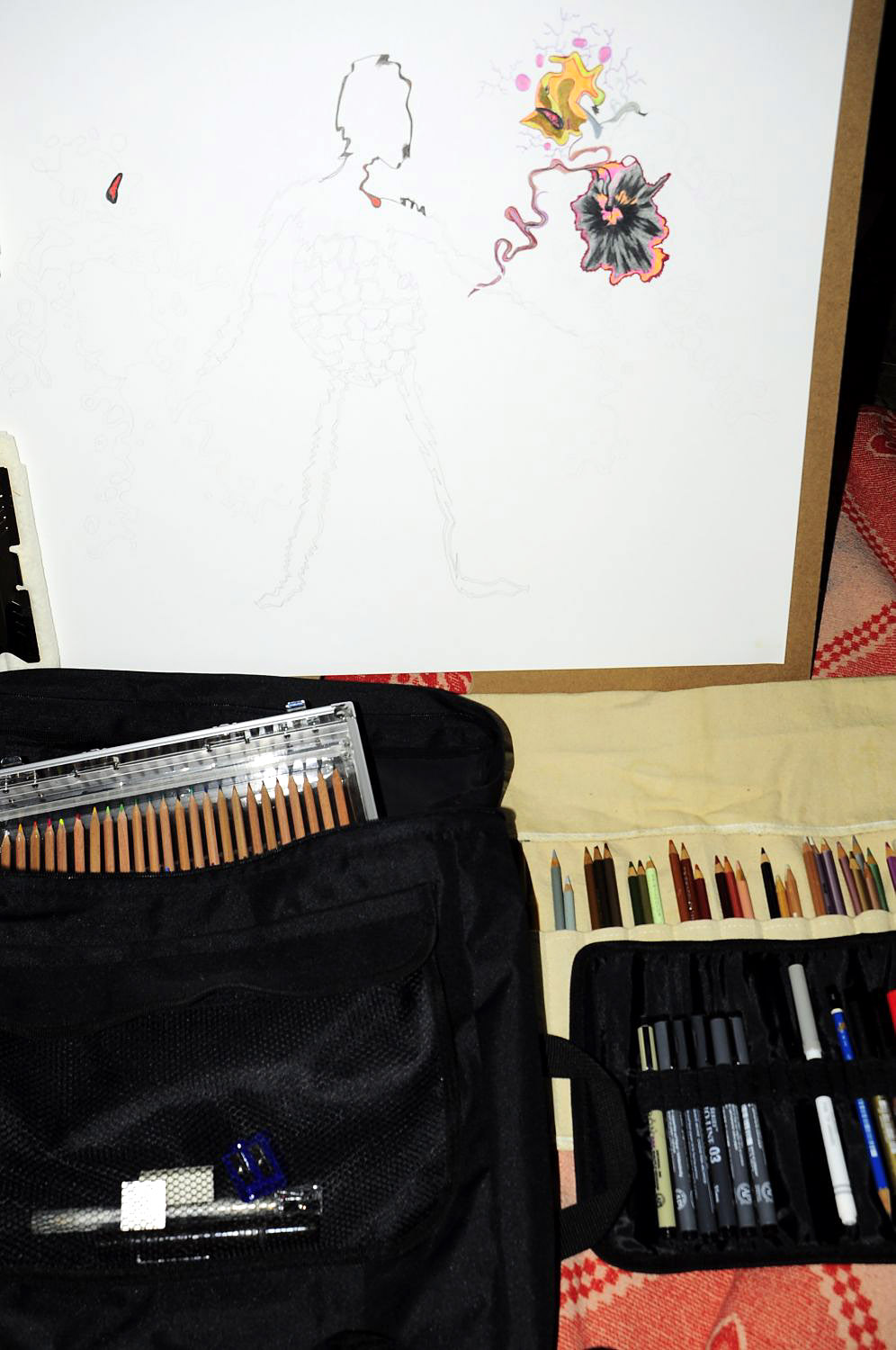
Getting stuff ready for all the hurry up and wait I have coming up. Besides, I’ve found if I’m in a waiting room, and start working, all of sudden, people want to do stuff on time. Kinda like magic, the highest annoyance factor always wins.
Mihai Marius Mihu has done a great job of creating Dante’s Nine Circles of Hell in Lego. Mihu did not immerse themselves in The Inferno for this project, limiting themselves to snippets about the circles, wanting their own take on it to dominate, and I think it’s a grand job. Lust is most impressive. I’m just going to post Gluttony here, because the red and black really attracted me, and you can have a wander through the other circles yourself, and also have a care if you curious sproggen trying to peek over your shoulder.

© Mihai Marius Mihu.

© Mihai Marius Mihu.
The Illustrations to Tales of Mystery and Imagination, by Edgar Allen Poe, by Harry Clarke, 1919. Click for full size.

There flashed upward a glow and glare.


A portrait of three herons, the one on the right holding an especially characteristic pose.
Text Translation:
[Of the heron] It is called heron, ardea, as if from ardua, meaning ‘high’, because of its capacity to fly high in the sky; it fears rain and flies above the clouds to avoid experiencing the storms they bring. A heron taking wing shows a storm is coming. Many people call the heron Tantalus, after the king who betrayed the secrets of the gods. Rabanus says on this subject: ‘This bird can signify the souls of the elect, who fear the disorder of this world, lest they be caught up by chance in the storms of persecution stirred up by the Devil, and raise their minds, reaching above all worldly things to the tranquility of their home in heaven, where the countenance of God is forever to be seen.
Although the heron seeks its food in water, nevertheless it builds its nest in woodland, in tall trees, as the righteous man, whose sustenance is uncertain and transitory, places his hope in splendid and exalted things. The soul of man sustained by transitory things, rejoices in the eternal. The heron tries with its beak to prevent its nestlings from being seized by other birds. So the righteous man lashes with his tongue those who, to his knowledge, are evilly inclined to deceive the gullible. Some herons are white, some grey, but both colours can be taken in a good sense, if white signifies purity, grey, penitence.
Folio 53v – the goose, continued. [De ardea] ; Of the heron.
The Illustrations to Tales of Mystery and Imagination, by Edgar Allen Poe, by Harry Clarke, 1919. Click for full size.

But, for many minutes, the heart beat on with a muffled sound.

Two aggressive geese in a roundel.
Text Translation:
[Of the goose] The goose marks the watches of the night by its constant cry. No other creature picks up the scent of man as it does. It was because of its noise, that the Gauls were detected when they ascended the Capitol. Rabanus says in this context: ‘The goose can signify men who are prudent and look out for their own safety.’ There are two kinds of geese, domestic and wild. Wild geese fly high, in a an orderly fashion, signifying those who, far away from earthly things, preserve a rule of virtuous conduct. Domestic geese live together in villages, they cackle together all the time and rend each other with their beaks; they signify those who, although they like conventual life, nevertheless find time to gossip and slander.
All wild geese are grey in colour; I have not seen any that were of mixed colour or white. But among domestic geese, there are not only grey but variegated and white ones. Wild geese are the colour of ashes, that is to say, those who keep apart from this world wear the modest garb of penitence. But those who live in towns or villages wear clothes that are more beautiful in colour. The goose, more than any other animal, picks up the scent of a someone happening by, as the discerning man knows of other men by their good or bad reputation, even though they live far away. When, therefore, a goose picks up the scent of a man approaching, it cackles endlessly at night, as when a discerning brother sees in others the negligence that comes with ignorance, it is his duty to call attention to it.
The cackling of geese on the Capitol once helped the Romans, and in our chapter-house daily, when the discerning brother sees evidence of negligence, his warning voice serves to repel the old enemy, the Devil. The cackling of the goose saved the city of Rome from enemy attack; the warning voice of the discerning brother guards the life of his community from disruption by the wicked. Divine providence would not, perhaps, have revealed to us the characteristics of birds, if it had not wanted the knowledge to be of some benefit to us.
Folio 53r – the nightingale, continued. [De ansere]; Of the goose.
From Charly: This is the knife I have given to my Mom for Christmas. Scary sharp – I could slice that tomato paper thin. Seems to hold edge well, it was already used since I made it and the edge was not touched up prior to photographing.
Measurements: Overall length ~26 cm, blade ~14 cm lenght, ~2 mm thick, blade grind convex with no secondary bevel.
Materials: handle scales chemically treated Elder wood (Sambucus nigra) coated with PU, blade N690 steel hardened at home in impromptu settings.
I hope to improve the design based on my mothers feedback and make more knives like this one in the future, it was fun. Beautiful! Click for full size.

© Charly, all rights reserved.
The Illustrations to Tales of Mystery and Imagination, by Edgar Allen Poe, by Harry Clarke, 1919. Click for full size.


“They swarmed upon me in ever-accumulating heaps.”