Bellicorum instrumentorum liber (1420).

Bellicorum instrumentorum liber,  Book of warfare devices, is a fascinating and absorbing inventor’s notebook. The title was bestowed by someone else, and it’s misleading as to the contents, which cover a very wide range of ideas.

Sometimes we try to invent something new by exploring within the bounds of what is known to be possible, and sometimes we invent by expanding those limits. For an imaginative engineer in the early fifteenth century — working more than two hundred years before the discoveries of Newton — the process of invention would be often a curious mix of the two. You would know so little about mechanical force that you could conjure up almost anything and believe it to be practical. Of course, attempts to bring the designs to reality would often fail, but they might, on occasion, also succeed.

Suppose for a moment that you were such a person possessing a talent for gadgets in the early fifteenth century, or an engineer hoping to build marvelous machines and clever structures no one else had yet dreamed of — how would you go about showing your talents? And what if you were someone who wanted to own wonderful and mysterious devices, such as a prince — how would you find the person who could make these things? A remarkable testimony to this meeting of engineering skill, technological ignorance, individual initiative, and public demand can be found in the Bavarian State Library, in the sketchbook of an Italian inventor of the early fifteenth century. It is a volume of sixty-eight drawings advertising the inventions that Johannes (or Giovanni) de Fontana (ca. 1395–1455), who was both the engineer and the artist, hoped to sell to patrons. Thought to have been created sometime between 1415 and 1420, the work has no title by Fontana that has survived, but a later owner gave it the title Bellicorum instrumentorum liber — the Book of Warfare Devices — despite the fact that most of it does not concern military matters.

This is an absorbing insight into thought, knowledge, and the desire to create, and you can see the whole thing here, or see selected bits along with text at The Public Domain.

Diabolus artificiosus, artificial devil.

Diabolus artificiosus, artificial devil.

Heilender Baum, Healing Tree.

Heilender Baum, Healing Tree.

Spleen, Gallbladder, Intestines.

Isidore sits on a chair, writing on a sloping desk the words '(ysid)oris (de) natu(ra) hominisI' Isidore, Concerning the Nature of Man.

Isidore sits on a chair, writing on a sloping desk the words ‘(ysid)oris (de) natu(ra) hominisI’ Isidore, Concerning the Nature of Man.

Text Translation:

The spleen, splen, gets its name from supplementum, because it fills up the part opposite the liver lest there should be an empty space; some reckon that it was created as a seat of laughter. For we laugh with the spleen, grow angry with the bile, discern with the heart and love with the liver; the whole animal is formed from these four elements in harmony.

The gall bladder, fel, is so called because it is a little bag holding the humour called bile, bilis. The gullet, stomachus, is called in Greek os because, as the door, ostium, of the belly it takes in food and sends it on to the intestines.

The intestines, intestina, are so called because they are contained in the inner, interior, part of the body. They are arranged in long coils, so that they are not obstructed by food that has been swallowed. The caul, omentum, is a skin containing the greater part of the intestines; the Greeks call it epiploon. The diaphragm, disceptum intestinum, is so called because it separates the belly and other intestines from the lungs and heart. The blind intestine, cecum, is so called because it lacks an opening or exit; the Greeks call it tiaonentipon [tuphlon enteron]. The thin intestine is calledieiuna; from it comes ieiunium, fast day. The belly, venter, the bowel, alvus, and the womb, uterus, differ from each other. The belly digests food that has been swallowed and is visible from outside; it extends from the breast to the groin. It is called venter because it conveys throughout the body the food of life.

The bowel is the part that receives the food and is regularly purged. Sallust: ‘Pretending that he purged his bowels’ (History, 1, 52). It is also called the bowel, alvus, because it is washed out, abluere, that is, purged. For from it flows out excremental filth.

Folio 89v – the parts of man’s body, continued.

Blood, Veins, Lungs, Liver.

Isidore sits on a chair, writing on a sloping desk the words '(ysid)oris (de) natu(ra) hominisI' Isidore, Concerning the Nature of Man.

Isidore sits on a chair, writing on a sloping desk the words ‘(ysid)oris (de) natu(ra) hominisI’ Isidore, Concerning the Nature of Man.

Text Translation:

The veins, vena, are so called because they are the channels, vie, of flowing blood and streams which are spread throughout the whole body, by which the members are supplied with blood. Blood, sanguis, gets its name from Greek etymology, because it is active, it survives and it has life. When it is in the body, it is called sanguis; when it pours forth, it is called gore, cruor. It is called cruor because when it is spilled, it runs down, decurrere; or because when it runs, it sinks into the ground, corruere. Others take cruor to mean corrupt blood which is discharged from the body. Others say blood is called sanguis because it is sweet, suavis. Except in young people, the blood supply does not remain constant. For physicians say that it diminishes with age, which is why old people have tremors. Strictly speaking, however, blood is a property of the soul. For this reason women tear their cheeks in grief, and we furnish the dead with purple clothing and purple flowers.

Isidore on the parts of man’s body. The lung, pulmo, gets its name from the Greek. The Greeks call the lung, pleumon, because it acts as a fan for the heart, in which the pneuma, that is, the spirit resides, by which they are both activated and set in motion; for this reason lungs too are called pulmones. In Greek the spirit is called pneuma; by inflating and activating, it sends out and takes in air, causing the lungs to move and throb, opening in order to catch a breath, contracting to expel it, for it is the organ of the body.

The liver, iecur gets its name because it is the seat of a fire which flies up to the brain. From there the fire is spread to the eyes and other senses and members of the body, and by its own heat, draws the moisture from food to itself and turns it into blood which supplies each part of the body with food and nourishment. Pleasure and lust reside in the liver, according to those who debate scientific matters. The extremities of the liver are filaments, fibre, like the outer parts of leaves on the vine or like projecting tongues. They are said to be so called because among pagans they were borne by soothsayers in religious rites to altars of Phoebus, so that when they had been offered up and burned, the soothsayers would receive answers.

Folio 89r – the nature of man, continued. Ysidorus de membris hominis; Isidorus on the parts of man’s body.

Isidorus On The Nature Of Man.

Isidore sits on a chair, writing on a sloping desk the words '(ysid)oris (de) natu(ra) hominisI' Isidore, Concerning the Nature of Man.

Isidore sits on a chair, writing on a sloping desk the words ‘(ysid)oris (de) natu(ra) hominisI’ Isidore, Concerning the Nature of Man.

Text Translation:

Isidorus on the nature of man Nature, natura, is so called because it brings a thing to birth, nasci, for it has the power to beget and to form. Some have said that nature is God, by whom all things are created and exist. Race, genus, comes from gignere, to generate; this derives from the word for ‘earth’, from which all things spring. For the Greek word for ‘earth’ is ge. Life, vita, is so called from vigor, ‘active power’, or because it has within it the force of birth and growth. As a result, trees are said to have life, because they spring from the earth and grow. Man, homo, is so called because he is made from the soil, humus, as it says in the book of Genesis: ‘And the Lord God formed man of the dust of the ground’ (2:7). It is said incorrectly that man in his entirety is formed from two substances, that is, from the union of a soul and a body. Strictly speaking, man, homo, comes from soil, humus. The Greek word for man is antropos [anthropos], because he looks upwards, raised up from the ground to contemplate his creator. This is what the poet Ovid means, when he says: ‘And though other animals are prone and fix their gaze upon the earth, he gave to man an uplifted face and bade him look at heaven and raise his countenance to the stars.’ (Metamorphoses, 1, 84-6). Standing erect, he looks at the heavens in search of God; he does not turn towards the ground, like the beasts who have been fashioned by nature and obedience to their appetite to bend their heads. But man is twofold: inner and outer.

[Read more…]

Trees.

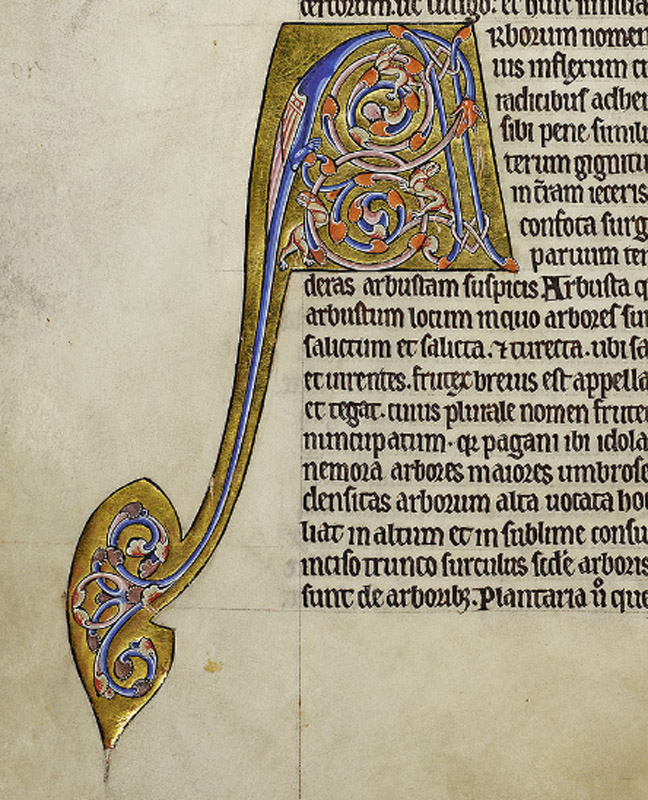
The major initial 'A', type 3, marks the start of the section on trees and plants. The stem of the letter is formed by a sweeping dragon's tail.

The major initial ‘A’, type 3, marks the start of the section on trees and plants. The stem of the letter is formed by a sweeping dragon’s tail.

Another very long entry.

Text Translation:

Of trees. The word for trees, arbores, and grasses, herbe, is believed to come from arva, a field, because they adhere to the earth with their roots which lie fast within it. The two words are almost the same, because one springs from the other. For when you throw a seed into the earth, first a grass shoot rises. Thereafter, with nourishment, it grows into a tree and within a short time, from looking down at shoot of grass you are looking up at a sapling.

[Read more…]

Here begins the account of fish.

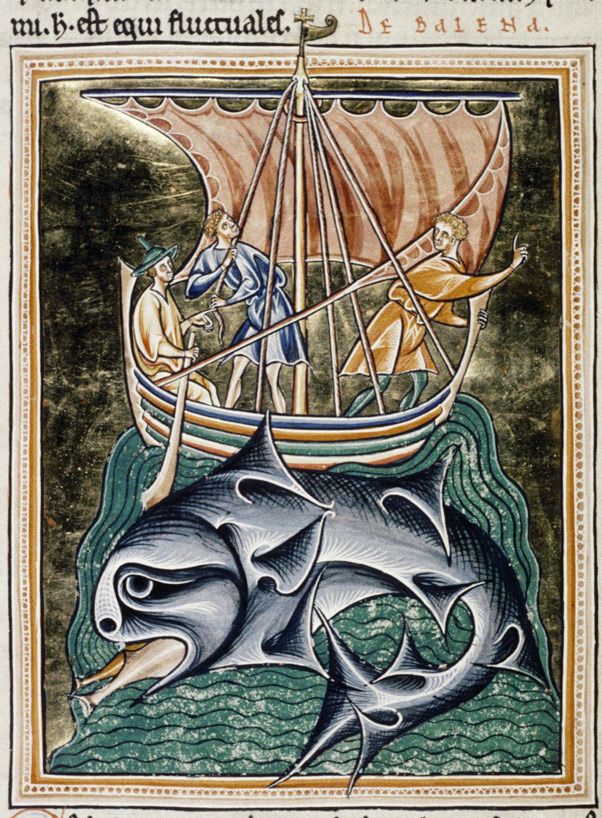
Major initial 'P', type 3, marks the start of fish. 'V' in margin is colour indicator for dark pink. A page is missing after f.72v which should contain the end of fish and the start of whale. The Ashmole Bestiary has a fine picture of a whale in this location (f. 86v).

Major initial ‘P’, type 3, marks the start of fish. ‘V’ in margin is colour indicator for dark pink. A page is missing after f.72v which should contain the end of fish and the start of whale. The Ashmole Bestiary has a fine picture of a whale in this location (f. 86v).

Whale, Ashmole Bestiary.

Whale, Ashmole Bestiary.

This is an incredibly long entry, with a great deal of misinformation.

Text Translation:

Here begins the account of fish. Fish, pisces, get their name, like cattle, pecus, from the word for grazing, namely, pascere. They are called reptiles because, when they swim, they have the appearance and manner of crawling. Although they can dive deep, nevertheless they crawl as they swim. On this subject David says: ‘So is this great and wide sea, wherein are things creeping innumerable’ (Psalms, 104: 25)

[Read more…]

Here begins the account of worms.

The next section of creatures, basically insects, otherwise called worms, is heralded by the major initial letter, type 3.

The next section of creatures, basically insects, otherwise called worms, is heralded by the major initial letter, type 3.

Text Translation:

Here begins the account of worms. The worm is a creature which generally springs from flesh, or wood or some other earthly material, but not as the result of intercourse, although occasionally they are hatched from eggs, like the scorpion.

There are worms that live in earth or in water, in air, in flesh, in leaves or in wood, or in clothes. The spider, aranea, is a worm of the air, and gets its name from the fact that it lives on air; it draws out long threads from its small body, and devotes itself continually to spinning its web, never ceasing to toil, constantly suffering loss in its art.

[Read more…]

Of The Nature Of Snakes.

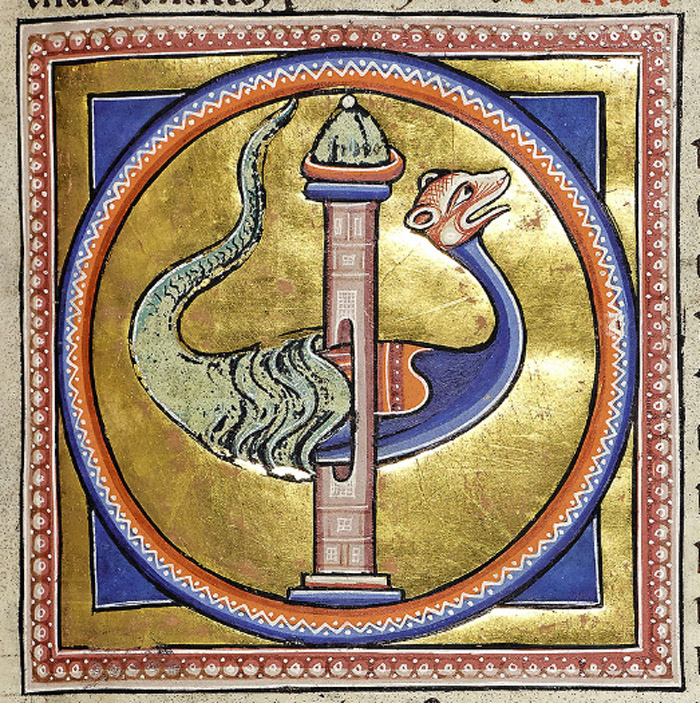
The snake squeezes through a slot in a narrow tower. The straightforward snake is nonethless shown with wings. Although the text says the snake goes through a rima (crack) in a rock, most of the second family of Bestiaries show the snake going through a masonry tower. This image appeared due to a misreading of the word rima for ruina (ruin).

The snake squeezes through a slot in a narrow tower. The straightforward snake is nonethless shown with wings. Although the text says the snake goes through a rima (crack) in a rock, most of the second family of Bestiaries show the snake going through a masonry tower. This image appeared due to a misreading of the word rima for ruina (ruin).

Text Translation:

Of the nature of snakes. The snake has three characteristics. The first of these is that when it grows old, its eyes grow dim; if it wants to regain its youth, it fasts for many days until its skin grows loose; then it seeks out a narrow crack in a rock, enters it, and scrapes through, sloughing off its old skin. Let us, too, through much affliction and abstinence in Christ’s name, slough off our former self and garb, and seek Christ, the spiritual rock, and the narrow crack, that is ‘the strait gate’ (Matthew, 7:13).

The snake’s second characteristic is this: when it comes to a river to drink water, it does not bring its venom with it, but discharges it into a pit. When we come together in church, drinking in the living, eternal water, to hear God’s heavenly word, we too should get rid of our venom, that is, earthly and evil desires.

The snake’s third characteristic is this: if it sees a naked man, it fears him; if it sees him clothed, it attacks him. In the same way, we are to understand in spiritual terms, that for as long as Adam, the first man, was naked in Paradise, the serpent was unable to attack him; but after he was clothed, that is, in mortal flesh, then the serpent assaulted him. If you are clad in mortal clothes, that is, in your former self, and if you have grown old in evil days, the serpent attacks you. If, however, you divest yourself of the robes of princes and of the power of the darkness of this world, then the serpent, that is, the Devil, cannot attack you.

The snake, at the onset of blindness, wards it off by eating fennel. Thus, when it feels its eyes growing dim, it has recourse to remedies it knows, knowing that it can rely on their effect. The tortoise, when it feeds on the snake’s entrails and becomes aware of the venom spreading through its own body, cures itself with oregano. If a snake tastes the spittle of a fasting man, it dies.

Pliny says:It is believed that if the head of a snake escapes, even if only two fingers’ length of the body is attached, it continues to live. For this reason it places its whole body in the way to protect its head against its assailants. All snakes suffer from poor sight; they can rarely see what is in front of them. This is not without reason, since their eyes are not at the front but in the temples of the head, so that they hear better than they see. No creature moves its tongue as swiftly as the snake, to such an extent that it seems to have a triple tongue, when in fact there is only one.

The bodies of snakes are moist, so that wherever they go, they mark their path with moisture. The tracks of snakes are such that, since they seem to lack feet, they crawl using their flanks and the pressure of their scales, which are laid out in the same pattern from the throat to the lowest part of the belly. For they support themselves on their scales as if on claws, and on their flanks as if on legs. As a result, if a snake is struck on any part of the body, from the belly to the head, it is disabled and cannot get away quickly, because where the blow falls, it dislocates the spine, through which the foot-like movement of the flanks and the motion of the body are activated.

Snakes are said to live for a long time, to such an extent that it also claimed that when they shed their old skins, they shed their old age and regain their youth. The snake’s skin is called exuvie, because they shed it, exuere, when they grow old. We refer to clothing as both exuvie and induvie because it is both taken off, exuere, and put on, induere.

Pythagoras says that the snake is created from the marrow of dead men, which is to be found in the spine. Ovid has the same point in mind in the Metamorphoses, when he says: ‘There are those who believe that when the spine has rotted in the grave, the human marrow changes into a snake’. This, if it can be believed, has a certain justice, for as the snake brings about the death of man, so it is created by the death of man.

Folio 71r – the newt, continued. De natura serpentium; Of the nature of snakes.

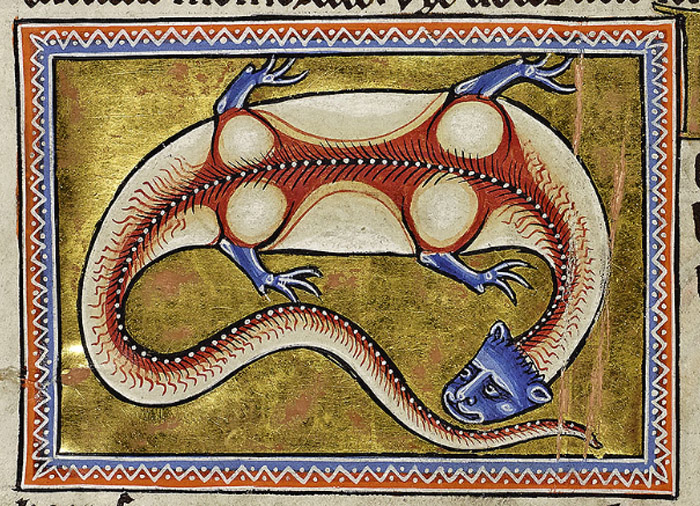
Salamander, Saura, Newt.

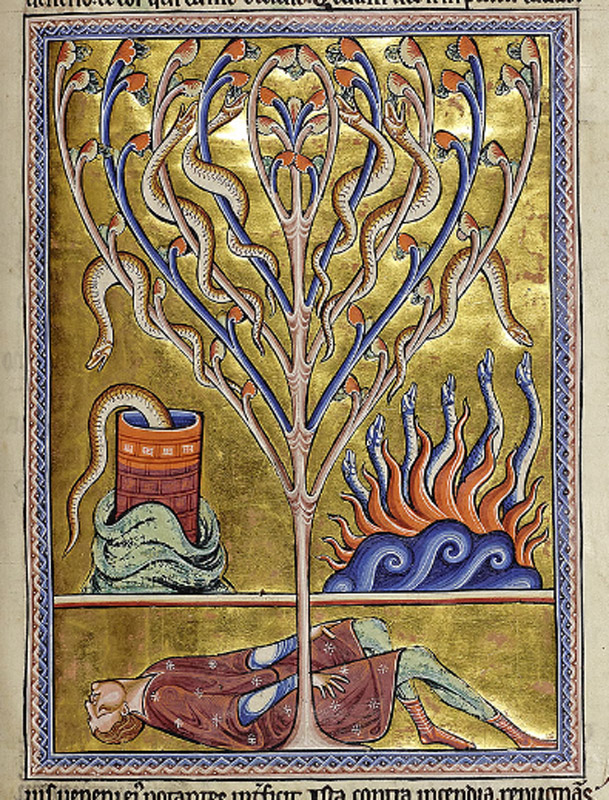
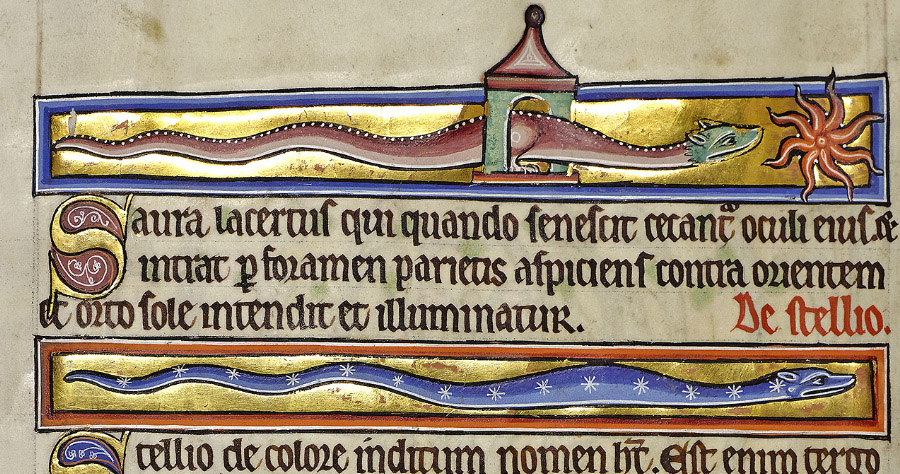
The tree writhes with salamanders; a salamander poisons a well; salamanders leap from flames; a man lies poisoned at the foot of the tree. The image of a man lying dead at the foot of a tree relates to the Tree of Jesse iconography. Above him a salamander plunges into a tub, an episode illustrated in Bern 318 f. 14v. The other salamanders are poisoning fruit in a tree and surviving in a fire. In certain conditions a bonfire can appear to be releasing live, red, wriggling snakes when the wood is damp and the flying sparks carry long red tails. The saura goes blind, enters a crack in the wall, faces the sun and regains its sight. The stellio or newt has spots over his body.

The tree writhes with salamanders; a salamander poisons a well; salamanders leap from flames; a man lies poisoned at the foot of the tree. The image of a man lying dead at the foot of a tree relates to the Tree of Jesse iconography. Above him a salamander plunges into a tub, an episode illustrated in Bern 318 f. 14v. The other salamanders are poisoning fruit in a tree and surviving in a fire. In certain conditions a bonfire can appear to be releasing live, red, wriggling snakes when the wood is damp and the flying sparks carry long red tails.
The saura goes blind, enters a crack in the wall, faces the sun and regains its sight. The stellio or newt has spots over his body.

The tree writhes with salamanders; a salamander poisons a well; salamanders leap from flames; a man lies poisoned at the foot of the tree. The image of a man lying dead at the foot of a tree relates to the Tree of Jesse iconography. Above him a salamander plunges into a tub, an episode illustrated in Bern 318 f. 14v. The other salamanders are poisoning fruit in a tree and surviving in a fire. In certain conditions a bonfire can appear to be releasing live, red, wriggling snakes when the wood is damp and the flying sparks carry long red tails. The saura goes blind, enters a crack in the wall, faces the sun and regains its sight. The stellio or newt has spots over his body.

The tree writhes with salamanders; a salamander poisons a well; salamanders leap from flames; a man lies poisoned at the foot of the tree. The image of a man lying dead at the foot of a tree relates to the Tree of Jesse iconography. Above him a salamander plunges into a tub, an episode illustrated in Bern 318 f. 14v. The other salamanders are poisoning fruit in a tree and surviving in a fire. In certain conditions a bonfire can appear to be releasing live, red, wriggling snakes when the wood is damp and the flying sparks carry long red tails.
The saura goes blind, enters a crack in the wall, faces the sun and regains its sight. The stellio or newt has spots over his body.

Text Translation:

Of the salamander The salamander is so called because it is proof against fire. Of all poisonous creatures, it has the strongest poison. Other poisonous creatures kill one at a time; it can kill several things at the same time. For if it has crawled into a tree, it poisons all the apples and kills those who eat them. In addition, if it falls into a well, the strength of its poison kills those who drink the water. It resists fire and alone among creatures can put fires out. For it can exist in the midst of flames without pain and without being consumed by them, not only because it does not burn but because it puts the fire out.

Of the snake called the saura The saura is a lizard which goes blind when it grows old; it enters a crack in a wall and, looking toward the east, it bends its gaze on the rising sun and regains its sight. Of the newt The newt, stellio, gets its name from its colouring. For it is adorned on its back with shining spots like stars, stella. Ovid says of it: ‘Its name fits its colour; it is starred on the body with spots of various colours’ (see Ovid, Metamorphoses, 5, 461). It is said to be so hostile to scorpions, that the sight of it paralyses them with fear. There are other species of snakes, like the admodite, elephantia, camedracontes. Finally, it can be said that snakes inflict as many kinds of death as they have names.

All snakes are cold by nature; they will only strike you when their body warms up. For as long as it is cold, they will touch no-one. As a result, their poison is more harmful by day than by night. For they become sluggish in the cold of the night; and rightly so, because they grow cold in the night-time dew. For the deathly cold and freezing weather draw off the warmth of the body. Thus in winter they lie inactive in their nests; in summer, they grow lively again. So, if you are struck by a snake’s poison, you are numbed at first; then, when the venom warms up and begins to burn, it kills you at once. Their poison is called ‘venom’, venenum, because it spreads through your veins. For when its deathly effect is introduced, it courses in every direction through the veins, increased by the quickening of the body, and drives out life. As a result, poison cannot hurt unless it infects your blood. Lucan says: ‘The poison of snakes is only deadly when mixed with the blood’ (Pharsalia, 9, 614). All poison is cold; as a result, the soul, which is by nature hot, flees from the poison’s icy touch. In terms of the natural qualities which we observe that we, reasoning beings, share with animals, who have no capacity for reason, the serpent stands out by virtue of its lively intelligence. On this subject, it says in Genesis: ‘Now the serpent was more subtle than any beast of the field’ (3:1).

Folio 70r – the salamander, continued. De saura serpente; Of the serpent called the saura.

Cancer Chronicles 7: Shock & Silences.

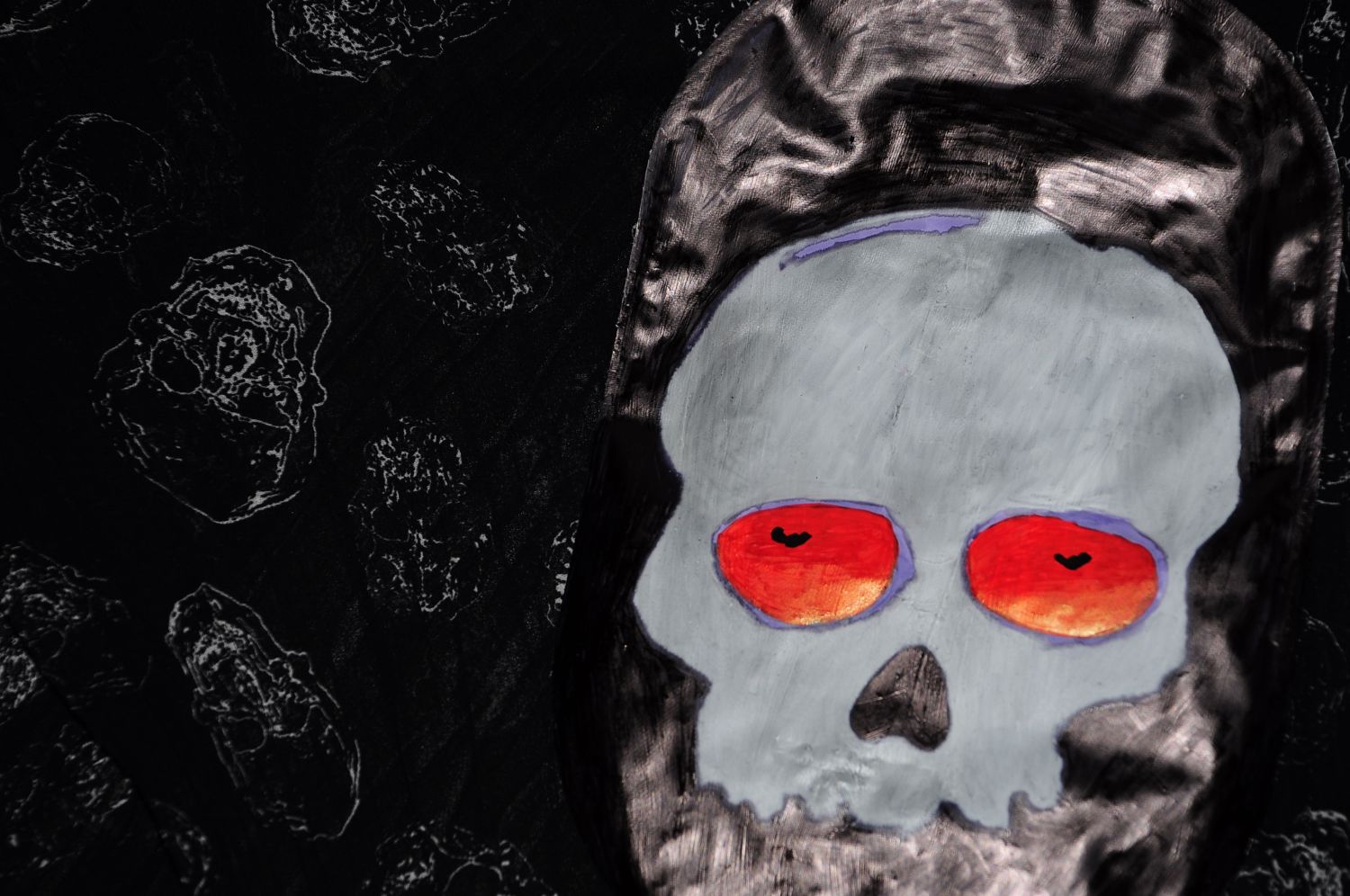
The first day of chemo outfit: shirt with skulls, bag to match. The rest: black jeans, knee high Doc Martens lace ups.

The first day of chemo outfit: shirt with skulls, bag to match. The rest: black jeans, knee high Doc Martens lace ups, bright red hooded coat.

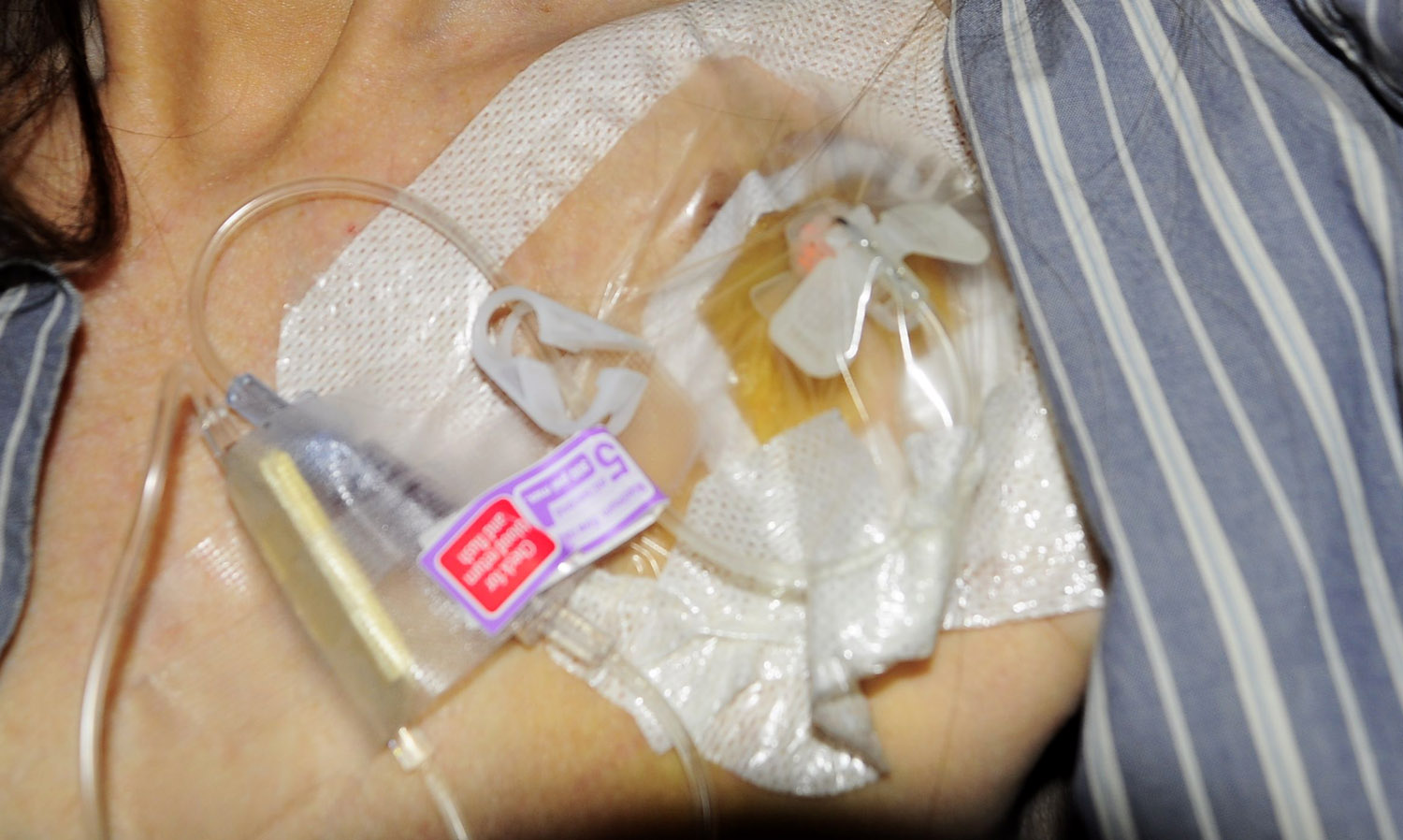
What your port looks like in use.

What your port looks like in use.

That is the giant pump which has to be attached to my port for two days. It’s 6″ in length and 7″ in diameter. They need to hire some people from Intel, it would miniaturized in no time. Has to be above the waist at all times. The other stuff is what I need to flush the port after disengaging the pump.

Cancer. The shock of it all didn’t set in until this past Monday (22nd). That’s when I felt like I was going to fall apart, and it was hard to keep tears at bay. My oncologist asked me if I wanted to start chemo this week or next; I replied “now is best, because I’m at the point of running away and not coming back.” Doc thought I was joking, but I wasn’t. I really wanted to run. So, yesterday was my first chemo day. My schedule will at least be less hectic for a while, and I’m grateful for that one.

Before I talk about the chemo, I want to briefly address reactions to CANCER. There will be a fair amount of people who you thought would have at least given you a “oh, that sucks”, but instead, don’t acknowledge the CANCER or you, in any way at all. If you’re newly diagnosed, don’t be surprised by that. A lot of people simply will not acknowledge or address the issue. There are other unexpected reactions too. Yesterday, stopped by my pharmacy to pick up Dexamethasone, and one of my pharmacists started crying when she found out I had cancer. That made me crumple up inside, and I felt awful for making her feel awful. For the most part, supportive friends and family are right there for you, and you can get to know your fellow travelers in treatment, too.

Okay, chemo. In my hospital, the chemo suite is called The Infusion Center. Long room, more like a very large, central hall, lined with individual stations. Each station has a comfortable recliner, a chair side table, IV stand to one side, and an overhead, swivel mount television with earphones. There’s a stack of extra chairs for whoever you bring with you. You go in, sit down, sign a bunch of forms, and repeat your surname and birth date for the zillionth fucking time. I’m seriously contemplating giving my birthdate as Fall 1529. I don’t think medical would be amused. Every single person you talk to, “okay, give me your name and birth date”. I know they don’t want to make mistakes, but fuck me, I’m beyond tired of it. Being a smart-ass helps, which is why I went with a skull theme. It was mostly appreciated by med staff. ETA: my infusion center comes with a nurse who never shuts up. (I was seated across from the nurses station.) Headphones and your choice of at least 4 hours of music: a very good thing.

I got all the lectures about Oxaliplatin, in particular, the cold sensitivity and possibility of peripheral neuropathy.  So far, I seem to have escaped those effects, but it’s early days yet. I have not come close to drinking as much fluid as I have been instructed to do, and I’m still pissing like an overhydrated horse. Which reminds me, forgot to get Kool-Aid. There’s only so much apple juice a person can take.

After chemo, I was feeling starved, so we ate, then we had to do a bit of shopping. I was feeling okay enough to do that, but having that giant capsule swinging about was a right pain in the arse. I was a bit antsy because I had not remembered to take my immodium with me, and while I didn’t really have that “ohgodsfuck diarrhea” sensation, I did have a weird one, which could be best described as the tumour playing at being Jack Nicholson axing his way through the door in The Shining. Just a vague sort of terror that the tumour might do something utterly mortifying while in public. So, remember to pack all the little stuff if you’re going to be out and about after chemo.

Going home, I could not keep my eyes open. I stumbled into the house, managed to shed clothes, and fall on the bed, got the giant capsule tucked under the pillow, and was out like a light for several hours. Woke up, ate too many fudge brownies, went back to bed, read Book of the Night by Oliver Pötzsch, a wonderfully fun book, went back to sleep. Biggest effects so far: crampy, tired, acid reflux and really sore leg muscles for some reason. That set in rather early in the infusion center. Other than that, okay. I’ll be right happy to get rid of this damn capsule on Friday, seriously bad design flourishes in the medical industry. Initially, they wanted me back on Friday to have the pump removed, but when we told them that was not convenient, I got instructions to do it all myself.

Still have the nasty butt pain, and can’t go unmedicated for very long, which is on the annoying side, but I’ll live. Hahaha. I feel another nap coming on…

ETA: Food. Stock up on frozen foods, and easy to prepare stuff, like cottage cheese with fruit or veg. Have things like chicken salad prepared, and bread in the house. If someone loves you to pieces and can cook, have them do up some casseroles for you. The easier it is to eat, the more likely it is you’ll actually do that. You’re much more likely to decide eating is not so important if you wander into the kitchen, and decide you really don’t want to be cooking. Also, stock up on all the ‘bad for ya’ stuff: ice cream, brownies, muffins, cup cakes, banana bread, what have you. If you have colon cancer, by the time you get to radiation, they’ll tell you to do a low fiber diet, which is basically all the stuff which is typically considered bad: white breads, pancakes, pasta, butter, cream, cheese, and so on. Having plenty of goodies around is a way to easily pig out when you’re feeling like it.

Siren, Seps, Lizard.

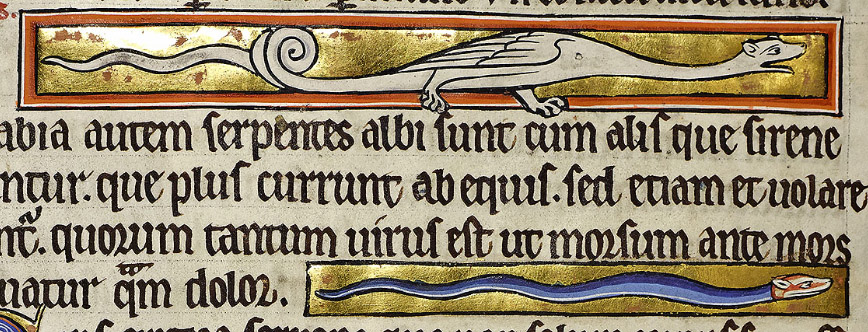
The speedy siren is at the top of the page. The small seps is seen in profile. The lizard has legs as well as arms.

The speedy siren is at the top of the page. The small seps is seen in profile. The lizard has legs as well as arms.

The speedy siren is at the top of the page. The small seps is seen in profile. The lizard has legs as well as arms.

The speedy siren is at the top of the page. The small seps is seen in profile. The lizard has legs as well as arms.

Text Translation:

Of sirens. In Arabia there are white snakes, with wings, called sirens, which cover the ground faster than horses, but are also said to fly. Their is poison is so strong that if you are bitten by it you die before you feel the pain.

[Of the seps] The seps is a small snake which consumes with its poison not just the body but the bones. The poet refers to it as: ‘The deadly seps, that destroys the bones with the body’ (Lucan, Pharsalia, 9, 723).

[Of the dipsa] The dipsa is a snake which is said to be so small that you tread on it without seeing it. Its poison kills you before you feel it, with the result that the face of anyone dying in this way shows no sadness from the anticipation of death. The poet says of it: ‘So Aulus, a standard-bearer of Etruscan blood, trod on a dipsa, and it drew back its head and bit him. He had hardly any pain or feeling of the bite’ (Lucan, Pharsalia, 9, 737).

Of the lizard. The lizard is called a kind of reptile, because it has arms. There are many kinds of lizards, such as the botrax, the salamander, the saura and the newt. The botruca is so called because it has the face of a frog and the Greek word for ‘frog’ is botruca.

Folio 69v – the iaculus, continued. De sirenis; Of sirens. [De sepe]; Of the seps. [De dipsade]; Of the dipsa. De lacerto; Of the lizard. De salamandra; Of the salamander.