The Healing Arts: Macassar Oil, An oily Puff for Soft Heads.

This is the oil which birthed Antimacassars. My great-grandmothers and grandmother had antimacassars on everything. Click for full size!

Macassar Oil, An oily Puff for Soft Heads. Thomas Rowlandson, Etching coloured, 1814. Subject: Macassar Oil, Rowland's Oil,Alexander Rowland,baldness,hair Tonic, Hair Oil,Proprietary Medicines.

Macassar Oil, An oily Puff for Soft Heads. Thomas Rowlandson, Etching coloured, 1814. Subject: Macassar Oil, Rowland’s Oil,Alexander Rowland,baldness,hair Tonic, Hair Oil,Proprietary Medicines.

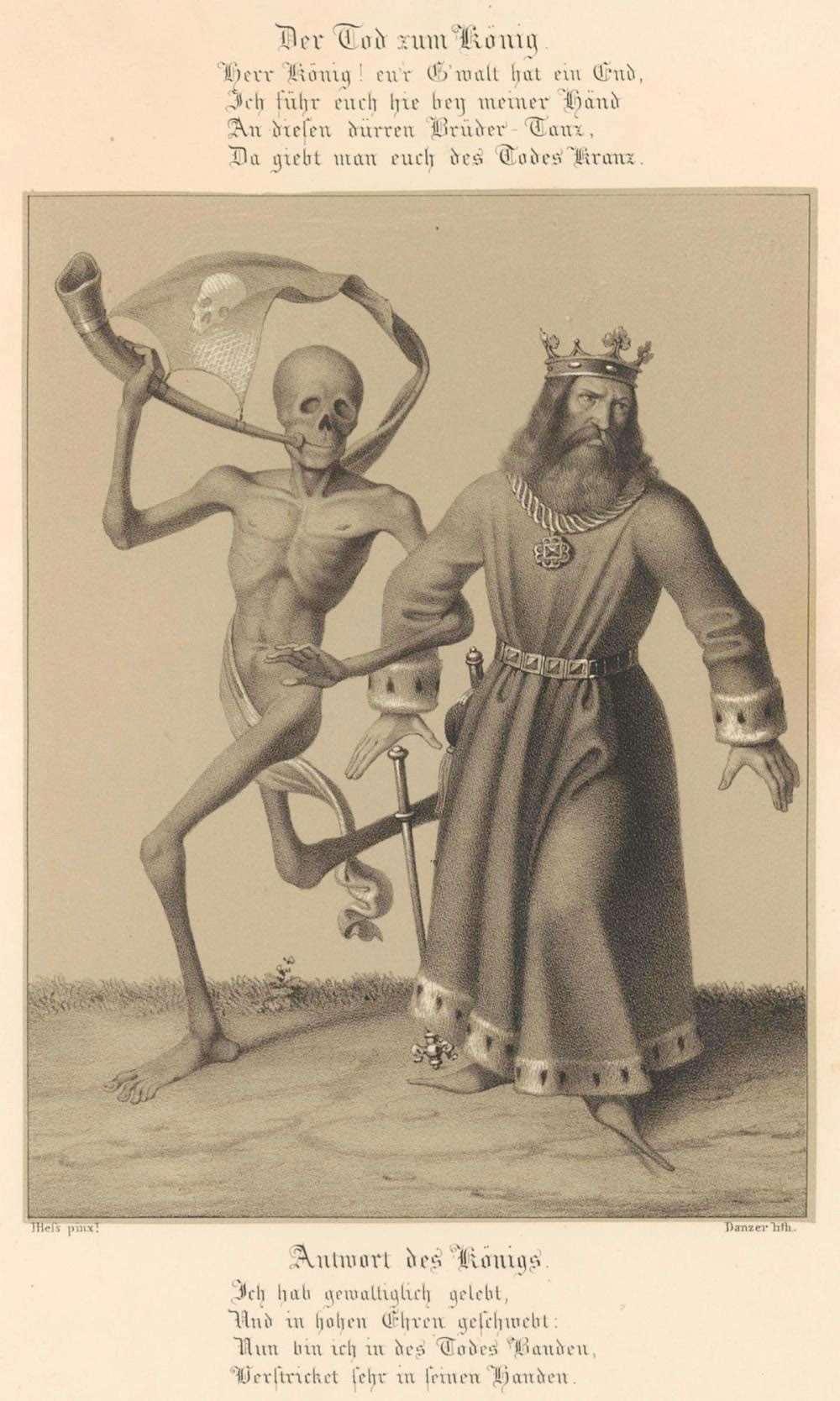
Dance Of Death: Emperor and Empress.

If you missed the beginning, it’s here. Click for full size. ETA: I’ve found translations, but I’m not sure as to their reliability.

Emperor.

Emperor.

Todt zum Keyser:
HErr Keyser mit dem grawen Bart,
Euwr Reuw habt ihr zu lang gespart,
Drumb sperrt euch nicht, Ihr müßt darvon,
Und tantz’n nach meiner Pfeiffen thon.

Death to The Emperor:
Mr. Emperor with the gray beard,
You have long saved your repentance.
Therefore, do not struggle, you must from here
and dance after my fife’s tone.

Der Keyser.
Ich kundte das Reich gar wol mehren
Mit Streitten, Fechten, Unrecht wehren:
Nun hat der Todt uberwunden mich,
Daß ich bin keinem Keyser gleich.

The Emperor.
I was able to increase the kingdom considerably,
with war and fight prevented injustice.
Now Death has won over me,
so that I’m not [any longer] like an emperor.

Empress.

Empress.

Todt zur Keyserin:
ICh tantz euch vor Fraw Keyserin,
Springen hernach, der tantz ist mein:
Euwr Hofleut sind von Euch gewichen,
Der Todt hat euch hie auch erschlichen.

Death to The Empress:
I dance beforeyou, Mrs. Empress,
Dance after, the dance is mine.
Your courtiers have left you,
Death has here sneaked up on you too.

Die Keyserin:
VIel Wollüst hat mein stoltzer Leib,
Ich lebt alß eines Keysers Weib:
Nun muß ich an diesen Tantz kommen,
Mir ist all Muth und Frewd genommen.

The empress:
My proud body had much pleasure.
I lived as an emperor’s wife.
Now I must come to this dance.
All spirits and joy have been taken from me.

Life Is Not A Ringing Bell.

From rq, a most beautiful art work: So out of that comment conversation earlier this morning/today, I made some art that looks completely unrelated but came out of the emotions. Also it is called “Life is Not a Ringing Bell” and I have decided to dedicate it to Rick. Such a beautiful piece, filled with quiet emotion and love. Life is not ringing a bell, but it is having a partner who loves you enough to nag you into doing what you should, and having a friend who can express that so well. Thank you is so very inadequate. Click for full size.

© rq, all rights reserved.

The Healing Arts: Medical Report of the Walcheren Expedition.

Click for full size.

The Winding Up of the Medical Report of the Walcheren Expedition. Thomas Rowlandson, Etching coloured, 1810. Subject: Lucas Pepys (1742-1830), Robert Jackson (1750-1827), Thomas Keate (1745-1821), Dr. James' Fever Powder, Chelsea Hospital, Walcheren Campaign, Military Medicine, Medical Boards, Drugs.

The Winding Up of the Medical Report of the Walcheren Expedition. Thomas Rowlandson, Etching coloured, 1810. Subject: Lucas Pepys (1742-1830), Robert Jackson (1750-1827), Thomas Keate (1745-1821), Dr. James’ Fever Powder, Chelsea Hospital, Walcheren Campaign, Military Medicine, Medical Boards, Drugs.

Walcheren Campaign:

The Walcheren Campaign involved little fighting, but heavy losses from the sickness popularly dubbed “Walcheren Fever”. Although more than 4,000 British troops died during the expedition, only 106 died in combat; the survivors withdrew on 9 December. […] Along with the 4,000 men that had died during the campaign, almost 12,000 were still ill by February 1810 and many others remained permanently weakened. Those sent to the Peninsular War to join Wellington’s army caused a permanent doubling of the sick lists there.

As for ‘Look Ass Peeps’ (Lucas Pepys):

In 1794 Pepys was made physician-general to the army, and was president of an army medical board, on which it was his duty to nominate all the army physicians. When so many soldiers fell ill of fever at Walcheren, he was ordered to go there and report. As a consequence the board was abolished; but Pepys was granted a pension.

Dance of Death: The Ossuary and The Pope.

I got right distracted today while working on the Healing Arts posts, distracted right into the amazing world of The Dance Of Death. There’s a large body of work by different artists devoted to this particular aspect of death, and they widely range in style, to say the very least. All of the art work is very beautiful, and is often poignant, witty, and sly. The main message being that death is no respecter of persons.

So this will be a sort of companion series to the Healing Arts. I’m going to start with Basel’s Dance of Death by Hieronymus Hess (1799-1850). These are based on copies of a mural which was done around around 1435-1441. The wall with the original mural was lost long ago, in 1804. Some fragments survive and are housed in a museum. We open with The Ossuary and Death’s first conquest, The Pope. Death looks positively gleeful walking off with the pope.  I’m quite enchanted with Hess’s portrayal of Death as a mostly fleshed character who must maintain modesty when it comes to the private bits. Death also changes gender in Hess’s portrayals, and there are obvious character shifts in Death, dependent on just who is being claimed. In The Pope, it almost looks as if Death were wearing a skull mask.

The Ossuary. Click for full size.

The Ossuary. Click for full size.

Death and the Pope. Click for full size.

Death and the Pope. Click for full size.

The Bakemono Zukushi “Monster” Scroll.

Rokurokubi (ろくろくび), a long-necked woman is pictured next to an Inugami (犬神) dog spirit.

Rokurokubi (ろくろくび), a long-necked woman is pictured next to an Inugami (犬神) dog spirit.

These wonderful images featured here are from a Japanese painted scroll known as the Bakemono zukushi. The artist and date is unknown, though its thought to hail from the Edo-period, sometime from the 18th or 19th century. Across it’s length are depicted a ghoulish array of “yokai” from Japanese folklore. […]

The class of yokai characterised by an ability to shapeshift, and that featured in this scroll, is the bakemono (or obake), a word literally meaning “changing thing” or “thing that changes”. The founding father of minzokugaku (Japanese folklore studies), Yanagita Kuno (1875–1962), drew a distinction between yurei (ghosts) and bakemono: the former haunt people and are associated with the depth of night, whereas the latter haunt places and are seen by the dim light of dusk or dawn.

Amongst the bakemono monsters depicted in the scroll is the rokurokubi (ろくろくび), a long-necked woman whose name literally means “pulley neck”. Whether shown with a completely detachable head (more common in Chinese versions), or with head upon the end of a long threadlike neck as shown here, the head of the rokurokubi has the ability to fly about independently of the body. In his 1904 collection Kwaidan, Lafcadio Hearn provides the first extended discussion of this yokai in English, telling of a samurai-turned-travelling-priest who finds himself staying the night in a household of rokurokubi intent on eating their guest.

Daichiuchi (大地打) is a mallet-wielding monster with a bird-like face.

Daichiuchi (大地打) is a mallet-wielding monster with a bird-like face.

Fascinating monsters all, and you can see and read much more at The Public Domain Review.

This Black Cloud Called Trump.

Brenda Goodman, “Impending” (2018), oil on wood, 80 x 72 in (courtesy of the artist). © Brenda Goodman.

Brenda Goodman, “Impending” (2018), oil on wood, 80 x 72 in (courtesy of the artist). © Brenda Goodman.

Fifteen months ago, Trump was just beginning to embrace his new position of power but now he’s well into the dismantling of our democracy. My emotions are whipped around all day long. Mothers are torn away from their babies at the border. Families living good, productive lives here are sent back to “where they came from” — a place some of them hardly know. The reversal of all that Obama put in place to protect our environment. The destruction of an educational system that was once the best in the world. The attack on our press, which is treated like an enemy. Taking away our rights as he edges closer and closer to a dictatorship. And the lies. The constant lies. So that we can hardly find truth anymore. So many gut-wrenching changes.

I have nothing to add here. You can read more at Hyperallergic.

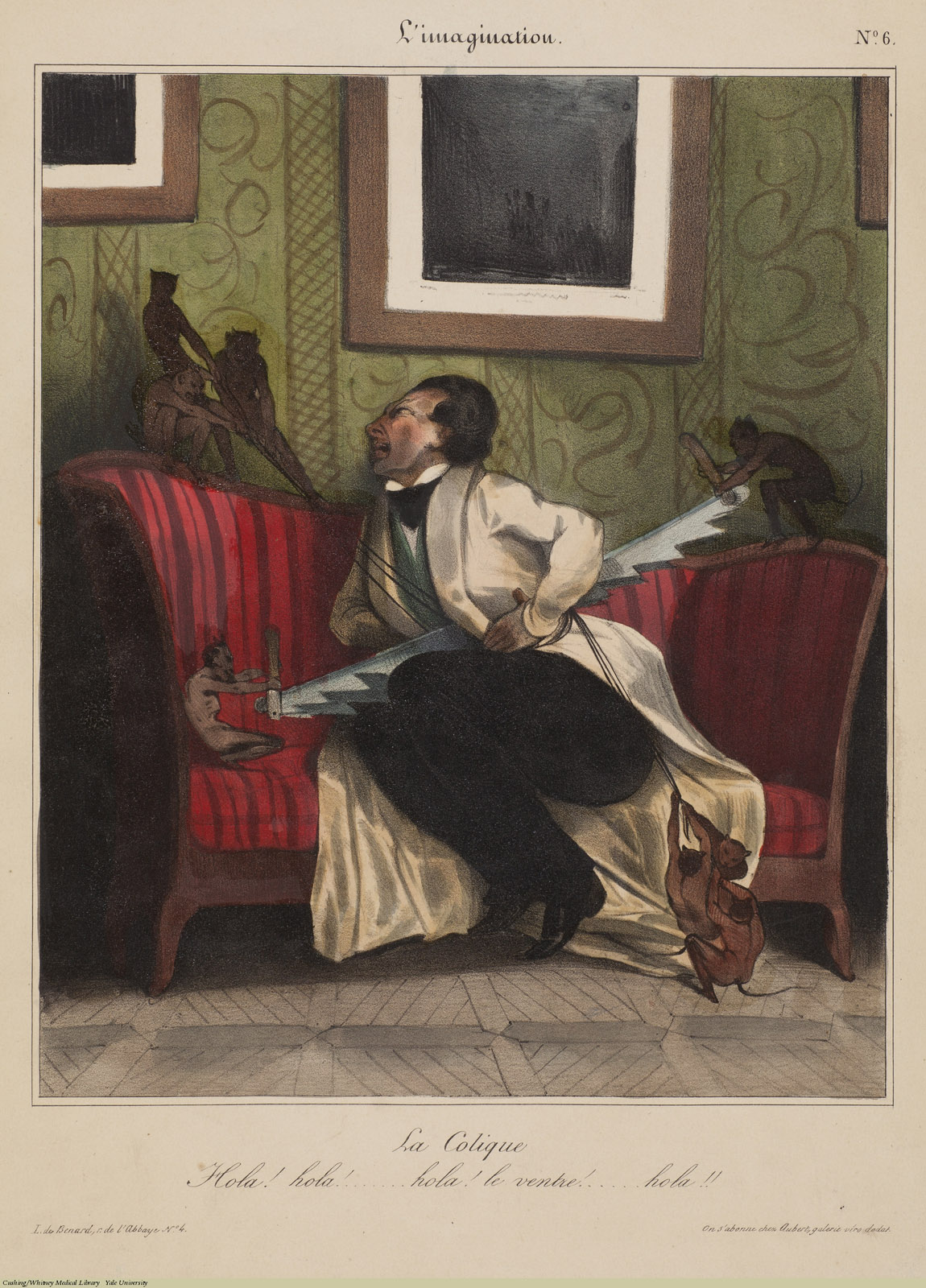
The Healing Arts: Le mal de tête, La Colique, Le Cure.

Click for full size.

Le mal de tete. Charles Ramelet / Honore Daumier, Lithograph coloured. Subject: Headache, Depiction of Pain.

Le mal de tete. Charles Ramelet / Honore Daumier, Lithograph coloured. Subject: Headache, Depiction of Pain.

La Colique. Charles Ramelet / Honore Daumier, Lithograph coloured. Subject: Cholic, Depiction of Pain.

La Colique. Charles Ramelet / Honore Daumier, Lithograph coloured. Subject: Cholic, Depiction of Pain.

Le Cure. Oui, mes freres... Charles Ramelet / Honore Daumier, Lithograph coloured. Subject: Alcohol, Sleep.

Le Cure. Oui, mes freres… Charles Ramelet / Honore Daumier, Lithograph coloured. Subject: Alcohol, Sleep.

Decor.

From rq: Wallpaper, wall art. This is an abandoned school down the southern half of the country. The first is layers of wallpaper/paint (couldn’t really tell), the second two are a local artist’s work for a nature-focused show that used the building as canvas and location. Click for full size!

© rq, all rights reserved.