Making a Rondel Dagger – Interlude

The now finished blade came out really nicely, so I will not be ashamed to be associated with it. So I will definitively sign it. However I mentioned already that I do not currently have my own maker’s mark, since the one I used from 10 years age is now used as bluetooth logo. I am not sure whether continuing to use it could lead to legal trouble, but I guess it would lead to confusion. “That knife has a bluetooth? What does it do?”.

I tried to design a new logo, but all designs I came up with either do not appeal to me, or they require quite precise etching process to be made on a blade. And that would definitively not fit this blade, where I aim for as authentic medieval look as I can achieve.

An idea came to me to use my initials, but not in Latin script, but in Glagolitic. At least for this particular dagger. It has the advantage that not only is it a very simple design, it is also thematic – Glagolitic script is the official script of the Witcher 3 game from which the inspiration for the dagger originated. And I am not appropriating other people’s culture.

So today I set out to try how it looks and also to refine/remember my etching process, since I did not do it for quite a long time. For that I yesterday polished a piece of steel from my failed broken machete.

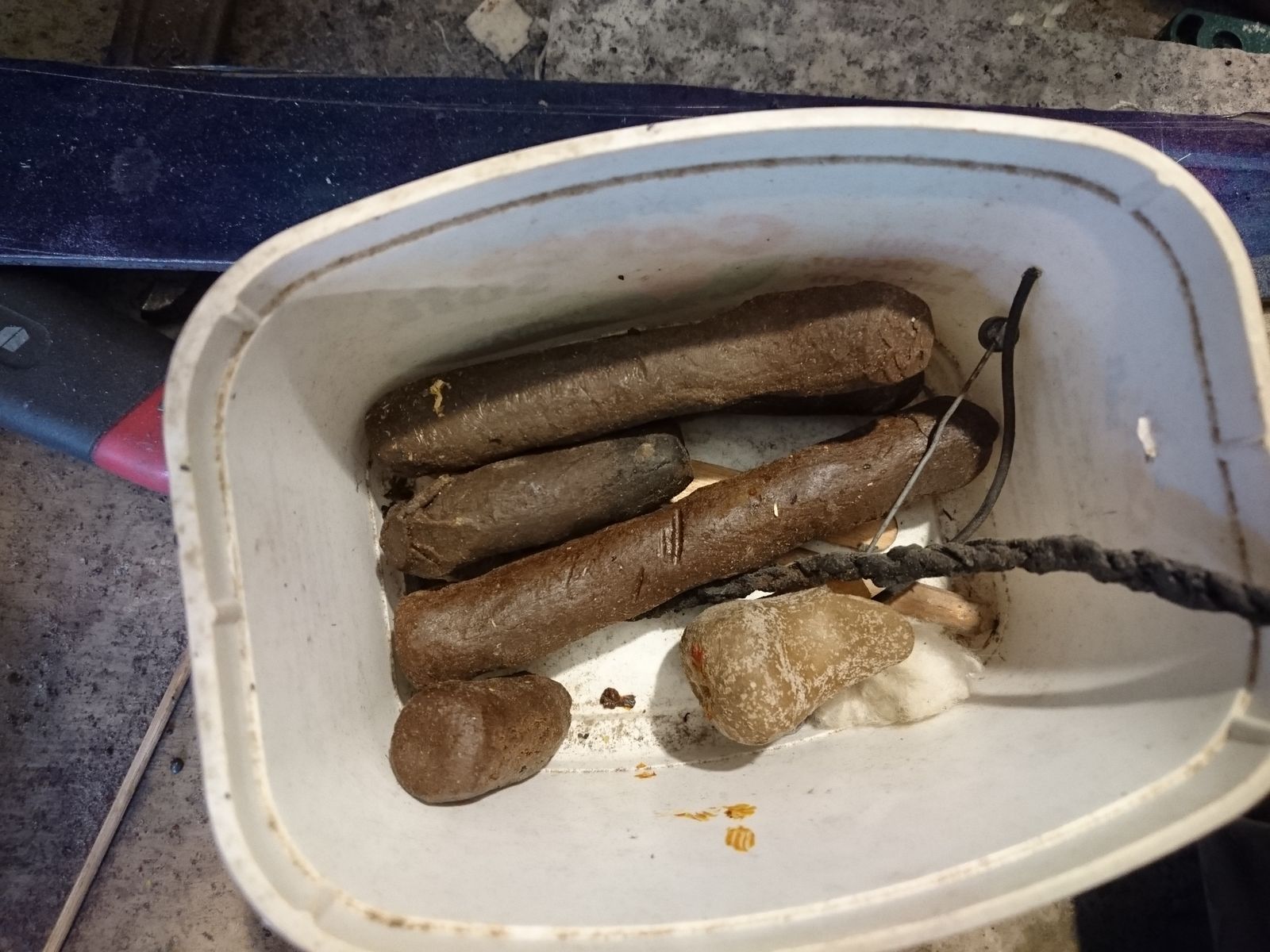
In the past I tried different materials as masking for etching and the best results I have got with material that does not look appealing in the least. But do not worry, it does not smell like what it looks like. It smells actually very nice when worked, because it has been made from equal parts of beeswax, bitumen and spruce resin, all boiled together and poured into water to solidify. I formed it in sticks and for last ten years it collected dust. But it does not spoil and it is just as usable as it was when new.

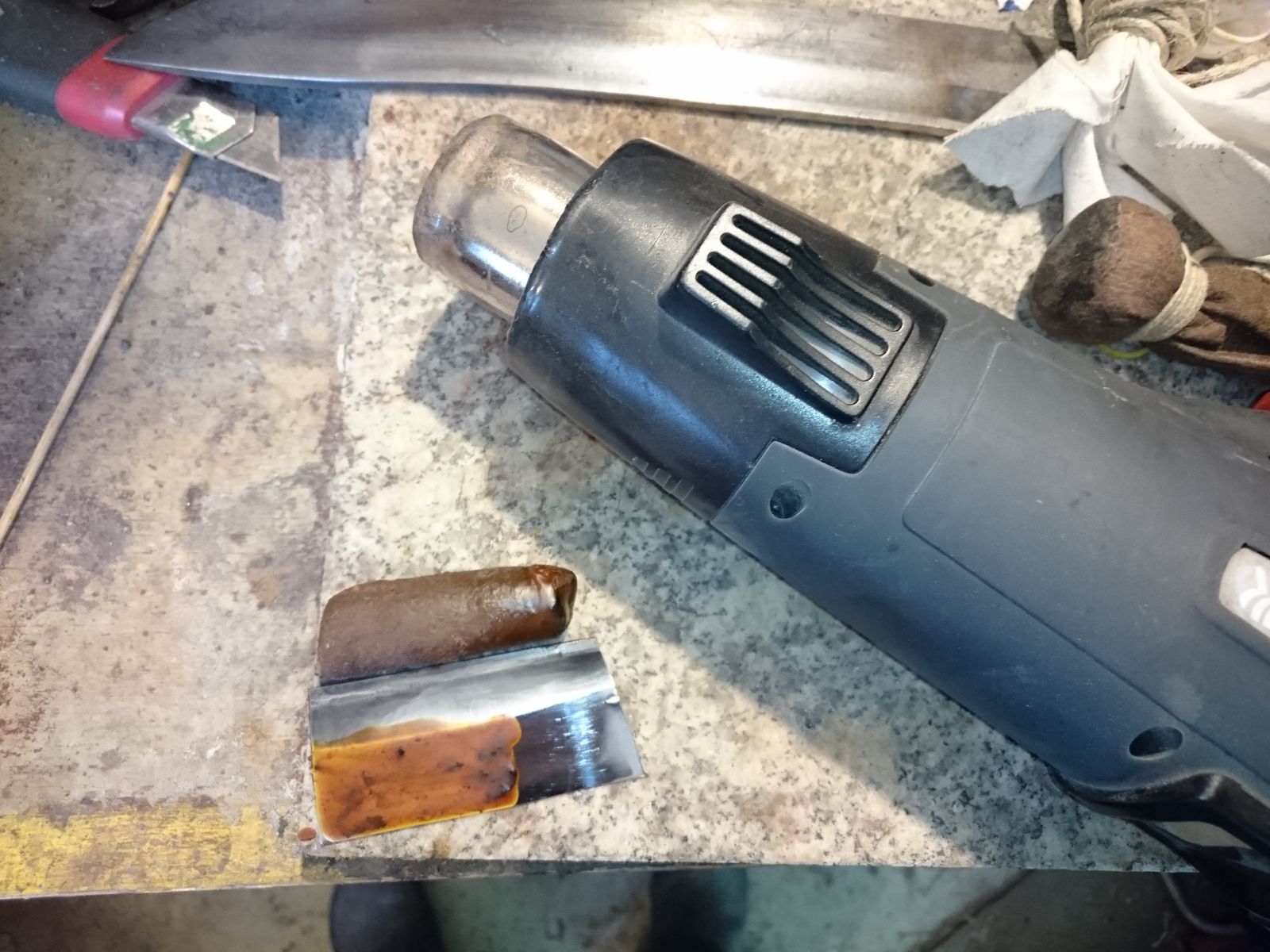
When heated with heat gun or even with hair dryer or a candle it quickly gets very sticky and adheres to the de-greased steel quite well. So I heat gently both the steel and the stick and rub them together to transfer some of the sticky material onto the blade. Then I use the air flow from the hot air gun to make an even thin layer. It is important for the layer not to be too thick, because it would be difficult to draw the design in it, but also not too thin because then it could delaminate during etching around the edges (delamination was a huge problem when I was trying to use paraffine btw.).

Next step is to draw the design. The layer remains fairly soft and plastic for long time and can be easily scratched through. For this I am using an old compass needle, but for finer design a razor blade or very sharp wood carving knife tip can also be used. It is important to keep the needle clean after every scratch, since the stuff adheres to it too. It is also necessary not only to scratch through, but more like scratch/chisel away. Minor mistakes can be repaired by pressing a piece of the mass on desired place and pressing it gently against the spot until it connects again. After just a few minutes of work under a magnifying glass I was ready to try etching.

For just a small logo I did not want to prepare whole big etching bath, so I used the masking mass to glue a bottle cap with cut-out top as a barrier for the etching fluid to remain in place. As a source of electrical current I have used a DC power supply from an external hard drive that has died on me a few years ago – it has an on/off switch which comes in handy. Anode (+) is connected on the steel and cathode (-) on a piece of graphite (a pencil core works too and I used it for very fine etchings in the past). As etching fluid I have used ordinary kitchen salt solution in the past, but today I have tried ferric chloride because I reasoned (correctly) that it will work better. It is solution for etching printed circuit boards diluted approximately 1:10.

It is important to not use too concentrated solution for two main reasons:

  1. The current that can go through the solution depends on concentration. Too high concentration can mean too high current and that can burn the DC power supply (lesson learned in the past).
  2. Too concentrated solution also etches too quickly and that is not desirable because it makes uneven “burned” looking and spotty etch.

After that I turned the switch on and waited for ten minutes. It was not complete success because towards the end the bath evaporated too much, it got warm and the masking layer delaminated around the whole logo. So I repeated the process once more with only five minutes etching time. I am satisfied with the result, the etching is clear and has nice black color that I know I would not get with table salt. Now I will play with the letters a bit in Photoshop to get the proportions right.

©Charly, all rights reserved. Click for full size.

The Healing Arts: A Medical Inspection. Or Miracles Will Never Cease.

Click for full size. As you can see, all effort was put into making Joanna Southcott as awful as possible. Ms. Southcott was a self-styled prophetess, and claimed to be pregnant at 64 years of age, and died shortly afterward. It would seem she was held to be nothing more than a con by the medical establishment, with little consideration that she might actually believe all the nonsense she preached. The depiction of her is certainly nothing at all like her actual appearance (there’s a photo at the link.)

A Medical Inspection. Or Miracles Will Never Cease. Thomas Rowlandson, Etching coloured, 1814. Subject: Obstetrics, Prophesy, Pregnancy, Anecdotes, Religious Mania, Joanna Southcott (1750-1814).

A Medical Inspection. Or Miracles Will Never Cease. Thomas Rowlandson, Etching coloured, 1814. Subject: Obstetrics, Prophesy, Pregnancy, Anecdotes, Religious Mania, Joanna Southcott (1750-1814).

Cornelis Corneliszoon van Haarlem. [NSFW]

Yesterday evening found me distracted again, chasing one tangent after another until I landed on Cornelis van Haarlem (1562-1638), a most talented painter. He was a Northern Mannerist, and given all the foibles of that particular style, he made his characters luminous and achingly beautiful, even when they were misbehaving. Click all images for full size. The first painting which caught my eye was A Monk With A Beguine, painted in 1591:

Een monnik en een begijn, A monk with a beguine, by Cornelis Cornelisz van Haarlem.

Een monnik en een begijn, A monk with a beguine, by Cornelis Cornelisz van Haarlem.

The detail and light are wonderful, it’s all so…lustrous. And reluctantly lusty. You can almost feel their consciences attempting to get the better of them, and failing. The story of the Beguines is an interesting one.  I think there’s a lot to be said for such structures as the beguines, just sans religion. At the time, this was a good option for a lot of women, when they had few choices in life.

What grabbed my attention next was Venus and Adonis:

Venus and Adonis, by Cornelis Cornelisz van Haarlem.

Venus and Adonis, by Cornelis Cornelisz van Haarlem.

You can see in Adonis’s face there’s some problem, one which has him quite emotional, while Venus has the solid air of confidence and casual comfort. Again, the details are astonishing in their beauty and light; the pearls are translucent.

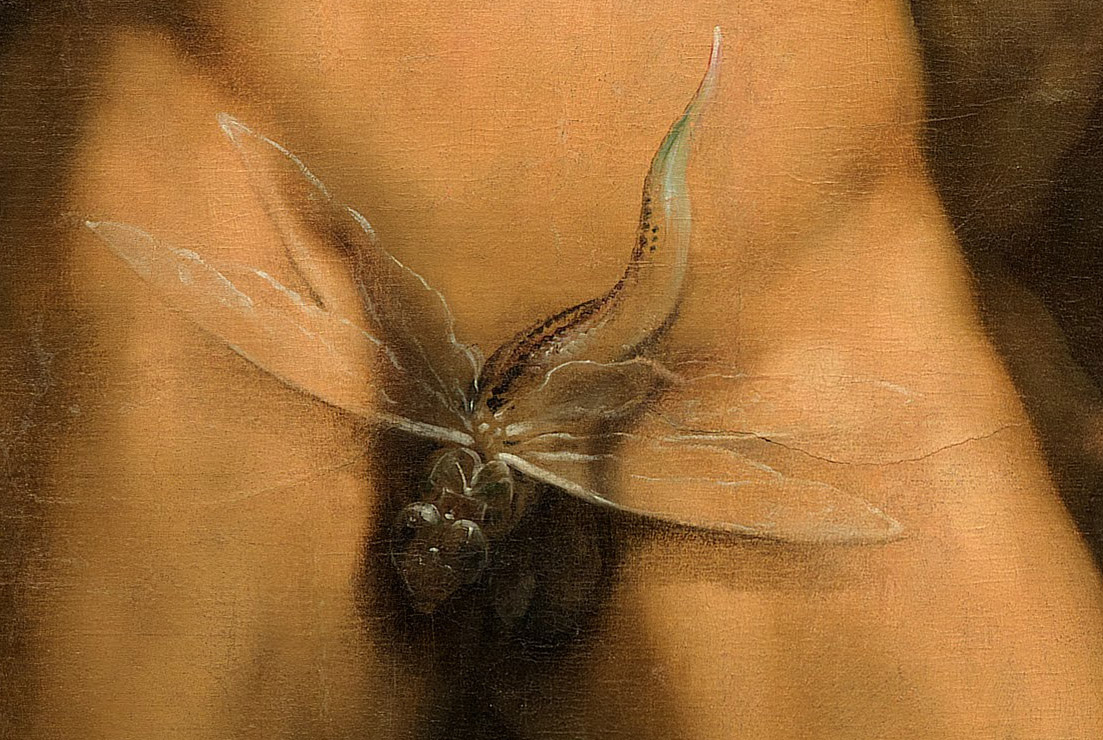
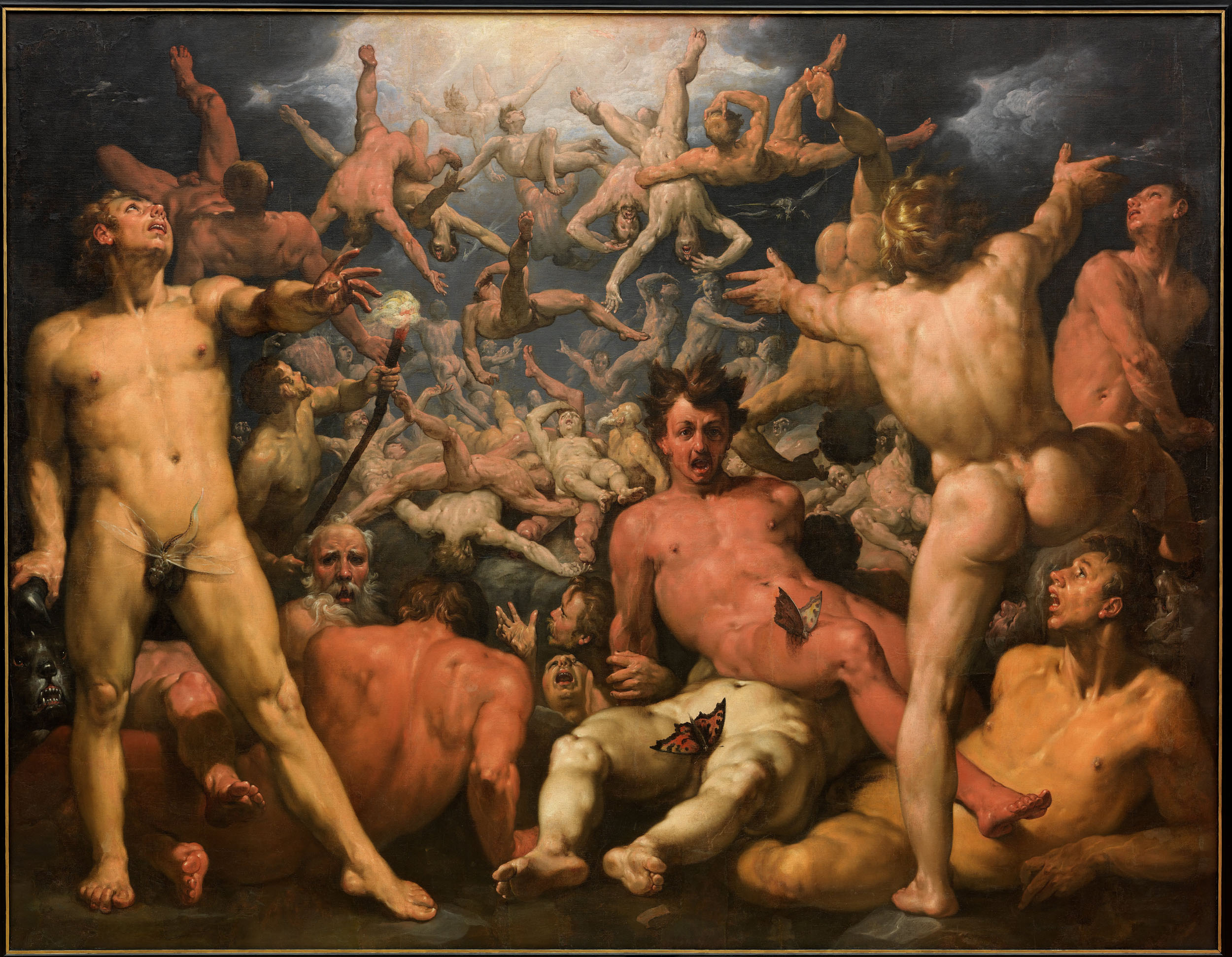
I’ll add just one more here, The Fall of the Titans, which leads me to the conclusion that all men should have a dragonfly for their dick. Yep. Here’s a detail first, then the full painting:

Detail from The Fall of the Titans by Cornelis Cornelisz van Haarlem.

Detail from The Fall of the Titans by Cornelis Cornelisz van Haarlem.


The Fall of the Titans by Cornelis Cornelisz van Haarlem.

The Fall of the Titans by Cornelis Cornelisz van Haarlem.

Look at the faces, those expressions. Incredibly poignant, once you can stop looking at the dragonflied and butterflied* genitals. Also, dragonfly dick and the character at the bottom right are same person.

*Not meant in that way!

Tools.

© C. Ford, all rights reserved. Bad flash, sorry. Click for full size.

© C. Ford, all rights reserved. Bad flash, sorry. Click for full size.

Good tools are important. Having the right tools is very important too. I can highly recommend the Staedtler sharpener (mine is in obvious need of a clean). It works beautifully and renders a very sharp tip. Speaking of sharp tips, everyone who has worked with pencil, colour or not, is familiar with point breakage during drawing. This sends tiny bits of core all over the place. If you’re working in ordinary pencil, it’s not a major deal if it smears, as it’s easily erased. That is so not the case with colour pencils, Prismacolor in particular. Normally, I use a fox tail brush to clean, but these can cause problems with colour pencils, in that no matter how lightly you wield one, it’s still heavy enough to cause many a smear. The solution? Feathers. I use 3 types of feather. Not only can you pick up minuscule bits of pencil with them, they are very good to brush an area of your work without smearing.  The turkey feather is the lightest, and excellent at picking up bits; the other two are stiffer, with more weight, and good for an overall sweep. If you have a bunch of bits and dust, gently press the feather down on them, and it will pick them up. Don’t forget to clean your feather after. Just using your fingers on the feathers works fine.

Living rural, I don’t have to go far to find feathers, but if you’re deep in an urbanscape, feathers of all types are easily found in craft stores. The benefit there is that you can buy feathers by the bag, so you’ll have more than enough for your needs.

ETA:

22 seconds in the microwave, kept all the info. Just sharpened it, seems to have worked. This was also a sharp reminder of a major failing on my part – not paying attention. I’m so colour focused, I completely ignore observing the condition of the pencil. Now that I had a very good look at this one, there are a number of gouges and scores, particularly on the ‘back’ of it, and there was a suspicious piece transparent tape, too. So, while it’s good to know you can fix your pencil up, it pays to be very observant of the pencil itself before you bring it home.

Stupid Is…

The Problem [right} and the New Choice [left].

The Problem [right} and the New Choice [left].

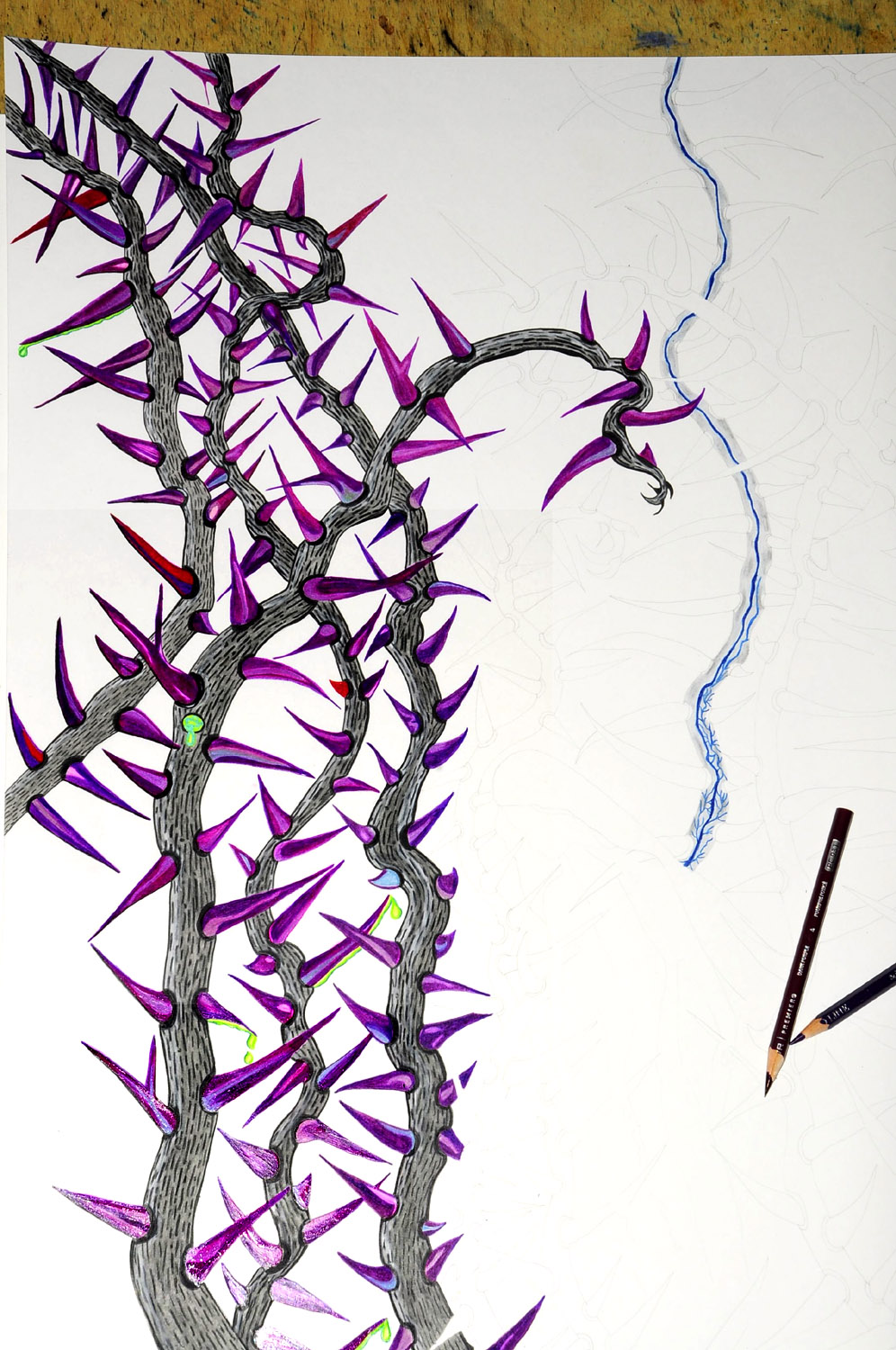
Right. Stupid is choosing a very hard to find colour in pencils, and compounding that stupidity by choosing a pencil out of gift set, which means no identifiers on the pencil. No number, no colour name. Now, before I got absurdly attached to this colour, I could have engaged my brain for a moment, and focused on the fact that I have a very large piece to do, and only one pencil. This should have called for patience enough to see if I could at least find a colour match. Did I do this? Oh no. Just started drawing, and it wasn’t until my pencil was diminishing at a rapid rate that I realised I was in trouble. Then I started looking for a colour match. Couldn’t find one. The Prismacolour Pourpre Foncé was in the range of my original pick, so I went with it, and bought two pencils. I’ll probably buy another one next week, just in bloody case.

I tried to make it work on the piece, but it just didn’t come together, so I got to start all over again. If, like me, you tend to get abnormally attached to a certain colour, get as many as you can, it will save you much aggravation in the long run.

Starting Over. Bad Flash Photography.

Starting Over. Bad Flash Photography.

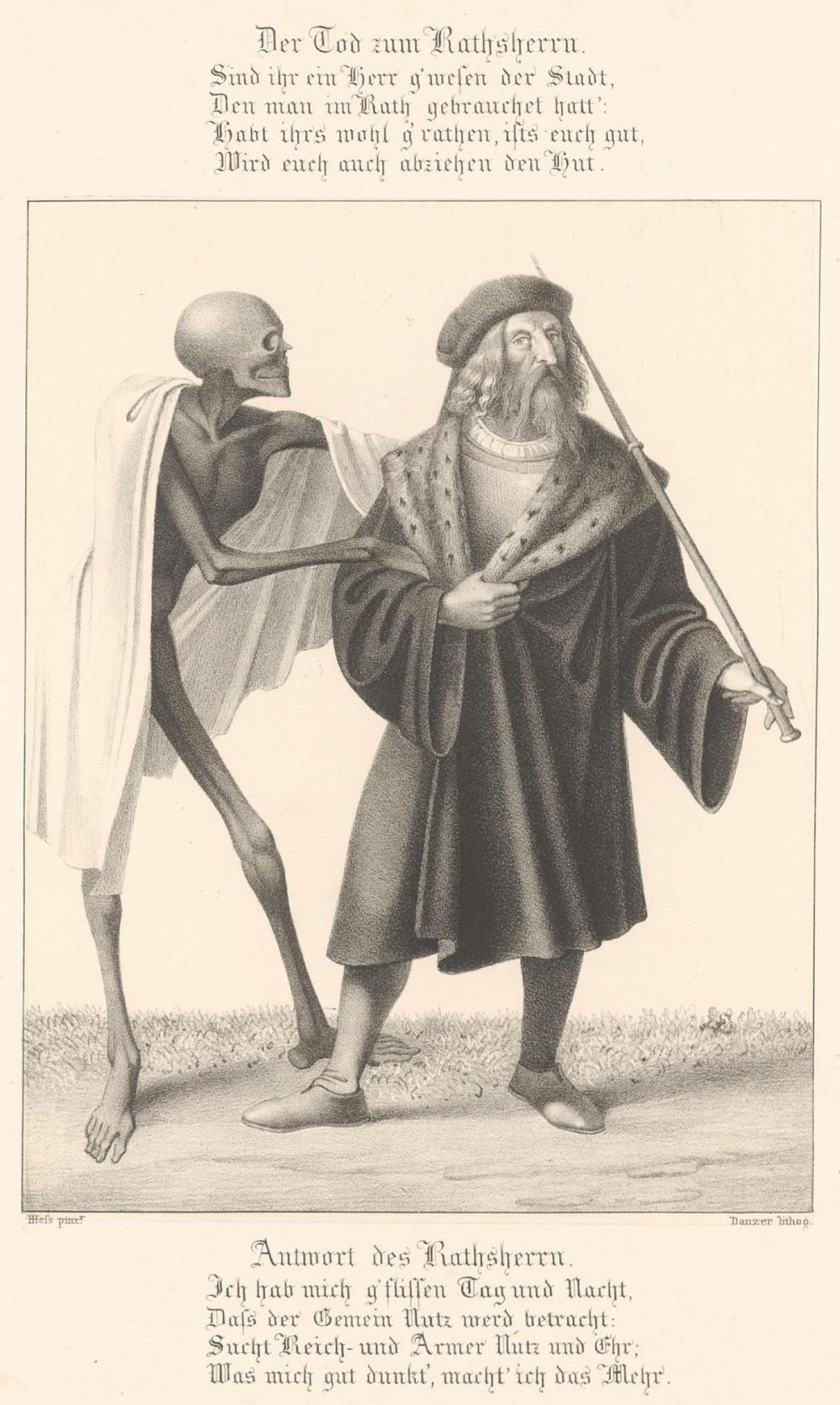
Dance Of Death: King and Queen.

Click for full size. I like the way Death addresses them as Mr. King and Mrs. Queen.

Todt zum König:
Herr König Ewr G’walt hat ein End,
Ich führ euch hie bey meiner Hend,
An diesen dürren Brüder-Tantz,
Da gibt man euch deß Todes-Krantz.

Death to The king:
Mr. King, your power has an end,
I lead you here by my hand
to this dance with dry brothers.
There they’ll give you the death-garland.

Der König:
Ich hab gewaltiglich gelebt,
Und in hohen Ehren geschwebt:
Nun bin ich in deß Todtes Banden,
Verstricket sehr in seinen Handen.

The king:
I have lived powerfully
and hovered in high honour.
Now I’m in Death’s bond,
caught in his hands.

Todt zur Königin:
Fraw Königin Euwr Frewd ist auß,
Springen mit mir ins Todten-Hauß,
Euch hilfft kein Schöne, Gold noch Gelt,
Ich spring mit euch in jene Welt.

Death to The Queen:
Mrs. Queen, your joy has ended,
dance with me into the death-house.
Neither beauty, gold nor money will help you.
I’m dancing with you into the next world.

Die Königin:
O Weh vnd Ach, O weh vnd jmmer,
Wo ist jetzund mein Frawenzimmer,
Mit denen ich hatt Frewden viel:
O Todt thu g’mach, mit mir nicht eyl.

The queen:
Oh woe and alas, oh woe for ever.
Where is now my band of maids
with whom I had many pleasures?
Oh Death, take it easy, don’t hurry with me.