Black-headed Grosbeak, male. Click for full size.

© C. Ford, all rights reserved.

Black-headed Grosbeak, male. Click for full size.
© C. Ford, all rights reserved.

Richard Spencer (Facebook).
Poor, poor Richard Spencer. His um, appeal to Ms. Clinton didn’t work at all. Neither did his frothy demands. Ms. Clinton went right ahead with her speech, the full text of which can be read here. Back to Mr. Spencer’s wish life:
Right Wing Watch notices that Richard Spencer, who last year hosted a conference on white racial identity that proposed the creation of whites-only states in the U.S., has issued a preemptive strike against Clinton’s speech that attacks her for allegedly hating white people.
“Over the past few months, Hillary Clinton has engaged, rhetorically and directly, with an array of groups that support an anti-White agenda,” Spencer wrote. “Whether that’s endorsing the ‘Black Lives Matter’ movement, which is directly responsible for a rise in violence throughout America, or her surrogates chastising European-Americans for their background and heritage.”
Spencer then called on Clinton to apologize for hating white people so much, despite the fact that Clinton herself is white.
“We call on her and her allies to issue an apology to European-Americans everywhere and confront her own troubling links to extremism and the civil unrest she has stoked for months,” he wrote.
Spencer attended a pro-Trump party at this year’s Republican National Convention in Cleveland, where he was quoted as saying he and his movement have “taken over the right” by nominating a presidential candidate who addresses the alt-right’s major concerns.
Goodness. You’d think treating people like people was genocide of white folks or something. Is it wrong of me to hope that Mr. Spencer gets stuck some place where Ms. Clinton’s speech is on a loop?
Via Raw Story.
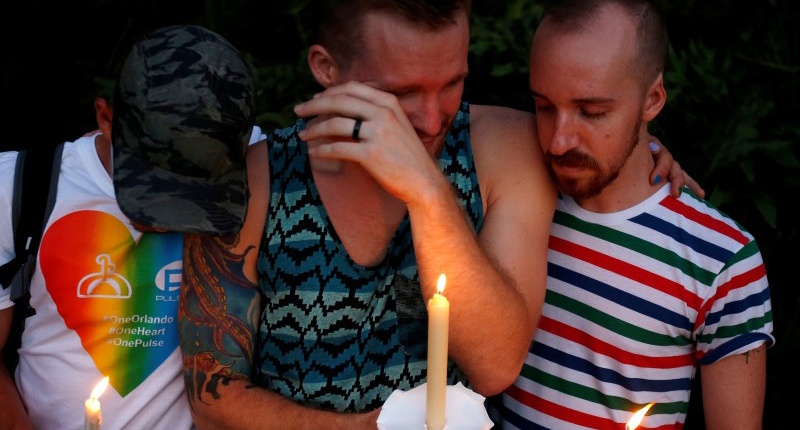
REUTERS/Carlo Allegri.
Two Florida hospitals will not seek payment of medical bills from the dozens of people treated for injuries suffered in the mass shooting at the Pulse nightclub in Orlando in June, officials at the health facilities said.
The move leaves the hospitals with estimated unreimbursed costs topping $5.5 million, they said on Thursday.
[…]
“It was incredible to see how our community came together in the wake of the senseless Pulse shooting,” said Daryl Tol, president and CEO of Florida Hospital. “We hope this gesture can add to the heart and goodwill that defines Orlando.”
Florida Hospital treated 12 shooting victims at a cost of about $525,400, it said.
Orlando Health said in a statement that it expects to absorb costs exceeding $5 million after payments from funding sources such as insurance plans. Its main hospital, Orlando Regional Medical Center, treated 44 patients at its trauma center located a few blocks from the nightclub.
[…]
“During this very trying time, many organizations, individuals, and charities have reached out to Orlando Health to show their support,” Orlando Health President and CEO David Strong said in a statement. “This is simply our way of paying that kindness forward.”
Another huge shoutout for people being great! My heart may have grown a size here.
Full story here.

Mother and child at the frontlines on the Standing Rock Reservation in North Dakota on August 16, 2016. Courtesy John Heminger.
Sarah Sunshine Manning (Shoshone-Paiute, Chippewa-Cree) has a wonderful story up at ICTMN. I agree that in many ways, we have already won. This is a historical time, this is history in the making, and the tribes have not been this united since Victory Day (that would be the Battle at the Greasy Grass, aka Custer’s final fuck up). That is also the foundation of the government’s fear, and all the intimidation games they keep playing, not that many would admit to that, but the grudge runs deep. When we are together, we are strong. When all people unite, we are strong, and our voices are powerful enough to be heard.
We woke up to sounds of joy- laughter, conversation, and warm greetings of “Good Morning.” We woke up to lingering fragrances of camp fires, coffee, and smoldering sage and cedar. Near our camp was the central gathering place, where early risers were already congregating over coffee, while others were making huge amounts of breakfast over open fire.
People of all tribes and many ethnicities gathered. I admit, that I was a little giddy just at the site of a blond gentleman there with his family — a wife and two young children. I admit, that I have been conditioned if not traumatized while living in the Dakotas for the last decade to expect much less than warmth from the majority of non-Natives in the area. But what I immediately saw in the camps at Standing Rock was pure unity of humanity. Unity for Earth, and solidarity for life. And it was beautiful. There were several non-Natives present, standing with the Lakota and Dakota people of Standing Rock as fellow human beings.

The Oceti Sakowin youth are asking for help, as we continue in our fight for healthy land, clean water, and healthy people.
Construction for the Dakota Access Pipeline has begun in spite of thousands and thousands of people demanding a stop to the project and the 1,800-mile run we made across the country to deliver your signatures to the Army Corps.
Now we’re going to the front lines of the fight against this pipeline and we want to bring other youth leaders with us to join the struggle!
What we’re doing is risky, but we’re willing to do it for our future. Will you help us bring youth leaders from surrounding reservations to the Sacred Stone Camp where we are staying? Your donation will go towards renting buses and buying food and camping gear for young activists.
We’ve already helped to disrupt construction of the pipeline by peacefully using our bodies to block roads – but we need more support!
We believe that young people should be on the front lines of the movement to protect our water and our future. Donate $5 today to invest in youth leadership and the protection of our planet!
If you can kick in, please do. I don’t have much myself, but I kicked in because this is so very important. If you can’t, please signal boost, can’t stop the signal!
https://www.change.org/f/send-native-youth-leaders-to-block-the-pipeline
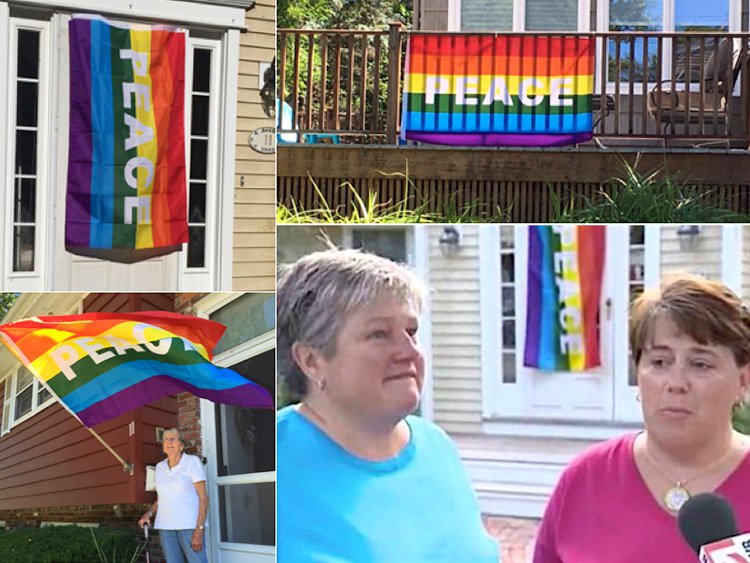
Oh, I am loving all the small stories of accepting, loving pushback. In this very stressful and trying time, these are good to see, and we all need this, we need to know that our fellow humans are, and can be, truly terrific people.
A same-sex couple has received a colorful show of support from neighbors.
Rainbow flags were unfurled at over 40 houses in Natick, a suburb of Boston, after the home of Cari and Lauri Ryding was vandalized, according to The Boston Globe.
While the couple was on vacation, the house had been egged. And a rainbow flag, which the Rydings had ordered after the Orlando shooting, had been stolen.
The neighborhood was quick to act after the couple reported the incident to the police last Wednesday, and no suspects were immediately identified.
“We said, ‘Why don’t we all have the flags? They can’t take them from all of us,’” said Dennis Gaughan. A response team sent a flurry of donation and requests to the Rainbow Peace Flag Project, which offers free flags to local residents.
“It just happened so quickly — the whole neighborhood said, ‘Get me a flag. Get me a flag. Get me a flag,’” said Penni Rochwerger. “If we can stop whatever hate is out there, I think that’s really important.”
On Sunday, a group of children on bicycles delivered the rainbow flags across the neighborhood. Lauri Ryding was awed to see the bright banners unfurl after cleaning up the damage from her porch.
“One person’s act of fear and maliciousness created such a powerful statement of love,” she said. “We are very blessed, very fortunate.”
“Somebody’s fear called them to action,” she added of the vandals. “But our neighbors support and love called them to action, and love conquers hate. Love wins. We win.”
A huge shout out to this neighbourhood, you did great!
Via The Advocate.
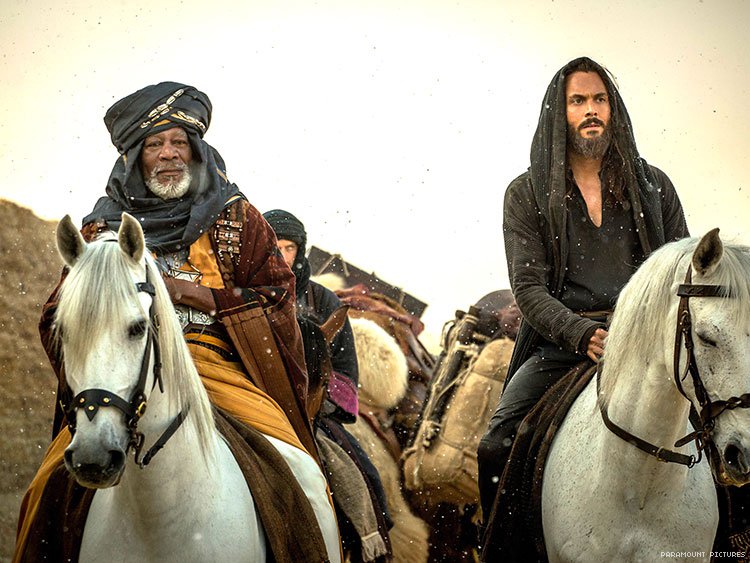
The film, which courted Christian viewers and abandoned the gay subtext of the 1959 classic, could lose up to $100 million.
Bye, Ben-Hur.
The film about betrayal in biblical times was an epic fail at the box office. Its opening weekend, it took in $11.2 million in domestic markets and $10.7 million in international ones, reports Variety, a dismal sum given to its production budget of over $100 million.
Ben-Hur ranked sixth at the box office, failing the cinematic chariot race to a top 5 position. It lost to films in their second and third weekend, including Suicide Squad ($20.9 million), Sausage Party ($15.5 million), and Pete’s Dragon ($11.3 million).
Prior to its release, Ben-Hurwas criticized by The Advocate and other outlets for not including the gay subtext present in the 1959 classic, a critical and commercial success that went on to win a slew of Oscars. In the 1995 documentary The Celluloid Closet, out screenwriter Gore Vidal revealed he had convinced the film’s director to incorporate this subtext in order to explain the tension between the film’s leads, a prince and a Roman soldier who betrays him.
Various excuses were offered as to why the gay subtext was not present in the story’s most recent iteration. At Ben-Hur‘s premiere, star Tony Kebbell (Messala, the soldier) said it wasn’t needed in the present day. In a conflicting report, screenwriter Keith Clarke claimed copyright law prevented him from incorporating it, as he could only adapt what was included in Lew Wallace’s 1880 book Ben-Hur: A Tale of the Christ.
As a result, the film placed more emphasis on the novel’s religious themes and fleshed out the character of Christ. It also marketed heavily to Christian audiences, holding special screenings and releasing promotional videos that featured reviews from religious leaders.
But not even Jesus could save Ben-Hur from bad reviews. The film currently has a score of 29 percent on the film aggregator Rotten Tomatoes. Critics called it “an amateurish effort,” “something soulless and empty,” “a compete snore-fest,” “gutless,” and a “digitalized eyesore hobbled in every department by staggering incompetence.”
“The filmmakers of this stagnant remake display all the technical tools needed to achieve greatness, but they lack that most basic of functions: a reason why this story needs to be retold,” wrote the Washington City Paper.
Wow. Those reviews are beyond scathing, those are brutal. I thought the whole hype of “Christian, Christian, Christian Ben Hur with Added Jesus!” was sheer silliness, but it turns out the film was much worse than the standard Christian silly. Ouch.
Via The Advocate.

George Bush.
If anything can be counted on, it’s the inconsistency of conservatives, especially the scarily right wing conservatives. Their howls over this outrage, that outrage, and the other outrage tend to be remarkably convenient. There’s always a noted lack of balance, and there’s scant evidence of thinking going on. Right now, the far right won’t let go of the Clinton email issue. They are like a starving dog with a bone, and they are not about to let go.
The frenzy and furor over Hillary Clinton’s email habits while at the State Department, now into their 16th month and still going strong, have predictably and effectively chipped away at her reputation, so a sizable majority of Americans (67 percent in a poll last month) find her “untrustworthy.”
That’s what a year of FBI investigation—leading to no recommended charges—a budding congressional investigation and a relentless right-wing watchdog’s lawsuit buy you in American politics.
But take a moment away from pawing through the tens of thousands of her personal and professional emails now on public view and consider the long list of elected and appointed Republicans who have done exactly the same thing as Clinton—and worse.
Between 2003 and 2005, the George W. Bush White House “lost” around 5 million emails, including messages related to the firing of federal prosecutors who didn’t adhere to Bush’s conservative agenda. A federal judge ruled that the White House didn’t have to look for them.
Those emails were among some 22 million messages that the Bush administration “lost” during its time in power, most from right around the period that it was crafting a scaffolding of lies to sell what turned out to be the greatest American foreign policy debacle in a generation: the Iraq War. The emails were eventually found in 2009, when Bush and Dick Cheney were safely back at their ranches, but long after thousands of young Americans were dead and maimed and hundreds of thousands of Iraqis were dead, and as Islamists were mustering to eventually capture swathes of lawless, war-ravaged turf for their hideous “caliphate.”
Colin Powell—Bush’s secretary of state and the team player dispatched to the floor of the U.N. to deliver some of the lies about Iraq’s supposed weapons of mass destruction—also used a personal email account while at the State Department. He didn’t even bother to set up his own home server but chose the eminently hackable public email giant AOL. And he was hacked, by an Eastern European criminal who used the nom de plume Guccifer.
Years later, at a 2009 dinner party in Washington, he recommended to Clinton that she use a private email account. In his upcoming book, Man of the World: The Further Endeavors of Bill Clinton, Joe Conason describes the conversation, which took place at a dinner for Hillary Clinton soon after she was appointed secretary of state: “Toward the end of the evening, over dessert, [former Secretary of State Madeleine] Albright asked all of the former secretaries to offer one salient bit of counsel [to Clinton]…. Powell suggested that she use her own email, as he had done, except for classified communications, which he had sent and received via a State Department computer on his desk. Saying that his use of personal email had been transformative for the department, Powell thus confirmed a decision she had made months earlier.”
Goodness me, all those lost emails, all that hacking, all that carelessness! Can we bring Bush back to give him a proper spanking now?
Full story here.

Just when you thought Pat McCrory couldn’t get any lower, he goes diving straight into an isht filled sewer of lies.
North Carolina Gov. Pat McCrory (R) has released a fear-mongering campaign ad that paints transgender people as dangerous predators who are out to rape children.
LGBTQNation.com posted the 30-second campaign spot on Wednesday, which accuses Democratic NC Attorney General and gubernatorial candidate Roy Cooper of willfully endangering the state’s children by not upholding the so-called “bathroom bill,” H.B. 2.
The ad begins with a woman named Gina Little of Greensboro, NC saying, “At 9, I was molested by a teenager.”
She continues, “When I heard that Pres. Obama and and Roy Cooper want to force schoolchildren to share the same locker room, shower and restroom with someone who claims to be the opposite sex, I was horrified.”
“Gov. McCrory knows this is not about discrimination, money or politics,” Little claims. “He’s standing up under intense pressure and doing what’s right. Our governor is on our side.”
The implication is clear. Little is saying that if trans men, women and children are allowed to use the facilities corresponding with their expressed gender, they will rape and molest children.
The truth, however, is that the overwhelming majority of sex crimes against children are committed by men who identify as heterosexual and the bulk of these crimes happen in the home.
Oh yes, most of these crimes do indeed happen in the home, and are most often committed by family members or close family friends. It happened to me, I was raped by a family member for six years as a child, and it had absolutely nothing to do with queer people or any sort of shared facility. I know McCrory is desperate, but this is lower than low, and he is such an immoral, evil person for doing this. Transgendered people already face high levels of violence, and this will do nothing except make that worse. McCrory is out to harm people.
Via Raw Story.
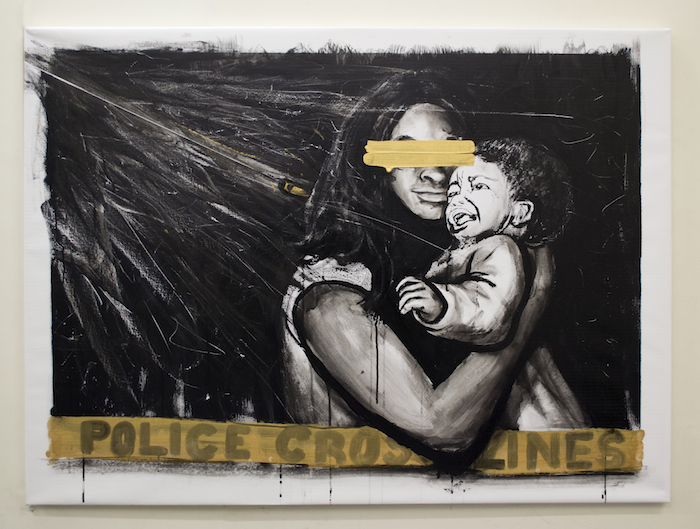
Police Cross Line 3, 2015.
In works such as Nick Cave’s Soundsuits or David Hammons’ Untitled (Rock Head), material evokes the metaphorical and mythological meanings of the black body. Recently, some artists have chosen to symbolically explore its heft and value by emphasizing elevating materiality over the modernist privileging of form. In the artist Dáreece J. Walker’s Black is the giant exhibition of painting, sculpture and text, for instance, the artist’s use of cardboard examines the weight of the black body politic in the age of the Black Lives Matter movement.
[…]
“It’s about a conversation,” says Walker to The Creators Project. “A conversation about how myself and other black Americans that I’ve spoken with feel devalued or not considered in the overall societal structures.” He explains, “There’s a lot of stigma and media bias toward people with dark skin and particularly here in the United States there’s been a lot of police brutality.”
“The reason I used the medium cardboard is because the associations it has with being easily replaceable or disposable. It’s a sentiment that I feel that started to spread through the media representations of black men. It seemed that, through the coverage, black lives didn’t matter as much.”

The Saint, 2015.
The exhibition includes two wooden sculptures, The Martyr and The Saint, that speak to the portrayal and discrediting of black victims of police brutality in the media. The abstract works allude to the media coverage branding Trayvon Martin a “thug,” as well as the selection of imagery of black victims of police shootings that inspired the black Twitter hashtag #IfTheyGunnedMeDown. A poem entitled “If They Gun Me Down” by Daniel J. Watts, a Walker collaborator and Hamilton star, presented alongside Walker’s objects, aims to capture the bleakness of the representation of black life by the media, even in death:
If they gunned me down
would the media paint a picture
of a poet
or would I be politically portrayed as a perilous person with potential to be a paraphernalia pushing pistol popping pilferer?
If they gunned me down, would you be shown the hopeless romantic mama’s boy who writes about how his grandmother taught him how to blow kisses or would you be presented with a production still of the anti-violent “This is how we shoot back” as I brandished a metaphor into the camera?
If they gunned me down
will the photos in which I hold some sort of stone cold pose as I throw two fingers into the air be recognized as peace when they land on judgmental eyes or will they be both misconstrued and inappropriately affiliated with gang culture
by the media vultures that will surely circle my dead carcass ready to feed without taking me or my deeds into consideration?
Full Story at The Creators Project.
Using some of the vintage thread.

© C. Ford, all rights reserved.

Detail of Jim Ricks’ Carpet Bombing. All images courtesy of the artist.
Carpets made in Afghanistan have a history of representing the imagery of war, but a recent work by artist Jim Ricks gives a conceptual perspective to this tradition. Carpet Bombing is a giant, handmade rug that depicts a “Drone Survival Guide” created by Amsterdam-based designer Ruben Pater. Pater’s diagram is a one-page illustration of various drone aircrafts, which references similar guides that were used to identify aircrafts in past wars. Ricks traveled to Afghanistan, where the drones on Pater’s survival guide are in use, to have a rug made by Kabul-based Haji Naseer and Sons Carpet Makers.

Carpet Bombing on display at Rue Red in Dublin. Photo: Andrew Hetherington.
There’s more to Carpet Bombing than the illustration of a poignant pun, as Ricks tells The Creators Project, “I think there is a tendency to ‘read’ the carpet like a poster and stop there. What I think is important about the piece is that not only is the graphic appropriated, it is always shown horizontal and flat in the gallery, as a carpet should be, thus reversing the observer from drone back to human again, and that it can be sat or walked on, activating the work in the way that is in keeping with the Persian carpet as a social space.”
The Creators Project has the full story.
Click for full size.





© C. Ford, all rights reserved.