Lady Grosbeak (Black-headed Grosbeak). Click for full size.

© C. Ford, all rights reserved.

Lady Grosbeak (Black-headed Grosbeak). Click for full size.
© C. Ford, all rights reserved.

We’re heading out to the camps today, should be back on Thursday. If we end up gassed, dog bit, or arrested, might be a bit longer. Hopefully, there will be much to share on our return. I already know I’m not going to want to come back home. Sometimes, having dependent pets is kind of a drag. The Daily Bird is scheduled for the next few days, and that’s as exciting as things will be, I’m not set up for live blogging and all that jazz, and no electricity, because camping.
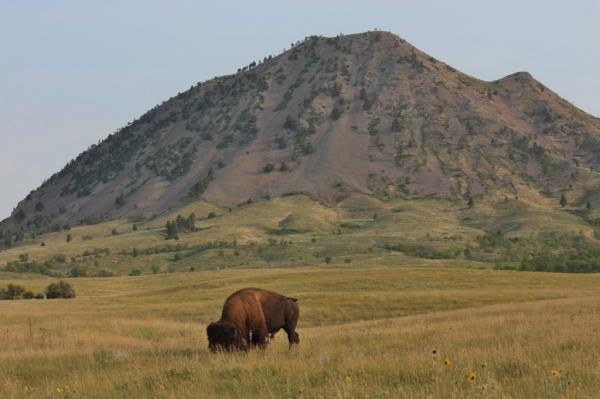
Courtesy Bob Sessions
While the Oceti Sakowin is busy attempting to stop the evil beings who are busy destroying sacred sites here in North Dakota, the South Dakota politicians are busy trying to steal Indian land, namely, the Black Hills.
South Dakota lawmakers, U.S. Sen. John Thune (R-S.D.), Mike Rounds (R-S.D.), and Rep. Kristi Noem (R-S.D.), at the behest of S.D. Governor Dennis Daugaard, have introduced legislation intended to facilitate a federal-state land transfer of 1,992-acres of federally-owned land in the Black Hills.
The land in question rightfully belongs to the Oceti Sakowin (The Great Sioux Nation) under the Fort Laramie Treaties of 1851 and 1868. These treaties, ratified by the U.S. Senate, recognized title in the “Sioux Nation” to approximately 60 million acres of land within present day Montana, Nebraska, North Dakota, South Dakota, and Wyoming, and established the “Great Sioux Reservation” which is made up of 26 million acres of land, including the Black Hills. This land was set aside for our “absolute and undisturbed use and occupation.” It also set forth that in order to be valid, any future cession of these lands would require the signatures of 3/4ths of the adult male population from the aforementioned “Sioux” bands.
The U.S. government unilaterally breached these treaties when it opened the Black Hills for settlement after gold was discovered there. In The Great Sioux Nation vs. the United States (1980), the Supreme Court of the United States agreed that the seizure of the Black Hills by the U.S. was an unlawful taking.
The Rosebud Sioux Tribe and other Oceti Sakowin Tribes were not notified or consulted by federal or state government on this matter.
You can read more about this latest move by greedy assholes here.
If your answer is yes, you do have something to say, consider saying it on FTB. We are actively seeking applications now. Here’s what you do:
send an email to ftbapplications@googlegroups.
Name:
Contact email:
Do you want your email public?:
Twitter account, if any:
Link for donations, if any:
Links to your current blog, any biographical material, or best examples of your writing in comments or forums or other media:
Why do you want to write for us?
As someone who is privileged to read the applications, personally, I’d like to hear a bit about your particular point of view, say as a person of colour, or queer nation member, a woman, military, educator, parent, artist, crafter, and so on. Whatever it is that drives your particular perspective on issues. That’s not a requirement at all, just a wish of mine, so you can ignore me with no consequence. Group blogs are happily considered and accepted, you just need to have one person who will consent to being the ‘head’ of the blog, meaning they get all the headaches, and the job of dividing up all the pennies. Give it a bit of thought, and if you have something to say, send it our way. I look forward to seeing all manner of bright, shiny people here.
From Kestrel. Click for full size.

This is called a “shrump”; it is a hump in the duff caused by a mushroom coming up from underneath. Just like a Christmas present, you can’t tell what’s in there until you open it.

Inside the shrump is Russula brevipes.

What on Earth is THAT? Well, believe it or not, this too used to be Russula brevipes. It was attacked by another fungus that is parasitic on other mushrooms – Hypomyces lactiflourum.

Hypomyces lactiflourum is not always so “mushroomy” looking. Many times the host is so deformed you can hardly tell what it was. In this one you can even still see where the gills are.
© Kestrel, all rights reserved.
From Lofty:
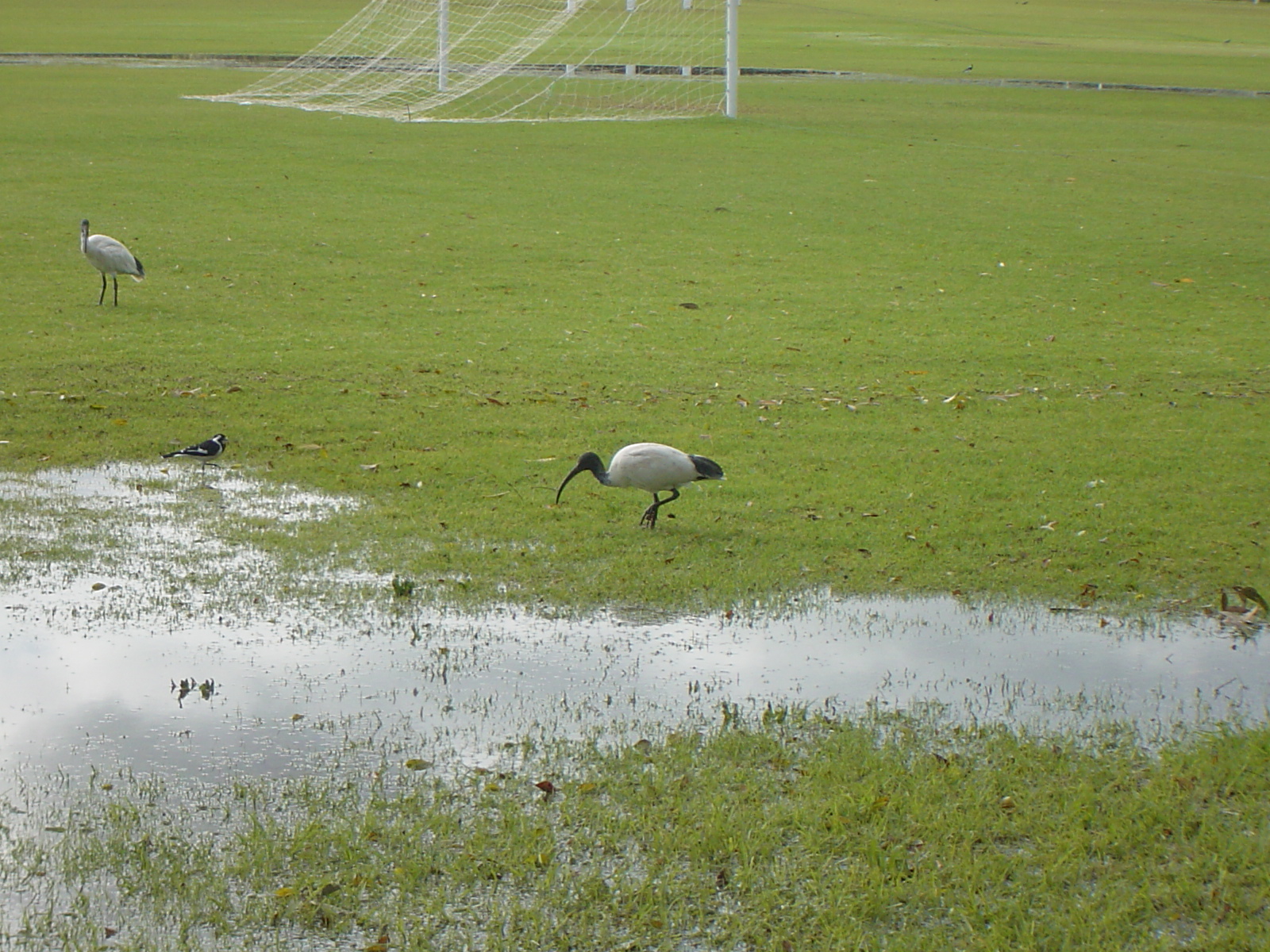
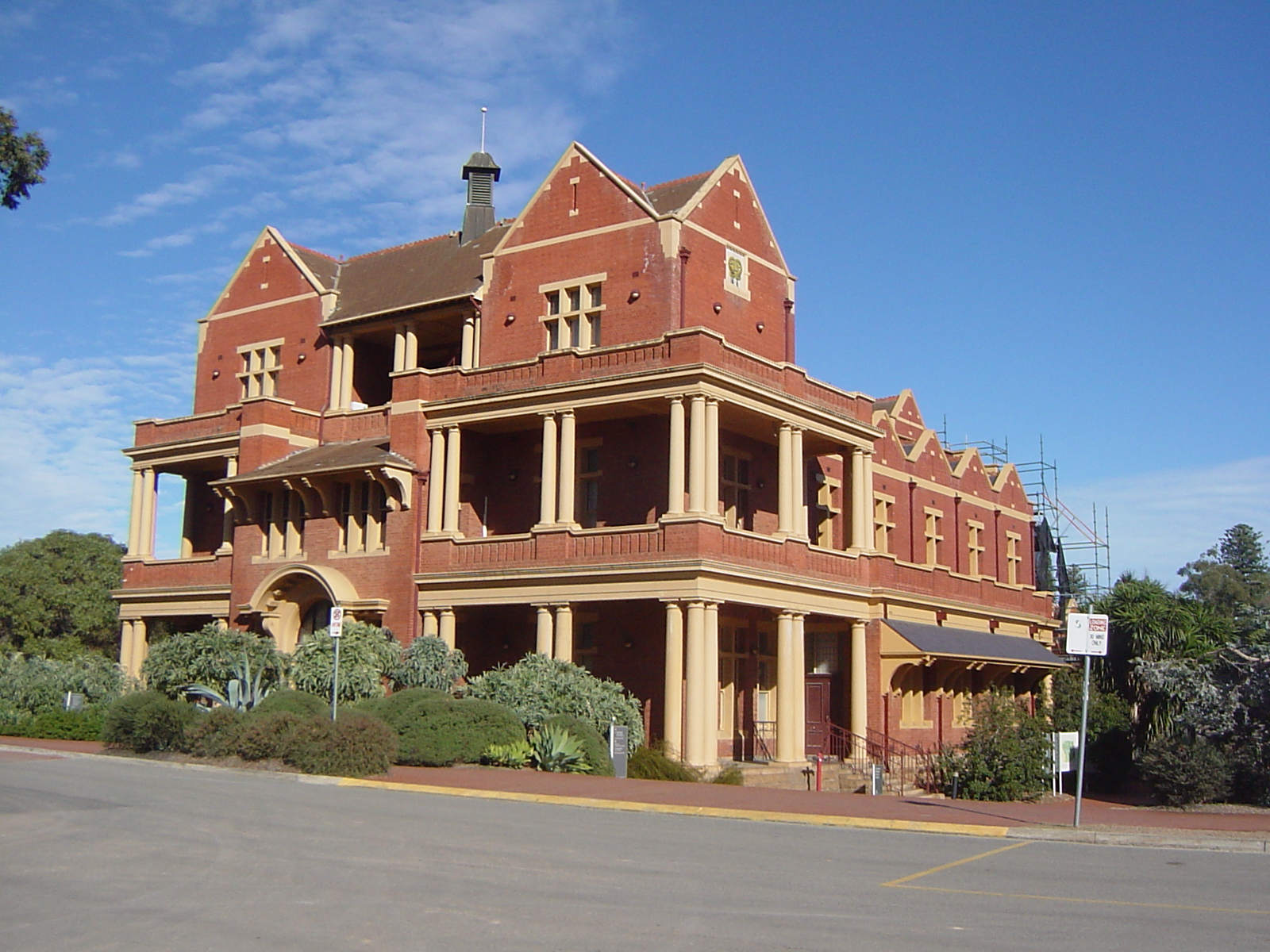
1. East Parklands with My Little Mountain (Mt Lofty) in the background. 2. A mulched avenue, once a carriage drive. 3. Ibis looking for grubs. 4. Black swans making their escape from the horrible human. 5. Goodman Building, HQ of the Botanic Gardens. 6. Moreton Bay Figs outside the Botanic Gardens entrance. 7. River Gums drinking at a small creek. 8. Pedal Prix cars practicing in the East Parklands.
Click for full size.





© Lofty, all rights reserved.
Bluejay, click for full size.

© C. Ford, all rights reserved.

Tim Mentz.
CANNON BALL, ND—The Standing Rock Sioux Tribe filed an emergency motion Sunday for a temporary restraining order to prevent further destruction of the Tribe’s sacred sites by Dakota Access Pipeline.
“On Saturday, Dakota Access Pipeline and Energy Transfer Partners brazenly used bulldozers to destroy our burial sites, prayer sites and culturally significant artifacts,” Tribal Chairman David Archambault II said. “They did this on a holiday weekend, one day after we filed court papers identifying these sacred sites. The desecration of these ancient places has already caused the Standing Rock Sioux irreparable harm. We’re asking the court to halt this path of destruction.”
After the initial destruction Saturday, Dakota Access Pipeline returned to the area and dug up additional grounds in the pre-dawn hours Sunday, Archambault said.
The motion seeks to prevent additional construction work on an area two miles west of North Dakota Highway 1806, and within 20 miles of Lake Oahe until a judge rules on the Tribe’s previous motion to stop construction.
That motion is based on the Standing Rock Sioux’s assertion that it was not properly consulted before the U.S. Army Corps of Engineers fast-tracked approval of the pipeline project.
A decision on the case, filed in the U.S. District Court for the District of Columbia, is expected by Sept. 9.
“Destroying the Tribe’s sacred places over a holiday weekend, while the judge is considering whether to block the pipeline, shows a flagrant disregard for the legal process,” said Jan Hasselman, attorney for the Standing Rock Sioux. “The Tribe has been seeking to vindicate its rights peacefully through the courts. But Dakota Access Pipeline used evidence submitted to the Court as their roadmap for what to bulldoze. That’s just wrong.”
Via ICTMN.

Courtesy Winona LaDuke/Honor the Earth.
The Sandpiper pipeline would have run through sensitive waterways, jeopardizing Ojibwe manoomin, or wild rice.
Enbridge Inc. has officially dropped its bid to build the $900 million Sandpiper oil pipeline, which would have crossed through Ojibwe wild rice lands.
The company said on September 1 that it was withdrawing its applications from the Minnesota Public Utilities after determining that “the project should be delayed until such time as crude oil production in North Dakota recovers sufficiently to support development of new pipeline capacity,” the company said in a statement on September 1.
The announcement came a month after the energy conglomerate revealed that it had bought a stake in the Dakota Access pipeline project, which is being opposed all along its four-state route.
“We are grateful for this victory against the black snake that threatened our water, wild rice, and way of life as Ojibwe people,” said Winona LaDuke, founder of the conservation group Honor the Earth, in a statement. “We call this land Anishinaabe Akiing. This is the land we belong to, and we will continue to protect it, as our ancestors did before us. We stand united against the proposed Line 3 pipeline, Dakota Access, and any new fossil fuel infrastructure anywhere. Our resistance will only continue to grow.”
I’m glad for this, however, I don’t trust any oil company to do the right thing, or to keep their grubby greed off Indian land. They have already shown, in the most despicable way, what concerns them. Full article here.
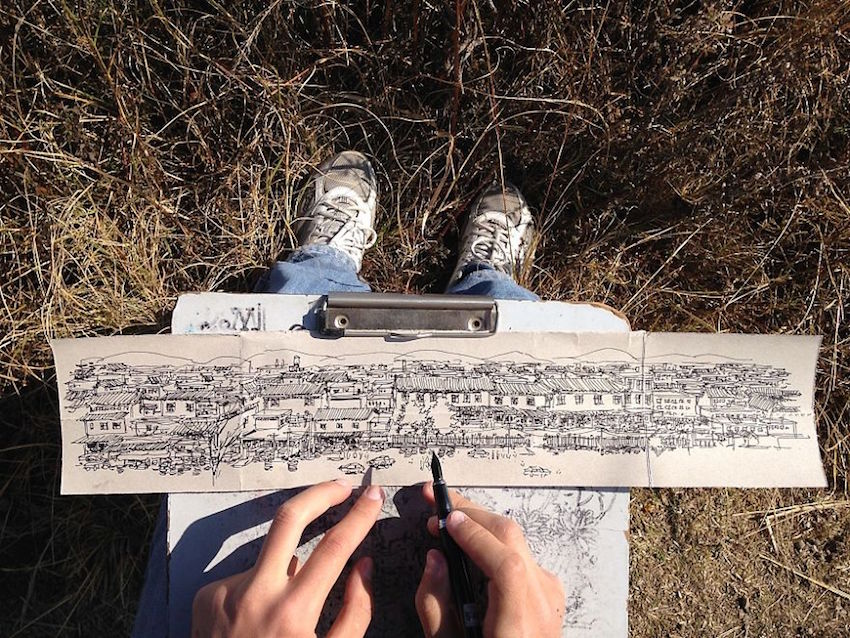
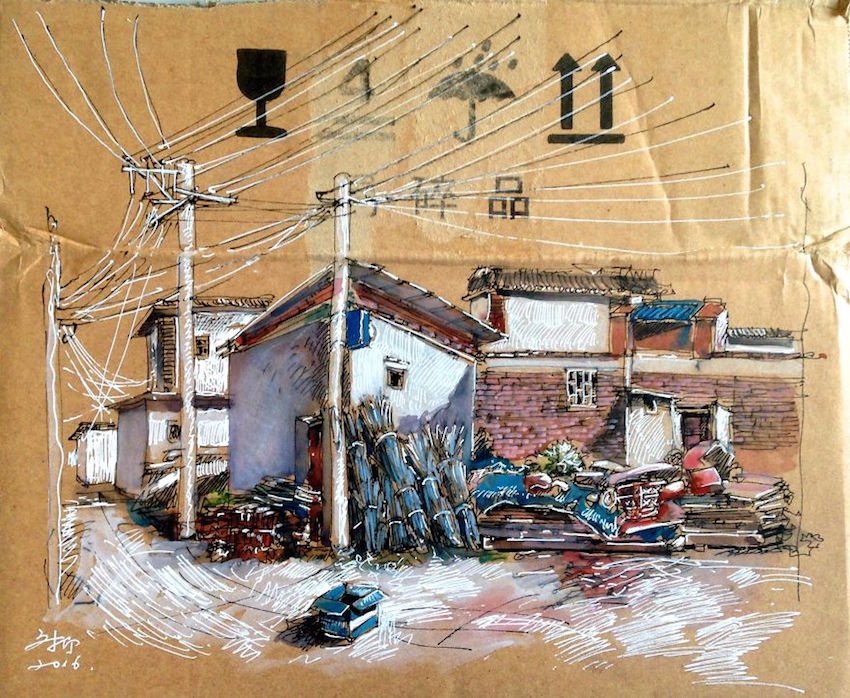

Chinese artist Wenyi wanders the streets of his home in Dali, Yunnan Province, China, gathering bits of discarded cardboard to use as his canvas. Wenyi then takes the bits of trash he finds and draws the surroundings on each object. The small pieces range from quick black and white sketches to colorful drawings of entire homes, each a snapshot of his hometown. After sketching the scenery Wenyi places his completed works back into their original locations, imbuing the everyday refuse with art. “I want people to see art in our everyday life,” said Wenyi to Bored Panda, “even if it’s on wasted paper.”
What could I possibly say? This is beautiful, inspired work, which I am sure has large ripples which affect people in a very good way. Via Colossal Art.
Togetherness. Click for full size.

Jayne, Chas and Alfie share a meal.
© C. Ford, all rights reserved.
A so very serious juvenile Grackle. Click for full size.

© C. Ford, all rights reserved.

LaDonna Bravebull Allard at Sacred Stones camp along the banks of the Cannonball River. Courtesy Kat Eng.
On this day, [September 3rd] 153 years ago, my great-great-grandmother Nape Hote Win (Mary Big Moccasin) survived the bloodiest conflict between the Sioux Nations and the U.S. Army ever on North Dakota soil. An estimated 300 to 400 of our people were killed in the Inyan Ska (Whitestone) Massacre, far more than at Wounded Knee. But very few know the story.
As we struggle for our lives today against the Dakota Access pipeline, I remember her. We cannot forget our stories of survival.
Just 50 miles east of here, in 1863, nearly 4,000 Yanktonais, Isanti (Santee), and Hunkpapa gathered alongside a lake in southeastern North Dakota, near present-day Ellendale, for an intertribal buffalo hunt to prepare for winter. It was a time of celebration and ceremony—a time to pray for the coming year, meet relatives, arrange marriages, and make plans for winter camps. Many refugees from the 1862 uprising in Minnesota, mostly women and children, had been taken in as family. Mary’s father, Oyate Tawa, was one of the 38 Dah’kotah hung in Mankato, Minesota, less than a year earlier, in the largest mass execution in the country’s history. Brigadier General Alfred Sully and soldiers came to Dakota Territory looking for the Santee who had fled the uprising. This was part of a broader U.S. military expedition to promote white settlement in the eastern Dakotas and protect access to the Montana gold fields via the Missouri River.
As my great-great-grandmother Mary Big Moccasin told the story, the attack came the day after the big hunt, when spirits were high. The sun was setting and everyone was sharing an evening meal when Sully’s soldiers surrounded the camp on Whitestone Hill. In the chaos that ensued, people tied their children to their horses and dogs and fled. Mary was 9 years old. As she ran, she was shot in the hip and went down. She laid there until morning, when a soldier found her. As he loaded her into a wagon, she heard her relatives moaning and crying on the battlefield. She was taken to a prisoner of war camp in Crow Creek where she stayed until her release in 1870.
Where the Cannonball River joins the Missouri River, at the site of our camp today to stop the Dakota Access pipeline, there used to be a whirlpool that created large, spherical sandstone formations. The river’s true name is Inyan Wakangapi Wakpa, River that Makes the Sacred Stones, and we have named the site of our resistance on my family’s land the Sacred Stone Camp. The stones are not created anymore, ever since the U.S. Army Corps of Engineers dredged the mouth of the Cannonball River and flooded the area in the late 1950s as they finished the Oahe dam. They killed a portion of our sacred river.
I was a young girl when the floods came and desecrated our burial sites and Sundance grounds. Our people are in that water.
This river holds the story of my entire life.
There is much more to this story, which you can read here.
Support Sacred Stone Camp. Legal Fund Help. Support Native Youth. Sign the Petition. Sign urgent petition.