From Giliell, click for full size!


© Giliell, all rights reserved.

From Giliell, click for full size!
© Giliell, all rights reserved.
Seems there’s a group, or organisation or something called Intercessors for America. So, a bunch of people praying, but praying apparently is not enough anymore, no. People need to vote, because Jehovah needs a government!
“You probably know the midterms are coming up,” Kubal said. “We believe God desires to align His watchmen alongside these candidates. Intercessory activism is not about mixing the role of the church with the role of government to create some form of spiritual nationalism, it is all about proper alignment between God’s people and government … God created government to punish the wrong and protect the right, [but] a government cannot know what is wrong or what is right without the church.”
Erm…so you’re not about mixing up church and government, you’re about mixing up people in the church and government, do I have that one right? Jehovah created government? Huh. Okay, just the Amerikkan version, or all governments? If it’s all governments, which one is best? Perhaps it’s just me, but I think you’re confusing the justice system with government.
“Intercessory activism is the correct alignment between God’s people bringing His values to our government,” Kubal added. “We are in a specific season where we can ask God to move greatly through the authority of our government. This is really important, this is kind of the crux of what I am talking about. In the past few years, we have prayed defensively for protection from our government, but now we are in a season to pray offensively to see great advances of the kingdom of God to be advanced through our government.”
I’ll give you credit for some grand bafflegab there, Mr. Kubal. So Jehovah has to work through the authority of the government? I guess bureaucratic red tape swallows everyone. Once again, I’m struck by the christian vision of a god, such a weak little critter, unable to do one damn thing on its own. From a christian point of view, there’s no fun at all in being a god, just another powerless being adrift on the seas of life. Tsk. I’ll be making offerings to all the art gods later this day, any one of which could whip Jehovah’s poor, powerless arse.
Kubal said that it is imperative that conservative Christians use the elections to connect with candidates with the goal of implementing “kingdom values through relationships to our government” and utilizing “the U.S. government to have His kingdom come, His will be done on earth as it is in heaven.”
Yeah, y’know, I’d think an all powerful god could push its agenda through without having to “utilize” anyone or anything. Interesting that you basically admit that all the intercessory crap is worthless.
The full mess is at RWW, with video.
And a bonus today, in the category of silliest damn prophecy ever: Prophecy: Paramedic Angels Dispatched.

Kara Walker with her “Katastwóf Karavan” at the Mississippi River Trail on February 23, 2018, in New Orleans. Josh Brasted/Getty Images.
[…] Walker titled the whole montage the Katastwóf Karavan, or Caravan of Catastrophe, the use of Haitian Creole signaling the mix of Caribbean and Southern histories that shaped New Orleans. Walker’s first public installation since the 2014 Marvelous Sugar Baby — the enormous Sphinx-like mammy figure that she built out of sugar in the now-demolished Domino factory in Williamsburg — the Karavan went up for the closing weekend of the Prospect.4 triennial, which ran for three months at multiple sites around New Orleans. The installation was freighted with layers of site-specific symbolism — none of it subtle if you knew a bit about local history, yet all of it obscured by years of avoidance or, at best, awkward notes in the narratives delivered by school curricula or tourist brochures.
Thus Algiers Point: Here, in the eighteenth century, traders warehoused disembarked captives — those who survived the Middle Passage — before selling them on the opposite bank in the markets that dotted the French Quarter and surroundings. This is where families were rent apart, humans assessed and packaged as commodities. Thus, too, Walker’s tableaux, relevant across the landscape of chattel slavery but especially here.
And thus the calliope, a direct retort to the one on the Natchez — “the OTHER calliope,” Walker called it on her handout for the event — and its sonic broadcast of a whitewashed history. Several times a day, the vessel’s instrument blares out to the city (there is no such thing as a quiet calliope) items from a hoary playlist such as “Old Man River,” “When the Saints Go Marching In,” “God Bless America,” and, yes, “Dixie’s Land.” […]
You can read and see much more about Kara Walker’s latest piece here.
This is the elusive, and very rare, flightless tube-nose Everglades albatross, but I think it’s a turtle. ;D Click for full size!

© Opus, all rights reserved.
From Giliell, click for full size!

© Giliell, all rights reserved.
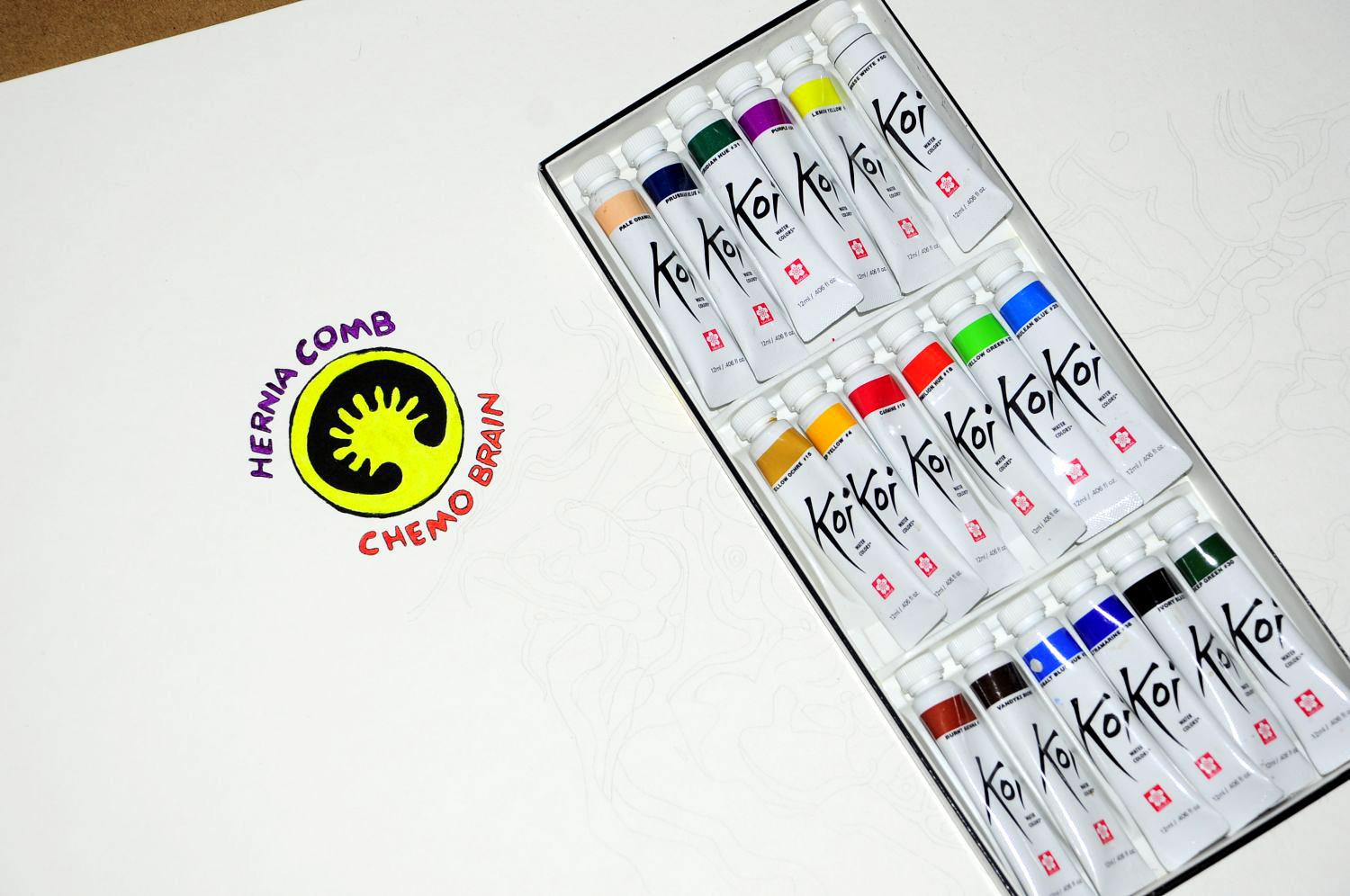
© C. Ford, all rights reserved.
I’ve been working in pencil too long, does my head in. Pigments are my true love, and always will be. They’ve been singing to me lately, which leads me to the matter of paints. A while back, a friend was thoughtful enough to send me a whole bunch of watercolours they weren’t going to use (Hi, Kestrel!), and I about screamed with delight when I saw the Sakura Koi paints. I haven’t had those in ages, and I love them. Love them to pieces. I’m not impartial to Sakura; I have a whole lot of their markers in my studio, and their products have never disappointed.
I’ve written before about the sheer gougery in art products, everything costs a bloody fortune. Just trying to recoup your materials cost in any given piece can seriously hike the price you end up asking. There is, of course, a staggering amount of snobbery in the world of art supply. Many people end up convinced that name equals quality. Sometimes, it does. Other times, not so much. Some people are so convinced that name equals quality, they don’t pay any attention to the actual quality of the product. This is oh so true when it comes to paints. The best way to insure the quality you want is to make your own, but that does your wallet no favours. Back to the Sakura Koi – the set I bought ages ago, I did buy because of price. Sakura manages to attach a reasonable price to their products, which is not a crime, in spite of many people thinking so. I was pleasantly surprised by the quality of the pigments, clear, bright, and luminous. It’s very easy to get distracted by the ‘big’ names, and spurn the reasonably priced stuff, but it’s truly worth your while to give the reasonable stuff a try, there are many gems there which you won’t be disappointed in at all, and they’re a kindness to that wallet too. The 18 set shown runs around $27.00 these days, and the tubes are a very generous 12 ml, so they’ll last a long time.

Members of the Dora Milaje in “Black Panther.” From left: Okoye (Danai Gurira), Nakia (Lupita Nyong’o) and Ayo (Florence Kasumba). Matt Kennedy / Marvel Studios.
Carolina Miranda has the compleat rundown on Pantherian analysis:
Have you heard about the little movie that tells the story of a royal man-feline named T’Challa who is powered by vibranium and defends a secret African paradise named Wakanda?
Ryan Coogler’s “Black Panther” is not just an epic comic-book action flick — it could approach the $1-billion mark globally after its opening in China this weekend — the movie is a full-blown cultural phenomenon, generating a cottage industry of cultural criticism that touches on a spectacular array of topics, including racial politics, geopolitics, gender issues, beauty standards, design and urbanism. (Hello, Wakandan municipal transit system!)
In fact, there are so many takes on “Black Panther” that New York-based educator Roberto Soto-Carrion has helpfully compiled dozens of analytical stories related to the film and the “Black Panther” comics in general into a 14-page Google Doc called “The Black Panther Reader.”
Ms. Miranda’s summary is excellent, and provides a great overview, with many links for those who wish to delve deeper. You can read it here.
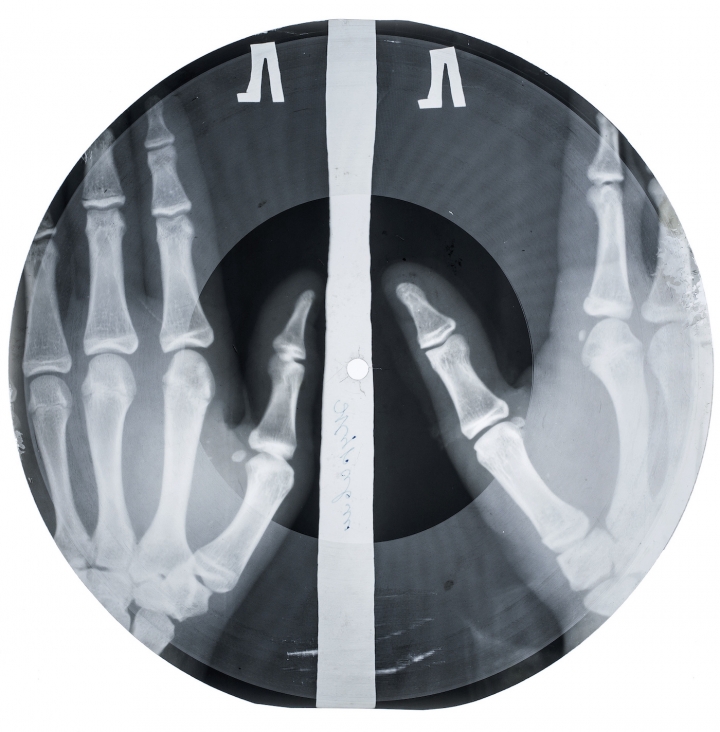
Example of an x-ray record (all photos courtesy X-Ray Audio Project/Paul Heartfield).
Several years ago, while poking around a flea market in St. Petersburg, musician Stephen Coates came across a record unlike any other he had ever seen. Rather than etched on vinyl, its tiny grooves were cut onto a medical X-ray, tracing shallow circles over the ghostly shapes of bones.
“I immediately knew I had to find out who made it, why they made it, and how they made it,” Coates told Hyperallergic in a recent phone interview. He soon realized that the 78 RPM he had purchased — a single of “Rock Around the Clock” by Bill Haley & His Comets — was just one of many strange, makeshift records created in the Cold War years of the Soviet Union. Produced and disseminated on an underground market to circumvent government control of culture, these flimsy sheets were known as roentgenizdat, or “bone music.”

Installation view of ‘Forbidden Music: X-Ray Audio in the USSR, 1946 – 1964’ at the Tel Aviv Museum of Art.
Working with photographer Paul Heartfield, Coates has since established the X-Ray Audio Project, a multi-faceted endeavor to chronicle and share the history of roentgenizdat. The pair has released a book and documentary on their extensive research and have also organized a traveling exhibition. It is currently at the Tel Aviv Museum of Art, where examples of the decades-old transparencies are on view along with documents and other ephemera that together tell the technical, cultural, and human stories of this particular form of audio. Visitors can also listen to digitized recordings of the bone music, which, like homemade mixtapes, are far from crystal clear.
An absolutely fascinating subject! Humans are utterly amazing in their ability to circumvent control, and there’s nothing like declaring something forbidden to bring out the creative rebellion in people. You can read and see much more at Hyperallergic. I would love to be able to see this show, if you have the chance, don’t miss it!

All of the stunning paintings in Svenska Fåglar (Swedish Birds) by the von Wright brothers (1929 folio version) are in the public domain, and free to download and use in any way you wish. This is exquisite artwork, so even if you don’t want to use it, have a wander anyway, your day will be better for it. Also in the public domain are Birds of Australia, Ornithological volume by John Gould (1804-1881), illustrated by Elizabeth Gould (1804–1841), which introduced more than 300 new birds to the world.

© C. Ford, all rights reserved.
From Giliell, click for full size!

© Giliell, all rights reserved.