Behind the Iron Curtain part 11 – Ownership of the Means of Production

These are my recollections of a life behind the iron curtain. I do not aim to give perfect and objective evaluation of anything, but to share my personal experiences and memories. It will explain why I just cannot get misty eyed over some ideas on the political left and why I loathe many ideas on the right.


It can be argued that the regime in former Soviet bloc was never communist. I would agree with that and so did the regime itself. However to argue that it was not socialist or leftist would be false. The regime did try to provide for people and take care of them. And whilst it was agreed that the ideal of communism was not achieved yet, the means of production did belong to the people. Sort of.

The argument presented to us at school was a simple syllogism: Means of production belong to the state. The state consists of the people. Therefore the means of production belong to the people.

As it often is, it never is that simple and it did not work out. And the experience convinced me that ownership of the means of production by the people cannot work on grand scale. I think it might work on small-scale, on a scale of up to a few dozen or perhaps a few hundred people, not more. This is about the maximum where people can function as internally cohesive society (commune, if you wish), because at this small-scale people can manage to keep internal tabs of tits for tats. So cheaters and slackers can feel the negative consequences of their actions quickly either by being shunned by those they wronged, or by not getting their share of the produce etc. Thus people keep connection to each other and to the consequences of their actions, because those consequences – both social and economical – are nearby both in time and space.

I have already mentioned slacking at work, because nobody was motivated to work too much. What has thrived on the other hand was black market for labor. So for example if you wanted a house repaired, via official means it might take years and not be done properly. The only way to get things done was often to have “friends” help you to repair it in their free time. Such helps were paid cash without paper trail and artisans like plumbers, electricians etc. were highly sought after – and such illegal work was for them the only means to get extra money. So they skived off of work and often even stole materials from the state in order to make untaxed money on the side (immediate and personal reward – and also immediate and personal punishment if the word got around that one does a sloppy job).

Rarely anyone ever felt this is wrong. There was a great emotional disconnect between the State and its people. The above mentioned syllogism was not convincing enough. I mentioned the saying “who does not steal from the state, steals from their own family”. It was perceived by many people that since everything belongs to the state, it also belongs to ME and therefore I am entitled to help myself when the opportunity presents itself. One teacher tried to explain to us that such is not the case, that by stealing for example a sack of cement from the state of ten million people means one is only taking one tenth of one millionth of said sack that is their own, and the rest is stolen from the remaining 9.999.999 people, but I have noticed that none of my schoolmates was affected much by this logic. Those 9.999.999 people are a faceless crowd, an abstract concept too big to fit into human mind.

The problem here, as Terry Pratchett once brilliantly stated in Night Watch, was not the wrong kind of government, but the wrong kind of people. People on average are not kind-hearted, altruistic and rational. They are petty, selfish and short-sighted. Trying to make them connect with something as grand as a “state” or “nation” only works as long as they are personally and immediately affected. It cannot keep them motivated for long and for a reward that might only affect their grandchildren when the communism finally arrives and money is not needed anymore.


 

The Cure for All Venereal Diseases!

The cure for all venereal disease, brought to you by…Jim Bakker, who else? One might enquire just what good christians might need with such a cure, but I doubt any sort of answer would ensue. By the way, silver is not a cure for fucking anything, particularly not venereal disease. It’s of no more use than mercury used to be, so don’t even think about it.

Source.

From Jim’s scamsite:

Silver Solution Gel

Silver Solution Gel (24ppm) works faster, longer and more efficiently than other silvers to promote natural healing.

  • Faster – By using catalytic instead of chemical action,  Silver helps speed up natural processes that have positive effects on the body.
  • Longer – Unlike other silvers that quit working after completing one function, Silver performs over and over for hours.
  • More Efficiently – By resonating at just the right frequency, Silver disrupts foreign elements without disturbing the body’s natural environment.

Silver Solution Gel provides soothing action for the skin and can be applied as needed. This four-ounce tube is perfect for toting in your purse or stowing in your desk drawer, glove box or medicine cabinet.

NO. No, no, no, to all that shit. Not so, not true, bullshit all the way. I do note that good ol’ Jim doesn’t personally believe in all these amazing benefits from silver, as he hasn’t turned even a light shade of gray-blue, [argyria] which is what taking colloidal silver will do to you eventually, and it’s permanent.  It’s not any nice shade of blue, either. It’s barely blue, more a decayed corpse colour.

Making a Rondel Dagger – Part 9 – Turning the Handle

The dagger of Ciri in The game Witcher 3 has handle turned from some yellow wood. Looks almost canary yellow in the game, but orange in the extracted 3D file without the in-game lighting. There is only one wood that I know that has such color – Osage orange – and only when freshly worked at that, it ages to dark brown. There is another wood that has very nice yellow (vanilla) color both fresh and aged, and that is Black elder. I would love to make the handle from black elder, because it is beautiful hard wood and it is a pleasure to work with. Alas, I do not have a piece big enough. So I had to go with Sycamore maple which is pale yellow and ages to slightly darker yellow.

I begun by cutting an approximately 50×50 mm rectangular block on my circular saw. Dried maple wood is unfortunately not only very hard, but also has very small pores, so it tends to burn on circular saw. There is nothing that can be done about it except to work slowly. Unfortunately I only had this one piece of big enough maple wood at hand and it had a very deep split at exactly the wrong place, so I had to shorten it to 120 mm, 6 mm shorter than I wanted to based on the proportions from the 3D game file. But since I am not aiming for exact replica and I will make slight changes to the design of the dagger anyway that should not bother me. But it does, go figure. I can gain a few mm on the bolster and on the rondel later on if I decide it needs to be done.


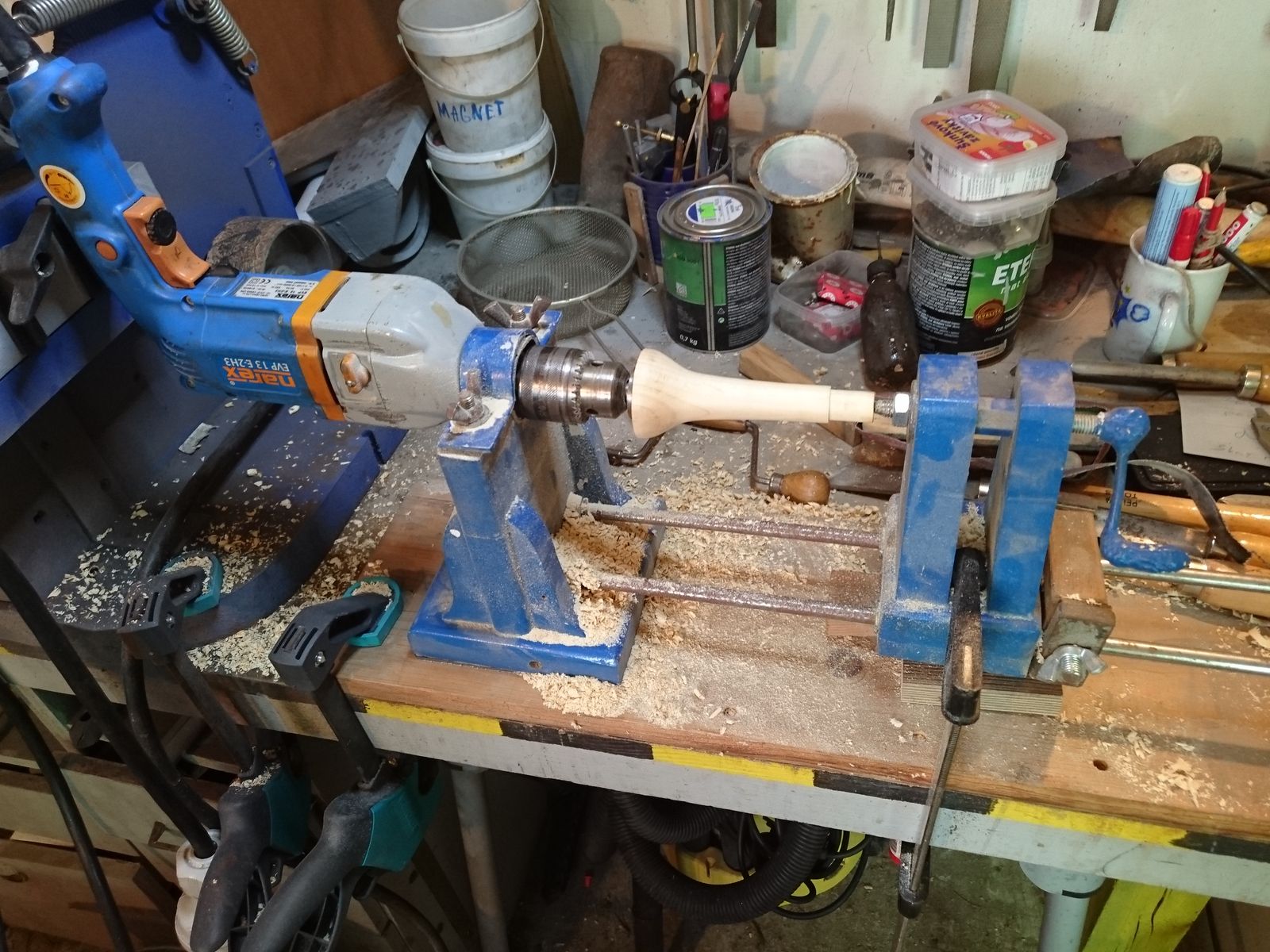
Next step was to turn the handle. This is where I can show off with my Poor Man’s Lathe that I have built twenty years ago. Unfortunately I did not have too many opportunities to work on it yet, so my experience with wood-turning is extremely limited.

First came fixing the piece of wood between the points of the lathe. On the left the drill holds not a drill bit, but a special piece with a central point and three screwdriver like flattened teeth to hold onto the workpiece. Normally I would hammer it into the wood, but sycamore wood is very hard. I had to pre-drill the holes. On the right there is a round tip that goes into a depression in the wood. It helps to put a bit of grease or a few drops of oil on this point, otherwise the friction can and will burn the wood and it will smoke.

Second comes turning the wood down to a cylinder of the maximum diameter the final piece is supposed to have. On this part it is important to work with slow rotations because the workpiece is not yet symmetrical and on high rotations it would vibrate and it could potentially fly out of the lathe and smash window in best case, or throat in worst case. Neither of these lessons have I learned first hand, and do not intend to. Better safe than sorry.

So easy does it, no rushing, slowly chipping on the edges until there is a symmetrical cylinder rotating on the lathe. Then the speed can be increased and final shape can be formed. Since this is hard wood, the angle of the chisel blade to the piece is held at close to 90 degrees and I was more scratching than cutting the wood. Trying to get a continuous cut on completely dried hardwood like this is asking for trouble unless one is very, very good and experienced at it – in best case the chisel bites in deep and no matter how sharp it is, it tears of a splinter instead of cutting, ruining the piece. Worst case the leverage could damage the chisel or tear it from one’s hands and… I shudder to think about it. I learned the first lesson here, but fortunately not the second one. For the same reason also the chisel support should be kept as close to the workpiece as possible the whole time.

When turning the shape I first turned town the part for bolster as precisely as I could under the circumstances (the circumstances being that I have no bolster prepared yet). then I turned a piece of handle down to the final width and lastly I turned the middle. Apart from the overall width on both ends I did not do any measurements and I turned the handle down to a shape that simply “looked” right to me.

After that I could remove the chisel support and could polish the piece with 80, 120, 180 and 320 grit sandpaper. This I have done partly on lathe by turning the piece and partly in hand sanding lengthwise in order to remove all visible scratches. Sycamore wood is very hard and can take very good polish, but this piece will get dirty yet no matter what I do, so there is no point fussing about that too much yet.

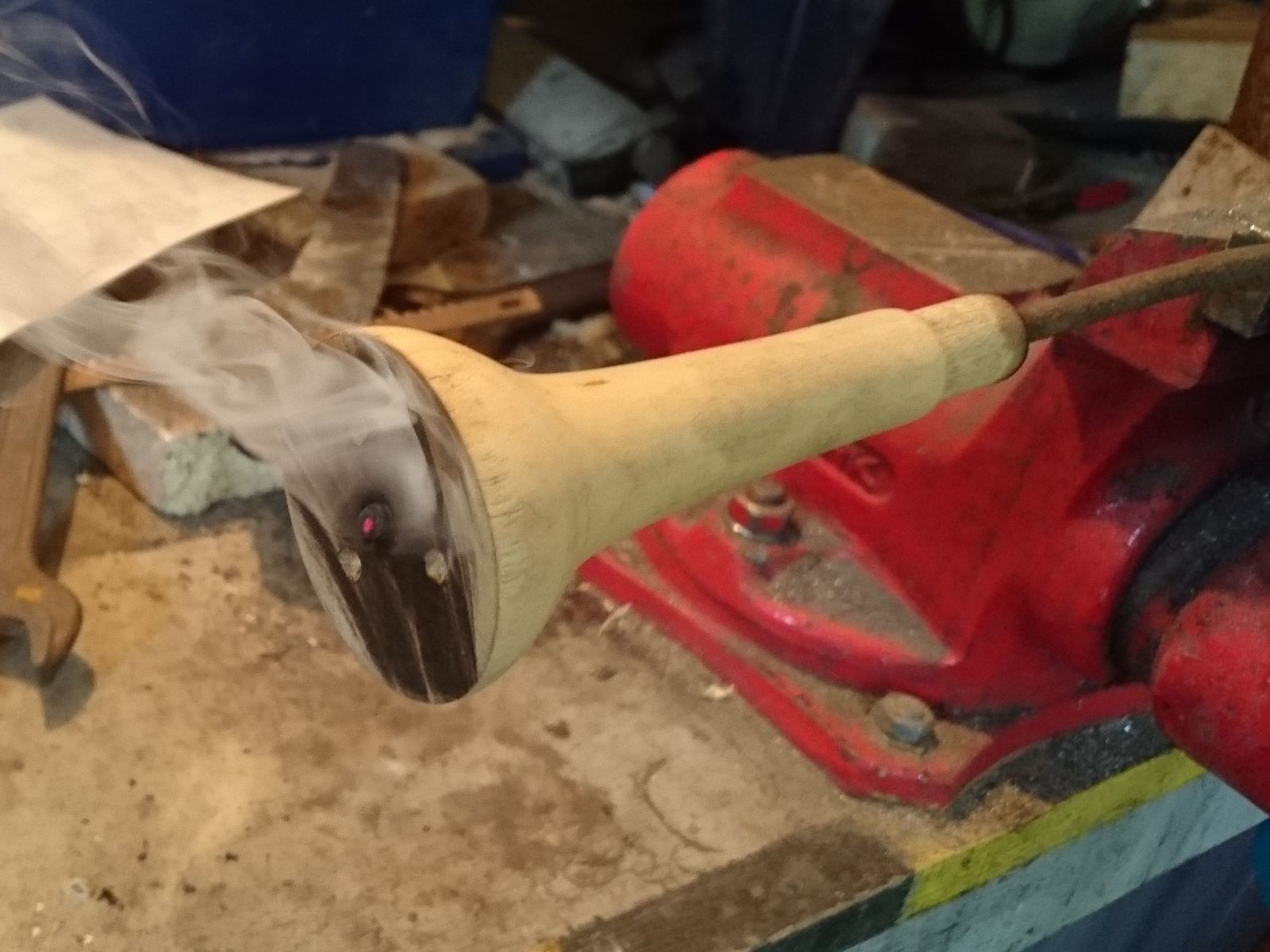
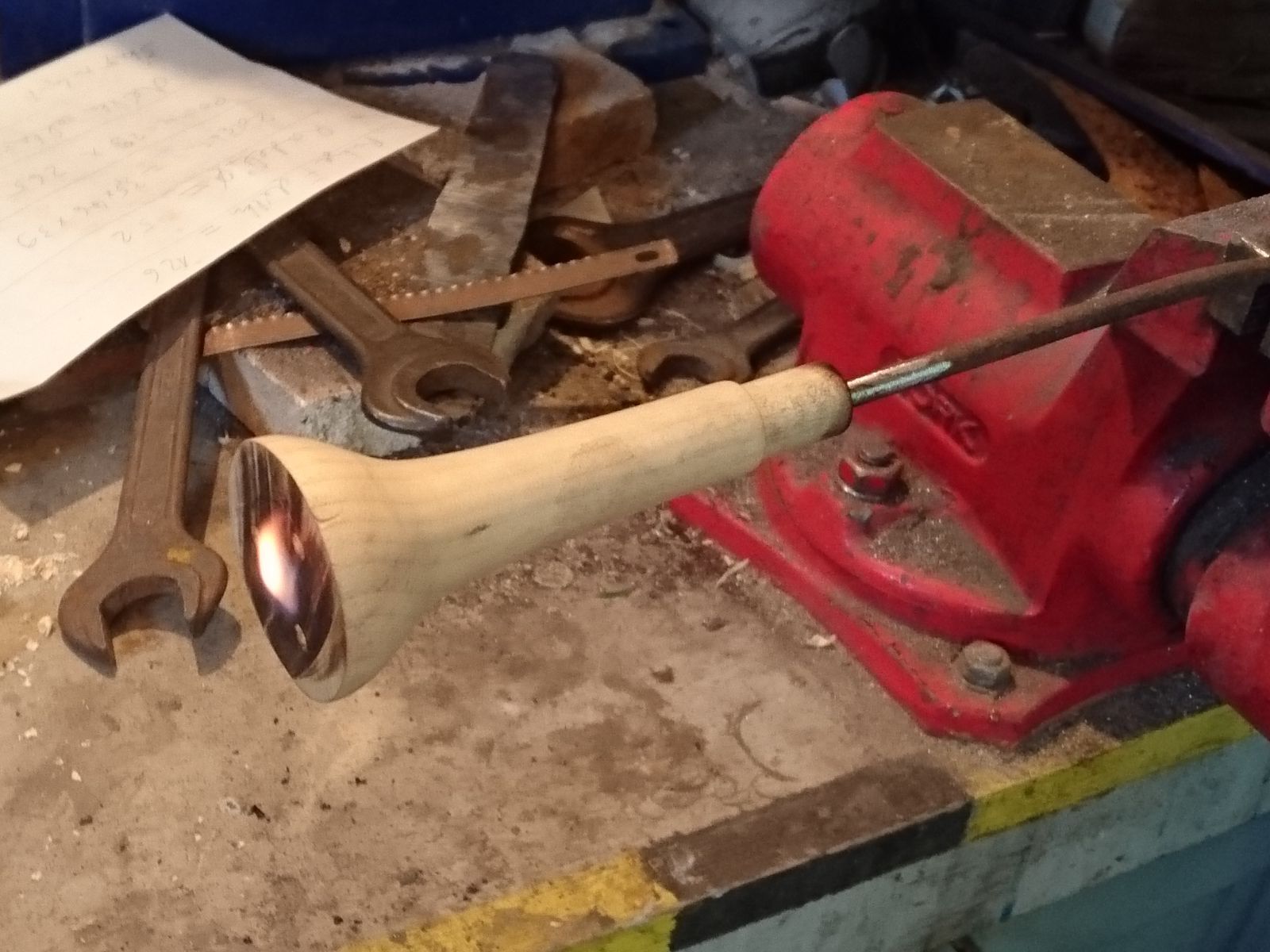
Last step is making the hole for the tang. I do not have a drill bit long and thin enough for this, so I drilled as far as I could and I burned the rest through with a piece of steel of approximately the right shape held in a vice and heated up with torch to red heat. This has produced an awful lot of smoke and took a lot longer than I hoped for. Not an enjoyable work, if you ask me. Not particularly safe one either. Even with the door open wide the whole room has filled with smoke hat stung the eyes even through protective welding goggles.

Towards the end, when the burnings from both ends met in the middle and actually made a hole throughout the whole handle, the smoke spouting out of the end could be ignited for a short time. That was fun to watch and a bugger to make a picture of, with burning torch in one hand and the phone in the other. I have managed only this one picture, where the flame almost goes out already. After I made hole through, I have closed the gas valve on the bomb and put the hot torch on granite stone on the table. Thus I was finished for the day with nearly thre hours of work done. Two hours later I went back to to check nothing burns and on finding my shop smoke-free I could go to bed.

Next step will be to find suitable pieces of steel for the bolster and the guard, and shaping them together with the hanlde – and the tang – so everything fits together.