From Nightjar, (photo is below the fold because of the bonus spider!)
Affinity
Art, Fun, & Nonsense.

From Nightjar, (photo is below the fold because of the bonus spider!)

Stick out your tongue and say aahh ©voyager, all rights reserved
Jack and I were out pretty early this morning because I had an out-of-town doctors appointment that took up most of the rest of my day. About every 3 or 4 weeks I get lidocaine injections along my spine that help control pain and muscle spasms related to scoliosis and fibromyalgia. It’s a bad day in a good way. The injections are exhausting and wipe me out, but that’s partly because I can feel the relief of my muscles relaxing. It’s a bit like breathing out after holding your breath for a really long time. I’m a bit dizzy, a bit light-headed and a bit groggy. That’s with a successful set of injections. Not every set is as good as every other, but I’ve been with this Dr. for a few years now and she’s gotten pretty good at figuring out the twists and dips of my spine. So, now I’m going to toddle off to bed and by morning I hope to have my cheerful back.

J.M. Callwell. Little Curiosity, The Story of a German Christmas. London (Glasgow, Edinburgh, Dublin), Blackie and Son, 1884.
Surprise! It’s July 25 – the perfect day for mid-summer Christmas. I love that this cover has none of the usual trappings that appear on later books about the season. There’s no snow, no crèche, no tinseled tree and nary a gift in sight – just a happy little bird singing.
via: University of Florida Digital Collections, George A. Smathers Libraries
In the past, I have expressed the opinion that just about the only really decent person in the whole Potterverse is Hermione Granger and I stand by that statement. Every single wizard was way too keen on having slaves.
I found this guy’s pronunciation a bit difficult to understand, but I got over it and the video was informative. I did not know that the argument “slaves are happy” was actually really used in the UK by anti-abolitionists since education about the minutiae of slavery is not really part of the curriculum in our schools.

X is for Xanthic, ©Nightjar,all rights reserved
Xanthic.
Just another word for yellow or yellowish things. The flower is Oxalis pes-caprae, an invasive weed here.
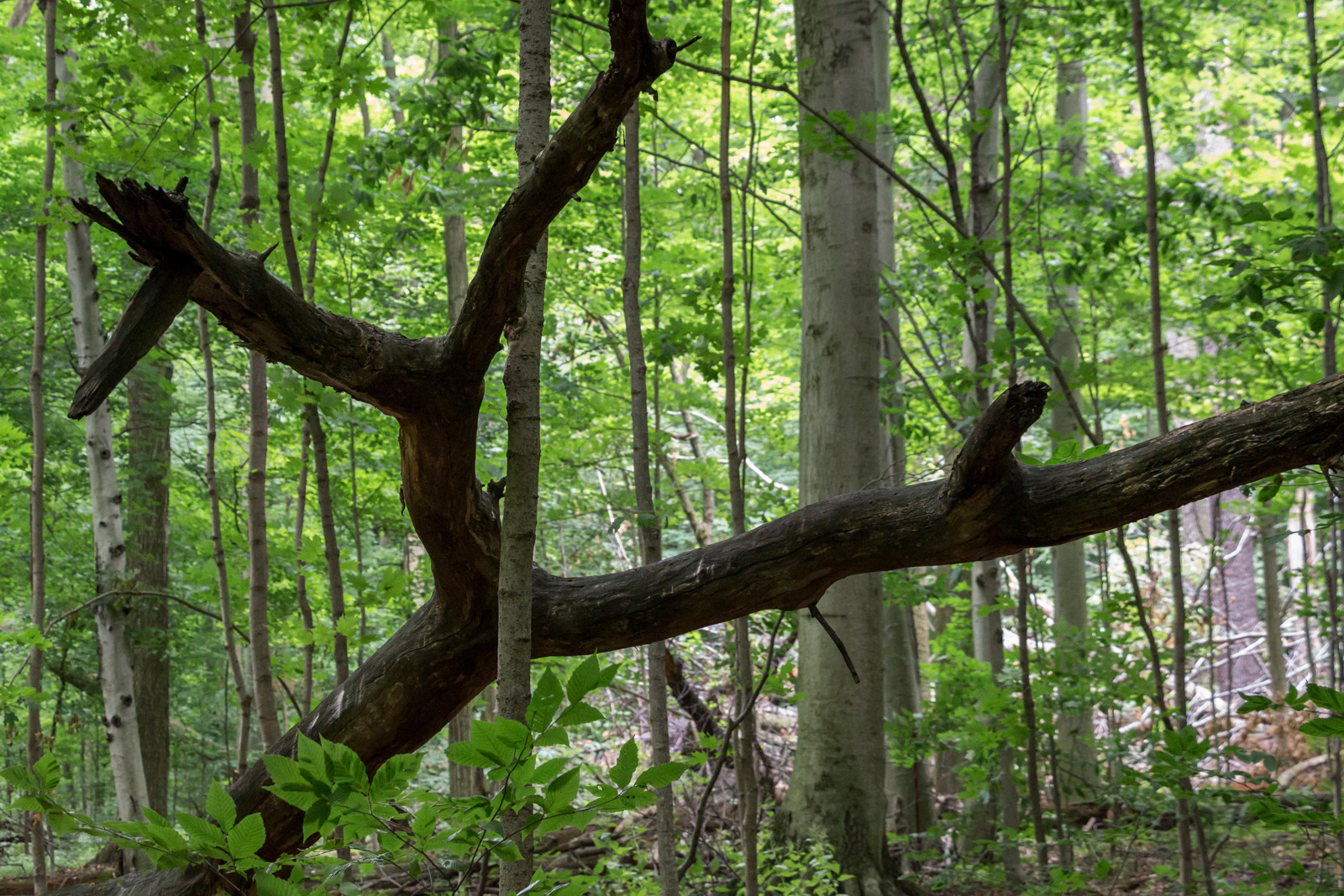
Lean on me ©voyager, all rights reserved
Jack and I are enjoying being outside this week. The heat wave has finally broken and so has the high humidity, making it ever so much easier to get out for walks. We don’t have to get up before dawn or go out late at night and even the mid-afternoon is an acceptable time to be outside if there’s a bit of shade around. We’ve also been able to turn the air-conditioning off at home which is the biggest plus of all. I’d much rather have my windows open and tuned to the sounds of my neighbourhood than listen to the droning hum of the A/C unit.
 These are the three blades that were quenched by using protective stainless steel foil. The function of the foil is to prevent decarburization during the extremely high temperature at which this steel needs to be held at for prolonged time in order to get all carbides into solution.
My initial thoughts were that the blades warped because they are ground too thin. Well, that is not true. Today I have measured the thickness and they are indeed way thinner than I should have made them – all are just 0,35-0,45 mm thick at the cutting edge – but three of the remaining blades are even thinner, three are in the same range and only four are thicker. And of those thinner or just as thin as these, one has very, very slight bend towards the tip that should be possible to correct, and the rest is straight.
So the blade thickness is not the cause. I cannot imagine what else could it be, I do not believe that the foil could have such impact, not to mention that these blades were pulled out of the foil prior to quenching.
My second guess would be decarburization, maybe the experimental protective coating did not work as well as it should and the steel has lost some of its carbon, making it less prone to warping in the quench. But it should also leave it much softer post quench, and I just do not see that.
I have tried my hardness assessing gauges on bought kitchen knife – that big fat stainless steel overpriced junk to be precise – and I got the same result as for the softest one of these – that is, approx 52 HRC.
This means that the blades where my 62 gauge does not scratch are definitively the hardest blades and harder than the store-bought one. And the 62 gauge scratches all these three, but it does not scratch 3 of those where I used the experimental protective coating. And to add to the confusion, one of those three hardest ones is also one of the thinnest. This to me rules out decarburization as the deciding factor for the warping, although it might have caused the high variation in hardness.
I do not believe it is due to my grinding skill, because that should distribute the warping randomly and not only on the three blades that were quenched with foil.
Currently, I am just scratching my head. Any opinion is welcome.
My next step can be either to make these blades circa 5 mm narrower by grinding away the curly parts or trying to re-harden them with the protective coating and maeybe even trying plate-quenching instead of oil. I have never done plate quenching, maybe this could be a good opportunity to try it out…

John Guidfollow; or, the Murder of the Earl of Strathmore. A Mystical, Historical Romance of Forfarshire. Alexander Lowson. Glasgow: Thomas D. Morison. London: Simpkin, Marshall & Co, 1890. First edition.
via: Books and Art
Update: The title of this post and the book I posted don’t match. Obviously, I wasn’t paying attention during the proofreading part of this posting. The book on display is: John Guidfollow; or the Murder of the Earl of Strathmore. I’ll post the book “Little Curiosity” tomorrow. I apologize for the mix-up.
From Nightjar,

W is for White, ©Nightjar, all rights reserved
White.
In the petals of a Chrysanthemums flower.
Summer is in full swing one way or another (it’s been sunny, it’s been rainy, it’s been both at once!), I’m on vacation time until the end of the month, and between work (yes, I know…) and the kids and the opportunity for physical recovery (sleep! sleep! sleep!), I have spending a lot of time contemplating my life – for better and for worse.
I don’t know how soon I will return to more regular posts, so the irregularity shall be maintained for the foreseeable future.

© rq, all rights reserved

Cedar Creek, ©voyager, all rights reserved
– Henry James
I took both blades to work and measured the hardness on the tang and near the spine. On one blade I have measured 52 HRC, which is actually good and is the value that I was aiming for this area. The second blade however only measured 47 which gave me a pause, because it just did not feel right (it is still perfectly OK value for the spine though). Scratching with an ordinary file has shown that both blades are softer at the spine than at the cutting edge, which is too desired and that it came out that way straight out of tempering means that I do not need to temper the spine extra with a propane torch, which was my original plan.
The “better” blade looks now like this.
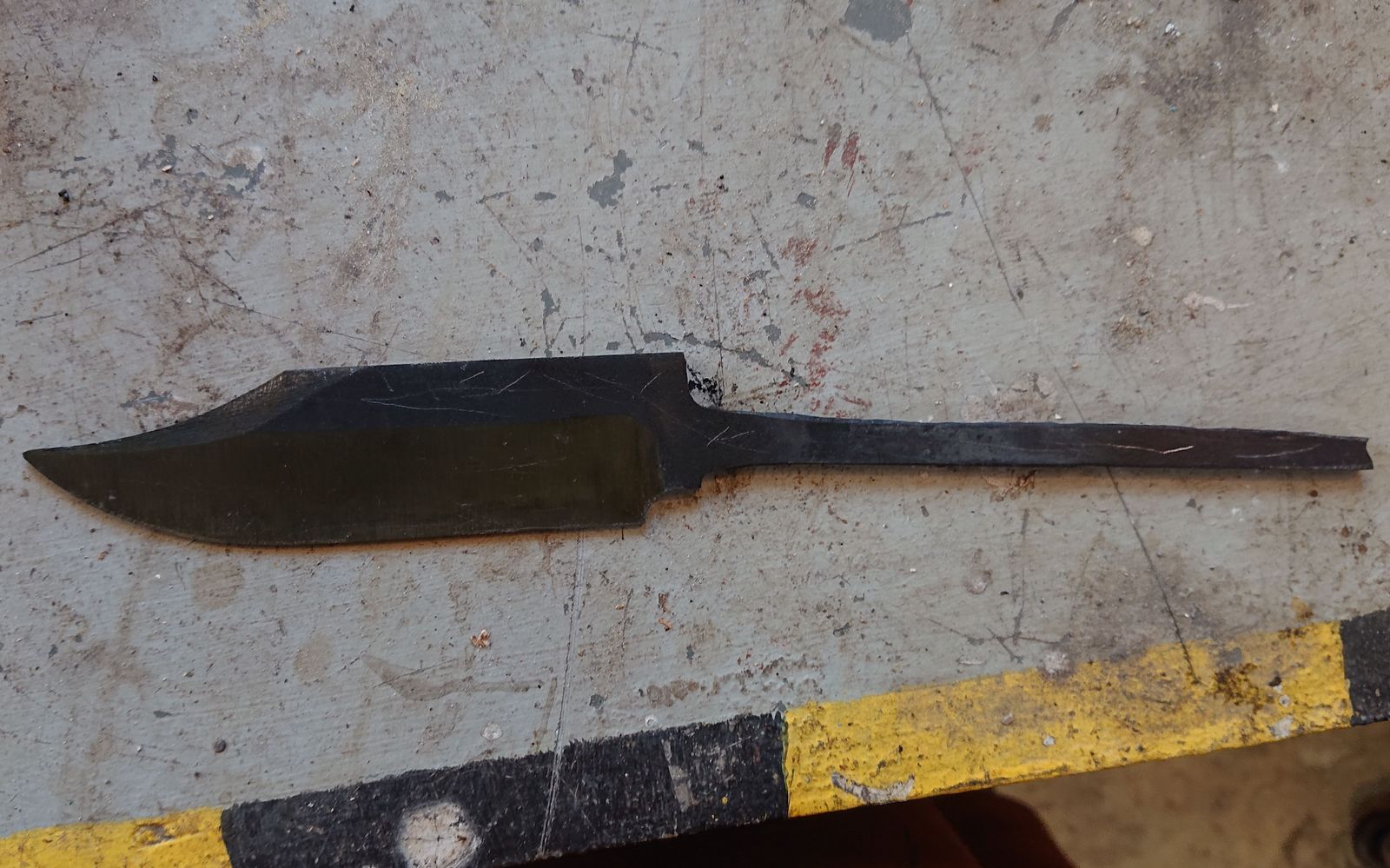
Tempered blade © Charly, all rights reserved. Click for full size.
You can see the scratches from further testing at home, where I have indeed established that both blades are approximately identical – both hardened through, but harder at the edge, both probably 52 HRC and more. So how came about the difference in measurement? I got an idea how that could happen and it turned out to be correct – the blade with lower measured value is ever so slightly bent, it is not visible with the bare eye, only when I put a straightedge alongside it and looked against the light. And I have measured it on the convex side, which means it was behaving a bit like a spring thus lowering the measured value. That is the reason why these measurements are supposed to be done on clean and flat-ground things with parallel surfaces.
And how did I establish, that both blades are nearly identical? With these.

Gages for estimating hardness. © Charly, all rights reserved. Click for full size.
I have made these miniature chisels in the winter and I measured them at work. I used nearly the same process as when McGyvering the precursors for these last year. Then it got put on hold until yesterday and today when I finally got to etching their HRC hardness onto the blades and inserting them in handles.
They are not perfect, for some reason the hardness can wary within one blade so the higher one does not always reliably scratch the lower one, but they do give me an estimate. For example, I have also tested the tempered blades for kitchen knives. One blade got scratched with the 53 gauge, but none got scratched with the 51. From the rest, none got scratched with the 57 gauge, and the 62 scratched all blades but three. And all gauges can scratch the unhardened tang.
That is a far better result than I expected – no blade seems to be under 52 HRC, which is the lowest limit I have set to myself for knives. I did not pull this value out of a hat – it is the lower tolerance limit used for combat knives in former Czechoslovak People’s Army, and I reckon if it is good enough for the army of a paranoid totalitarian state, it is good enough for me. And since 62 HRC is nearly the upper limit for the steel I used for these knives, it seems that despite still a bit improvised setup, I have indeed hardened some blades as well as it is possible.
Although there is no reason to really think one of the two blades is really worse than the other, still the blade where I measured 52 goes to the customer, and the blade where I measured 47 goes into auction here (provided I do not destroy one in due course).

Chic Choc Mountains, Gaspe Peninsula ©voyager, all rights reserved
There’s one more reason to love trees. A new study from The Crowther Lab, ETH Zurich, published in the Journal of Science, July 2019, says that targeted reforestation could isolate 2/3 of human-made carbon emissions and would be the best way to mitigate the effects of climate change.
The researchers calculated that under the current climate conditions, Earth’s land could support 4.4 billion hectares of continuous tree cover. That is 1.6 billion more than the currently existing 2.8 billion hectares. Of these 1.6 billion hectares, 0.9 billion hectares fulfill the criterion of not being used by hu-mans. This means that there is currently an area of the size of the US available for tree restoration. Once mature, these new forests could store 205 billion tonnes of carbon: about two thirds of the 300 billion tonnes of carbon that has been released into the atmosphere as a result of human activity since the Industrial Revolution.
Calculations were made based on current conditions and cities and agricultural areas were not included because those areas are necessary to support human life.
According to Prof. Thomas Crowther, co-author of the study and founder of the Crowther Lab at ETH Zurich: “We all knew that restoring forests could play a part in tackling climate change, but we didn’t really know how big the impact would be. Our study shows clearly that forest restoration is the best climate change solution available today. But we must act quickly, as new forests will take decades to mature and achieve their full potential as a source of natural carbon storage…. The study also shows which parts of the world are most suited to forest restoration. The greatest potential can be found in just six countries: Russia (151 million hectares); the US (103 million hectares); Canada (78.4 million hectares); Australia (58 million hectares); Brazil (49.7 million hectares); and China (40.2 million hectares).
I encourage you to check out the Crowther Website where you can read the report in full. The site also offers a tool that allows you to pinpoint any area on the globe to find out about its reforestation potential.
via: Science Daily