Jack’s Walk

©voyager, all rights reserved
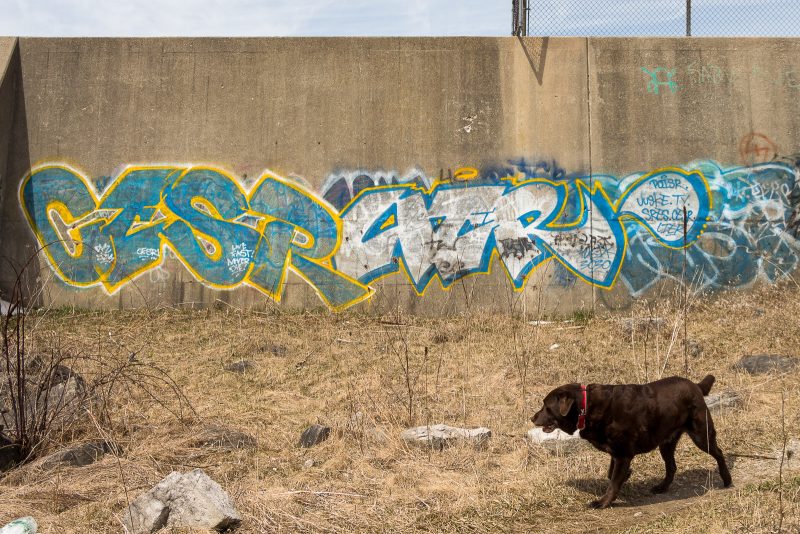
It’s another beautiful day here and I’m enjoying the freedom of being outside without being all bundled up. For the past few days Jack and I have been walking in a new area because our usual forest path hasn’t been cleared yet of several large fallen trees. Jack thinks this new route is pretty swell. It runs close to the river and he’s been able to frolic in the water every day. I don’t think the route is swell and it’s not because of the wet dog. It’s because of all the dead trees. Several years ago my area was hard hit by the emerald ash borer beetle. (Agrilus planipennis) It destroyed every tree in the park that connects with this path and many more were cut down in neighbouring areas to help to help prevent the spread. What was once a lush green park with mature trees is now riddled with decaying stumps and fallen branches. Our winters have become so warm that these critters can now survive this far north. One more victim of climate change.

Scandinavian Letters: Äng.

Äng.

Äng is meadow in Swedish. The sunset picture is a variant version of a picture from the Laajalahti Nature Preserve I’ve used before and sent to this blog. While there are trees in the picture, there’s open land that is used for as a cow pasture there, in order to restore traditional seashore meadowland.

The night time picture is from summer 2017. I was walking home from my cousin’s wedding and decided to take some night photos.

Ä is used in at least Finnish, Swedish, Estonian and German. In different languages, different pronunciations are used, but it’s generally a wovel pronounced in the frontal part of the mouth. In Finnish and Swedish it’s the second to last letter in the alphabet.

Click for full size!

© Ice Swimmer, all rights reserved.

Russia – Famous Graves

The most prestigious cemetery in Russia lies on the other side of Lenin’s tomb, directly in the Kremlin wall necropolis. That is where the greatest of Russians lie.  There you will find Stalin, Brezhnev, Chernenko and astronaut Yuri Gargarin. Very few are up to this highest of honors, though, so where do the rich and famous of Russia go when they die? The answer is likely the Novodevichy Cemetery in Moscow.

The cemetery is large and active with many visitors, some to visit specific graves and others to view the entire site as an outdoor gallery filled with history and graced by the best of Russian art. Despite large numbers of people the cemetery maintains a quiet, reflective quality. Some graves have small chairs for guests. Many graves have small offerings of fruit or sweets. Many more have fresh flowers and there is, conveniently, a florist’s shop at the front gate. There are several graves that I photographed that I was unable to locate information about. They are so beautiful that I include them anyway. I really wish I’d had more time here. Lots more time. What a very special place. (I apologize about the quality. My real camera broke and I was using an old spare)

First, I’ll start with the well-known graves.

Boris Yeltsin


Nikita Krushchev


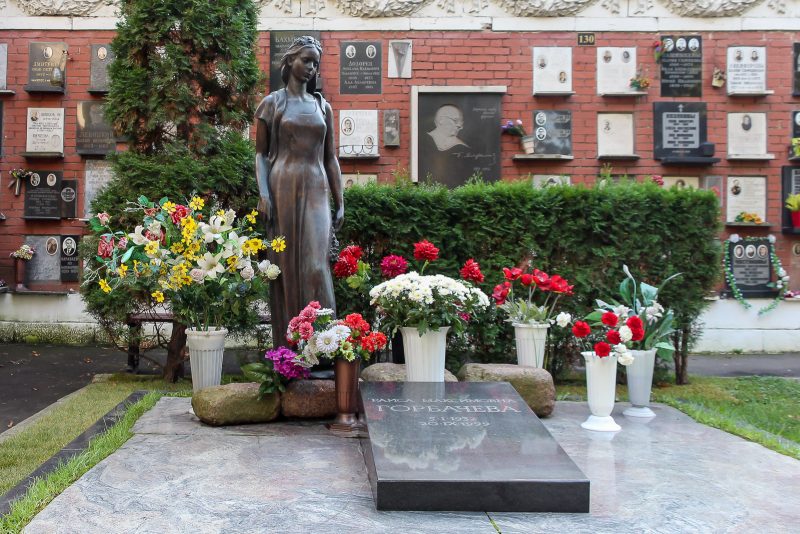
Raisa Gorbechov, wife of Mikhail Gorbachov


Anton Checkov


Yuri Nikulin, beloved actor and clown with his dog


General A Lebed

And now for the beautiful graves I could not identify. The last is my favourite. But first, the flower shop. (note: some names have been added to the original post. See below.)

Florist, Novodevichy Cemetery


Russian entertainer Boris Brunov


Cat lover Valentina Reinholdovna Gliere


Come and sit


Russian singer


Someone to keep watch, Yelizaveta Kairova


Agony


Young lovers


Living tree

©voyager, all rights reserved

Edit note: Thanks to meaderborn and Ice Swimmer for helping me fill in a few names on my unidentified list. I have added their names in respect.


Link to previous Post – Russia –  The Novodevichy Nunnery


Scandinavian Letters: Å.

Å.

Å is Swedish for river. These pictures are from the two biggest rivers flowing in Helsinki. Vantaanjoki (Vantaa river, the Swedish name is Vanda å) and Mätäjoki (rotten river, the Swedish name is Rutiån). Mätäjoki was the original channel through which Vantaanjoki flowed into the sea, west of Helsinki peninsula, but about 3000 years ago, Vantaa changed its course eastward and started to flow into the sea east of the peninsula.

Mätäjoki is more like a brook, even though it’s called a river, a few kilometers long, flowing in its oversized channel. Vantaanjoki, on the other hand is 101 km long and a proper river.

The first two pictures are from Vantaanjoki at the Vanhankaupunginkoski (old town rapids, the modern Swedish name is Gammelstadsforsen). The city of Helsinki was originally sited near the rapids at the moutgh of the river in Helsinge parish (the name is a Swedish name, the population was mostly Swedish speaking).

The third is a picture of Mätäjoki flowing through a park in Pitäjänmäki, Helsinki.

The fourth is Vantaanjoki a bit upriver from Vanhankaupunginkoski.

The fifth is from the same park as the third and the sixth is a bit upriver from the park, Mätäjoki is flowing between a street and a residential area.

In the seventh and eighth it is again Vantaanjoki at Vanhankaupunginkoski. There’s an island in the river at the rapids. The western channel has been dammed and there’s a power station there (nowadays a museum, but it produces electricity), but the eastern channel has been restored closer to the natural state and the salmon and trout can swim through the eastern channel upriver to breed in the river.

The letter Å is one of the so called Scandinavian letters. It originates from late medieval Swedish and is nowadays used in Danish and Norwegian as well. It is used in words which used to have long a A in Old Norse but the pronunciation changed to an O (think of Latin or Standard German wovel sounds, not English).

More photos under the fold, click for full size!

[Read more…]