
George Duval. The Romance of the Sword. New York, The Merriam Company, c1895.

George Duval. The Romance of the Sword. New York, The Merriam Company, c1895.
Well, now that I am down to only one blade, I can at least concentrate on it. So I did and today I have polished it all the way to 7.000 grit. There is still cable damascus on the very tip, but I have decided against making the knife shorter again and I will go with it as it is. The cable damascus is hardened and in composition similar to the 1095, so it will still cut and hold an edge well.

© Charly, all rights reserved. Click for full size.

© Charly, all rights reserved. Click for full size.
Now it will sit in FeCl3 for a while.
Initially, I have used still relatively concentrated solution (~1/10 dillution of solution for printed circuit boards) to see where the 1095 is. Now I am using a very diluted solution (~1/100) for the final etch, because etching this works a bit differently than etching damascus made from two kinds of steel where one has high nickel content. Why is that?
As a former chemist, I know at least a bit about what is going on now so I can show off.
The way etching works on carbon steel like this is an electrochemical process. The impurities gather during the forging process at the boundaries between the various steel layers and those impurities make the steel in those areas more susceptible to chemical attack because they create a sort of microscopic electric cells that attract the ions from the solution to the area. That is why in the etch with the more concentrated solution the cable steel quickly turned all grey and the 1095 remained all silvery – the 1095 is a mono steel with very few impurities uniformly spread throughout, whereas the cable, whilst being similar to the 1095 in chemical composition, has most impurities concentrated at the boundaries between former cable strands and at the boundary with the 1095.
In a concentrated solution, the reaction happens too quickly and can lead to pitting in areas with inclusions or more impurities. And a layer of various oxides builds up, leading to blotchy, uneven etch. That is ideal for revealing where the mono steel in the sandwich is, but not so great for showing the grain boundaries.
A diluted solution gives the reaction more time to attack the steel more evenly, but it of course also takes a lot longer. I probably won’t risk letting it sit in there overnight, but it will take hours. Allegedly the smiths of times bygone have used fruit (citrus, apple) juices, and it took a very long time, but I do not have several pieces to make a scientific study of it. Although, I might just cut the failed pairing knife into several pieces and perform an experiment….. Hm. I will think about it, that would be one way to get some knowledge and some fun out of a failure.

Charles Stedman Newhall. Ruthie’s Story. Philadelphia, Presbyterian board of publication, 1888.
You may remember these resin pieces that resemble areal views of coastlines. At the time I mentioned that while I love the pieces, they are a bit too small to make an impactful necklace on their own, so I had to figure out how to combine them. One issue here was colouring. How do I get a consistent blue colour if I used different batches of resin? Now, one opportunity would be to very, very carefully weigh the resin every time and very carefully count the drops of colour I pour in. Yeah, I can’t see me do that either. Also, the risk of just squeezing the tiny paint bottle a bit too much is pretty high, so I tried something else: “Normal” resin is two components, the resin and the hardener, that react with one another and cure over time. I just mixed the resin part with the blue colour in an old marmalade jar and then took out 12 grams whenever I did a batch of “islands” and added the hardener to the already coloured part. I only did this for the blue resin, because the metallic pigment isn’t that sensitive to small differences in the amount of colour.
That little trick turned out really well and I must remember it for other projects. That way I ended up with a handful of fairly similar pieces in terms of colouring. I selected the ones I wanted to use, drilled holes on them and somehow messed up the surface. Not much, but the shine was gone on some pieces so I polished them a little and then added some more resin on top. Quite often that’s easiest way to get a really shiny surface again. Also it created a concave surface which breaks the light differently, taking away the sharp edges on the land mass, and I really like that because it creates a more “natural” look since coasts are rarely terraced.
Once I had all the pieces ready I needed to assemble them and of course I have enough beads to stock a small shop but none that were a good match for these pieces. Luckily I found the perfect fit on Etsy, it just meant waiting a couple more days before I could finish. It’s the closest I’ll get to the sea this year and I absolutely love the result.

©Giliell, all rights reserved
The one thing I don’t like are the dull drill holes in the outer pieces. I think I’ll try to carefully add s tiny bit of resin. This would also fix the to the wire and thus prevent the fastening from sliding to the front over the course of time. I still have some rectangle pieces that await assembly and some earrings to finish.
I want to stress up front, that none of these failures is Marcus’s fault.
So, what went wrong this time, I don’t hear you ask? Well, a lot, I am down one blade out of three.
I thought the pairing knife goes on really well, until 320 grit when I noticed a little perpendicular line on the spine. And It was not a line in the damascus pattern – those become visible during polishing, and that is very cool – it is a crack. I do not know when it happened. It might be there from the start, it might have happened when I was straightening the blade, it might have cracked due to the stresses involved during polishing – it is a very thin piece of steel after all. There are also some imperfect welds with inclusions in the piece, but this is not one of them, this is a crack.

Cracked spine. There is one more crack on the other side of the blade too. © Charly, all rights reserved. Click for full size.
No matter the cause, this blade is now irredeemable garbage, the only thing it could be reworked to is an awl,
I am going to finish the piece only as a show of what it could have been, but I am definitively not using any fancy materials for the handle. I planned on using stabilized maple burl (also a gift from Marcus), but now it will probably be just some random piece of birch or oak.
Works on the boot knife also did not go well. First I messed up the grind, bigly, but that was not the problem, that was still repairable, there was enough material that needed thinning out anyway. What was not repairable was the position of the cutting edge towards the blade’s tip. It turns out that I did not hit the 1095 at the center of the blank quite well. My grind was straigth, but the the 1095 in the center of the san mai damascus was bending ever so slightly to the left in this area. Had I positioned my grind just about 0.25 mm to the left, this would not have happened.
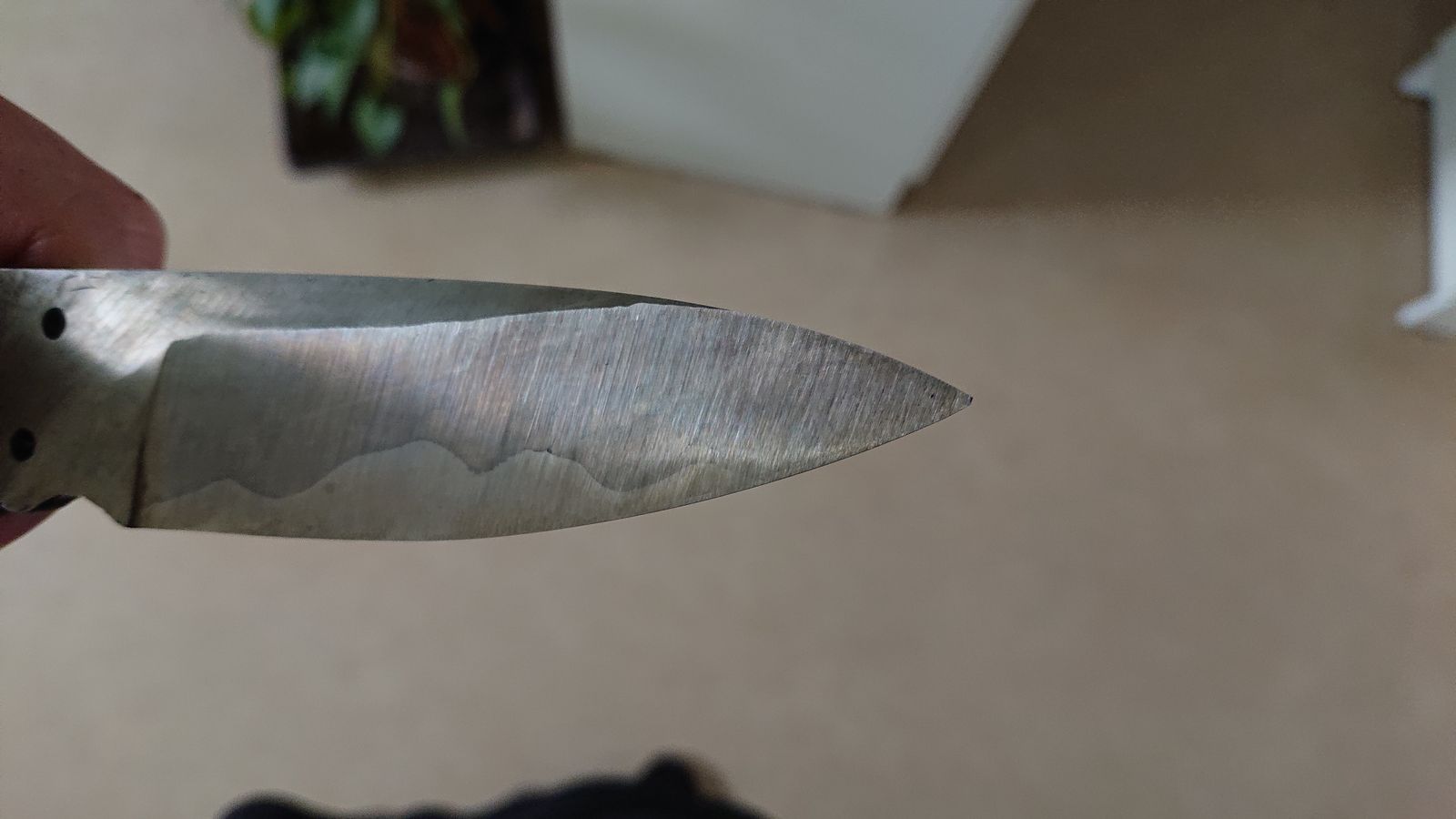
The darker cable damascus is reaching all the way to the cutting edge near the tip, where only the shiny 1095 should be.
© Charly, all rights reserved. Click for full size.
I have tried to re-grind the blade, but for that, I had to make it about 1 cm shorter and I do not think it looks as well as it did before, it is too short and stubby. It should become a usable little knife, but I am not happy with it, and I am not finished yet.
Next time I will work with san mai damascus, I will probably first polish and etch the edge to see exactly where the cutting steel is. Too bad I did not think of that before.
All in all, so far this project has made me nearly cry several times and to want to quit knife-making because I am no good at it. When one spends several days with some work only then for all that effort to be for nothing, it has quite an influence on one’s mood.

Andrew Lang. The Lilac Fairy Book. Illustrated by H.J. Ford. New York (etc.), Longmans, Green, and co., 1910.
We’ve reached the last book of the Andrew Lang coloured fairy series. The Lilac book was published in 1910, at a time when illustrated fairy tales were going out of fashion. It’s filled with the whimsical drawings of H.J. Ford and, as usual, I’ve attached all of the full-page drawings below the fold. The entire set of 12 books are all linked at the end of the post. Enjoy.

Mrs. Gene Allen Martin. Make Your Own Hats. Boston, and New York, Houghton Mifflin Company, 1921.
I’m having a bad hair life. It’s baby fine and board straight and doesn’t take well to styling, so I almost always wear a hat when I go out. It’s hard to find stylish hats, though, and even harder to find one to fit my small head, so I’m going to keep this book handy. Who knows? I might decide to make myself a sweet little number with flowers and feathers and maybe even a few cherries on top. And netting. I’ll add a bit of netting that I can drape seductively over one eye. Oh, the possibilities.
via: The Internet Archive

Jonathan Pariam. The Prairie Farmer Horse Book. Chicago, Prairie Farmer Publishing Company, 1891.
via: The Internet Archive
The line between artist and artisan can be a bit blurry and some people can actually be both. As it is in my opinion this case – there is a great deal of craft involved, as well as creativity.
I must confess though, I find the art and the process a bit creepy. A lot creepy. Despite the fact that my own creative process when I was painting was in some aspects similar – first a sketch of a skeleton, then add muscles, then skin, then clothes.

John Muir. Steep Trails. Boston & New York, Houghton Mifflin Company, 1918.
via: The Internet Archive

Lydia Whitaker. The Prophet of Martinique. New York, J.S. Barcus Company, c1906.
via: The Library of Congress
Well, the title gives away that this article won’t end well. I am glad I did not start to write about this project right from the start as a series, I dislike having expectations build up only to be disappointed so I do not wish to do that to readers. And this is why I was also putting off work on this for so long – it was always a project with the potential of high reward – and high risk of failure.
You may remember that Marcus was so very kind and has sent me some damascus to play with, three pieces to be precise – one san-mai of 1095 and cable and two pieces of just cable.

© Charly, all rights reserved. Click for full size.
Here you can see the san-mai piece on the right already partially cleaned and ground, then in the middle is the smaller piece of cable with the scale cleaned off already with vinegar bath and on the left the big piece of cable damascus as it came. On that one, I had to grind the scale off with an angle grinder and after that, I have ground all the pieces to flat-ish until I could not spot any imperfections on the surface that might signify poor weld. This must be done since each inclusion or poor weld increase the probability of failure. It took me the whole last Friday to do this.

© Charly, all rights reserved. Click for full size.
With all the pieces flat, I could decide what kind of blade I would want to make out of them.
The san-mai damascus had one end of the bar rather ugly and it had an unseemly weld right in the middle, so making it into a long blade with hidden tang was not feasible. So I have decided to make it into a small drop-point boot hunting knife.
The smaller piece of cable damascus would look great as a dagger, but for that, it was too thin, so I have decided to make it into a pairing knife.
The big piece was just about the right size for either a big chef-knife or a chopper. I have decided to go for a chopper.

© Charly, all rights reserved. Click for full size.
I cut the excess with angle-grinder and then ground the outlines and bevels with 40 grit belt (which was a matter of mere minutes with my new magnetic jig, it works really well and I am happy with it). A draw-filing took care of all the perpendicular scratches and flattened the surfaces a bit and my new file-guide has proven itself very useful for making the shoulders flat and straight. It really does speed up the work when you have proper tools at hand. And in case you are wondering why the clothespins – they reduce vibrations and therefore the noise the blade and the tang make when filing the shoulders.
Drilling the holes was a nightmare, I have destroyed three 3 mm drill bits, which is something I did not expect. But I have managed to drill al I need and with this, I was done on Saturday.

© Charly, all rights reserved. Click for full size.
Today I have decided to normalize the steel before quenching, so I have covered all three pieces with a thin layer of clay to protect them from decarburization, I have heated them above austenitic temperature and then put them into a bucket of pearlite to cool off. That is a bit slower than how normalizing is usually done (which is air-cooling for about an hour) but faster than how annealing is done (which is very slow cooling in the furnace for multiple hours). I have done this two times for the cable damascus (with straightening after the first cycle – the pieces warped, showing that it was a good call to normalize them) and after that, I have performed one more air-cooling cycle for the san-mai, because it is much thicker than the other two and has required more straightening.
I wanted to try differential hardening on the cable damascus so I have prepared a mixture of clay, perlite, and a tiny bit of water-glass as a binder and adhesive. I did not want to wait overnight for it to dry, so I have used first a heat gun and then the forge with low-fuel reducing flame to dry it quickly, thus the dark greyish color of the clay. No clay fell off, it did not crack either, so far it seemed all to work well.
Well, quench is when it all went wahoonie-shaped.
First I have quenched the small blade, in water. Unfortunately, it was so small that I have overheated it, and thus instead of the differentially hardened blade, I got a full hardened one. I have decided to not try again and I will finish it as it is, it can still be a good blade, just not with a hamon.
As second went the san-mai. I have quenched that first in sunflower oil, pre-heated to 100 °C, and then in water. It has definitively hardened and it seemed to be OK afterward.
Last I have hardened the big chopper. I have learned my lesson from the small blade so I have paid more attention to color, adjusted the flame, and took care to heat the blade to only just above the austenitic transition on the cutting edge and just below that on the covered spine. Then I plunged it into water, agitated, pulled it out, plunged it in again, and agitated it some more to cool it off below the martensite start temperature quickly enough for it to harden.
And during that second plunge, I heard a quite tell-tale “ping” sound. That was the moment I knew this blade has failed. I have scraped the scale and clay off with an old angle-grinder disk and took it in daylight to search for a crack. And I found it, right in the middle of the blade.

© Charly, all rights reserved. Click for full size.
I will polish the blade a little bit in order to see whether I have succedes at the differential hardening at least (preliminary scratch-test would suggest yes). However the size and position of the crack make it unlikely that the piece will be salvageable for a smaller/thinner blade, it is smack in the middle and it seems to go all the way through the hardened part right up to the soft material on the spine.
Today was not a good day, however from what I have read, this happens even to very experienced smiths. Even so, it sucks. I hope that at least the remaining two blades have no nasty surprises hidden for me.
I will have to buy some high-carbon tool steel to practice differential hardening some more.
