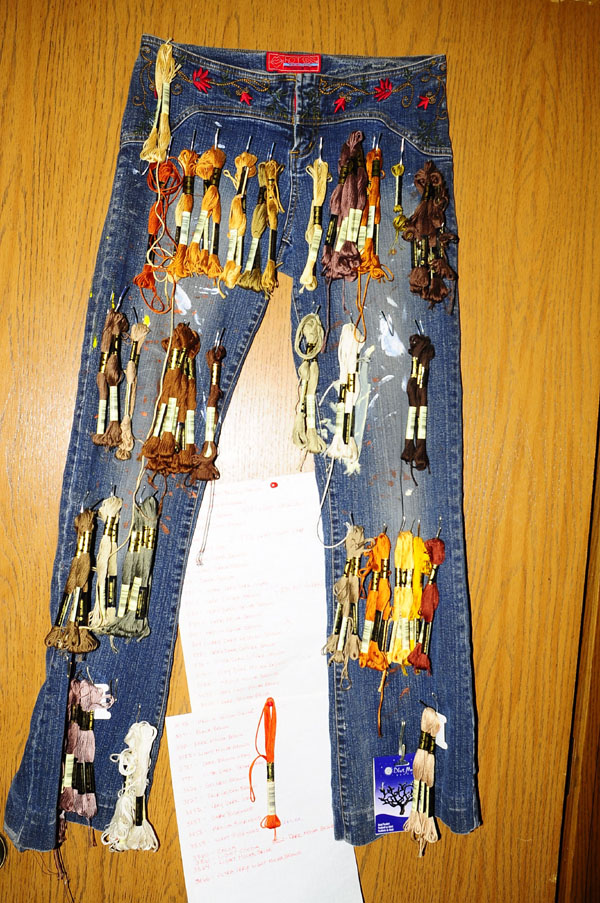
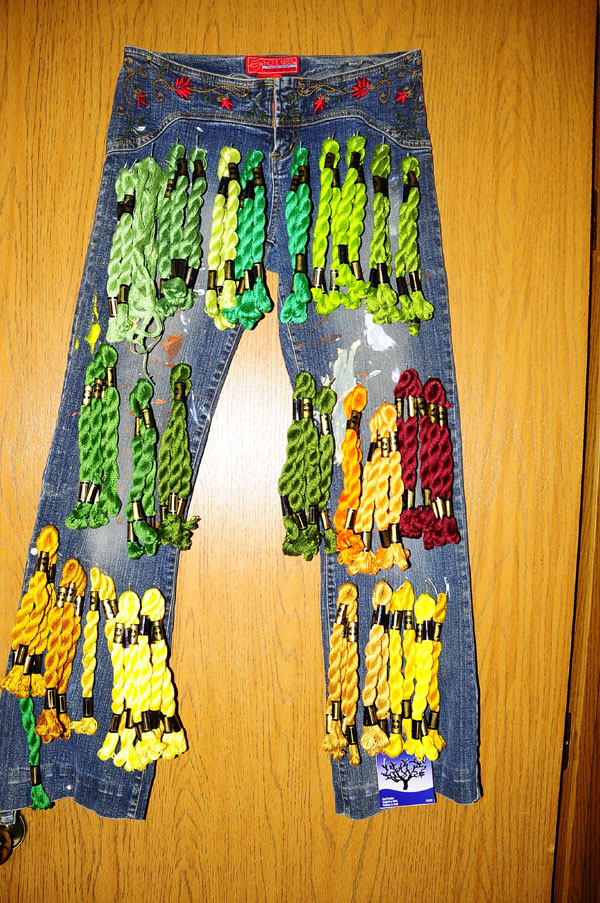
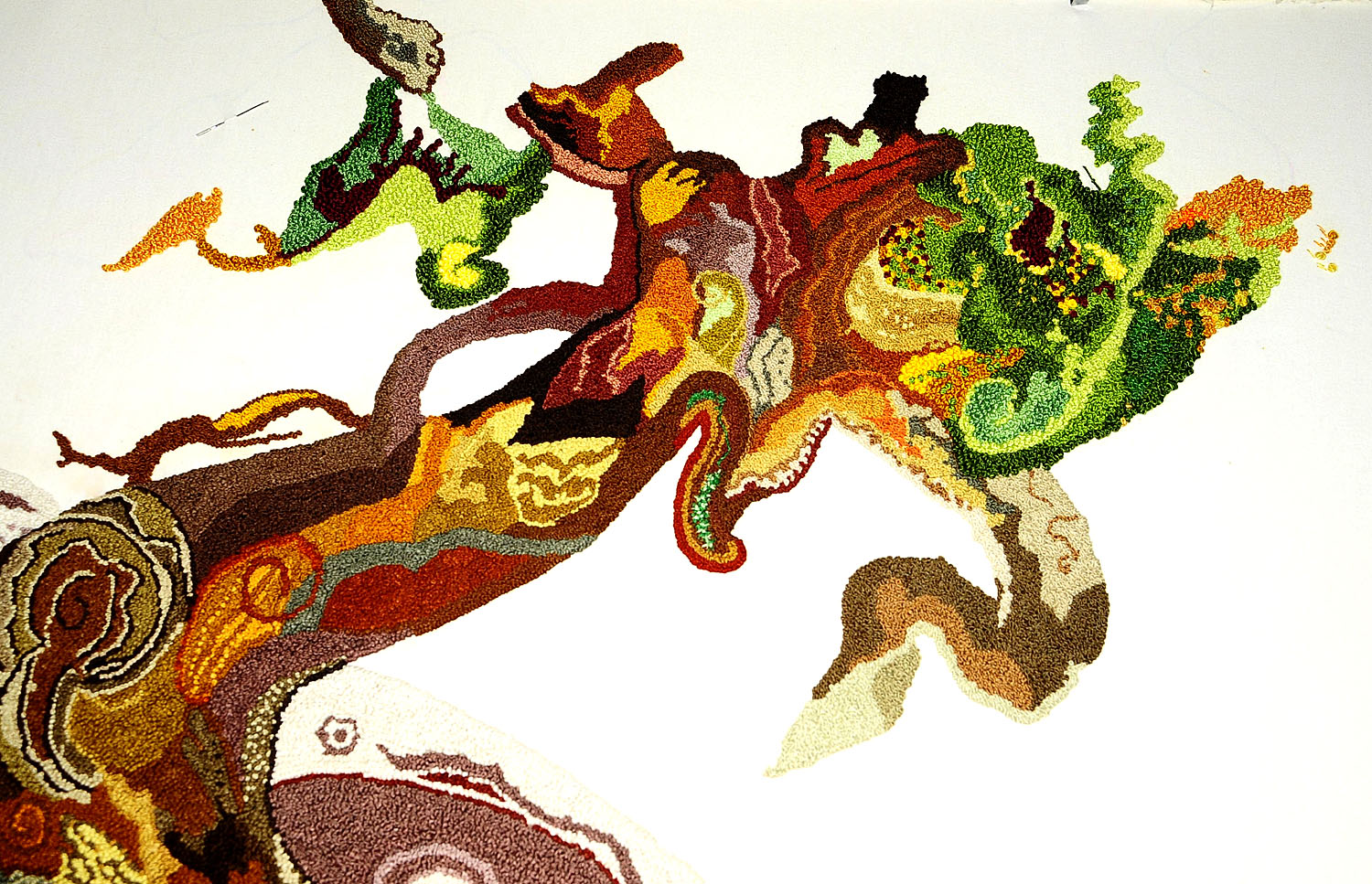
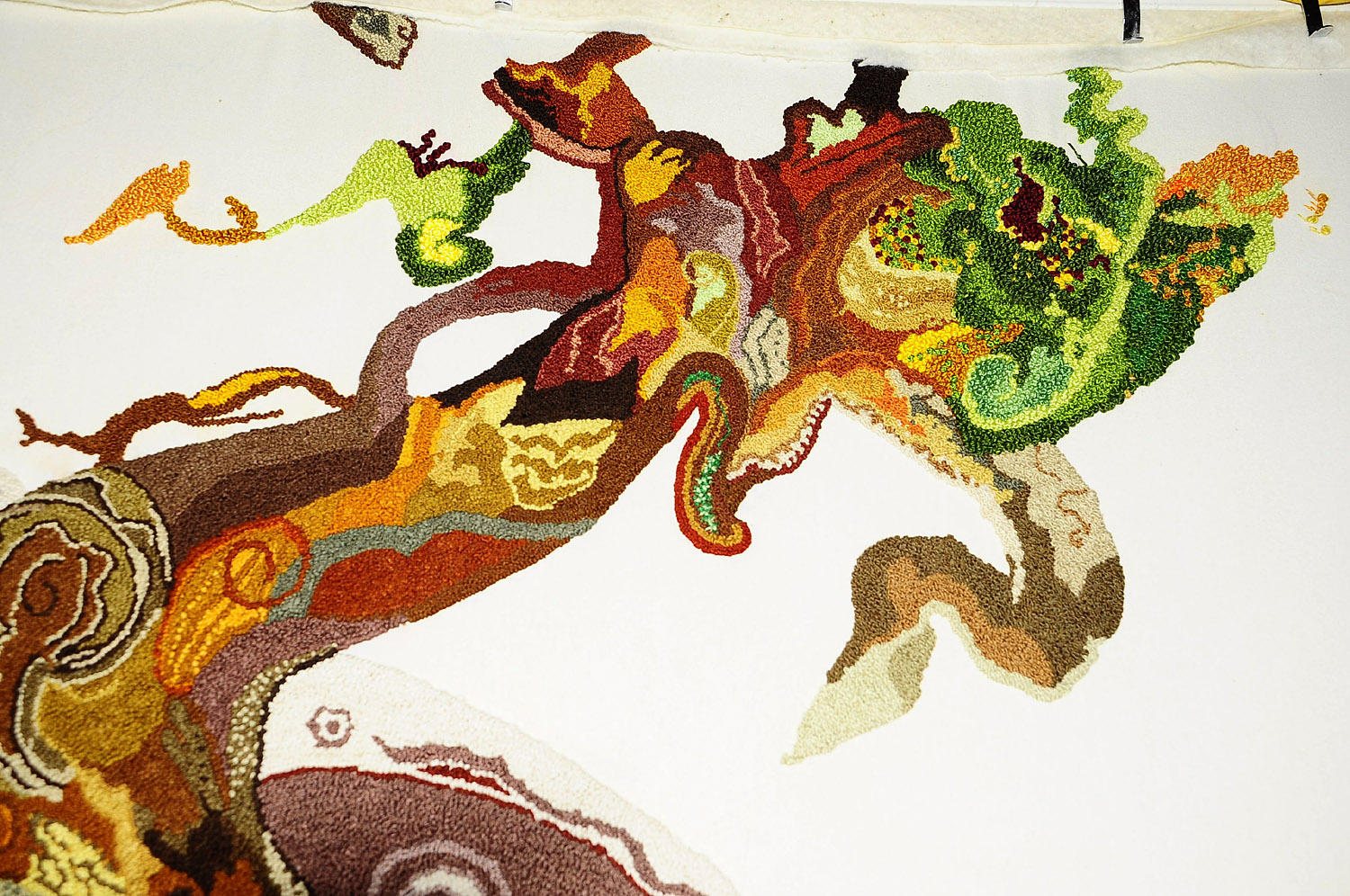
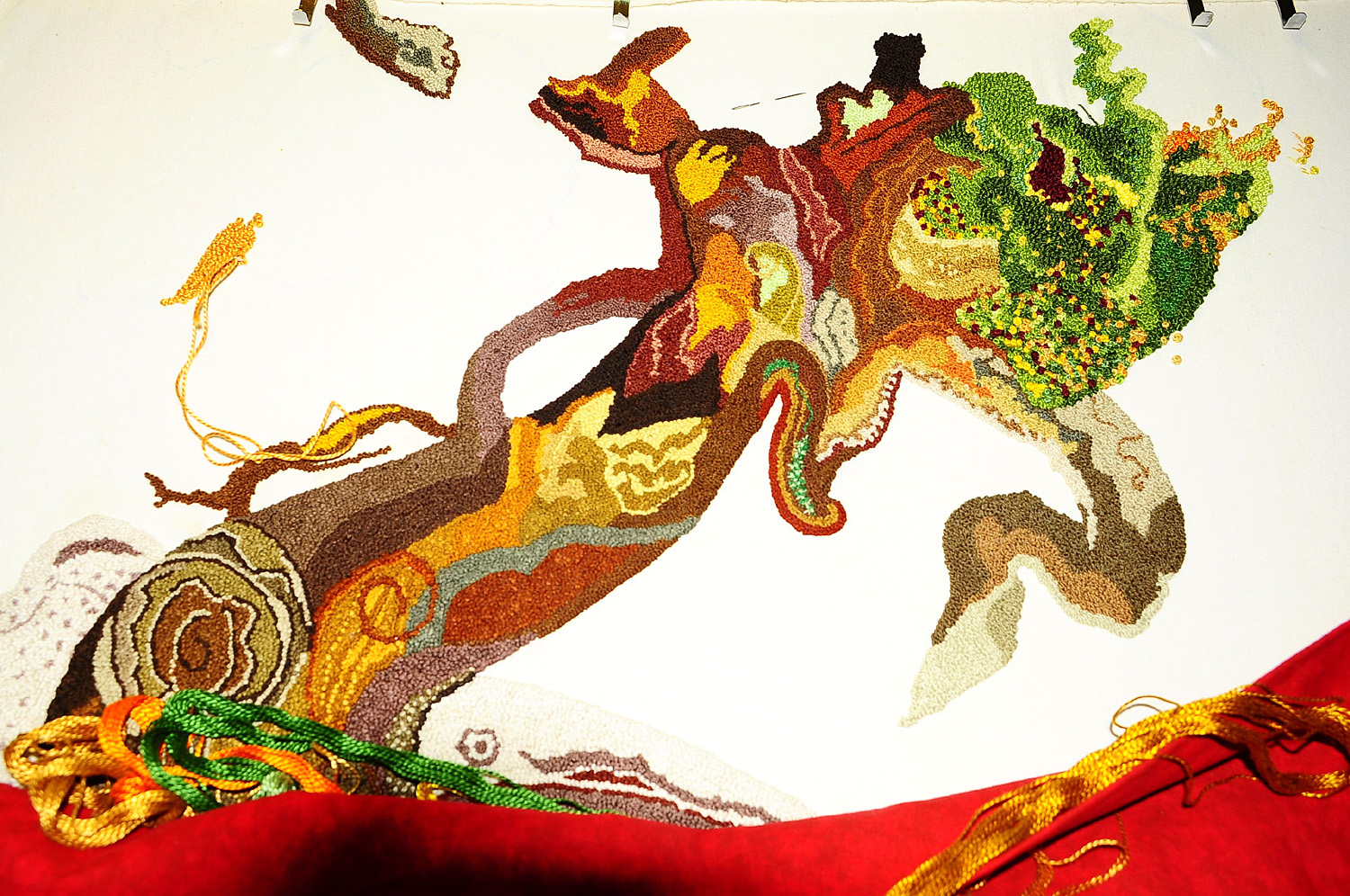
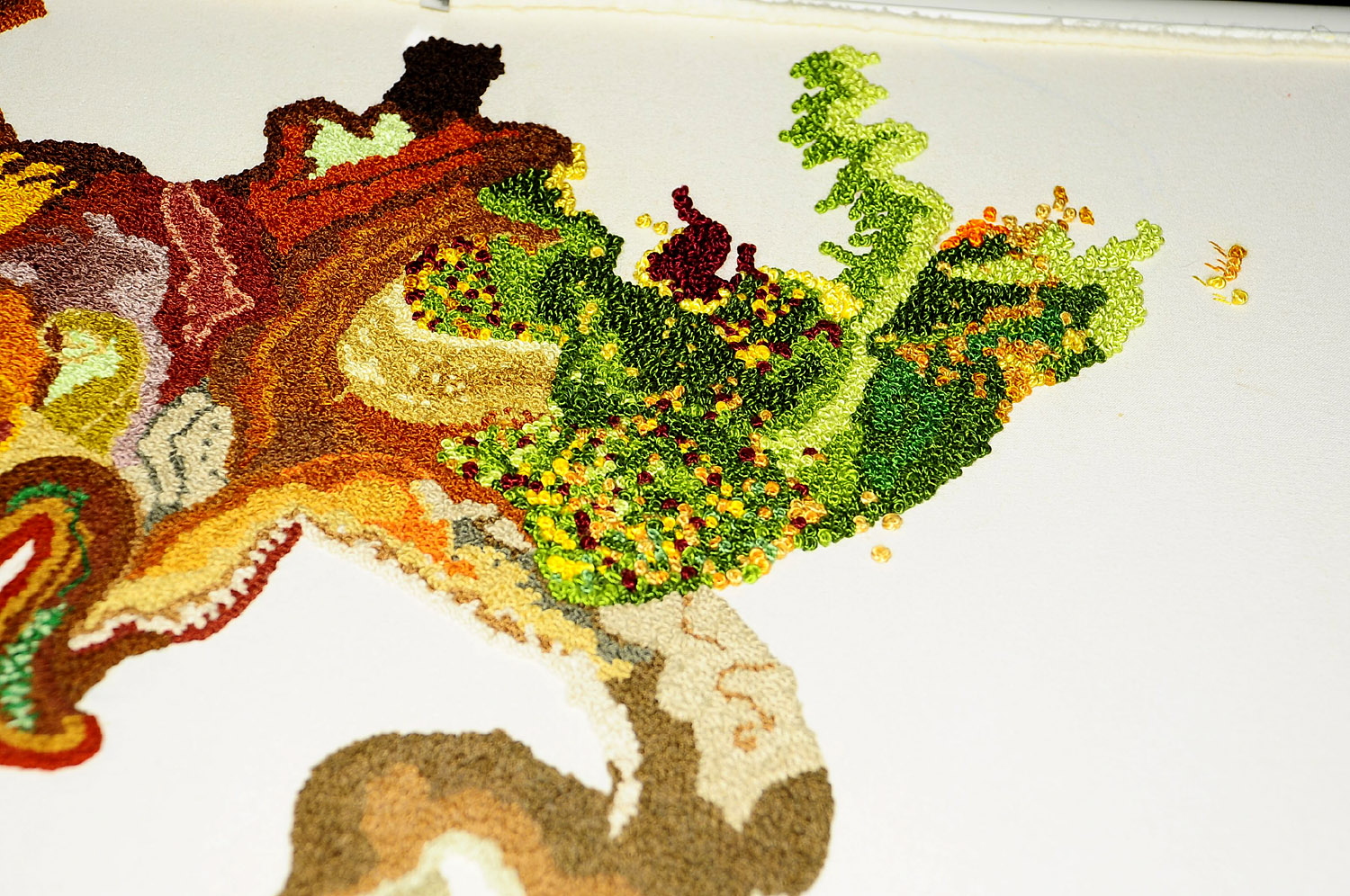
Current Hours: 1,211. Skeins Used: 190. Click for full size.
© C. Ford, all rights reserved.
Oh, the vintage pistachio Perles (light and medium, 320 and 368), holy fuck, do they ever taste nasty. If you’re wondering why I know what they taste like, it’s because I stick one end in my mouth to get it nice and wet, so it can be easily flattened for threading. I won’t be doing anymore of that with these particular threads. I don’t think these are nearly old enough to have employed arsenic, but who the fuck knows? Even cinnamon mouth wash isn’t getting rid of it. Yikes.
© C. Ford.
This is a wonderful series, from Nina Röder:
Berlin-based artist Nina Röder’s series “A little deeper than you thought” explores the meaning of existence through a series that captures the relationship between humans and the natural environment.
Inspired by Jean Paul Sartre’s exploration of existentialism as propounded in “Nausea”, the series explores the nuances of human existence, focussing on the chasm between presence and absence, being and nothingness. Shot across the rugged landscapes of Iceland, Ireland, Spain and the Harz Mountains, the images evoke a sense of mystery, inviting contemplation on the nature of our existence. “Ancestry, gender, education, religion – all are factors with an invisible influence on our existence,” explains the artist in a statement. To make such factors visible, we need images to expose what determines our fate and creates a distance between ourselves and our personae.”
Have a wander through a bit of Nina Röder’s world. Via iGNANT.
Artist Nagato Iwasaki‘s lifelike driftwood sculptures are perfect examples of the uncanny valley — the feelings of revulsion and uneasiness one experiences from non-human objects that appear a bit too similar to real human beings. Japan seems to excel at this in areas like robotics technology, and indeed, the term “uncanny valley” itself was coined in 1970 by a Japanese roboticist, Masahiro Mori. Iwasaki takes this concept out into nature, blurring the line between flesh and wood.
Over the past 25 years, Iwasaki has been crafting these sculptures as part of a collection he simply calls “torso.” The sculptures themselves are life-sized at around 180 centimeters tall, or 5 feet 9 inches and made entirely of driftwood the artist collects in various locations in Japan. No one sculpture is exactly like another which makes them all seem like individuals with their own quirks and personalities. Descriptions of Iwasaki’s sculptures by viewers run the gamut from scary, unsettling, and imposing, to profound, intriguing, and otherworldly.
I love these sculptures, perhaps because I’ve always seen wood as flesh. You can read and see much more at Spoon & Tamago.
Last month, a team of 58 scientists from around the world embarked on 31 day oceanic voyage to research the ethereal life forms living at the bottom of the ocean off the Eastern coast of Australia. On May 15, the Sampling The Abyss team set out from Bell Bay in Launceston, Tasmania. During their month aboard the Marine National Facility research vessel, appropriately named Investigator, the crew visited seven different Commonwealth Marine Reserves, which are essentially National Parks for sea creatures, before returning to port in Brisbane mid-June.
The expedition was initiated by Museums Victoria in partnership with the NESP Marine Biodiversity Hub, and a government research organization called the Commonwealth Scientific and Industrial Research Organization (CSIRO). The goal of the trip was not only to document undiscovered sea life, but to research how they have adapted to harsh living conditions two-and-a-half miles below the ocean surface.
Check out a daily blog about the voyage here, and check out more videos on the Marine Biodiversity Hub’s YouTube Channel.
You can read and see more at The Creators Project.
For years Westerners have experimented with wearing traditional Japanese clothing like the kimono and jinbei. The results have, at best, been mixed. Let’s just say that it takes a certain type of non-Japanese man or women to wear a kimono without looking out of place. I for one, have never even felt the urge to try, that is until my recent encounter with the T-Kimono.
Check out the T-Kimono, a truly great alternative to the uptight Western suit.
Anyone who questions baking as an art form should look no further than the cookies made by Okashi no Kobito. Professional cookie artist Nobuyo Toyono began this enterprise creating edible masterpieces out of Osaka after graduating from confectionery vocational school (yes, there is such a thing). Using all-natural ingredients, Toyono designs, bakes, and ices each and every cookie by hand.
According to her website, Toyono pledges to “put her heart and soul into making colorful iced cookies that will make you smile.” Most incredibly, the eye-catching colors she uses in the icing are made from natural pigments: beets (red), spirulina algae (blue), beni imo potatoes (purple), gardenia (yellow & green), and cocoa (brown). Her creations are intricate and whimsical and so beautifully made that it’s almost a shame to eat them.
Check out her Instagram for even more examples of her confectionery handiwork.
Via Spoon & Tamago.
Absolutely check out all the amazing work of Ribbonesia! You can see and read much more at Spoon & Tamago.
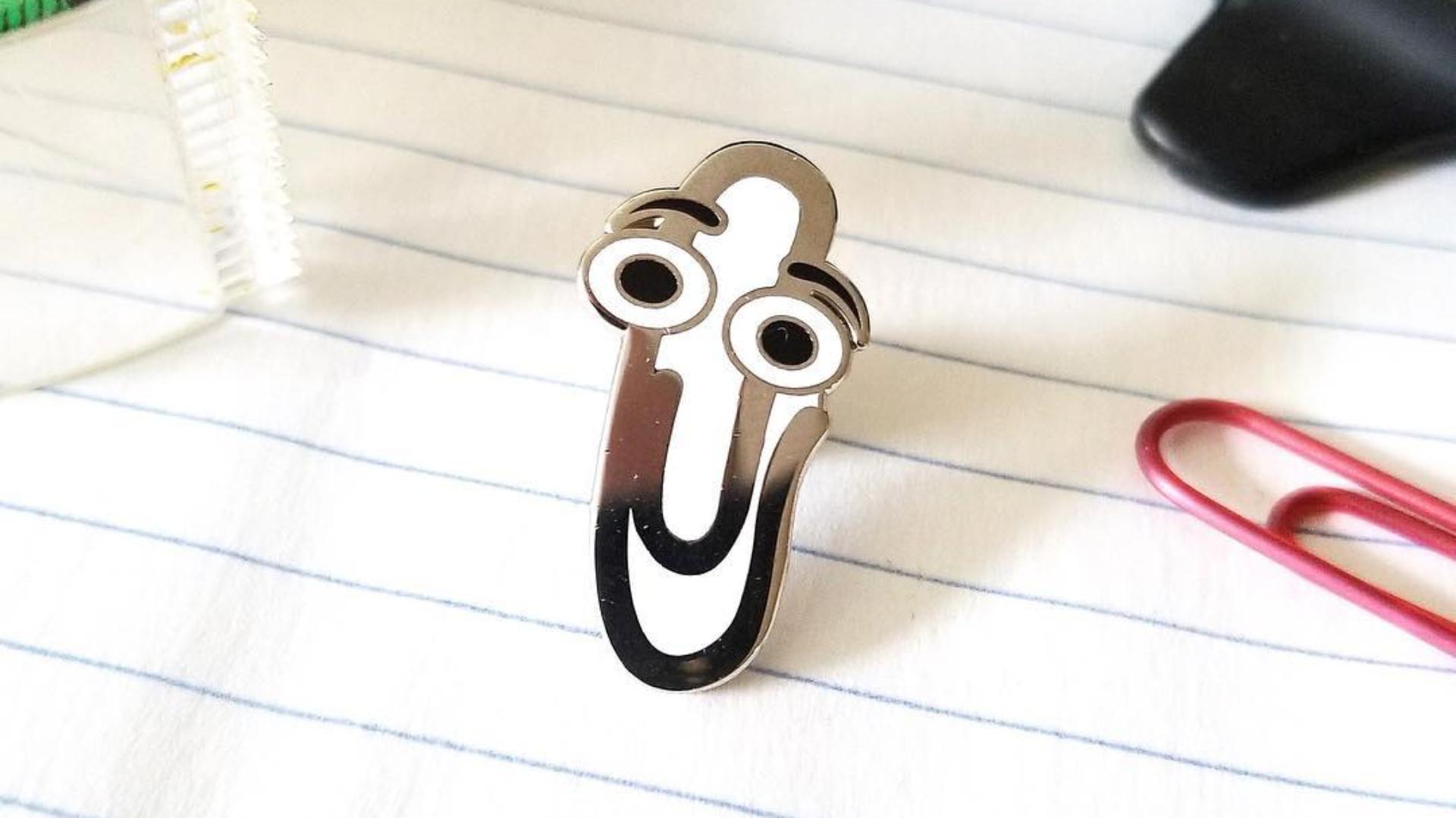
Aficionados of Microsoft’s Clippy can now have an enamel pin. The Creators Project has all the info.
Until now, I’ve avoided unpicking on the tree quilt, which has been so very nice. In my early haste to start the foliage, however, I fucked up. I hadn’t picked up the flow yet, and now that I have it, that first section jars, badly. I’ve left it be, telling myself to give it a chance. It keeps drawing my eye, and leaving a bad taste in the brain, so it must go. Every needlesmith on the planet knows the feelings when you meet up with the unavoidable unpickening. Unpicking knots is not as bad as unpicking, say, a raised satin stitch, but it’s not fun, either. Eh, that wasn’t so bad. At least I didn’t rip the fabric!
© C. Ford, all rights reserved.
Working on the foliage. The trunk was all Candlewick knots, which are much too small for the foliage. Even French knots are on the small side with the Perle 3, so I’ve combined the two. I get to keep the in front, half infinity movement of the Candlewick, with two wraps added. This gives me a bulkier knot, with the added plus of keeping movements which are now automatic. I usually work with thread lengths of 65 to 85 inches, because it takes very little time to go through that length of thread. Click for full size.
© C. Ford, all rights reserved.
From hawking sports cars to hamburgers, advertising has always relied on the objectification of women to market products. But starting June 26 SaveArtSpace, an arts organization that transforms advertising spaces into canvases for public art, is reclaiming New York City billboards for the female gaze.
SaveArtSpace: The Future is Female will showcase work by female artists on advertising spaces across the city. The exhibition includes a variety of media and styles, ranging from cartoon sketches to puppet-like sculptures. In one piece, titled Grace Meets Matisse, artist Elise Peterson has photoshopped Grace Jones’s iconic Island Life album cover onto Matisse’s La Danse, distorting the painting’s dimensionality in certain ways but contributing to its overall sense of movement.
You can see and read much more at The Creators Project and at SaveArtSpace: The Future Is Female.