2016 AICP Sponsor Reel – Dir Cut from Method Studios on Vimeo.
Affinity
Art, Fun, & Nonsense.


No, not that goop. The real stuff. As every needlesmith and other handcrafter knows, hand care is extremely important. You can’t have rough bits of skin snagging expensive materials and so forth. So, goop. When your skin reaches a too rough to work point, spoon a bit of sugar (couple tablespoons) and the oil of your choice, whisk it up, and have a good, long hand scrub. Most artists have their own formula, some prefer specific sugars, or coarse salt, and the oil choice varies quite a bit. I usually go with olive oil. I don’t use coarse salt, because I can always be counted on to have small nicks on my hand somewhere.

Hummingbirds often brave downpours to gather the nectar needed to avoid starvation. This Anna’s hummingbird shakes off rain as a wet dog does, with an oscillation of its head and body. According to researchers at UC Berkeley, each twist lasts four-hundredths of a second and subjects the bird’s head to 34 times the force of gravity. Even more remarkable: Hummingbirds can do this in flight as well as when perched.
SOURCES: VICTOR ORTEGA-JIMENEZ AND ROBERT DUDLEY. Photographs by Anand Varma / National Geographic.
I am just filled with awe after watching this:
Space may be the final frontier, but scientists have found plenty of head-scratchers right here on one of Earth’s zippiest creatures, the humble hummingbird. The July issue of National Geographic Magazine includes stunning photography by Anand Varma of ornithologist Christopher Clark’s experiments studying how the Anna’s hummingbird sees, moves, and eats.
Clark recreated studies from UC Berkeley and the University of British Colombia that use smoke, optical illusions, and specially-created tools in conjunction with high-speed cameras to reveal hummingbirds’ strange body parts. For example, the reason they can hover is because their unique bone structure allows them to create lift on the upswing, as well as the downswing of their wings.
You can see and read more about this at The Creators Project. I might have to put that video on a loop.
Clickety for full size.

© C. Ford.

Painted flask from 1700 BCE found in a burial under a house in area A East, Karkemish (photo courtesy Nicolò Marchetti).
Archaeologists in southern Turkey have dug up an ancient precedent to the Kool-Aid Man. Recent excavations at the ancient Hittite city of Karkemish have revealed a bulbous pitcher decorated with a faint smiley face, as Andalou Agency first reported. At 3,700 years old, the grin predates by a long shot what scientists in Slovakia had previously dubbed the world’s oldest smiley face, a 17th-century drawing on a legal document.
As head researcher Nicolò Marchetti put it, “We have probably found the oldest smiley emoji. We do not know with which purpose the craftsmen drew this symbol on the pitcher, but we call it a smile.”
Marchetti, an associate professor at the University of Bologna, has been leading the seven-year long excavations at Karkemish, which today lies along the border between Turkey and Syria. The short-necked pitcher is one of the most interesting artifacts found so far at the site, which has also yielded a number of urns, pots, and vases. Found in a burial chamber beneath a house, the unusual vessel was once used for drinking sweet sherbet. It will eventually go on view at the nearby Gaziantep Museum of Archaeology — so yes, you’ll be able to get a selfie of yourself smiling with the one-of-a-kind, jolly jug.
Via Hyperallergic.

Scammers are busy phishing for artists now. For the full story, wonderfully illustrated by Steven Weinberg, head over to Hyperallergic.

Purgatory Pie Press, “Volumptuous: Hanging Tower of Babble” (2017) (all photos by the author for Hyperallergic).
Hyperallergic has a write-up on what sounds like a very grand show indeed, Tongue Tides, in Long Island City. I would so love to see this in person.
Are you ready for volumptuous? This hilarious sign by Purgatory Pie Press dangling from Flux Factory’s ceiling, part of “Volumptuous: Hanging Tower of Babble,” a large installation of hanging signage, is a fitting mascot for this playful summer show. Tongue Tide invites us all to play a little more with language, and to ponder other languages besides English. It’s a must-see for writers and wordsmiths and is well worth the trip to Long Island City.
Queens is the most linguistically diverse area on the planet. No other place boasts so many languages in such close proximity, something Rashedul Hasan and Dan Silverman illustrate in “We Are the Queens of New York” (2017), a map piece where dots of different colors represent these many varied languages. It’s really powerful to dwell on just how unique the borough — and New York City as a whole — is from this perspective.
[…]
It’s also good to ponder this map because, with all due to respect to Oscar Wilde and Dorothy Parker, English does not own a monopoly on wit. Many turns of phrase and poetic expressions in other languages pack a punch, even in translation. Some of the best work in this show plays with other languages to give us glimpses of their clever bons mots.
An intriguing artist book by Magali Duzant, A Light Blue Desire (2017), complies blue bromides from across the globe, and blue postcards featuring some of the selections are available for visitors to take home. Blue, in word and concept, can be stretched in so many semiotic directions. The blues are great, but they cast a sad shadow on the color as a metaphor in today’s English, which is further exacerbated by the minority status of the so-called blue states in the US’s broken political system. But blue is not so sad in other languages. One vivid example is the Polish expression for what we might call daydreaming: to think about blue almonds. It captures the futility of idle fantasy so well.
You can see the map, and much more, and there’s more to read at Hyperallergic.

Rodolfo Lanciani’s photo capturing the discovery of the bronze statue of the Boxer (1885) (all images © Istituto Nazionale di Archeologia e Storia dell’Arte).
In 1885, excavations at Rome’s Quirinal Hill revealed one of the most celebrated Hellenistic Greek sculptures: the bronze, seated Boxer at Rest. Present was the archaeologist Rodolfo Lanciani, who witnessed its exhumation and snapped a photograph of the rare ancient object. The image he produced is as arresting as the sculpture itself, capturing the figure perched on a mound of dirt, like a time traveler taking in the ruins of a once-familiar world. It’s one of many photographs Lanciani captured of his city’s changing landscape, and it’s just one gem from his own, massive archives — amassed as his impressive effort to document Rome’s entire archaeological history through the end of the 19th century.
Nearly 4,000 records from Lanciani’s collection are now digitized and accessible through a new, online database created over two years by researches at Stanford University Libraries, the University of Oregon, and Dartmouth College. The Rodolfo Lanciani Digital Archive makes accessible about one fourth of the archive that ended up at the National Institute of Archaeology and Art History in Rome when the archaeologist died in 1929, which is available to the public at the Palazzo Venezia only during select weekday hours.
You can now browse through high-resolution drawings, prints, and photos created between the 16th and 20th centuries that show the many infrastructural layers of the capital. From watercolors of entire buildings to architectural plans to sketches of decorative elements rendered by hundreds of artists, the works reveal the city’s famous buildings at different stages as well as structures that have been lost to time.
rq asked if I had made any progress, and I promised another pic. Another bad one, I’m afraid. I didn’t feel like dismantling the quilt frame top and hauling it outside. Not as much progress as I’d like, but I haven’t been able to work on it consistently. The current section is 13.5″ x 5″. Click for full size.

© C. Ford.

Photos: Niklas Adrian Vindelev.
Instead of accelerating the demise of traditional craftsmanship, what if digital tools enhanced it and expanded the possibilities of what we can make?What if an architect could use a digital tool — a CNC machine, say — to create something with a distinctly human quality? How might the machine be applied to skills such as woodwork and metalwork? Could it be used to make objects with the aesthetic appeal, including the touch and feel, of a handmade object? Could it also make objects that can be scaled — objects with applicability to architecture?
These were the timely questions that three architects recently explored as residents at SPACE10 — IKEA’S external future-living lab. With a shared interest in exploring how digital tools can be applied to traditional techniques — and the potential of a CNC milling machine in particular — Yuan Chieh Yang, Benas Burdulis, and Emil Froege together found answers in three very different but eye-opening ways.
You can read and see more at Space10.

If you’re in Ottawa, consider Indigenous Walks.
Indigenous Walks is a walk and talk through downtown Ottawa exploring landscape, architecture, art and monuments through an Indigenous perspective.
The character Danerys Targaryen finally returned to Westeros on Sunday night’s Game of Thrones Season 7 premiere, but the actress, Emilia Clarke, shot the scene on a Northern Irish beach called Downhill Strand. Much of what viewers know as Westeros, in fact, is actually Northern Ireland, including parts of Winterfell, Slaver’s Bay, and the Kingsroad—all thanks to the nation’s open tracts of land and many surviving castles. To draw attention to this fact, Ireland’s tourism board commissioned a massive tapestry that details every episode of the series.
The 66-meter-long artwork is on display at the Ulster Museum in Belfast. A group of artisans including the museum’s director, Katherine Thomson, are embroidering each meter with characters and symbols that summarize each one of the episodes preceding Sunday’s “Dragonstone.” As Season 7 progresses, they’ll add more yardage to the tapestry to reflect new developments on the HBO juggernaut. By the end of season 7 it will be 77 meters long.
You can read and see more at The Creators Project.
Home Sweet Home from Home sweet home the film on Vimeo.
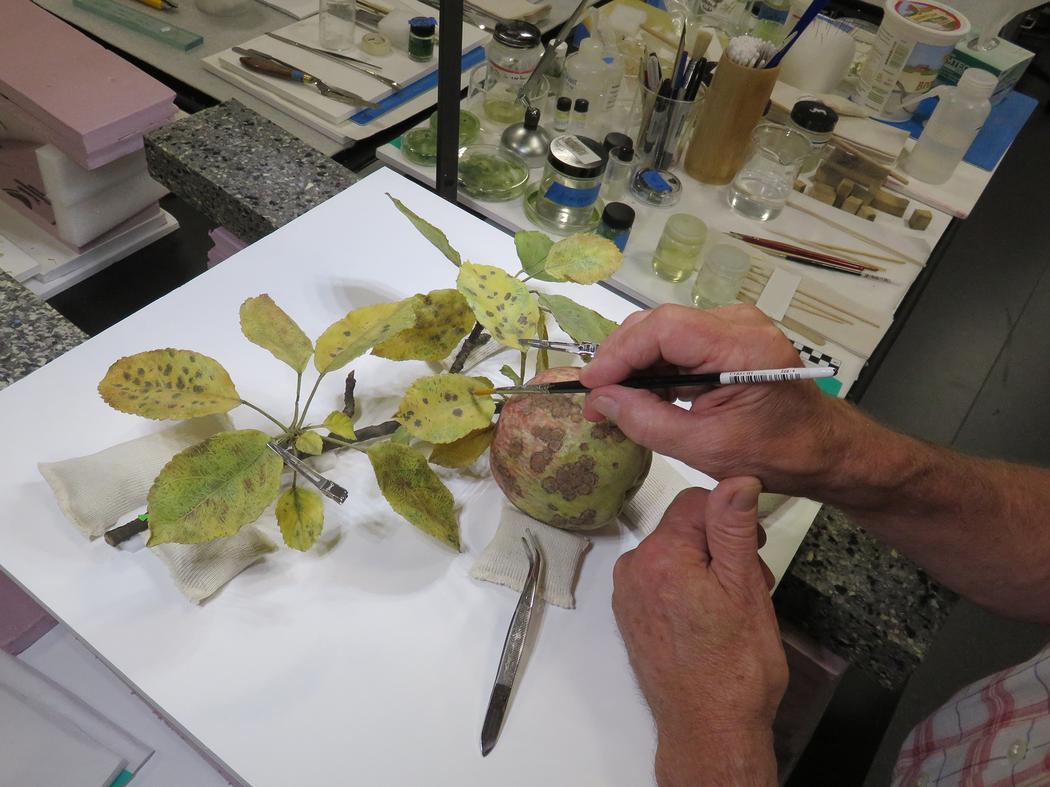
Scott Fulton working on a model of an Emperor Alexander apple affected by apple scab disease: Malus pumila (Model 813).
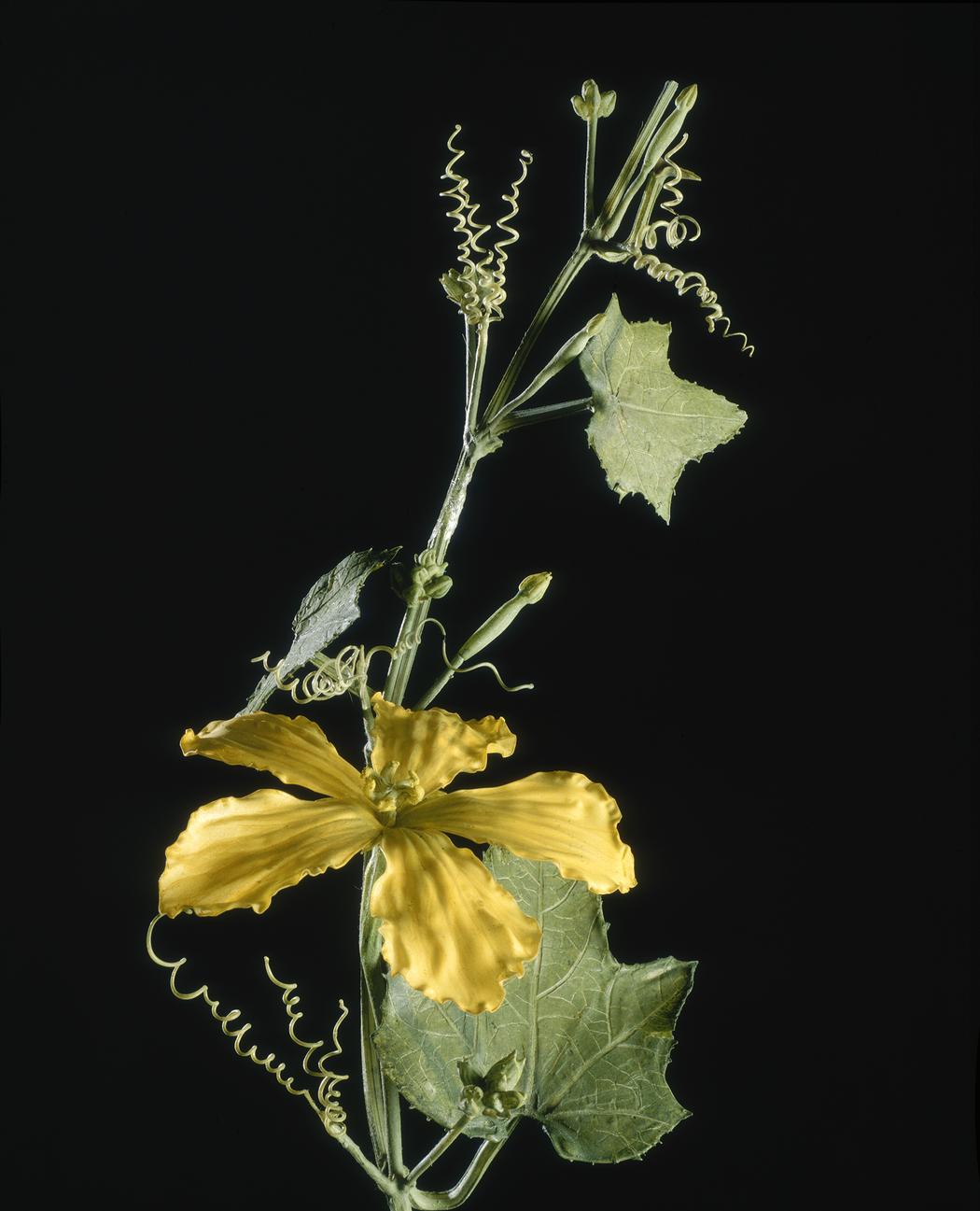
Luffa cylindrica (Model 272), Leopold and Rudolf Blaschka, 1892. The Archives of Rudolf and Leopold Blaschka and The Ware Collection of Blaschka Glass Models of Plants, Harvard University © President and Fellows of Harvard College.
You can read all about this fascinating restoration at The Creators Project.