Fox, Yale, and Wolf.

The fox is crafty and deceitful. When it is hungry it rolls in red earth to look as if it is covered in blood. It feigns death by holding its breath. Birds come to sit on the body whereupon the fox jumps up and eats them.

The fox is crafty and deceitful. When it is hungry it rolls in red earth to look as if it is covered in blood. It feigns death by holding its breath. Birds come to sit on the body whereupon the fox jumps up and eats them.

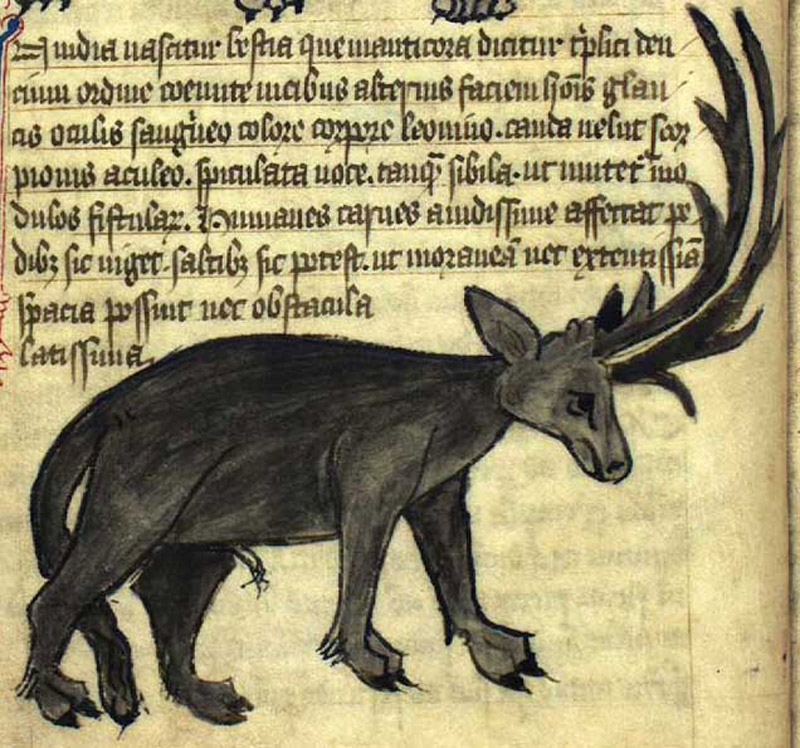
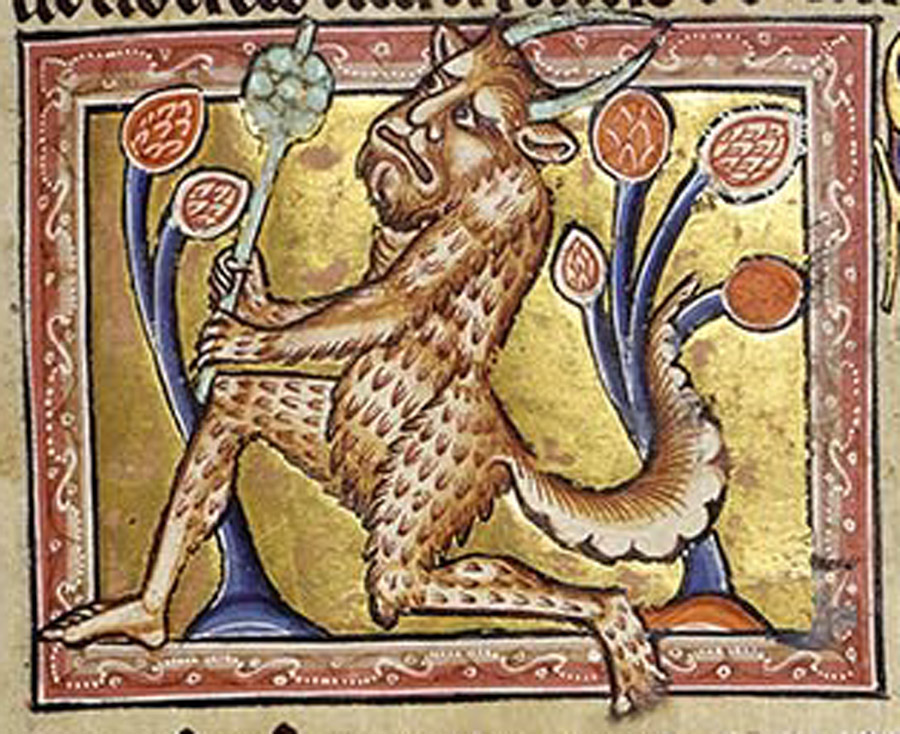
The yale is as large as a horse, is black, and has an elephant's tail and the jaws of a wild boar. Its horns are long and mobile: one can fold backwards while the other fights.

The yale is as large as a horse, is black, and has an elephant’s tail and the jaws of a wild boar. Its horns are long and mobile: one can fold backwards while the other fights.

The wolf approaches a sheepfold like a dog, stealthily and silently, without waking the shepherd. His eyes shine at night like lamps.

The wolf approaches a sheepfold like a dog, stealthily and silently, without waking the shepherd. His eyes shine at night like lamps.

Text Translation:

Of the fox The word vulpis, fox, is, so to say, volupis. For it is fleet-footed and never runs in a straight line but twists and turns. It is a clever, crafty animal. When it is hungry and can find nothing to eat, it rolls itself in red earth so that it seems to be stained with blood, lies on the ground and holds it breath, so that it seems scarcely alive. When birds see that it is not breathing, that it is flecked with blood and that its tongue is sticking out of its mouth, they think that it is dead and descend to perch on it. Thus it seizes them and devours them. The Devil is of a similar nature. For to all who live by the flesh he represents himself as dead until he has them in his gullet and punishes them. But to spiritual men, living in the faith, he is truly dead and reduced to nothing. Those who wish to do the Devil’s work will die, as the apostle says: ‘For if ye live after the flesh, ye shall die; but if ye through the Spirit do mortify the deeds of the body, ye shall live.’ (Romans, 8:13) And David says: ‘They shall go into the lower parts of the earth: they shall fall by the sword: they shall be a portion for foxes.’ (Psalms, 63:9-10)

Of the yale There is an animal called the yale. It is black, as big as a horse, with the tail of an elephant, the jaws of a boar and unusually long horns, adjustable to any movement the animal might make. For they are not fixed but move as the needs of fighting require; the yale advances one of them as it fights, folding the other back, so that if the tip of the first is damaged by a blow, it is replaced by the point of the second.

Of the wolf The word lupus, wolf, in our Latin tongue derives from the Greek. For the Greeks call it licos; this comes from the Greek word for ‘bites’, because maddened by greed, wolves kill whatever they find. Others say the word lupus is, as it were, leo-pos, because like the lion, leo, their strength is in their paws, pes. As a result, whatever they seize does not survive. Wolves get their name from their rapacity: for this reason we call whores lupae, she-wolves, because they strip their lovers of their wealth. The wolf is rapacious beast and craves blood. It strength lies in its chest or its jaws, least of all in its loins. It cannot turn its neck around. It is said to live sometimes on its prey, sometimes on earth and sometimes, even, on the wind. The she-wolf bears cubs only in the month of May, when it thunders. Such is the wolf’s cunning that it does not catch food for its cubs near its lair but far away. If it has to hunt its prey at night, it goes like a tame dog here and there to a sheepfold, and lest the sheepdogs catch its scent and wake the shepherds, it goes upwind. And if a twig or anything, under the pressure of its paw, makes a noise, it nips the the paw as a punishment. The wolf’s eyes shine in the night like lamps.

Well, that’s a new one to me, calling women Lupae. I guess men who stripped others of their wealth were good christians.

It has this characteristic, that if it sees a man first, it takes away his power of speech and looks at him with scorn, as victor over the voiceless. If it senses that the man has seen it first, it loses its fierceness and its power to run. Solinus, who has a lot to say about the nature of things, says that on the tail of this animal there is a tiny patch of hair which is a love-charm; if the wolf fears that it may be captured, it tears the hair out with its teeth; the charm has no power unless the the hair is taken from the wolf while it is still alive. The Devil has the nature of a wolf; he always looks with an evil eye upon mankind and continually circles the sheepfold of the faithful of the Church, to ruin and destroy their souls. The fact that the she-wolf gives birth when the thunder first sounds in the month of May signifies the Devil, who fell from heaven at the first display of his pride. The fact that its strength lies in its forequarters and not in its hindquarters also signfies the Devil, who was formerly the angel of light in heaven, but has now been made an apostate below.

The wolf’s eyes shine in the night like lamps because the works of the Devil seem beautiful and wholesome to blind and foolish men. When the she-wolf bears her young, she will only catch food for them far away from her lair, because the Devil cherishes with wordly goods those he is sure will suffer punishment with him in the confines of hell. But he constantly pursues those who distance themselves from him by good works; as we read of the blessed Job, whose name, substance, sons and daughters the devil carried off to make him desert the Lord in his heart. The fact that the wolf cannot turn his neck without turning the whole of his body signifies that the Devil never turns towards the correction of penitence. Now what is to be done for a man when the wolf has taken away his power of shouting, when he has lost even the power of speech; he loses the help of those who are at a distance. But what is to be done? The man should take off his clothes and trample them underfoot, and taking two stones in his hands, he should beat one against the other. What happens then? The wolf, losing the boldness that comes with its courage will run away. The man, saved by his cleverness, will be free, as he was in the beginning. This is to be understood in spiritual terms and can be taken to a higher level as an allegory. For what do we mean by the wolf if not the Devil? What by the man, if not sin? What by the stones, if not the apostles, or other saints of our Lord? For they are all called by the prophet ‘stones of adamant’.(see Ezekiel, 3:9) For our Lord himself is called in the law ‘as tumbling stone and rock of offence’; (see Romans, 9:33, 1 Peter,2:8) and the prophet says of him: ‘I saw a man standing on a mountain of adamant.’ [SOURCE] Before we were finally redeemed, we were under the power of the enemy and had lost the capacity to call for help, and much as our sins required it, we were not heard by God, nor could we call any of the saints to our aid. But after God in his mercy bestowed his grace upon us in his son, in the act of baptism we laid aside, like old clothes, the person we were before, withall his deeds, and put on, like new clothes, a new person made in the image of God. Then we took stones in our hands and beat them one against the other, because we attract with our prayers the attention of the saints of God, who now reign with him in heaven, asking them to gain the ear of God, our judge, and procure a pardon for our sin, lest Cerberus, whom we do not know should swallow us up, rejoicing in our death.

Wolves mate on no more than twelve days in the year. They can go hungry for a long time, and after long fasts, eat a large amount. Ethiopia produces wolves with manes, so diversely coloured, men say, that no hue is lacking. A characteristic of Ethiopian wolves never turns towards the correction of penitence. is that they leap so high that they seem to have wings, going further than they would by running. They never attack men, however. In winter, they grow long hair; in summer, they are hairless. The Ethiopians call them theas.

This is an Ethiopian Wolf (Theas is correct).

Folio 16r – Leucrota, continued. De vulpe; the fox.

The Bear, Leucrota, and Parandrus.

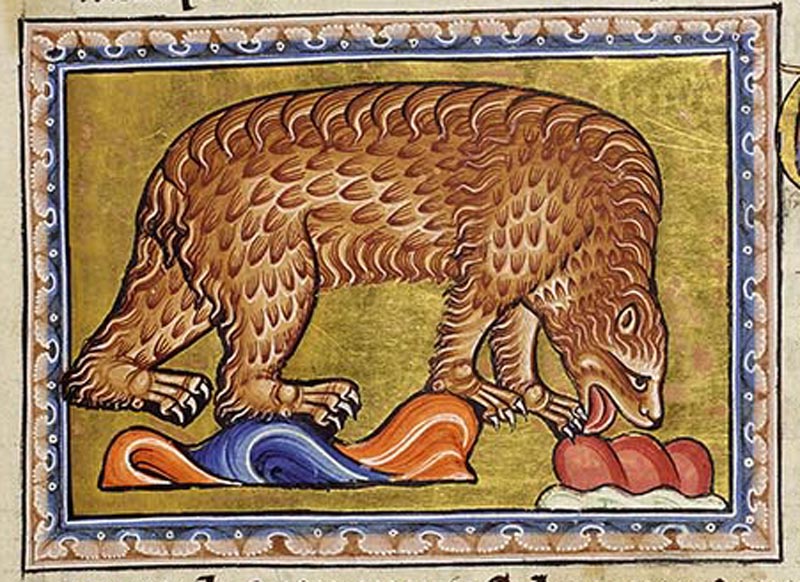
The bear forms its offspring with its mouth. The female gives birth to a small eyeless piece of flesh which is gradually shaped in to a cub by licking. It is born head first resulting in a weak head supported by strong loins which allow the animal to stand on its hind legs.

The leucrota is a swift animal born in India. It is the size of an ass with the hindquarters of a stag, the chest and legs of a lion, [a horse’s head and a mouth split open as far as its ears. It has a continuous jawbone instead of teeth].

Parandrus, Kongelige Bibliotek, Gl. kgl. S. 1633 4º, Folio 15v.

Text Translation:

Of the bear The bear is said to get its name because the female shapes her new-born cub with her mouth, ore, giving it, so to speak, its beginning, orsus. For it is said that they produce a shapeless fetus and that a piece of flesh is born. The mother forms the parts of the body by licking it. The shapelessness of the cub is the result of its premature birth. It is born only thirty days after conception, and as a result of this rapid fertility it is born unformed. The bear’s head is not strong; its greatest strength lies in its arms and loins; for this reason bears sometimes stand upright. Bears do not neglect the business of healing themselves. If they are afflicted by a mortal blow and injured by wounds, they know how to heal themselves. They expose their sores to the herb called mullein – flomus, the Greeks call it – and are healed by its touch alone. When sick, the bear eats ants. The bears of Numidia stand out from other bears by virtue of the shagginess of their hair.

Bears are bred in the same way, wherever they come from. They do not mate like other quadrupeds but embrace each other when they copulate, just like the couplings of humans. Winter arouses their desire. The males respect the pregant females, and honour them by leaving them alone; although they may share the same lair at the time of birth, they lie separated by a trench. Among bears the time of gestation is accelerated. Indeed, the thirtieth day sees the womb free of the cub. As a result of this rapid fertility, the cubs are created without form. The females produce tiny lumps of flesh, white in colour, with no eyes. These they shape gradually, holding them meanwhile to their breasts so that the cubs are warmed by the constant embrace and draw out the spirit of life. During this time bears eat no food at all in the first fortnight; the males fall so deeply asleep that they cannot be aroused even if they are wounded, and the females, after they have given birth, hide for three months. Soon after, when they emerge into the open, they are so unused to the light that you would think they had been blinded. They attack beehives and try hard to get honeycombs. There is nothing they seize more eagerly than honey. If they eat the fruit of the mandrake they die. But they prevent the misfortune from turning into disaster and eat ants to regain their health. If they attack bulls, they know the parts to threaten the most, and will not go for any part except the horns or nose: the nose, because the the pain is sharper in the more tender place.

Of the leucrota The beast called leucrota comes from India. It is the swiftest of all wild animals. It is as big as an ass, with the hindquarters of a deer, the chest and legs of a lion, the head…[Of the parander] … thick coat. It is said that the parander changes its appearance when it is afraid and, when it hides itself, takes on the likeness of whatever is near – a white stone or a green bush or whatever other shape it prefers.

This part of the manuscript is a bit confusing. The leucrota is somewhat confusingly described as having the rear parts of a stag, and the chest and legs of a lion, but with cloven hooves. Its most distinctive characteristic is its charming wide-mouthed grin, which stretches across its head. Its teeth are single, continuous pieces of bone, and it is capable of imitating the sound of a human voice.

The Parandrus is a beast from Ethiopia that can change its appearance, so that it can conceal itself by taking on the appearance of its surroundings. It is colored like a bear, but is the size of an ox and has long hair. It has the head of a stag with branching horns, and has cloven hoofs.

Folio 15r – De monocero; the monceros. De urso; the bear.

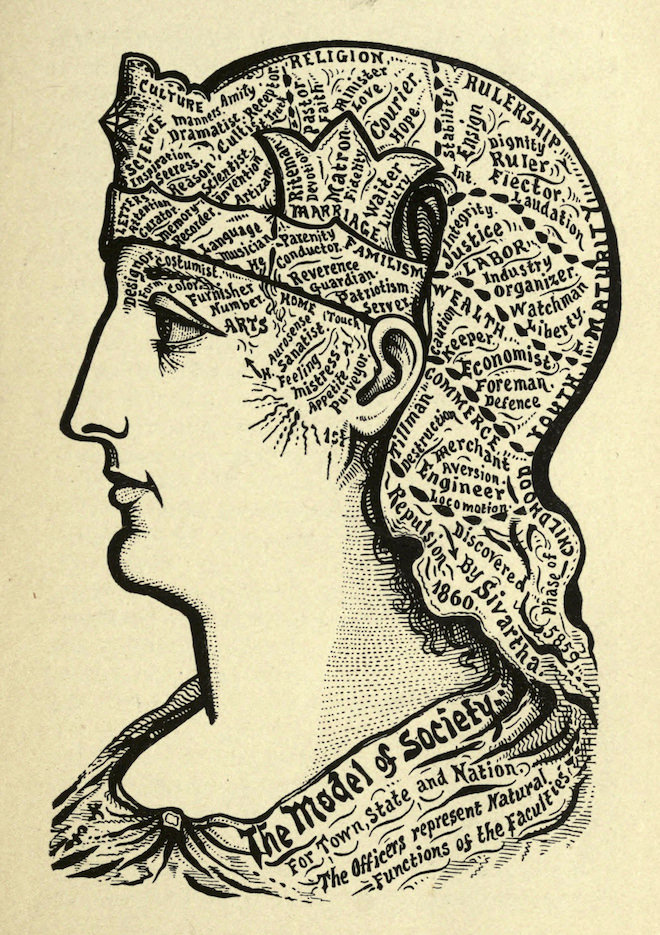
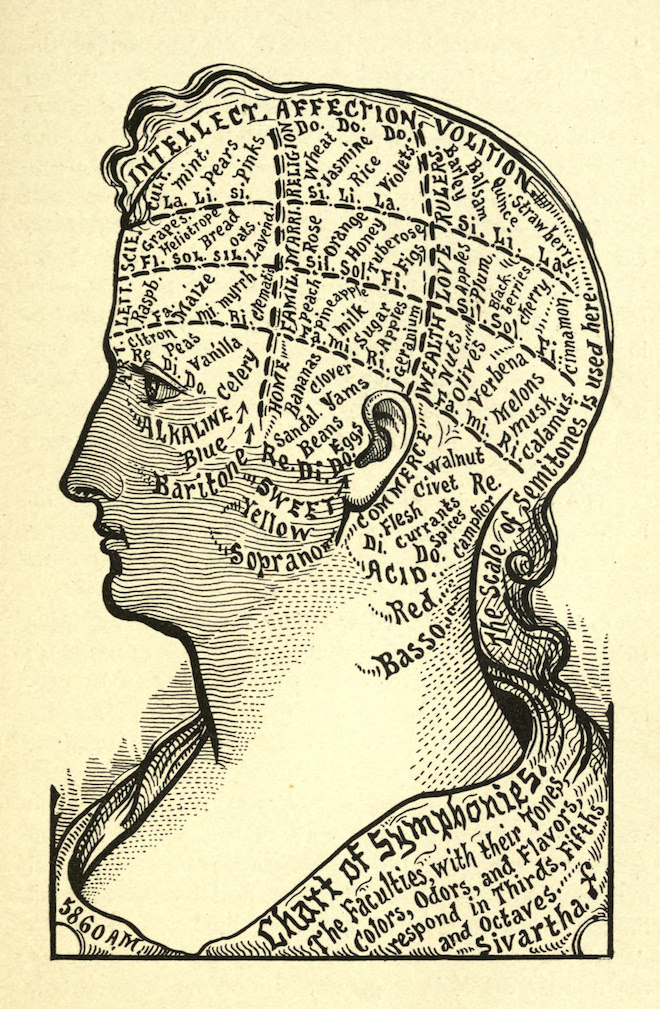
Sivartha’s Book of Life (1898).

The Social Model.

Odors and Flavors.

The Aurosphere.

Nervous Structure.

Titled The Book of Life: The Spiritual and Physical Constitution of Man, Dr Alesha Sivartha’s enigmatic 1898 work expounds his unique blend of blend of science, sociology, mysticism and religion, a spiritual teaching which apparently attracted the attention of Mark Twain among others. Sivartha was clearly a man bursting at the seams with an abundance of complex and esoteric ideas, and while in written form this might translate into somewhat dense and bamboozling prose, visually it gave birth to a series of superbly intricate and striking diagrams. Obsessed with the magical properties of the number 12, Sivartha, in each of his wonderful “brain maps”, breaks down the grey matter into twelve different sections, as well as turning his gaze to other parts of the body such as hands and the nervous system as a whole.

[…]

As for the author himself, not a lot is known for certain, other than Sivartha appears to be the pen-name for a Kansas doctor named Arthur E. Merton (1834?-1915?), who is listed as the author of an earlier 1876 version of The Book of Life. What little additional information out there seems to stem mainly from a website (which seems to share the same mesmerising sense of horror vacui as its subject!) run by his great-great grandson, which claims Sivartha/Merton to be the illegitimate son of the Indian scholar and activist Raja Ram Mohun Roy Bahadoor and an unknown English Unitarian woman who became romantically embroiled with the Raja during his tour of England.

All the diagrams are fascinating, and there are so many of them! You can see some of them at The Public Domain, and the rest here.

Goat and Monoceros.

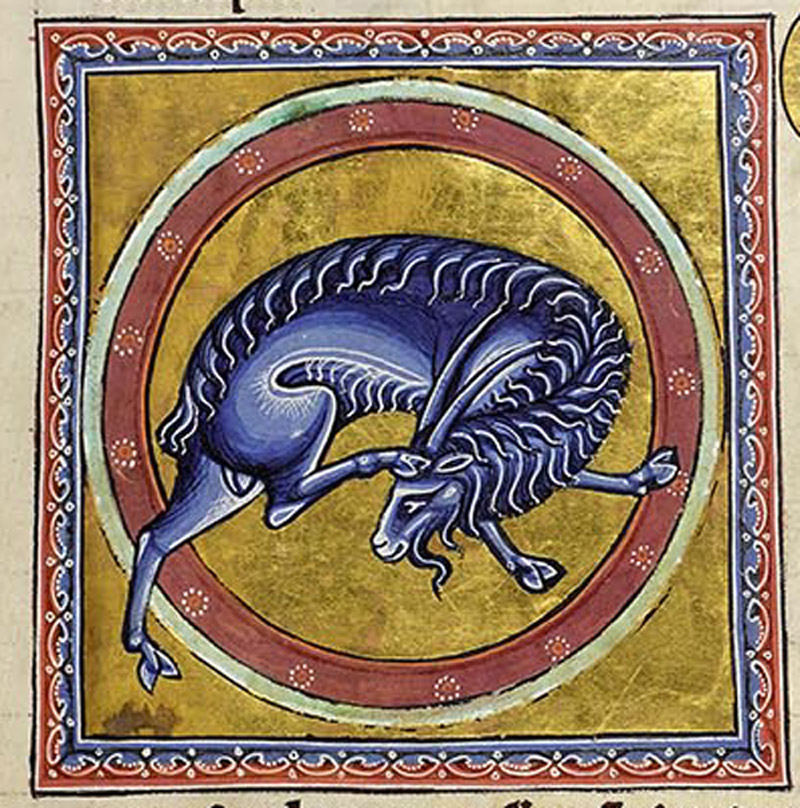
The image of the goat in the roundel, scratching his head with his hind leg, is not related to the attributes given in the text which describe him living in high mountains.

The image of the goat in the roundel, scratching his head with his hind leg, is not related to the attributes given in the text which describe him living in high mountains.

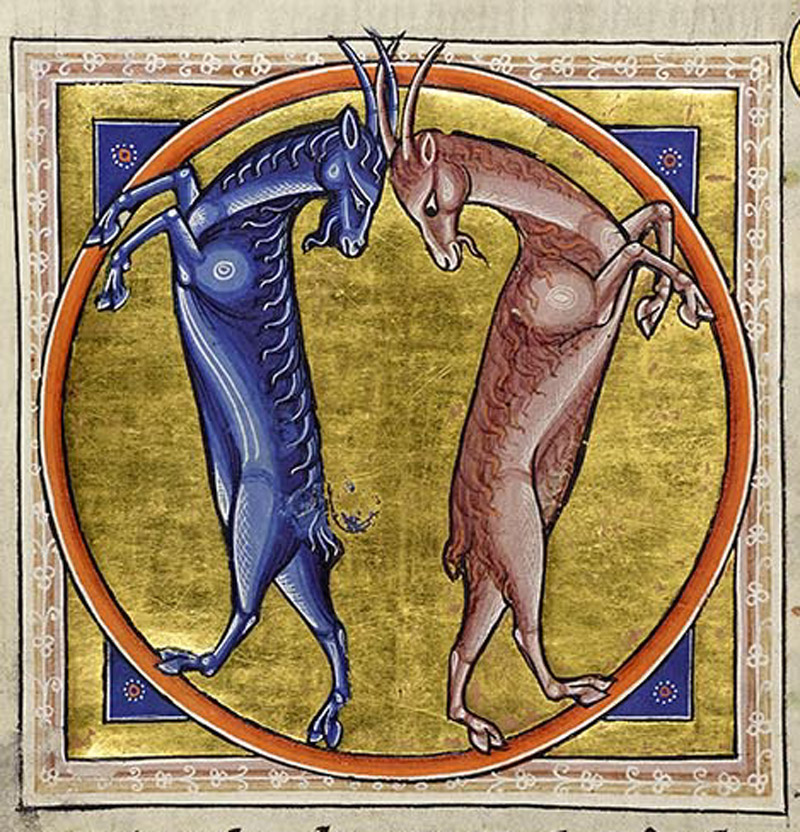
Two agile beasts lock horns in a roundel.

Two agile beasts lock horns in a roundel.

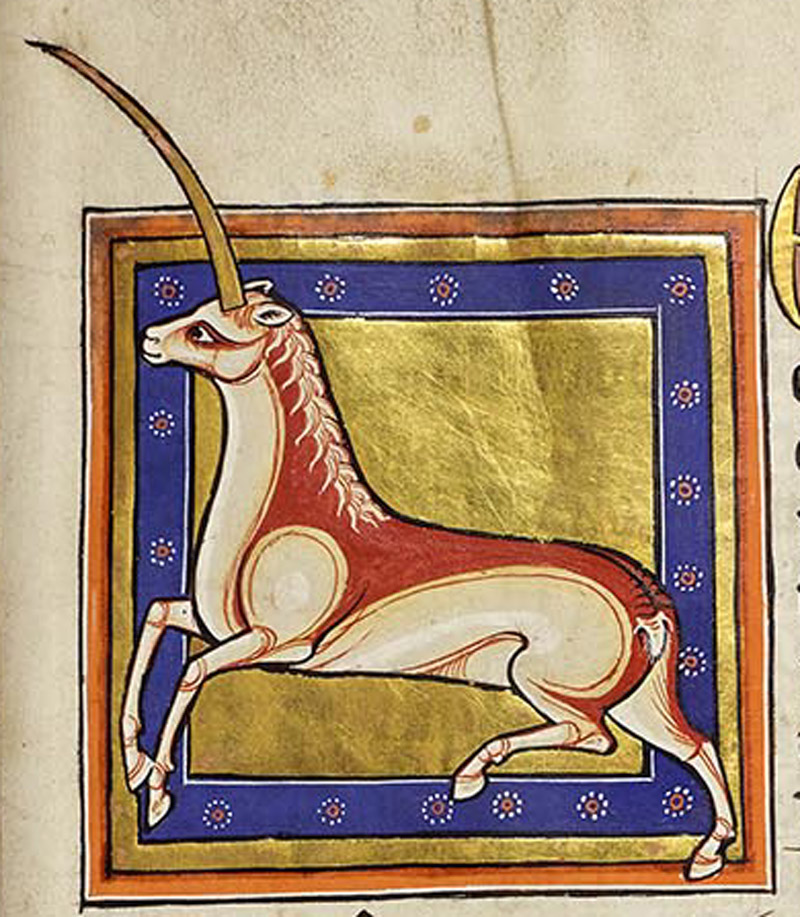
The monoceros has the head of a stag, the tail of a boar, elephant's feet and a horse's body. A horn four feet long projects from his head. This creature was derived from the Indian rhinoceros.

The monoceros has the head of a stag, the tail of a boar, elephant’s feet and a horse’s body. A horn four feet long projects from his head. This creature was derived from the Indian rhinoceros.

Text Translation:

Of the goat There is an animal called in Latin caper, goat, because it chooses, capere, to live in rugged places; some call it capra from crepita, ‘a rustling noise’. These are the tame goats which the Greeks called dorcas, gazelle, because they have very sharp sight. They live in high mountains and can tell if men approaching a long way off are hunters or travellers. In the same way, our Lord Jesus Christ loves high mountains, that is, the prophets and Apostles, as it says in the Song of Songs: ‘Behold, my beloved cometh leaping upon the mountains, skipping upon the hills (see Song of Solomon, 2:8). As a goat grazes in the valleys, our Lord grazes on the church; the good works of Christian people are the food of him who said: ‘For I was an hungred, and ye gave me meat; I was thirsty, and ye gave me drink.’ (Matthew, 25:35) By the valleys of the mountains are understood the churches spread through different regions, as it says in the Song of Songs: ‘My beloved is like a roe or young hart.’ (Song of Solomon, 2:9) The fact that the goat has very sharp eyesight, sees everything and recognises things from a long way off, signifies our Lord, who is the lord of all knowing and God. And elsewhere it is written: ‘Though the Lord be high yet hath he respect unto the lowly but the proud he knoweth afar off.’ (Psalms, 138:6) He created and established all things, and rules and judges and sees; and before anything arises in our hearts he foresees and understands it.

Lastly, just as the goat perceives from afar hunters approaching, so Christ knew in advance the plot of his betrayer, saying: ‘Behold, he is at hand that doth betray me.’ (Matthew, 26:46) Of the wild goat The goat has these characteristics: when grazing, it moves from high to even higher pastures. It picks out good grass from bad by the sharpness of its eyes. It feeds by chewing the grass. When wounded, it hurries to find the herb dittany and, by touching it, is healed. In the same way, good preachers graze on the law of the Lord and take delight in good works as in good pastures, rising from one virtue to another. They choose good writings from bad with the eyes of the heart and meditate upon those they have chosen, that is they examine the good in the views expressed and, having pondered them, commit them to memory. Wounded by sin, they hurry back to Christ by confessing and are quickly healed. For this reason, Christ is rightly said to be like ditanny. For as dittany drives out iron from a wound and heals it, so Christ through confession casts out the devil and pardons sin.

Of the monocerus The monoceros is a monster with a horrible bellow, the body of a horse, the feet of an elephant and a tail very like that of a deer. A magnificent, marvellous horn projects from the middle of its forehead, four feet in length, so sharp that whatever it strikes is easily pierced with the blow. No living monoceros has ever come into man’s hands, and while it can be killed, it cannot be captured.

Note: The monocerus was not always considered to be separate and distinct from a unicorn. Some works hold them to be the same beast; others hold them as separate beasts.

Folio 14r – Deer, continued. De capre; the goat.

Just Press The Right Button.

Vaught’s Practical Character Reader is an appalling little book on phrenology. I can’t imagine going around, staring at people, then feeling free to poke their head. Seems to me that would be an invitation to a facial rearrangement. There’s an insistence that anyone who doesn’t adopt their particular system is an idiot and worse, which  handily brings us to:

[Read more…]

Apes and Deer.

The female monkey gives birth to twins, loving one and hating the other. When hunted, she carries the loved one in her arms while the other clings to her back. Eventually she tires, drops the favoured baby and the other one is saved. The ape does not have a tail.

The female monkey gives birth to twins, loving one and hating the other. When hunted, she carries the loved one in her arms while the other clings to her back. Eventually she tires, drops the favoured baby and the other one is saved. The ape does not have a tail.

The satyr, like the ape, has some similarities with man. He is partly like a goat with a beard, horns, and broad tail. His rather human body is covered with shaggy hair. He holds his thyrsus or wand, used in his lustful and disorderly revels. His face is quite attractive and he makes pantomime gestures.

The satyr, like the ape, has some similarities with man. He is partly like a goat with a beard, horns, and broad tail. His rather human body is covered with shaggy hair. He holds his thyrsus or wand, used in his lustful and disorderly revels. His face is quite attractive and he makes pantomime gestures.

Bodleian Library, MS. Bodley 764, Folio 20r. Two stags with a doe and fawns.

Bodleian Library, MS. Bodley 764, Folio 20r. Two stags with a doe and fawns.

In the upper register, a stag is wounded by a hunter's arrow. Below, the stag eats the herb dittany, causing the arrow to come out. British Library, Harley MS 4751, Folio 14v.

In the upper register, a stag is wounded by a hunter’s arrow. Below, the stag eats the herb dittany, causing the arrow to come out. British Library, Harley MS 4751, Folio 14v.

Text Translation:

Apes are called simie in Latin because the similarity between their mentality and that of humans is felt to be great. Apes are keenly aware of the elements; they rejoice when the moon is new and are sad when it wanes. A characteristic of the ape is that when a mother bears twins, she loves one and despises the other. If it ever happens that she is pursued by hunters, she carries the one she loves before her in her arms and the one she detests on her shoulders. But when she is tired of going upright, she deliberately drops the one she loves and reluctantly carries the one she hates. The ape does not have a tail. The Devil has the form of an ape, with a head but no tail. Although every part of the ape is foul, its rear parts are disgusting and horrid enough. The Devil began as an angel in heaven. But inside he was a hypocrite and a deceiver, and he lost his tail, because he will perish totally at the end, just as the apostle says: ‘The Lord shall consume him with the spirit of his mouth.’ (2 Thessalonians, 2:8) The name symia is Greek, meaning, ‘flattened nostrils’. Hence we call the ape symia because they have compressed nostrils and a hideous face, its creases foully expanding and contracting like a bellows; although she-goats also have a flattened nose. The apes called circopetici have tails. This alone distinguishes them from the apes mentioned earlier. Cenophali are numbered among the apes. They occur in great numbers in parts of Ethiopia. They leap wildly and bite fiercely. They are never so tame, that their ferocity does not increase. Sphynxes are also included among apes. They have shaggy hair on their arms and are easily taught to forget their wild nature. Of satyrs There are also apes that men call satyrs. They have quite attractive faces, and are restless, making pantomimed gestures. The apes called callitrices differ from the others in almost every aspect of their appearance. They have bearded faces and broad tails. It is not difficult to catch them but they rarely survive in captivity. They do not live elsewhere than under the Ethiopian sky, that is their native sky.

I’ll admit, I find that whole tail business a bit confusing. Before continuing with the deer, I’ll note that A drink made from the tears and the heart bones of a stag is a cure for troubles of the heart was a common belief way back when, the ‘heart bones’ of a stag being in the shape of a cross. This interesting belief is a main plot point in This Night’s Foul Work, by Fred Vargas.

Of deer The word cervi (deer) comes from ceraton, ‘horns’, for horns are called cerata in Greek. Deer are the enemies of snakes; when they feel weighed down with weakness, they draw snakes from their holes with the breath of their noses and, overcoming the fatal nature of their venom, eat them and are restored. They have shown the value of the herb dittany, for after feeding on it, they shake out the arrows which have lodged in them. Deer marvel at the sound of the pipes; their hearing is keen when their ears are pricked but they hear nothing when their ears are lowered. Deer have this characteristic also, that they change their feeding-ground for love of another country, and in doing so, they support each other. When they cross great rivers or large long stretches of water, they place their head on the hindquarters of the deer in front and, following one on the other, do not feel impeded by their weight. When they find such places, they cross them quickly, to avoid sinking in the mire. They have another characteristic, that after eating a snake they run to a spring and, drinking from it, shed their long coats and all signs of old age.

The members of the holy Church seem to have a mentality corresponding to that of deer, because while they change their homeland, that is, the world, for love of the heavenly homeland, they carry each other, that is, the more perfect bring on and sustain the less perfect by their example and their good works. And if they find a place of sin, they leap over it at once, and after the incarnation of the Devil, that is, after committing a sin, they run, by their confession, to Christ, the true spring; drinking in his commandments, they are renewed, shedding their sin like old age. Stags, when it is time to rut, rage with the madness of lust. Does, although they may been inseminated earlier, do not conceive before the star Arcturus appears. They do not rear their young just anywhere but hide them with tender care, concealed deep in bushes or grass, and they make them stay out of sight with a tap of the hoof. When the young grow strong enough to take flight, the deer train them to run and to leap great distances. When deer hear the dogs barking, they move upwind taking their scent with them. They are scared rigid by everything, which makes them an easier mark for archers. Of their horns, the right-hand one is better for medical purposes. If you want to frighten off snakes, you should burn either. If deer have few or no teeth, it shows that they are old. In order to tell their age, Alexander the Great ringed a number of deer; when they were recaptured a century later they showed no sign of old age. The offspring of the deer are called hinnuli, fawns, from innuere, ‘to nod’, because at a nod from their mother, they vanish from sight.

The rennet of a fawn killed in its mother’s womb is a marvellous remedy against poisons. It is known that deer never grow feverish. For this reason ointments made from their marrow bring down sick men’s temperatures. We read that many men who have regularly eaten a small amount of venison since their early days have lived for a long time unaffected by fevers; but ultimately it fails them as a remedy if they are killed by a single blow.

Folio 12v – Simie vocantur…; apes.

Hyena and Bonnacon.

The hyena should not be eaten because it is dirty and has two natures, male and female. Both sexual organs are clearly shown. It dwells in the tombs of the dead and devours human bodies. Its spine is rigid and it must move its whole body in order to turn.

The hyena should not be eaten because it is dirty and has two natures, male and female. Both sexual organs are clearly shown. It dwells in the tombs of the dead and devours human bodies. Its spine is rigid and it must move its whole body in order to turn.

This is one of my all time favourite Medieval Bestiary depictions. I love that external spine. Wish I had one to wear.

Detail of miniature of a lioness, a crocote, and a bonnacon, Harley MS 3244, f. 41r.

Detail of miniature of a lioness, a crocote, and a bonnacon, Harley MS 3244, f. 41r.

The bonnacon is an Asian beast whose head is like a bull but his horns curl inwards so that they do not harm the victim. When the bonnacon is chased he expels dung which burns a wide area.

The bonnacon is an Asian beast whose head is like a bull but his horns curl inwards so that they do not harm the victim. When the bonnacon is chased he expels dung which burns a wide area.

Text Translation:

Of the hyena. There is an animal called the hyena, which inhabits the tombs of the dead and feeds on their bodies. Its nature is that it is sometimes male, sometimes female, and it is therefore an unclean animal. Since its spine is rigid, all in one piece, it cannot turn round except by turning its body right around. Solinus recounts many marvellous things about the hyena. First, it stalks the sheepfolds of shepherds and circles their houses by night, and by listening carefully learns their speech, so that it can imitate the human voice, in order to fall on any man whom it has lured out at night. The hyena also [imitates] human vomit and devours the dogs it has enticed with faked sounds of retching. If dogs hunting the hyena accidentally touch its shadow behind, they lose their voices and cannot bark. In its search for buried bodies, the hyena digs up graves. The sons of Israel resemble the hyena. At the beginning they served the living God. Later, addicted to wealth and luxury, they worshipped idols. For this reason the prophet compared the synagogue to an unclean animal: ‘My heritage is to me as the den of a hyena.’ (see Jeremiah, 12:8) Therefore those among us who are slaves to luxury and greed, are like this brute, since they are neither men nor omen, that is, neither faithful nor faithless, but are without doubt those of whom Solomon says: ‘A double-minded man is unstable in all his ways’; (James, 1:8) of whom the Lord says: ‘You cannot serve God and mammon.’ (Matthew, 6:24)

This beast has a stone in its eyes, called hyenia; anyone who keeps it under his tongue is believed to foretell the future. It is true that if the hyena walks three times around any animal, the animal cannot move. For this reason men declare that the hyena has magical properties. In a part of Ethiopia the hyena mates with the lioness; their union produces a monster, named crocote. Like the hyena, it too produces men’s voices. It never tries to change the direction of its glance but strives to see without changing it. It has no gums in its mouth. Its single, continuous tooth is closed naturally like a casket so that it is never blunted.

Of the bonnacon In Asia an animal is found which men call bonnacon. It has the head of a bull, and thereafter its whole body is of the size of a bull’s with the maned neck of a horse. Its horns are convoluted, curling back on themselves in such a way that if anyone comes up against it, he is not harmed. But the protection which its forehead denies this monster is furnished by its bowels. For when it turns to flee, it discharges fumes from the excrement of its belly over a distance of three acres, the heat of which sets fire to anything it touches. In this way, it drives off its pursuers with its harmful excrement.

Folio 11v – Ibex, continued. De yena; the hyena.

Beaver and Ibex.

If you’re a person with testicles, hang on to ’em. :D

The beaver is a gentle animal whose testicles have a medicinal value. When hunted, the beaver escapes with his life by biting off his testicles. If he is hunted for a second time he shows his incompleteness and is spared.

The ibex has two enormously strong horns. If it jumps from the top of a mountain, its body is held safe by its horns.

Text Translation:

Of the beaver  There is an animal called the beaver, which is extremely gentle; its testicles are highly suitable for medicine. Physiologus says of it that, when it knows that a hunter is pursuing it, it bites off its testicles and throws them in the hunter’s face and, taking flight, escapes. But if, once again, another hunter is in pursuit, the beaver rears up and displays its sexual organs. When the hunter sees that it lacks testicles, he leaves it alone. Thus every man who heeds God’s commandment and wishes to live chastely should cut off all his vices and shameless acts, and cast them from him into the face of the devil. Then the devil, seeing that the man has nothing belonging to him, retires in disorder. That man, however, lives in God and is not taken by the devil, who says: ‘I will pursue, I will overtake them…'(Exodus, 15:9) The name castor comes from castrando, ‘castrate’.

Of the animal called the ibex There is an animal called the ibex, which has two horns of such strength that, if it were to fall from a high mountain to the lowest depths, its whole body would be supported by those two horns. The ibex represents those learned men who are accustomed to manage whatever problems they encounter, with the harmony of the two Testaments as if with a sound constitution; and, supported as by two horns, they sustain the good they do with the testimony of readings from the Old and New Testament.

Folio 11r – Elephant, continued. De castore; the beaver. De animale qoud dicitur ibex; the ibex.