Markers on Bristol, 16″x20″.
I have to say, this made me laugh. One of my great grandmothers had a great love of blood based dishes, but I never did develop a taste for them. Out of all these, I don’t think Kyselo sounds bad at all, and that’s coming from someone who is not a fan of cooked mushrooms.
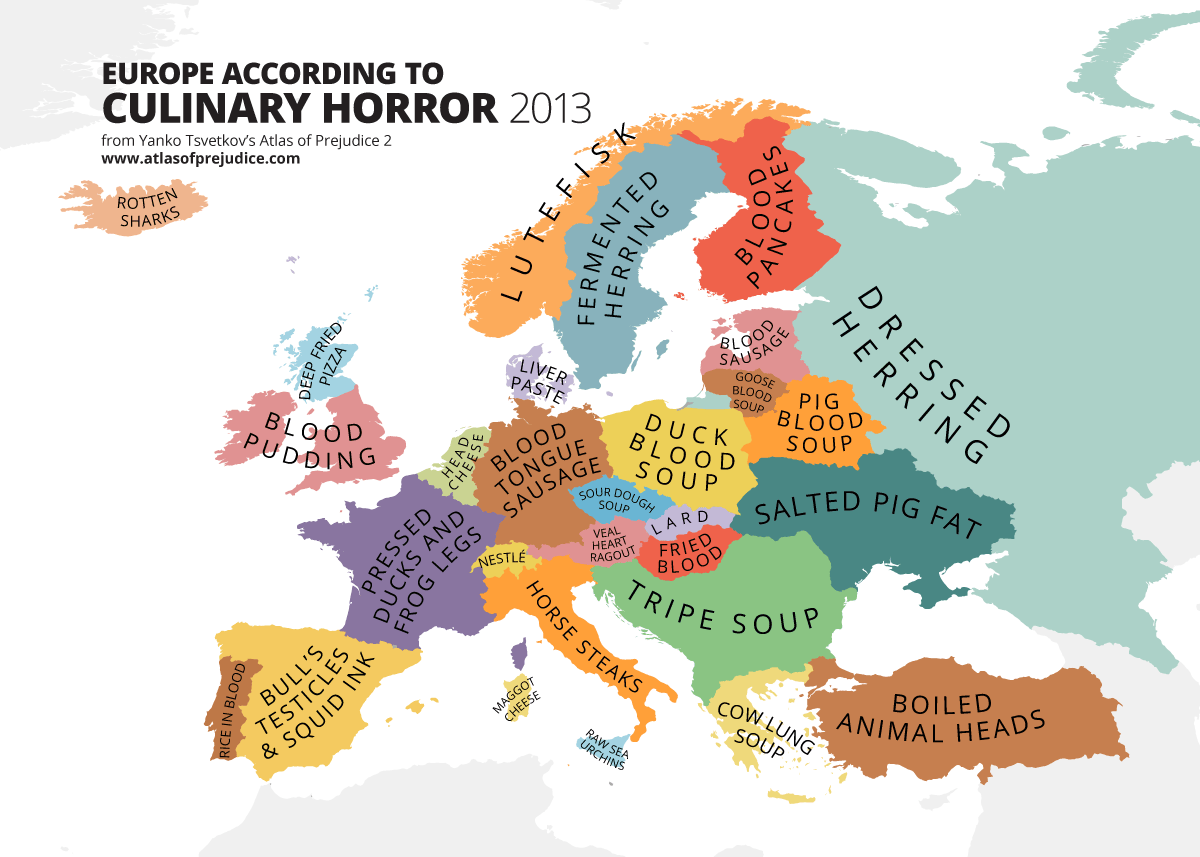
While European food has a very positive international reputation, it’s not all steak frites and pasta. As the map above shows, the continent also has its fair share of disgusting dishes and culinary horrors.
The map is the work of Yanko Tsvetkov and appears in Atlas of Prejudice 2: Chasing Horizons (also be sure to check out his first book Atlas of Prejudice: Mapping Stereotypes, Vol. 1)
You can see a linked list of all the foods in the map here, if you’re looking for more culinary info. Interesting reading all the way around! One thing is absolutely certain – there is absolutely nothing which would induce me to try maggot cheese. There are just some lines not to be crossed. :D

Spider costume designed by Charles Briton for the “Missing Links” theme, Mistick Krewe of Comus, 1873: Carnival Collection, Louisiana Research Collection, Tulane University — Source (some potential restrictions on reuse).

“D for Dragon” float design by Bror Anders Wikstrom for the “Alphabet” theme, Krewe of Proteus, 1904: Carnival Collection, Louisiana Research Collection, Tulane University — Source (some potential restrictions on reuse).

“U for Unicorn” float design by Bror Anders Wikstrom for the “Alphabet” theme, Krewe of Proteus, 1904: Carnival Collection, Louisiana Research Collection, Tulane University — Source (some potential restrictions on reuse).

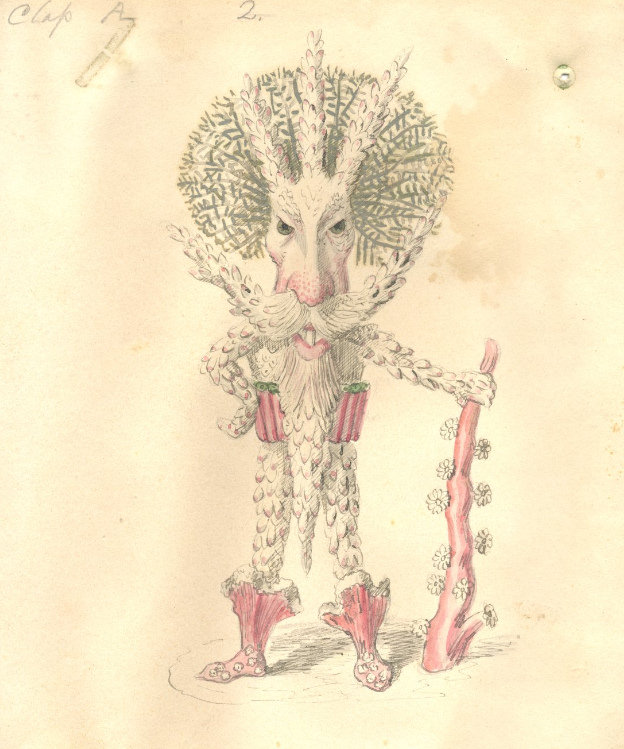
Coral Polyp costume designed by Charles Briton for the “Missing Links” theme, Mistick Krewe of Comus, 1873: Carnival Collection, Louisiana Research Collection, Tulane University — Source (some potential restrictions on reuse).

Darwin as an ass costume designed by Charles Briton for the “Missing Links” theme, Mistick Krewe of Comus, 1873: Carnival Collection, Louisiana Research Collection, Tulane University — Source.
Oh gods, these are beyond fabulous! I am so in love with the Coral polyp costume. Also in love with the bat, so cheerful!
On March 6, 1889, the New York Times breathlessly reported on the recent Carnival spectacles in New Orleans. The Krewe of Rex’s pageant, themed around “Treasures of the Earth”, included a “Crystal” float “attended by figures in gorgeous costumes and prisms by the thousand”, and a “Diamond” float featuring “a rocky diamond dell” through which flowed “limpid streams where nymphs sported and played with the gems”. The Krewe of Proteus, meanwhile, dazzled with their “Hindoo Heavens” pageant, where in one scene appeared Agni “God of Fire” riding a ram that “strides the flames, attended by the fire sprites.” This opulent, and highly exoticized, interpretation of South Asian religion concluded with a tableau where “Vishnu, under the guise of a horse with silver wings, shatters the earth with his hoof and rises to the celestial abode.”
The modern American Mardi Gras owes much of its bombastic revelry to this late nineteenth-century “Golden Age” of Carnival design. From the invitations to the costumes to the hand fans carried by spectators, artists designed entire identities for each Krewe (a group that organizes a Carnival event).
[…]
Mythology, literature, religion, and history, as well as nineteenth-century book illustration and turn-of-the-century Art Nouveau, were remixed into an eclectic excess. Up to the early 1900s, the main Krewes were Rex, Comus, Proteus, and Momus, each with their favorite artist collaborators. The names of these individuals are now obscure, but artists Jennie Wilde, Bror Anders Wikstrom, Charles Briton, Carlotta Bonnecaze, and others now anonymous all influenced the embrace of the fantastic that endures into the present. The greatest publicly accessible resource of their art is the Carnival Collection, part of the Louisiana Research Collection (LaRC) at Tulane University and supported by a bequest from the late journalist Charles L. “Pie” Dufour. In 2012, Tulane marked the completion of a two-year digitization project that put over 5,500 float and costume designs in the Carnival Collection online.
You can read and see so much more at The Public Domain Review, every single piece of artwork is utterly amazing and delightful! You can see all the images at a much larger size at the Tulane University source site. If you’re someone always on the lookout for inspired costume design, you cannot afford to miss these.
Medievalists has a fun article up about colour. Me, I’m all about the red first. Black second. I was rather delighted to find out I’d be an evil knight. :D Some interestin’ bits:
Medieval scholars inherited the idea from ancient times that there were seven colors: white, yellow, red, green, blue, purple and black. Green was the middle color, which meant that it sat balanced between the extremes of white and black. It was also considered a soothing color, so much so that scribes often kept emeralds and other green objects beside them to look at when they needed to rest their eyes, while the poet Baudri de Bourgueil suggested writing on green tablets instead of white or black ones.
I wouldn’t mind keeping a few emeralds around…
Arthurian romances, one of the most popular forms of literature in the High Middle Ages, often made symbolic use of color, especially in the depiction of knights. Pastoureau writes:
The color code was recurrent and meaningful. A black knight was almost a character of primary importance (Tristan, Lancelot, Gawain) who wanted to hide his identity; he was generally motivated by good intentions and prepared to demonstrate his valor, especially by jousting or tournament. A red knight, on the other hand, was often hostile to the hero; this was a perfidious or evil knight, sometimes the devil’s envoy or a mysterious being from the Other World. Less prominent, a white knight was generally viewed as good; this was an older figure, a friend of protector or the hero, to who he gave wise council. Conversely, a green knight was a young knight, recently dubbed, whose audacious or insolent behavior was going to cause great disorder; he could be good or bad. Finally, yellow or gold knights were rare and blue knights nonexistent.
There’s also the mystery of why the colour blue took so very long to show up, and much more.
Michel Pastoureau has written extensively about symbolism and colors in the Middle Ages. His series A History of a Color, has four books that have been translated into English – Black, Blue, Green and Red.
I’ve already tracked these down at B&N and put my order in! :D Not only a lovely little history, but a nice read, and fun resource for artists. You can read everything at Medievalists.net.
Everyone must have had thoughts like these before:
Broccoli and parsley may sometimes look like a forest of trees, and tree leaves floating on the surface of water may sometimes look like little boats. Everyday occurrences seen from a miniature
perspective can bring us lots of fun thoughts.
I wanted to take this way of thinking and express it through photographs, so I started to put together a “MINIATURE CALENDAR.” These photographs primarily depict diorama-style figures surrounded by
daily necessities.
Just like a standard daily calendar, the photos are updated daily on my website and SNS page, earning it the name of “MINIATURE CALENDAR.”It would be great if you could use it to add a little enjoyment to your everyday life.
Add a little enjoyment to your world, by visiting Tatsuya Tanaka’s worlds, they are wonderful! You can see the current month and all the archives at Miniature Calendar.

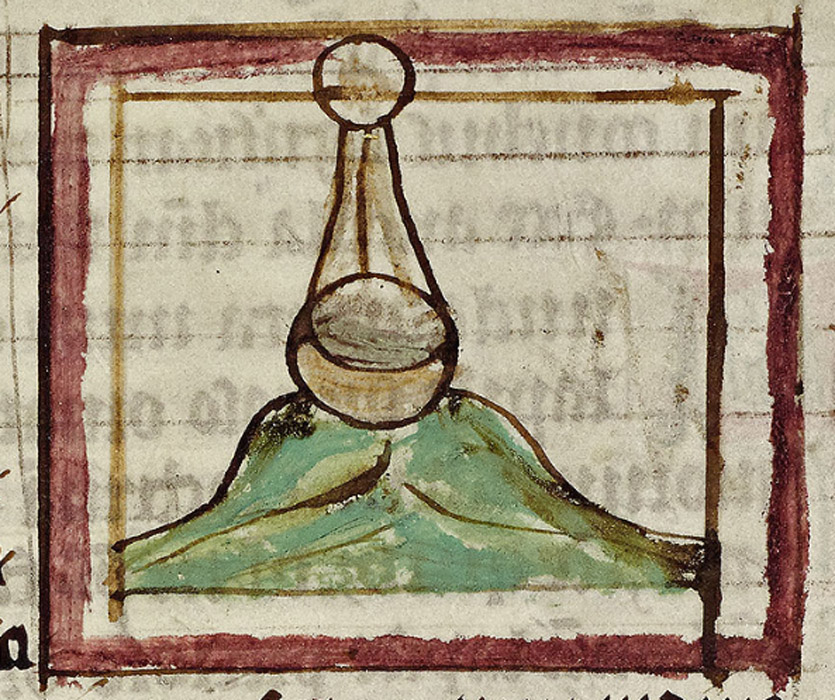
A poor sketch by the same hand as f.94r. The open stone, lying on green water, takes in the heavenly dew in order to grow a pearl.
Nothing but preaching.
Text Translation:
Of the stone called mermecoleon. There is a stone in the sea which is called in Latin mermecoleon and in Greek concasabea, because it is both hollow and round. It is, moreover, divided into two parts, so that if it wants to, it can close up. The stone lies at the bottom of the sea and comes to life early in the morning. When it rises from its resting-place to the surface of the sea, it opens its mouth and takes in some heavenly dew, and the rays of the sun shine around it; thus there grows within the stone a most precious, shining pearl indeed, conceived from the heavenly dew and given lustre by the rays of the sun. The stone, therefore, is called conchus; it symbolizes Saint Mary, of whom Isaiah foretold, saying: ‘There shall come forth a rod out of the stem of Jesse’ (Isaiah, 11:1). And again: ‘Behold a virgin shall conceive and bear a son’ (Isaiah, 7:14). Of the rod and the virgin, Saint Mary, it is said: ‘A flower was born of Saint Mary, our Lord Jesus Christ’. For just as the stone rises from the sea, so Saint Mary went up from the house of her father to the temple of God and there received the dew from heaven. These are the words which were said to her by the archangel Gabriel: ‘The Holy Ghost shall come upon thee, and the power of the Highest shall overshadow thee; therefore also that holy thing which shall be born of thee shall be called the Son of God’ (Luke, 1:35). Behold these words are the heavenly dew, just as before her, the patriarch Isaac, blessing his son, signifying that Christ would be born from his seed, said to him: ‘God give thee of the dew of heaven and the fatness of the earth’ (Genesis, 27: 28), signifying the chaste, untouched virgin Mary. ‘Early in the morning’ refers to the time of prayer. The mussel opening its mouth signifies the occasion when Mary says to the angel: ‘Behold the handmaiden of the Lord; be it unto me according to thy word’ (Luke, 1:35).
From a while back, actually, when I was still feeling well enough to shop. A new pair of Ro-Search combat boots, 8 dollars at a local thriftshop, and a set of Mondrian Composition coloured pencils, from the sale table at the bookstore. Not my fave Mondrian piece, but hey, pencils. My fave is Avond; De rode boom.
© C. Ford, all rights reserved.
I can’t be the only one who remembers Gay Bob. If you don’t remember Gay Bob, perhaps you remember the lunatic reaction, starting in 1978, which Anita Bryant climbed on top of, screaming her hatred of all things queer to the skies.

A 1978 magazine advertisement for the Gay Bob doll. Joe Wolf/CC BY-ND 2.0
I think it’s time for Gay Bob to come out of the closet again, along with his family, and some new additions, as well.
Gay Bob, who was meant to resemble a cross between Robert Redford and Paul Newman, was blond, with a flannel shirt, tight jeans, and one pierced ear. The doll gave anti-gay organizations plenty to fear; intrinsic within it was a celebration of gay identity, evidenced by Gay Bob’s programmed speech. “Gay people,” Bob said, “are no different than straight people… if everyone came ‘out of their closets’ there wouldn’t be so many angry, frustrated, frightened people.”
In a cheeky move, the box in which Gay Bob was packaged came in the outline of a closet, so that when he left his box, he was literally coming out of the closet. Gay Bob explained: “It’s not easy to be honest about what you are — in fact it takes a great deal of courage… But remember if Gay Bob has the courage to come out his closet, so can you.”
The affirming message was no accident. The doll’s creator, Harvey Rosenberg, a former advertising executive who developed marketing campaigns for various corporations, wanted Gay Bob to “liberate” men from “traditional sexual roles.” He created the doll soon after a series of shocks rocked his life: in quick succession, his marriage fell apart and his mother became seriously ill. He decided that his next projects would need to be of great personal significance.
[…]
Initially sold through mail-order ads in gay-themed magazines, Gay Bob soon expanded into boutique stores in New York and San Francisco. Rosenberg even pitched it to major department store chains, one of which liked the idea (but ultimately did not purchase it). And, it turns out, those consumers who feared the introduction of more “disgusting” dolls were partially correct—Rosenberg soon gave Gay Bob a family of his own, with brothers Marty Macho, Executive Eddie, Anxious Al, and Straight Steve (who lived in the suburbs and wore blue suits), and sisters Fashionable Fran, Liberated Libby, and Nervous Nelly.
If this is all new to you, you can read all about Gay Bob at Atlas Obscura.
Whole lotta preachin’ going on. The last paragraph is about the stone.
Text Translation:
Of the adamas stone. Physiologus says: There is a stone called adamas found on a certain mountain in the east. Such is its nature, that you should search for it by night, not day, since it shines at night where it lies, but it does not shine by day, since the sun dulls its light. Against this stone, neither iron, fire or other stones can prevail. The prophet says of it: ‘I saw a man standing on a wall of adamant and in his hand was an adamant stone in the midst of the people of Israel’ (compare Amos, 7:7). But a creature cannot prevail against its creator, and for this reason Christ is the adamas stone. He stands on a wall of such stone, on the holy and living stones of which heavenly Jerusalem is built. These are the Apostles, the prophets and the martyrs, over whom neither fire, nor the sword nor the teeth of beasts could prevail.

The tale is divided into two scenes. A naked man and woman stand apart above a fire, offering each other fire stones. In the lower image, they embrace.
Commentary:
A literal illustration of the text only requires a picture of stones, as shown in London, B.L.Harley MS 3244, f. 60, but the arrangement of the figures and tree is intended to suggest the Fall in the Garden of Eden.Fire-bearing stones are male and female. When they are apart the fire does not ignite, when close together, the mountain burns. The warning is for men to stay clear of women and avoid kindling lust. Beside the painting are sketches which are a combination of the Ashmole and Aberdeen illuminations. Ashmole Bestiary, f.103v. Their comparisons are analysed here.
More misogyny ahead.
Text Translation:
Of fire-bearing stones. On a certain mountain in the east, there are fire-bearing stones which are called in Greek terrobolem; they are male and female. When they are far from each other, the fire within them does not ignite. But when by chance the female draws near to the male, the fire is at once kindled, with the result that everything around the mountain burns.
For this reason, men of God, you who follow this way of life, stay well clear of women, lest when you and they approach each other, the twin flame be kindled in you both and consume the good that Christ has bestowed upon you. For there are angels of Satan, always on the offensive against the righteous; not only holy men but chaste women too. Finally, Samson and Joseph were both were tempted by women. One triumphed; the other succumbed. Eve and Susanna were tempted; the latter held out; the former gave in. The heart, therefore, should be guarded and guided by all forms of divine teaching.
For the love of women, which has been the cause of sin from the beginning, that is from Adam to the present day, rages uncontrolled in the sons of disobedience.
Folio 93v – the age of man, continued. De lapidibus igniferis; Of fire-bearing stones.

Isidore sits on a chair, writing on a sloping desk the words ‘(ysid)oris (de) natu(ra) hominisI’ Isidore, Concerning the Nature of Man.
Quite the misogynistic treatise.
Text Translation:
Of the age of man There are six stages of life. Infancy, childhood, adolescence, youth, maturity and old age. The first age is infancy, which lasts from the time the child enters the light till it is seven. The second is childhood, that is, when the child is pure and not yet old enough to generate young; it extends to the fourteenth year. The third is adolescence, when the child is old enough to generate children; it lasts until the twenty-eighth year. The fourth is youth, the the most robust of all the ages; it ends in the fiftieth year. The fifth age is that of riper years, that is, of maturity, and represents the movement away from youth to old age; you are not yet ancient, but you are no longer young; the Greeks call someone at this age of maturity presbiteros, an elder; an old man they call geron. This age, beginning in the fiftieth year, ends in the seventieth. The sixth age is that of old age, which has no end-date; whatever of life is left after the five Previous ages is classed as ‘old age’. The final part of old age is senility, senium, so called because it marks the end of the sixth age, sexta etas.
Philosophers, therefore, have categorised human life in these six periods, during which it is changed and runs its race and comes to an end, which is death. So, let us proceed briefly through the above-mentioned categories of the ages, pointing out their etymology in the context of man.
L’Origine du Monde, The Origin of the World, is a famous and well known painting by Courbet. It’s a beautiful work, and housed at Musée d’Orsay, Paris. Facebook France decided that a small thumbnail of this work was deserving of censorship.
The dispute around Gustave Courbet‘s graphic 1866 oil painting “L’Origine du Monde” (The Origin of the World), has escalated with teacher is taking Facebook to a Parisian court over allegations of censorship. Frédéric Durand-Baïssas says the social media network blocked his account without notice when he posted a thumbnail with footage and information about the painting.
The incident took place in 2011 but it has taken years of wrangling to establish whether or not Facebook is liable to French law, as it regards itself as a U.S. company. The art-lover posted a clip of the Courbet work after the account of Danish sculptor Frode Steinicke went down for a similar violation of the website’s rules on nudity. The company reactivated Steinicke’s account, although without the allegedly offending piece.
“On the one hand, Facebook shows a total permissiveness regarding violence and ideas conveyed on the social network,” the teacher’s lawyer, Stéphane Cottineau, told the Associated Press in 2016. “And on the other hand, [it] shows an extreme prudishness regarding the body and nudity.”
I would think, at this point, with Facebook being up to their neck in unethical and questionable activities they refuse to do anything about might have given them a bit of a wake up call over their astonishing prudery. They don’t care about threats. They don’t care about people being harassed. They don’t care about people using their service to steal. They don’t care about fakery of any kind. Oh, but if there is even an implied nipple, they are on the case, you betcha! There isn’t even an attempt to understand that the rest of the world does not have such puritanical views. There is nothing wrong with the human body, and it’s past time Facebook stopped acting like it’s the biggest shame of all.
Via Raw Story.