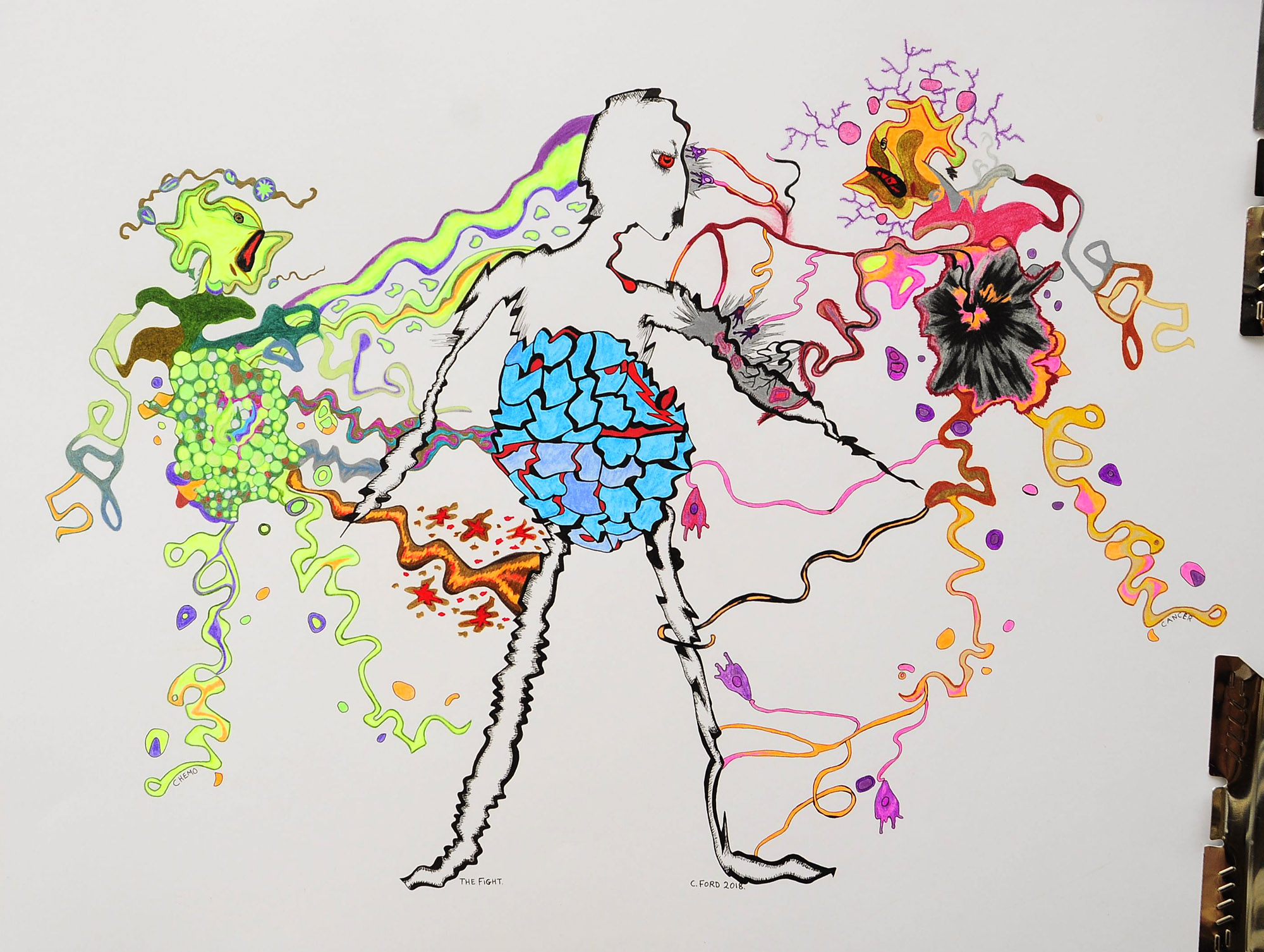
The Fight.

Finished! 18″ x 24″, pencil & marker on Bristol. Click for full size. I am so curious, so this is for everyone, not just fellow artists. For the artists, how would you depict cancer and chemotherapy? For all the non-artists, how do you picture things like cancer and chemotherapy? What shape do they take in your head? Prior to getting cancer, I can’t say I ever gave it any thought at all, and I’m not overly sure where the images in The Fight came from, they were just there. After trying to think about it for a bit, seems the main concepts in my head had to do with fluidity and a crackling electricity, mass power out of control.

© C. Ford, all rights reserved.

A Love Letter To Bolivia.

© Kevin Faingnaert.

© Kevin Faingnaert.

© Kevin Faingnaert.

© Kevin Faingnaert.

Belgian photographer Kevin Faingnaert spent a month capturing what he calls a love letter to Bolivia, penned to, “the land and to the generations of people and animals who have shaped it.”

Bolivia is a country of extremes: from the Andes to the Amazon, its landscape offers seemingly infinite horizons, each more spectacular than the next. Enchanted by both the topographic extremes and the cultural tradition of the country, Faingnaert photographed what he saw as he traveled from the famed Lake Titicaca, across the Salt Flats and to the wild-west of the country. In the interview below, we spoke to him about his month in Bolivia, the majesty of its landscape, and the traditions that still thrive there.

You can read and see so much more at iGNANT. Amazing photographs!

Seductive Sins: 100 Years of Ads.

In this catalog of twentieth-century advertisements, Taschen has drawn together examples of advertorial seduction that were employed by liquor and tobacco companies over the past 100 years.

This colorful tome showcases an undeniably vibrant chapter of advertising history: highlighting trends — from the kitsch to the cliché and the classy — in drinking and smoking in America. 20th Century Alcohol and Tobacco Ads is as much a lesson in popular culture and pseudo-science as it is in advertising: see the pages dedicated to doctors testifying that smoking soothes the throat and liquor bring social success! With contemporary legislation in many countries moving cigarettes to plain packaging and alcohol advertisements to after hours on TV, the images in this publication seem almost closer to caricature than they do to real life.

You can see several more ads at iGNANT, and buy the book here.

The Medieval Method of Cooking Octopus.

Grilled octopus – photo by Alpha / Flickr.

Grilled octopus – photo by Alpha / Flickr.

“This is a vile fish of no value; therefore cook it the way you want.” ~ Liber de Coquina, a 14th century cookbook.

I’ll admit upfront that I’m a fan of octopuses, when they are alive. I don’t care for them in the least when dead, regardless of the cooking method.

Platina’s Right Pleasure and Good Health, a 15th-century work from Italy, offers these thoughts:

On octopus – The polypus has been named because it has many feet. It uses its gills as feet and hands, and its tail, which is two-pronged and is pointed, while mating. They are very pleased with smell, and they eat the flesh of shellfish. They carry everything into their house and then separate the shells from the red meat. It hunts the small fish which are swimming near the shells. You season a cooked octopus with pepper and asafetida.

Platina also has this to add: Whatever way you cook it, you will say it is bad. Doesn’t seem to much point with such a conclusion.

Meanwhile, The Book of Sent Sovi, a 14th-century Catalan text, gives this recipe:

To Stuff Octopus – If you want to stuff octopus or squid, take the octopus and wash it well, boil it, cut off the arms, and take out what is inside. Chop the arms all together with parsley, mint, marjoram and other good herbs. You can chop another kind of fish if the tentacles are not enough. Put in the best spices that you can find. Make sure that the octopus is cleaned well. Put in the stuffing, and put in raisins and scalded garlic and fried onion. Then make almond milk with the broth that has boiled the fish, and put it in a bowl or a casserole together with the octopus; in the milk you can put a little verjuice and good spices, the best you might have, and oil. You can cook it in the oven or on iron trivet with live coals beneath.

If you’re just dying for medieval cooked octopus, that sounds like an interesting recipe to work out.

Via Medievalists.

In exciting news, the Newberry has opened up access to 1.7 million historical images!

The Newberry has announced a major revision to its policy regarding the re-use of collection images: images derived from collection items are now available to anyone for any lawful purpose, whether commercial or non-commercial, without licensing or permission fees to the library.

You can read much more here.

Medieval Courses Online.

There is now a unique range of medieval and Tudor courses which can be downloaded or followed online, complete with the full text from www.medievalcourses.com – once registered students have unlimited access to study at their own pace, and can complete online quizzes at the end of each module. The courses are professionally produced in thirty minute lessons and include up to 11 hours of teaching, plus bonus materials, reading lists and links to other resources. The tutors are all established experts in their field.

The courses are all very reasonably priced. You can read much more, including a summary of the offered courses here.

Adeline Harris Sears.

In 1856, a seventeen-year-old girl from Rhode Island embarked on a unique and brilliant quiltmaking project. The girl’s name was Adeline Harris and her project was to make a quilt incorporating hundreds of celebrity autographs. While signature quilts were nothing new, the contributions were typically sourced from within a small community, such as a church, and functioned to commemorate a single event, such as a birth or marriage — Adeline, however, had bigger ideas, her community as the notable figures of her day, her event the phenomenon of nineteenth-century celebrity. Although one might imagine Adeline dutifully lugging a quilt to all corners of the globe for the famous to adorn with their scrawl, her process was much more ingenious (and practical). She sent a small diamond of white silk in the post with an explanation of her project and a request that they send it back to her signed. The returned and now autographed fragments were then worked into the quilt as the “top” planes in a wonderful trompe l’oeil tumbling block design. The response she got to her unusual request was nothing short of phenomenal — she ended up incorporating 360 signed pieces in total, including those from such luminaries as Jacob Grimm, Alexander von Humboldt, Charles Dickens, Ralph Waldo Emerson, and Abraham Lincoln (one of eight American presidents represented). According to her grand-daughter the Lincoln signature was, due to a family connection, actually acquired in person, and Adeline was meant to have even danced with Lincoln at his inauguration ball. Many of the pieces included a short message in addition to the signature. The diamond from the poet and editor N. P. Willis includes the following (suggestive?) rhyme: “Dream what thou willst / beneath this quilt, / My blessing still is — Yours.”

You can read and see more of this quilt, and the brilliant Ms. Sears at The Public Domain.

The Bracero Program.

Blueprints for the El Paso [Santa Fe Bridge] disinfection plant, 1916 (image from Ringside Seat to a Revolution: An Underground Cultural History of El Paso and Juarez:1893-1923 by David Dorado Romo).

Blueprints for the El Paso [Santa Fe Bridge] disinfection plant, 1916 (image from Ringside Seat to a Revolution: An Underground Cultural History of El Paso and Juarez:1893-1923 by David Dorado Romo).

During the Second World War, with industrial resources bent toward the war effort, the US suffered a dangerous shortfall of farm and railroad workers. From 1942 to 1964, the federal government, in partnership with Mexico, oversaw one of the largest foreign worker programs in US history. It was called the “Bracero Program,” from the Spanish word for manual labor. Between 1951 and 1964, Rio Vista Farm, near El Paso, Texas, accepted more than 80,000 Mexican workers per year. The contractual time, wages, and transportation of workers were documented at these sites after they underwent medical and psychological examinations, which often included fumigation with DDT. Approximately 4.6 million braceros went through the system over a 22-year period.

Artist Adriana Corral, with assistance from the National Trust Foundation and historian David Romo, has spent several years preparing to erect a site-specific installation at the historic Rio Vista Farm, titled “Unearthed: Desenterrado.” The work, curated by Cortney Lane Stell and produced by the Denver-based traveling museum Black Cube, is composed of a 60- by 40- foot flag. On each side of its semi-translucent white cotton support, a single eagle is embroidered: the Mexican golden eagle on one side and the American bald eagle on the other, claws connecting. Artist Vincent Valdez, who collaborated on the idea and design, told Hyperallergic in an email:

The historic usage of the eagle as nationalistic and patriotic symbols are used to evoke power, aggression, invulnerability and triumph. In this case, two eagles caught dueling in mid-flight speak to the tangled love and hate relationship between the neighboring countries.

It symbolizes the monumental contributions made by Mexicans and Mexican-Americans in the US, and captures a neglected narrative in American history. Corral discussed the project with Hyperallergic.

Hyperallergic has an in-depth article and interview about this project, and the history of the Bracero Program, along with more images. Click on over to read all about it.

U.S. Government Abuse: Manzanar to Guantánamo.

Clem Albers, “San Pedro, California, April 5, 1942” (courtesy National Archives and Records Administration).

Clem Albers, “San Pedro, California, April 5, 1942” (courtesy National Archives and Records Administration).

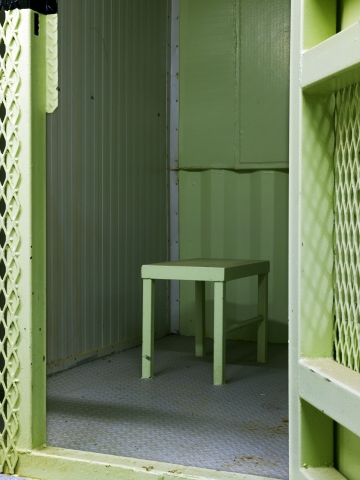
Edmund Clark, “Camp 1, isolation unit” from the series Guantanamo: If the Light Goes Out (2009) (© Edmund Clark).

Edmund Clark, “Camp 1, isolation unit” from the series Guantanamo: If the Light Goes Out (2009) (© Edmund Clark).

Edmund Clark, “Camp 6, Immediate Response Force equipment,” from the series Guantanamo: If the Light Goes Out (2009) (© Edmund Clark).

Edmund Clark, “Camp 6, Immediate Response Force equipment,” from the series Guantanamo: If the Light Goes Out (2009) (© Edmund Clark).

The exhibition Then They Came for Me: Incarceration of Japanese Americans during World War II is what brought me to the International Center of Photography. After all, the wartime photos of Dorothea Lange, Ansel Adams, and Toyo Miyatake are much celebrated today, historical artifacts in themselves. But I felt compelled to stay for The Day the Music Died, British photographer Edmund Clark’s eight video, music, and photography installations on the post-9/11“War on Terror” around the globe.

The pairing of the two exhibitions invites viewers to search for parallels between US national security efforts more than 70 years ago and today: How does the forced relocation of virtually all ethnic Japanese people residing in the US during World War II resemble the dragnet of the current anti-terrorism apparatus around the globe? Both shows shed light on people, more that half a century apart, swept into detention by the US government without due process, in the name of national security. And the juxtaposition has become all the more timely since President Trump’s late January signing of an executive order to keep Guantánamo Bay’s prison open.

[…]

The exhibitions Then They Came for Me: Incarceration of Japanese Americans during World War II and Edmund Clark: The Day the Music Died continue at the International Center of Photography (250 Bowery, Lower East Side, Manhattan) through May 6.

You can read and see much more about these terribly poignant photographs and their history at Hyperallergic.

Everyday American Hell.

Peter Williams, “Resistance II” (2017), oil on canvas, 48 x 36 inches (photo by Carson Zullinger).

Peter Williams, “Resistance II” (2017), oil on canvas, 48 x 36 inches (photo by Carson Zullinger).

[…] Williams uses caricature to invite viewers — whatever their political persuasion— to reflect upon how they see people of a race different from their own, as well as underscore the intolerance, distrust, and fear running throughout our everyday lives. A brave and intrepid curator ought to buy “Mass Murder” and install it near the entrance of a museum.

Walking home, I remembered something a black artist friend told me about raising his son in New York City: “I told him never to run down the street.” This is the reality we inhabit. There is nothing “united” about the United States, something artists as different as Jasper Johns and Peter Williams have known their whole lives.

Peter Williams: With So Little To Be Sure Of continues at CUE Art Foundation (137 West 25th Street, Chelsea, Manhattan) through March 29.

Hyperallergic has an in-depth article on Peter Williams’s latest works and show, well worth a detour in your day to read and see many more art pieces.

Neanderthals Have Done It Again.

Panel 78 in La Pasiega cave, which includes red horizontal and vertical lines that date to more than 64,000 years ago, long before Homo sapiens arrived in the area (photo by C.D Standish, A.W.G. Pike and D.L. Hoffmann used with permission).

Panel 78 in La Pasiega cave, which includes red horizontal and vertical lines that date to more than 64,000 years ago, long before Homo sapiens arrived in the area (photo by C.D Standish, A.W.G. Pike and D.L. Hoffmann used with permission).

Neanderthals have done it again. They’ve reminded us Homo sapiens that we’re not as creative, original, or special as we’ve thought for the past 150 years. Last week, archaeologists published two astonishing reports that provide the most compelling evidence to date that our evolutionary cousins not only had the cognitive wherewithal to create art — specifically cave paintings — but they also did so well before modern humans entered the European Pleistocene.

In the journal Sciencean international team of archaeologists reported that three caves in southeastern Spain — La Pasiega, Maltravieso, and Ardales — contain cave art that’s at least 64,800 years old. These sites are not new or unknown to archaeologists. But pinning down exactly when the cave art was painted has been a problem for decades. (The La Pasiega panel was originally sketched by researchers in 1913.) Dating experts, working in conjunction with archaeologists, developed a new set of techniques, carefully sampling geological material near the art in order to pin down the most likely time of painting.

The results have rocked the archaeological world, because the paintings appear to predate the arrival of modern humans in Europe by 20,000 years. In other words, the art comes from a time when the area was only occupied by Neanderthals.

Exciting! You can read and see much more, and there’s video at Hyperallergic.

Quilts: Tools For Resistance.

Yaneli Martinez, “Inequality 4 All”.

Yaneli Martinez, “Inequality 4 All”.

Jaquie Gering, “Veer”.

Jaquie Gering, “Veer”.

PASADENA, Calif. — “SHUT UP and Listen,” proclaims a quilt in bold, red letters. It shows a muted American flag, hung upside down on its phantom flagpole. The aggressive “SHUT UP” is rendered in darker red fabric, like oxidized blood. But the message softens with the word “Listen,” looped in beautiful script, using sweeter reds and an assemblage of floral, plaid, and paisley fabrics. The quilt is willing to have a conversation if I’m willing to hold my tongue.

Jessica Wohl’s quilt was just one of many beckoning calls to action at QuiltCon 2018, the Modern Quilt Guild’s annual convention, held at the Pasadena Convention Center late February. The guild launched in 2009, after quilters making innovative, nontraditional works began forming connections online and realized they weren’t alone in their experimentation. The guild has established chapters internationally, in which quilters come together and show their work, workshop new techniques, and build a community.

Embedded in this year’s quilt show, which featured over 350 works, were acts of protest. They carried messages like “strong women taught us to quilt…and to fight,” “rise up, resist,” and simply, “oh no.” Others depicted difficult, but insightful, interpretations of mass incarceration, police brutality, school shootings, and acts of terror. The need quilters have felt to channel their frustrations into their craft during Trump’s America was palpable. But the members of the Modern Quilt Guild are also continuing a very old tradition of using the quilt as a tool for resistance.

You can read and see much more at Hyperallergic. I wish I could have seen this show.

Sculptures of Wishes.

all photos courtesy Yusuke Aonuma.

all photos courtesy Yusuke Aonuma.

all photos courtesy Yusuke Aonuma.

all photos courtesy Yusuke Aonuma.

Amazing, and full of wonder! I so wish I could see these in person.

One would be hard-pressed to find a more delicate material to create art from. But for Japanese artist Yusuke Aonuma, single dandelion fluff, the feathery, umbrella-like structure that carries the seed to faraway lands, captivated his creative mind.

Aonuma begins by harvesting the dandelions (tanpopo, in Japanese) and drying them, thereby creating an abundant supply for him to work with. He then “plants” them upright in acrylic slabs to form three-dimensional geometric and architectural shapes. Over 50 different slabs were on display recently at an exhibition in Tokyo, a show that Aonuma titled “Iki wo tateru” (息を立てる), which roughly translates as “to breath.” Aonuma encouraged visitors to gently breath on the dandelion fluff sculptures as a way of visualizing that they were real and standing upright.

Although Aonuma’s exhibition has since closed, the artist has announced an upcoming exhibition in March of 2018, which will take place in the Omotesando district of Tokyo. The exact location and dates have yet to be revealed. You can follow the artist on Twitter and Instagram.

You can see more at Spoon & Tamago.