Indian Country Today Is Back!

Who Will Be Our First Founding Member? The new Indian Country Today is launching a membership drive and an auction. Top bid will be forever known as Indian Country Today’s: “First Founding Member.”

Who Will Be Our First Founding Member? The new Indian Country Today is launching a membership drive and an auction. Top bid will be forever known as Indian Country Today’s: “First Founding Member.”

Indian Country Today is back! The NCAI has taken over, and this is grand news.

From September through February I have heard about the importance of saving Indian Country Today. So many people across Indian Country had the same idea:

What if … What if we all contribute?

What if I step up to make certain Indian Country has solid, accurate, fair reporting?

Is it worth it to save this voice? A national media platform for Indian concerns?  And how much will it take?

Yes. Yes. And the answer is a lot  — or perhaps a few tax-deductible dollars if we all contribute together.

We are building a new Indian Country Today on a public media model. We will have some advertising, but most of our resources will come from members, tribes, enterprises, and non-profits.

We need you.

We are launching a membership drive and an auction.

The membership drive will solicit help from our “members” as $100 Founding Members, $500 Sustaining Members, and $1,000 for Premier Members.

Unlike public media we don’t have nifty gifts as a thank you. No t-shirts. No coffee mugs. Just a better news report. We want to use the money to build our news operation, a multimedia reporting platform about what’s going on across Indian Country. We’ll stretch your dollars by partnering with other organizations, and amplify our reporting by letting others repurpose our editorial content.

We will serve.

This is great news, but to work, ICT needs help from people. If you can drop a few dollars into the fund, please do, and if you can’t do that, please, please, spread the word, get it out everywhere! You can read more by Mark Trahant at Indian Country today, or go straight to the membership drive. This is so very important, it’s vital for Indigenous peoples to have a voice.  Also, be sure to check out the new edition, there’s all manner of interesting reading!

ETA: I should point out that it’s possible to donate $5.00 to the membership drive, which is all I can manage right now, but I’ll be dropping more fives each week.

Making a Rondel Dagger – Part 2

Today I planted new cherry tree but there was not much that I could otherwise meaningfully do, so I have spent about 40 minutes testing my belt grinder. It has worked reasonably well, but the supporting table needs improvement.

I chose this particular file for this project because it is thick at the base – almost 6 mm – and it already had a distal taper. That means I do not need to grind of as much material, but it is actually more challenging to work with, and therefore better exercise.

Centerline for he edge.

Centerline for the edge.

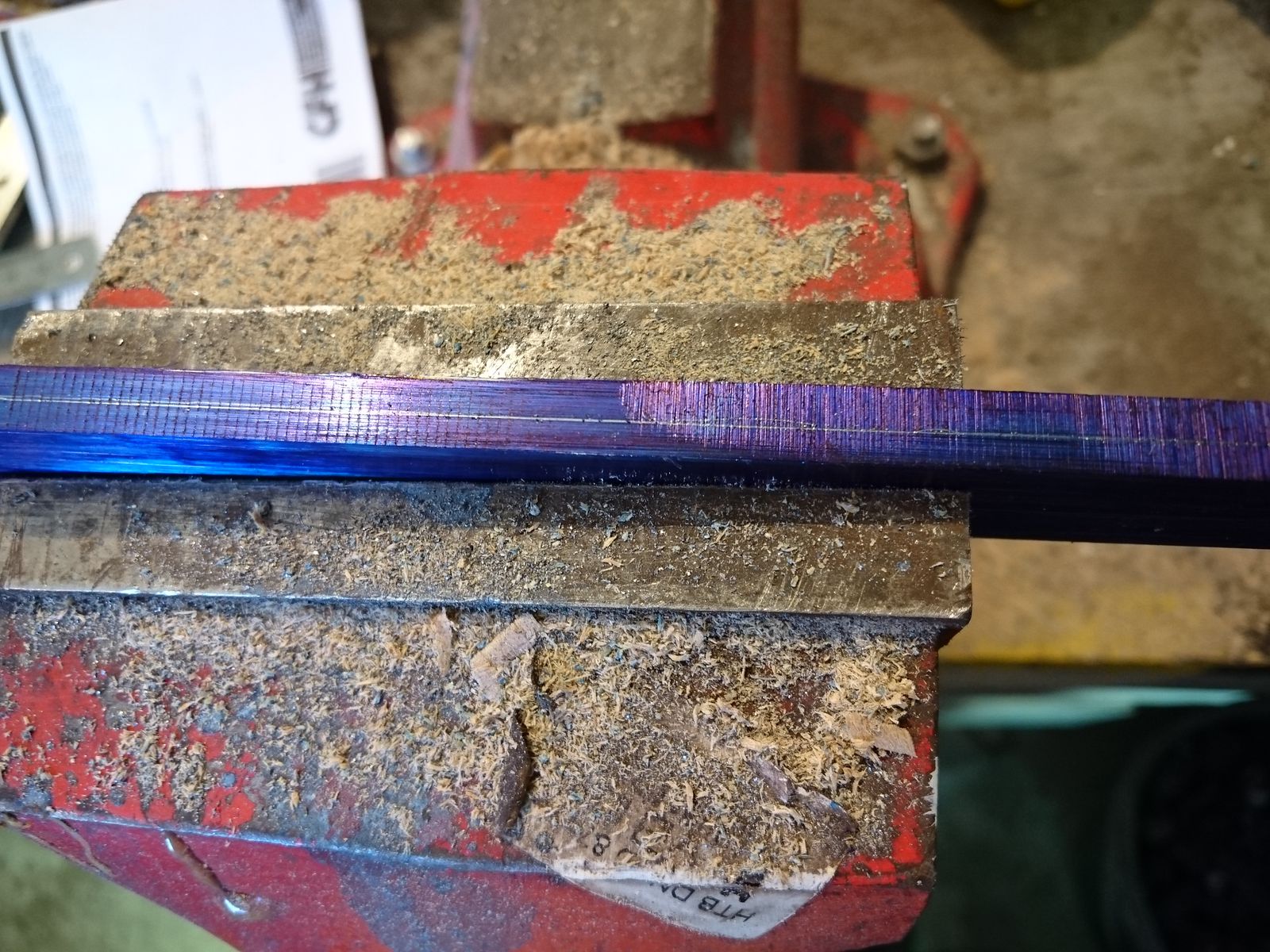
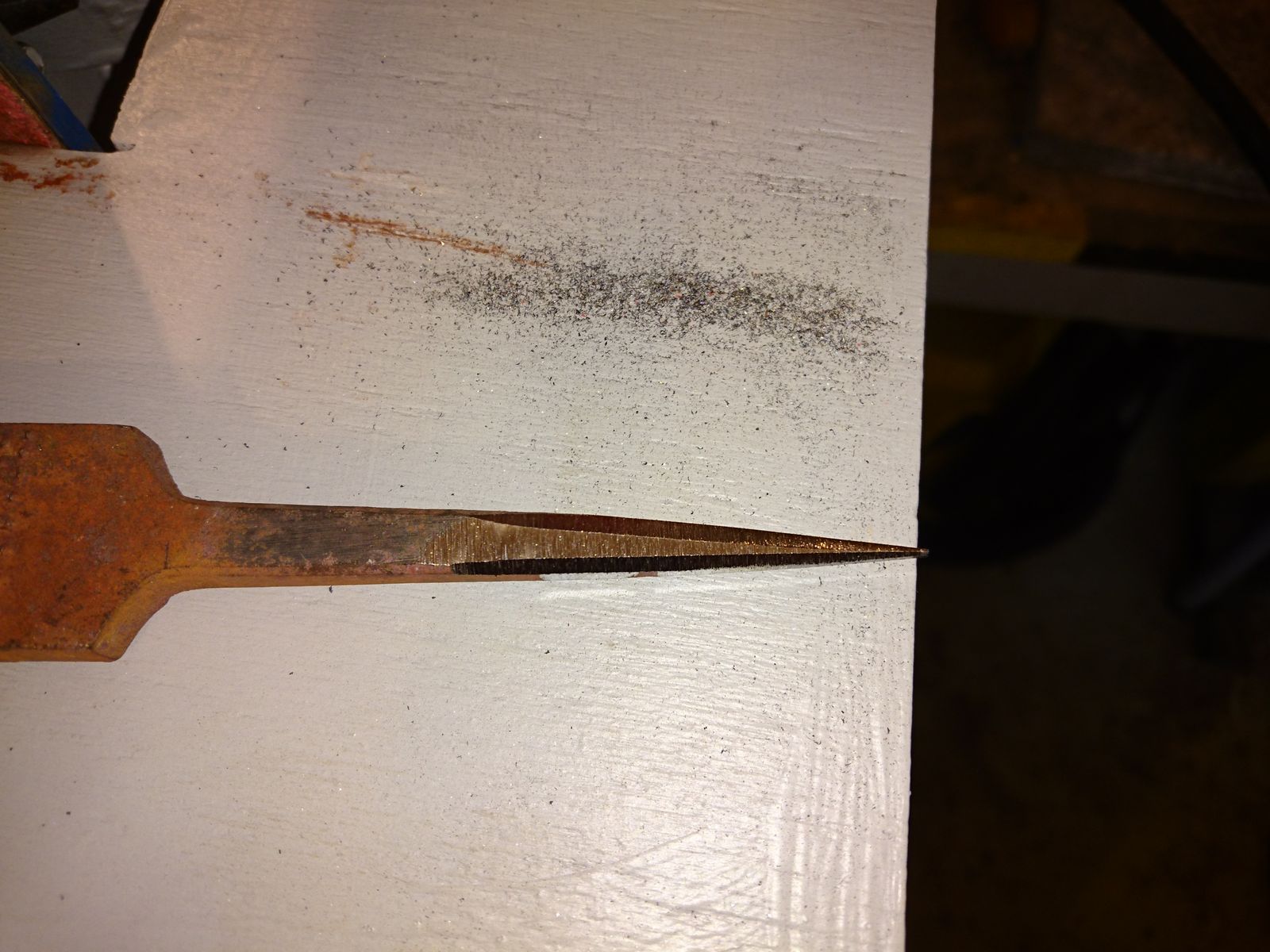
First problem was scribing the center line for where the edge shall be. Due to the taper I could not use my scribing tool because it scribes line at a constant distance from an edge. Luckily the curvature is very mild, so I could do with a steel ruler for most of the way and steady(ish) hand for the rest. I am not fond of measuring, I prefer to eyball the work, but for blade symmetry is important. The more asymmetrical the roughed out blade, the more it warps in quench. Very slight warp can be ground off, but big warp not. And of course grinding off a warp on hardened blade is tougher on the abrasive belts, and those do not grow on trees.


Scribed bevel lines.

Scribed bevel lines.

After scribing the center line, I also scribed two lines for where the bevels shall go. This dagger will have only one cutting edge, and in order to make it more useful as an ordinary knife, the bevel should go almost all the way to the spine at first grind, and wander de-facto all the way to it during polishing. On the other hand shallower bevel is easier to make and makes for stiffer blade. At this point I have not decided on the way I will do it. I scribed two bevel lines and decided to grind to the first one and reconsider.

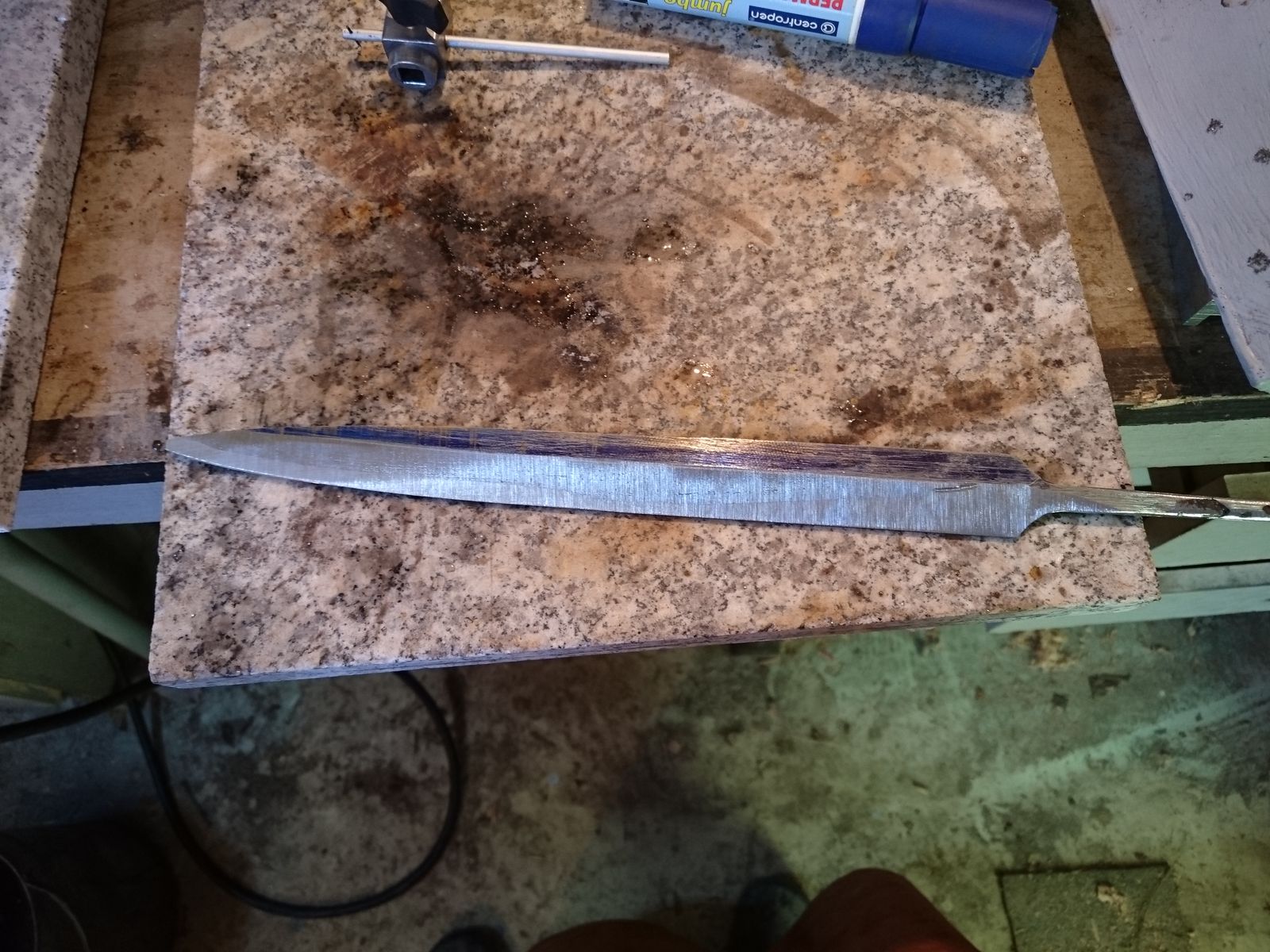
With these preparations done, which took only about five minutes, I have spanned a 60 grit belt on my grinder and started. First time I was grinding with the use of supporting table and it was a great help at first and slight hindrance later on. For me it might be good to use the table for first facing and then go back to free-hand. I am slowly finding my personal way of doing these things. After slightly over half an hour I ground both sides to the first bevel line and had to call it quits for the day. Now I am considering my next step. Grind or not to grind, that is the question.

Ground bevels

©Charly, all rights reserved.

Wake: The Hidden History of Women-Led Slave Revolts.

Page from Wake by Rebecca Hall and Hugo Martinez (all images courtesy Hugo Martinez).

Page from Wake by Rebecca Hall and Hugo Martinez (all images courtesy Hugo Martinez).

In 1712, New York City witnessed a dramatic uprising when over 20 black slaves, fighting against their unjust conditions, set fire to several houses of white slaveowners and fatally shot nine. Known today as the New York Slave Revolt of 1712, the insurgence resulted in the conviction and public execution of 21 slaves, as well as more severe slave codes. While sources often state that these rebels were all men, the historian Dr. Rebecca Hall has identified four women who were captured during the clashing and were tried. Their names were Amba, Lilly, Sarah, and Abigail.

Erased from history books, their stories will now be told in vivid form by Hall, who has devoted much of her career to unearthing the roles of women in slave revolts. Hall is currently working on her first graphic novel, which will highlight female rebels in various 18th-century uprisings, from three in New York to those that broke out on slave ships. Titled Wake: The Hidden History of Women-Led Slave Revolts, the 150-page work emerges out of Hall’s 2004 dissertation on the same topic. She is now collaborating with independent comic artist Hugo Martinez to produce the storyboards and, through Friday, May 4, is raising $5,900 on Kickstarter to realize it for submission to publishers.

“The way the history of slave resistance has been written, this very gendered narrative developed about how manly and masculine enslaved men actually were, which served to elide the role that women played,” Hall told Hyperallergic. “I was going against everything being taught in women’s roles in slave resistance by insisting that, if I looked, I bet I would find these women.” She recalled how her dissertation advisor had told her that she wouldn’t find any sources to realize her chosen topic; how one archive claimed that it had no related material.

This is a fascinating, and I think, a necessary work. You can read and see much more at Hyperallergic, as well as on the kickstarter page, where there’s also a video. They are close to their goal, but could use a bit more help, so if you can’t donate, you can help to spread the word!

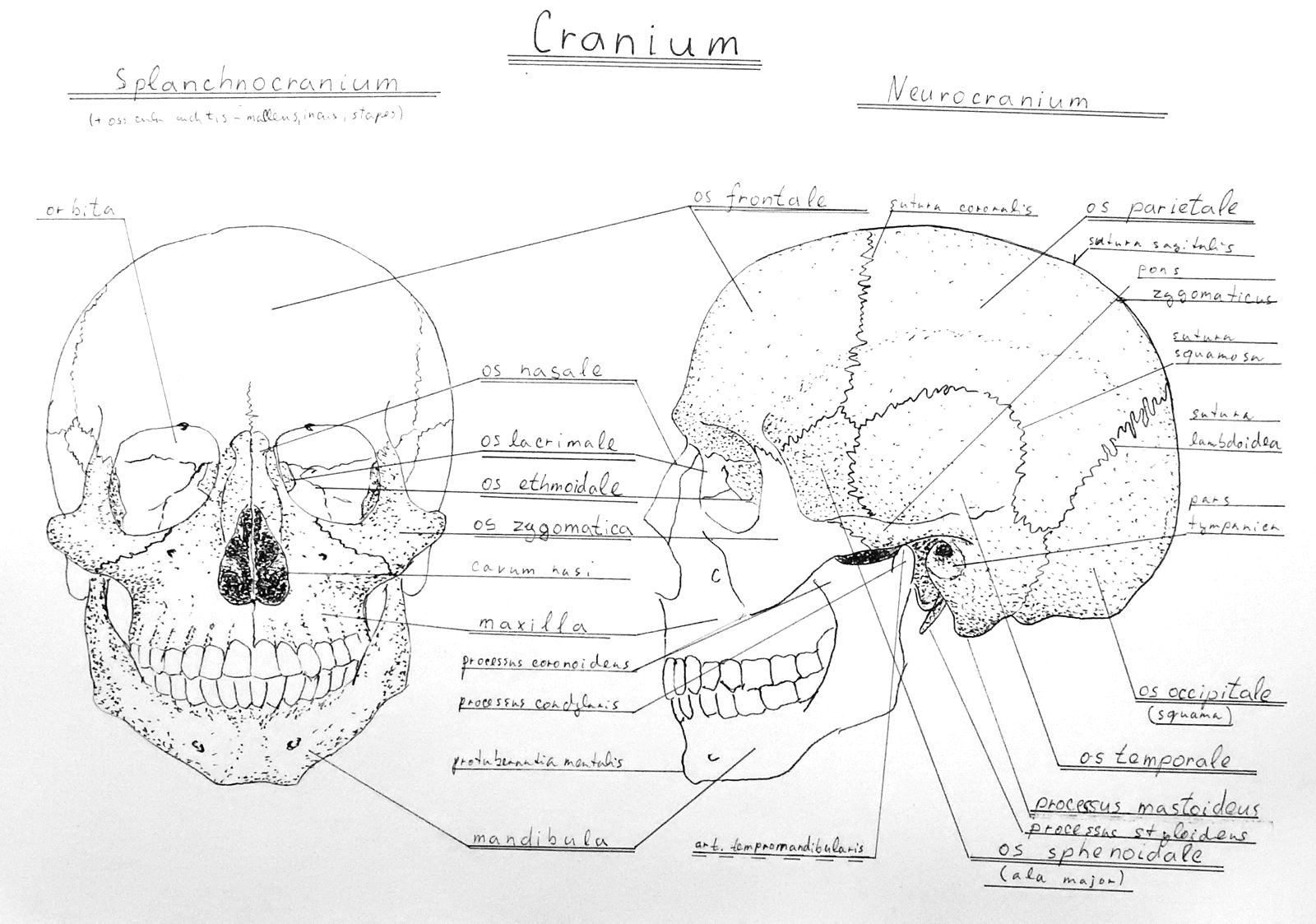
Anatomy Atlas Part 4 – Skull

This is no Jolly Roger, but it looks grim nevertheless. I do not think any other part of human skeleton is more evocative than skulls. And I wonder sometimes whether this is a purely a cultural thing, or whether there is something innate in us that associates skulls with death, danger and general unpleasantness. There might be, because our brains are clearly predisposed to recognizing facial features.

Content warning for description of a very unpleasant medical procedure.

Skull Drawing

©Charly, all rights reserved. Click for full size.

The four dots at the jaw bones – bellow the eye sockets in each maxilla and two on the chin on mandibula –  and two dots above the eye sockets are points where the nervus trigeminus exits the protective shell of the skull to innervate facial muscles. That is why these points are more sensitive to pressure than other parts of the face. Professor Kos told us that an inflammation of this nerve is allegedly the most painful illness there is. The whole face hurts and a feather caressing the cheek may feel like being burned with hot poker. One way to reduce the pain in very severe inflammation cases (I do not remember whether this was an old procedure or one or still in use) was to inject a powerful neurotoxin directly into these points. Extremely painful procedure, but one that provided the needed long relief. He told us the patients would scream and sometimes pass out. And the neurotoxin used? Alcohol.

Nervus trigeminus is near surface once more just behind mandibula, right bellow the ear lobe. This knowledge has helped me twice in self-defence, once when I was held in chokehold but I managed to slide my hand to my attackers head and drill my forefinger into this point and second time when another person was having their arm twisted by a wannabe teenage ninja. The pain is so intense, that anyone will let go of anything they hold and try to get their head dout of the way. If you feel brave you can experiment on yourself. I did. I do not recommend it.

Making a Rondel Dagger – Part 1

When the weather is not suitable for work outside, I will make use of my belt grinder, now  Mark 2. So today I took another old file and I decided to make a dagger out of it. The inspiration is dagger used by Vesemir and Ciri in the game Witcher 3, but there will be some design changes even for the blade (less daggery, more knifey). I will post my progress, but beware that I am no expert, just a self-taught hobbyist goofing around. Risk of concussions from facepalming for any expert. You have been warned.

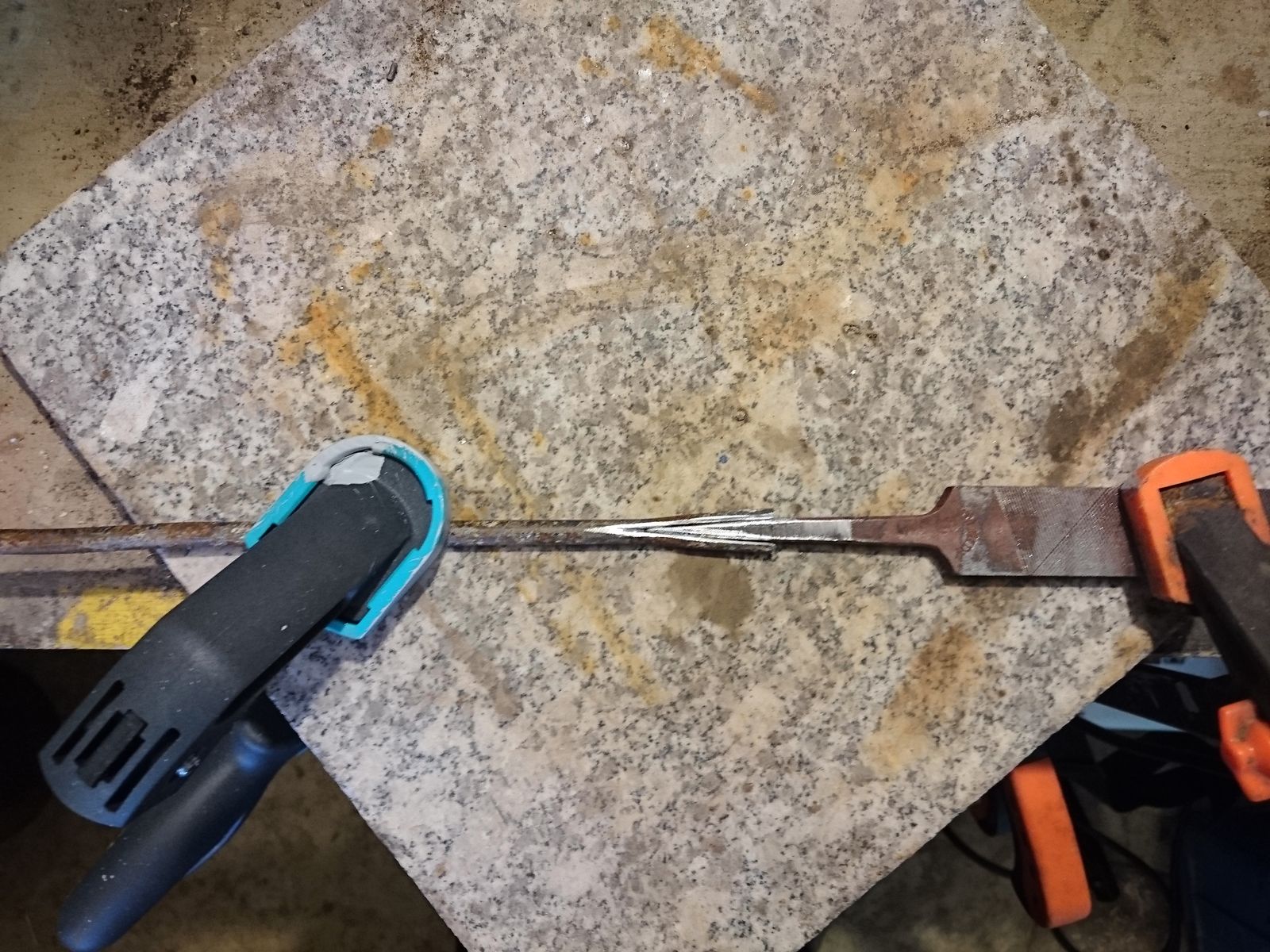
I started with an old file that I threw in the stove fire last year to soften the steel. I cleaned some of the rust on the belt grinder when I was testing the new design. But before proceeding I needed to make the tang slightly longer. So today I just made the tang more pointy and chamfered the edges. Then I took an old piece of round stock of structural steel, cut it lengthwise for a few cm and fitted it onto the file tang.


Old rusty file

Old rusty file

Chamfered file tang

Chamfered file tang

Fitted tang extension

Fitted tang extension

After that there came the trial by fire, or more precisely, electric arc. My first real welding. I admit I should have tried to simply weld scraps together a few more times before I try for something real. I should have. But learning skill on something that is subsequently thrown away simply is not me. I always try to learn on the real thing. Not smart, I know, but that is just me. I have already forced my self to try it once on scraps.

I must admit, I could not have done a better job. That is to say, the job is crap, but I lack the skill to do better. But it holds together even after grinding off the slag and rust from the whole thing. There are some visible slag inclusions in the weld, but it is definitively welded together and since it will all be hidden in the handle, I will not lose sleep over it. Hopefully no rampaging rhino will stamp on it and ruin it all.

Welded tang extension

Welded tang extension with slag.

File cleaned.

Cleaned and the tang ground to rough shape.

With that done I finally could do some work on the belt grinder. Since I do not have machinist’s blue, I used 1 cm thick blue marker to cover one side of the file. Then I have drawn the center line  and quarter marks using a steel ruler and a self-made steel marking needle. After that I ground the file into a symmetrical leaf shape. With that I was done for the evening and I will resume the work at some other random date.

ground basic blade outline

©Charly, all rights reserved.

Daniel Pešta.

Daniel Pešta, “Scream III” (2015-2016), acrylic on canvas, (all images courtesy of DOX Centre for Contemporary Art, Prague).

Daniel Pešta, “Scream III” (2015-2016), acrylic on canvas, (all images courtesy of DOX Centre for Contemporary Art, Prague).

Daniel Pešta is an artist with a lot to say, and he’s well worth getting acquainted with, to say the least. His work is deeply expressive, profound, and stirring. Many times it’s frightening, because people can be quite frightening, and Daniel Pešta has a good deal of insight when it comes to human nature.

Daniel Pešta’s largest exhibition to date, drawn from his high-flying decade starting in 2007 , which has included three Venice appearances and Second Prize in Painting at 2017’s London Art Biennale, dominates Prague’s DOX Centre for Contemporary Art. Pešta’s work is timely, disturbing and profound. His extraordinary artistic range encompasses photography, video, assemblage, installation, sculpture, drawing and painting; his materials include wax, leather, resin, textiles, paper, plaster, wood, acrylic, latex, gum, paint, neon lighting, and stone. Two generative objects pull this exhibition together. One is red string, signifying blood, genetic coding, fatalism, or humanity’s endlessness, variously. The other is the mask. A central motif in Pešta’s practice, it is meant to evoke disguise, dissemblance, and anonymity.

Born in 1959, Pešta lived according to the larger Czech struggle for self-determination. He was painting as the Czechs stumbled out of the darkness of Communist rule in 1989. In the mid-1980s he entered into the underground music scene, anticipating what has been dubbed the “Velvet Revolution” — the demise of what former Czech President Vaclav Havel had called “post-totalitarianism” (in his 1978 samizdat essay “The Power of the Powerless”). After a trip to New York, in 1998, Pešta saw the possibilities of multimedia art.

You can read and see more at Hyperallergic.

Repotting Bonsai Trees

I have to pass on the Iron Curtain series this weekend, because my mind and my hands are now fully occupied by work that won’t wait – repotting my trees. I only have this weekend for the deciduous trees and next weekend for the conifers, because after that the trees would be too grown and I would not be able to touch them without risking they die as a result. Which I do not want.

Currently my trees are more about quantity than about quality, because creating high quality bonsai takes time and I am only doing it for twenty five years. The plan is to build up stock now and refine it when I retire. Growing bonsai trees is not something for the impatient. But I have some medium to good quality ones already and I will share pictures. (I also have trouble getting my hands on quality bonsai pots, because they are not sold anywhere near and I am reluctant to buy them over the internet).

Here is a glimpse into the work that I am currently doing:

SandIt starts with buying a load of coarse sand and spreading it out to dry in the sun. That does not need to be done, strictly speaking, but I find it easier to work with dry substrate so I try to dry it as much as possible. Another ingredience to the sand is high-quality soil or compost, sieved through a 5 mm mesh and also dried if possible. And last ingredience is peat or some suitable substitute, like shredded old leaves and moss  and twigs, or maybe even saw dust. The organic material is there mostly to hold moisture and stop the substrate from clumping.


Mixing substrateNext step is mixing up the substrate. Because I have a lot of trees and other potted plants, this used to be the most time consuming and tiring part, taking up hours of hard work. Nowadays I am doing it in  a concrete mixer. A great saving of time and strength, I do not understand how I could manage without it. I was younger, healthier and I had less money but more time on my hands, so there’s that.


Various pots and bowls for bonsai trees.Whilst I am mixing suitable ammount of substrate, lets say 100 liters or so for starters, I also have to scrub and disinfect all the pots and bowls that are currently not in use. That is, I take them out, rinse them with boiling water and let them dry in the sun. That seems enough, I never had problem with fungal infections or rotting roots. I do not have enough pots to replant all trees at once, so I have to repeat this process multiple times as pots are emptied.


When the pots are ready and the substrate mixed, it is time to take out my most important tool case. Have fun trying to spot all the tools that are in it. All are used for tree care. And just in case someone can decipher the writing on that lid in top left corner – that is not actual mustard, just the cup in which once was mustard. Now it is full of charcoal to treat big cuts on roots.

Tool box for bonsai trees.

Angry White Men.

LOS ANGELES — Judging from the paintings and drawings on view at Susan Vielmetter Los Angeles Projects, Nicole Eisenman has been thinking a lot about angry white men. They are almost the exclusive population throughout the expansive gallery. There is a large contingent of shooters, each confronting us from behind a firearm aimed directly outward, so that to look at the drawings is to stare down a gun-barrel. These shooter drawings are almost all from 2016, with a few from 2017 and one from 2018, elaborated in ink, charcoal, oil, acrylic, and pencil. This last is the largest, and the only one bearing a title, “The Shooter.” One of the untitled drawings, in pencil and blue ballpoint pen, shows a man pointing his gun at us with one hand while the other grasps his penis. Along the bottom margin Eisenman has written “BAMSPLOOSH.”

Nicole Eisenman, “The Tea Party” (2012–2017), ink on gessoed paper, 40” x 35″ paper size, 52” x 45.50” x 2″ framed (photo by Robert Wedemeyer).

Nicole Eisenman, “The Tea Party” (2012–2017), ink on gessoed paper, 40” x 35″ paper size, 52” x 45.50” x 2″ framed (photo by Robert Wedemeyer).

While there is nothing original about equating guns with penises, the full array of drawings in Dark Light reveals Eisenman’s mind ping-ponging through a number of visual rhymes, adding up to many of the show’s most compelling moments. The circle of the gun barrel becomes the end of a cigarette smoked by impassive men. In one case, smoke billows from a man’s right nostril; in another, a sooty cloud issues from a cigarette belonging to an African American in a drawing titled “A Moment of General Anesthesia” (2018), suggesting this man’s need for relief from pain of America’s continuous police shootings of black men. Further iterations of the black circle appear: in a small 2016 sketch it is a bullet hole in the middle of someone’s face, in others it is a darkened sun. A 2015 ink drawing titled “Black Sun” has the cheerless orb spewing fecal liquid that piles like a mound of pudding below, resembling a pipe depositing sewage in our waterways. Finally and inescapably, the circle is an anus.

Nicole Eisenman, “Heading Down River on the USS J-Bone of an Ass” (2017), oil on canvas, 127.25” x 105” x 1.75″(all images courtesy the artist and Susanne Vielmetter Los Angeles Projects; photo by Robert Wedemeyer).

Nicole Eisenman, “Heading Down River on the USS J-Bone of an Ass” (2017), oil on canvas, 127.25” x 105” x 1.75″(all images courtesy the artist and Susanne Vielmetter Los Angeles Projects; photo by Robert Wedemeyer).

Nicole Eisenman: Dark Light continues at Susanne Vielmetter Los Angeles Projects (6006 Washington Blvd, Culver City, Los Angeles) through April 21.

Fascinating viewing and reading, you can do more of both at Hyperallergic.