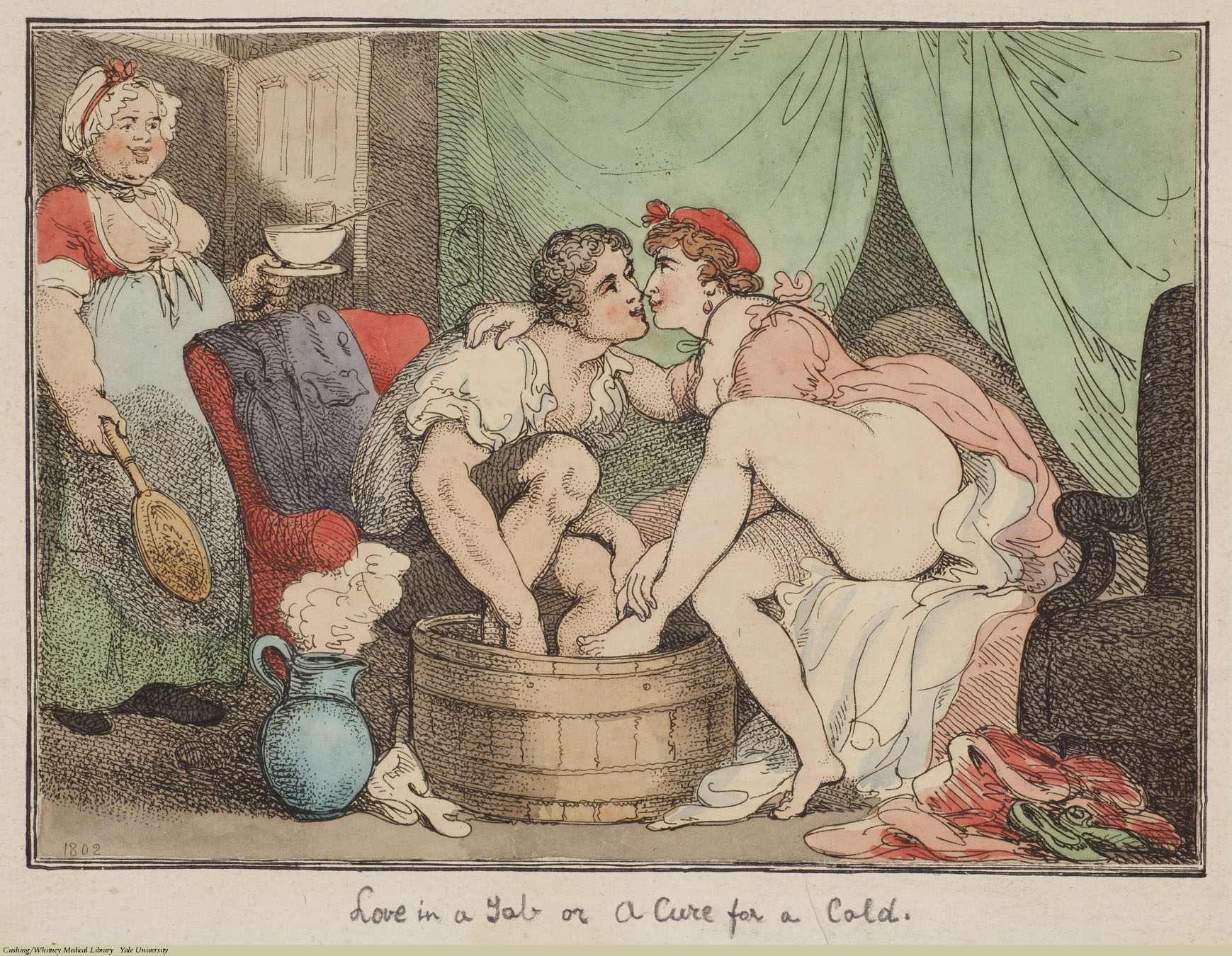
The Healing Arts: Humbugging and Hocus Pocus.

Click for full size!

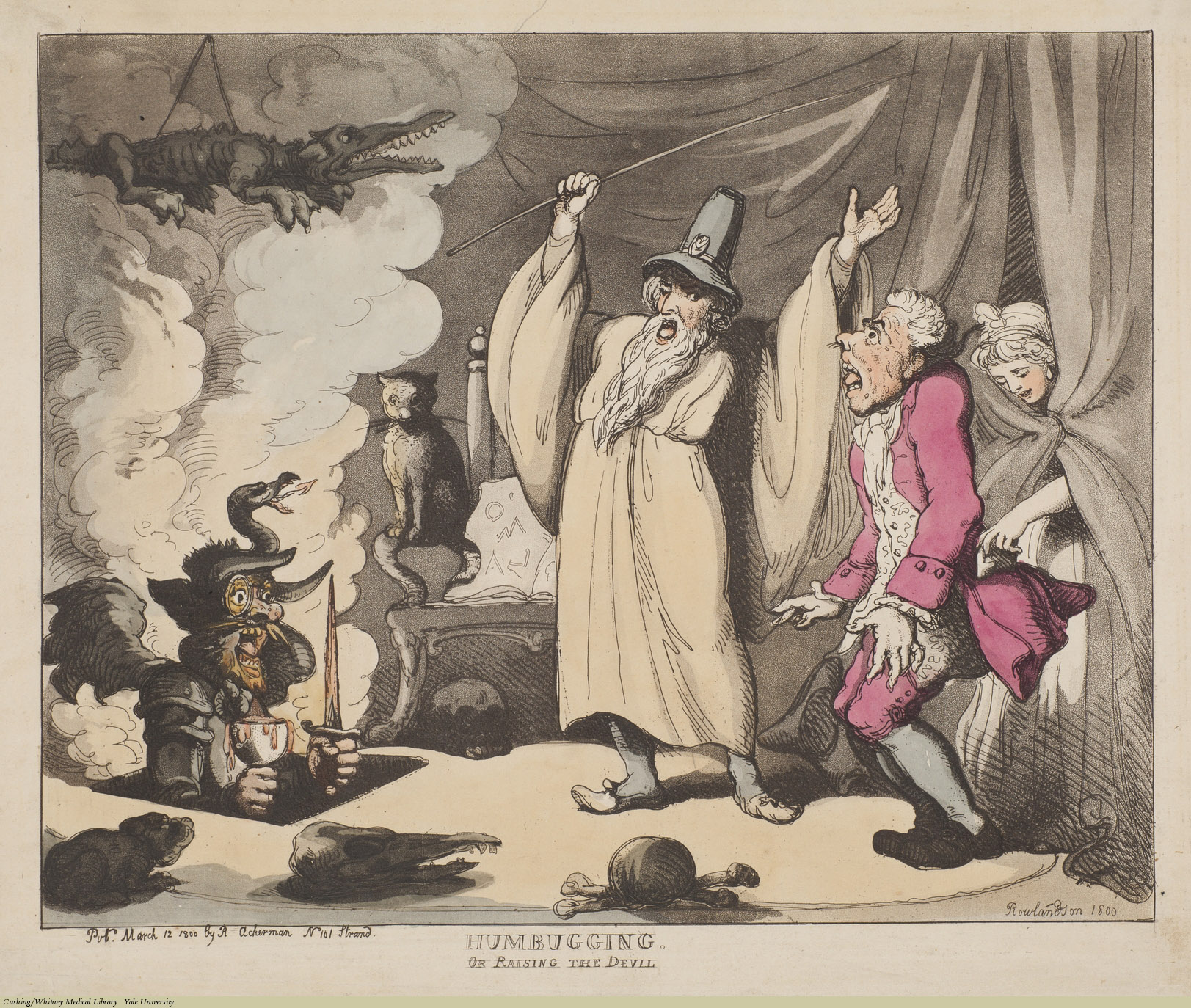
Humbugging. Or Raising The Devil. Thomas Rowlandson, Aquatint coloured, 1800. Subject: Wizards, Confidence Trickster, Pickpocket.

Humbugging. Or Raising The Devil. Thomas Rowlandson, Aquatint coloured, 1800. Subject: Wizards, Confidence Trickster, Pickpocket.

Hocus Pocus Or Searching For The Philosopher's Stone. Thomas Rowlandson, Aquatint coloured, 1800. Subject: Count Alexander Cagliostro (Giuseppe Balsamo), Alchemy, Sex.

Hocus Pocus Or Searching For The Philosopher’s Stone. Thomas Rowlandson, Aquatint coloured, 1800. Subject: Count Alessandro Cagliostro (Giuseppe Balsamo), Alchemy, Sex.

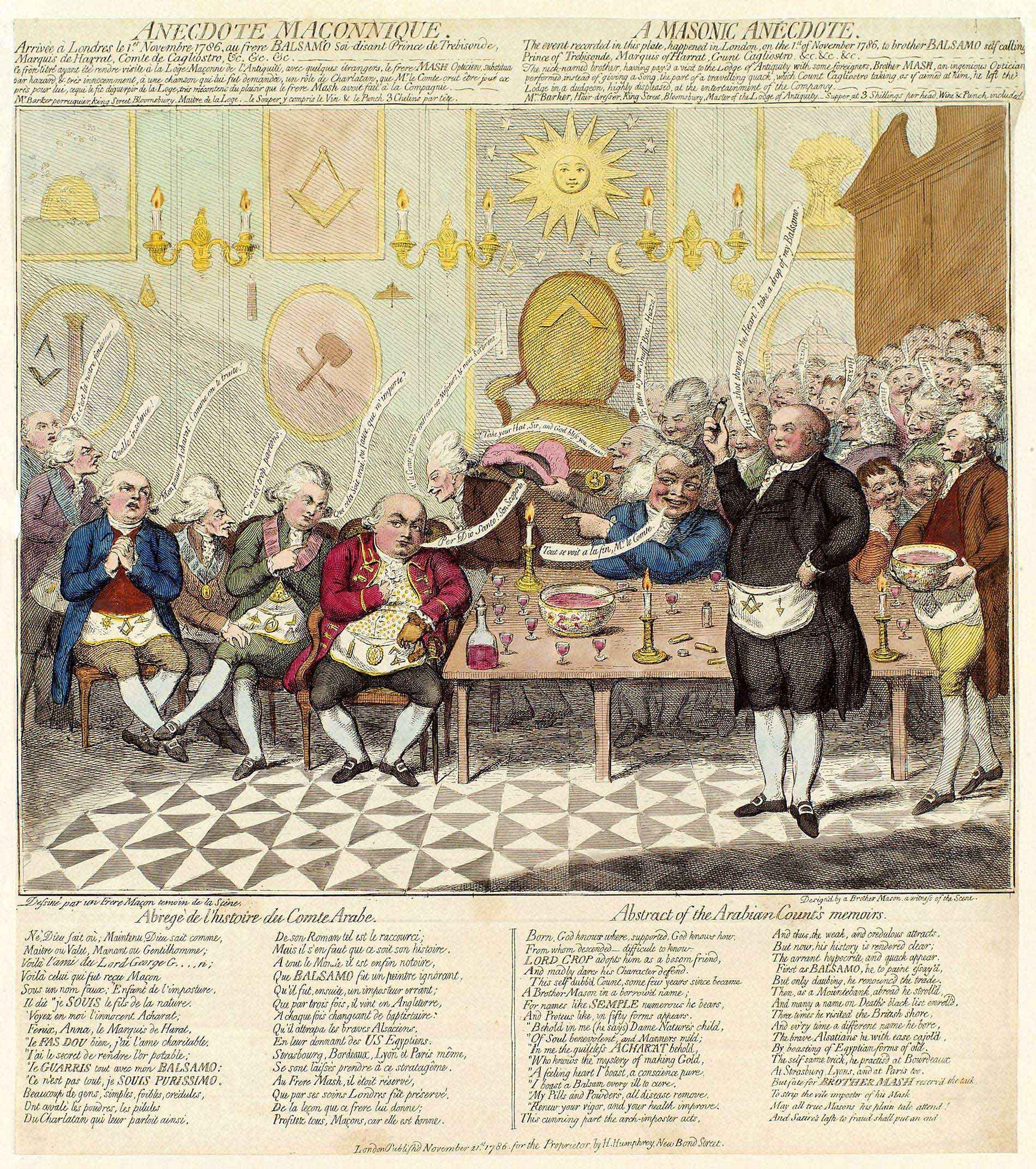
James Gillray did a scathing piece on Cagliostro, click for full size:

Making a Rondel Dagger – Part 7 – Starting on the Scabbard

I am not done with the polishing yet, since the hardened layer was too thin and I had to start all over again with hardening. This time i made it during the day with controlled temperature. And also a different hardening mixture because the thinness might have been caused by phosphorus in the steel, which inhibits dissolution of carbon. I shall not go into technical details here, maybe another time in another project, but the result is twofold – the dagger has now really, really hard surface, maybe too hard, it eats abrasives. And it has a few discoloured spots, which I was trying to avoid by using charcoal. It is a beautiful blade nevertheless so I had to solve the conundrum how to keep it from scratching. I cannot just lay it on the workbench, because there will always be abrasive grains from angle grinder, sandpaper etc. and highly polished surface gets unseemly scratches in a blink. So I decided to start on the scabbard.

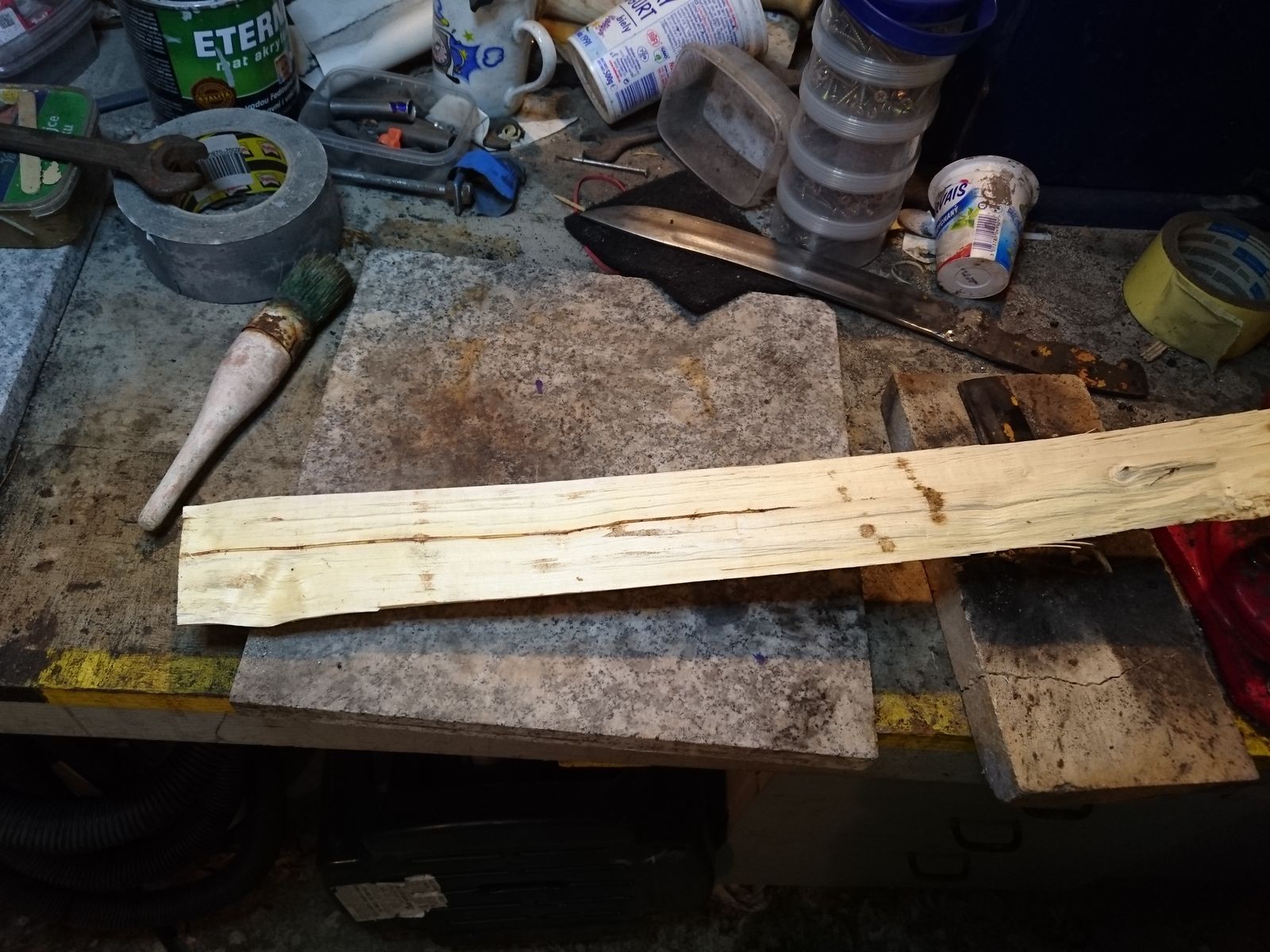
Piece of woodI intend to do proper, wooden scabbard and for this I have set aside a piece of fast growing poplar (Max 4 (Populus maximowiczii x P. nigra)) that I grow in my garden for firewood. It is very light, porous and soft wood, feels in hand like balsa but does not split or break very easily – it tends to keep hanging on threads. That makes it an ideal material for a scabbard. Since it is a modern fast growing hybrid, it is not authentic material, but it is closest to authentic material (P. nigra) I can get my hands on straight away. The piece I have here is from a four year old tree that I harvested this spring.

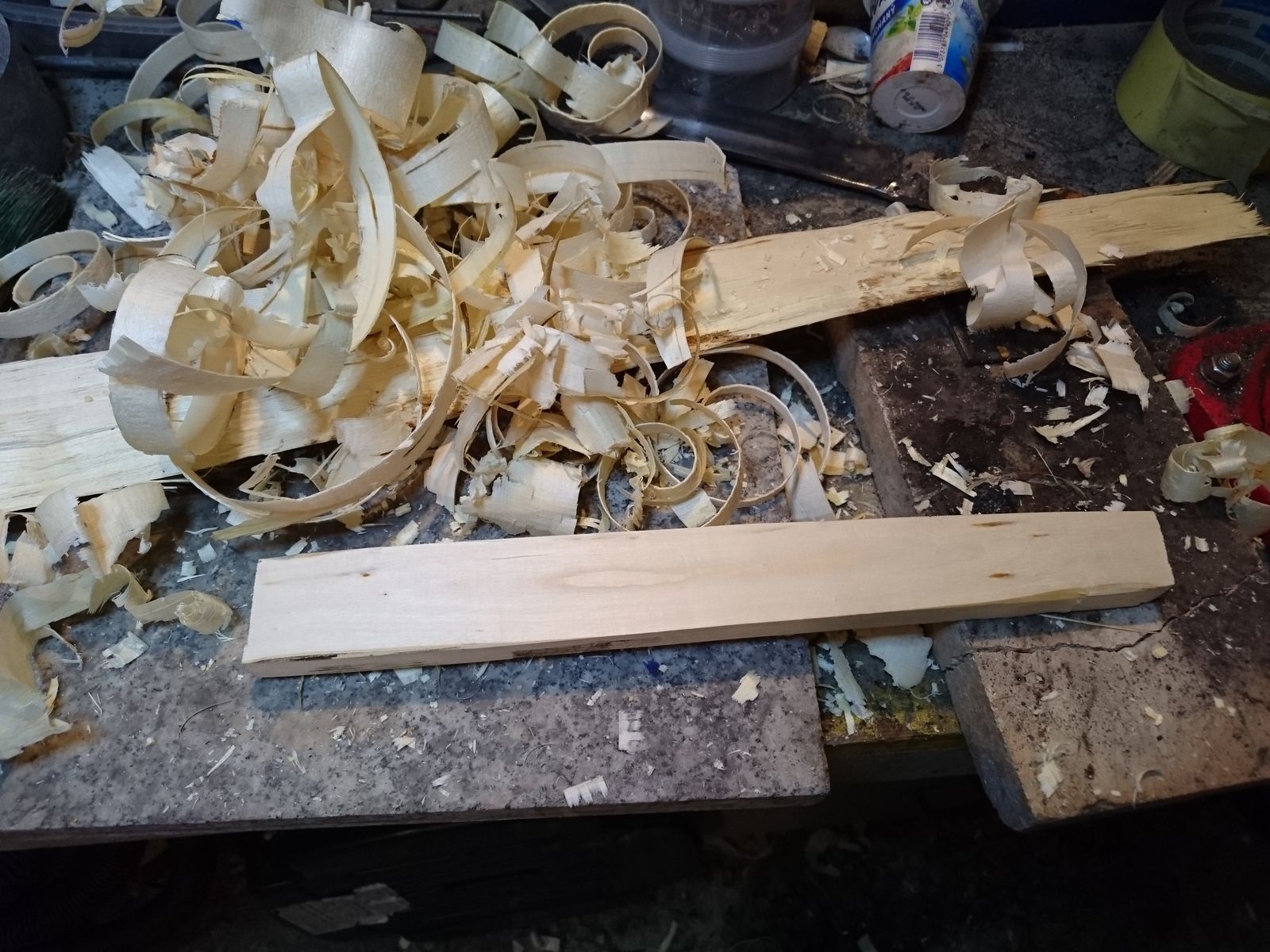
Cutting a rectangular block with a draw knife and a plane, cutting the block in two halves and facing them, all was a matter of mere minutes. The wood is extremely easy to work with.

Rectangular piece of wood Halved

A scabbard must be tight enough for the knife not to fall out with its own weight, but not so tight as to make it difficult to pull it out. So I had to cut half-blade grooves in both halves (I also took this opportunity to use my belt grinder to sharpen all my chisels and carving knives, it was long overdue in any rate). For this a bit harder wood would probably be slightly easier to work with, because with wood this soft I had to be really careful not to cut too much. I did however cut a little more than for a perfect fit, because after the grooves were cut, I had to rough the halves with a hacksaw blade for greater surface and therefore better glue adhesion which takes about half a mm off. There is a special type of plane for that, but I do not own it and even if I did, this is too small surface for a plane. The hacksaw blade is an old and tried trick. Only because the blade teeth are asymmetrical it is important to turn the blade around in order to get symmetrical grooves, or check the direction of the teeth and make them match.

starting blade groove Scratched

Thus prepared wooden halves were then glued using a hide glue that I cooked from sinews a few years back.

Jar with dried glue.I do not like working with hot hide glue, but not only is it a medieval authentic material, it has one huge advantage over modern glues – it can be redone and repaired with the help of steam over boling water multiple times, so any mistake can be corrected.

Not that I ever make mistakes that must be corrected. The mistake I did not make and therefore did not have to correct this time was forgetting that since the scabbard is hollow, the warm gooey snot gets squeezed not only on the outside, where it is of no consequence, but also on the inside, where it constrains the already tight fit. I also most definitively did not make the scabbard too tight the first time so it was nigh impossible  to get the dagger in and out. But after a few days and multiple attempts … What am I saying. After I glued it and clamped it over night it was fit and ready.

Later I left it dry naturally in the sun for a day and I heated it with hot air pistol with the blade inside so the wood forms better around the blade and also to dry it as much as humanly possible. After that all that remained was to cut it to proper length and chamfer the edges. Now I have safe storage for the blade during final polishing and a piece of work done at the same time.Blade in the scabbard


A Little Palate Cleanser After Alt*Hero Comic

I am not a fan of any particular superhero comics, I have never read any and do not plan to do so in foreseable future. I do however on occasion read some web comics. And the one I wish to recommend today is Hominids  by Jordan Kotzebue.

The comic is probably NSFW though (partial nudity), but the artwork is exceptional and the storytelling very captivating. I think you will enjoy it.

The Healing Arts: New Discoveries in Pneumaticks!

By James Gillray. In this etching, he caricaturised a lecturer – most likely physician and chemist Thomas Garnett, as administering gas at London’s Royal Institution to a particularly long-winded member of parliament, Sir John Coxe Hippisley. Squeezing the bellows next to the pair is the grinning future Sir Humphry Davy. Just over a week after Hannah Humphrey published Gillray’s etching, Davy would replace Garnett as the Royal Institution’s Lecturer of Chemistry. Source.  Over to the left, toward the bottom, there appears to be an interracial couple with a child. Click for full size!

New Discoveries in Pneumaticks!: or an Experimental Lecture on the Powers of Air, James Gillray, Etching coloured, 1802. Subject: New Discoveries, Equipment, Supplies, Teaching.

New Discoveries in Pneumaticks!: or an Experimental Lecture on the Powers of Air, James Gillray, Etching coloured, 1802. Subject: New Discoveries, Equipment, Supplies, Teaching.

Anatomy Atlas Part 7 – Rib Cage

I thought that I am done with skeleton, I really did. I was wrong and I admit it. There is one more. The rib cage.

Rib Cage

©Charly, all rights reserved. Click for full size.

However I cannot remember any interesting story about ribcage from my education. I have a personal story instead regarding deformities of the rib cage.

I had so-called Pectus carinatum, aka pigeon chest, as a child. The worst thing about it is not the physical deformity itself, which is now nearly invisible, but the way it fucked up my head. In addition to my other medical problems I had also suffered from shortness of breath due to constrained lungs. That meant that no matter how much I tried, I never had much stamina for running or swimming or any sport really.

This is where gym teachers come into picture. I find it astounding how all the athletic people I have ever met are convinced that accidents of birth played no role whatsoever and that they are the sole instigators of their strength and beauty and they take all the credit. So children who were not born physically beautiful and strong get ridiculed, body shamed and blamed – sometimes even by teachers whose should know better.

To this day I dislike being seen topless, the subconscious fear of ridicule is still there. And I hate PE teachers.

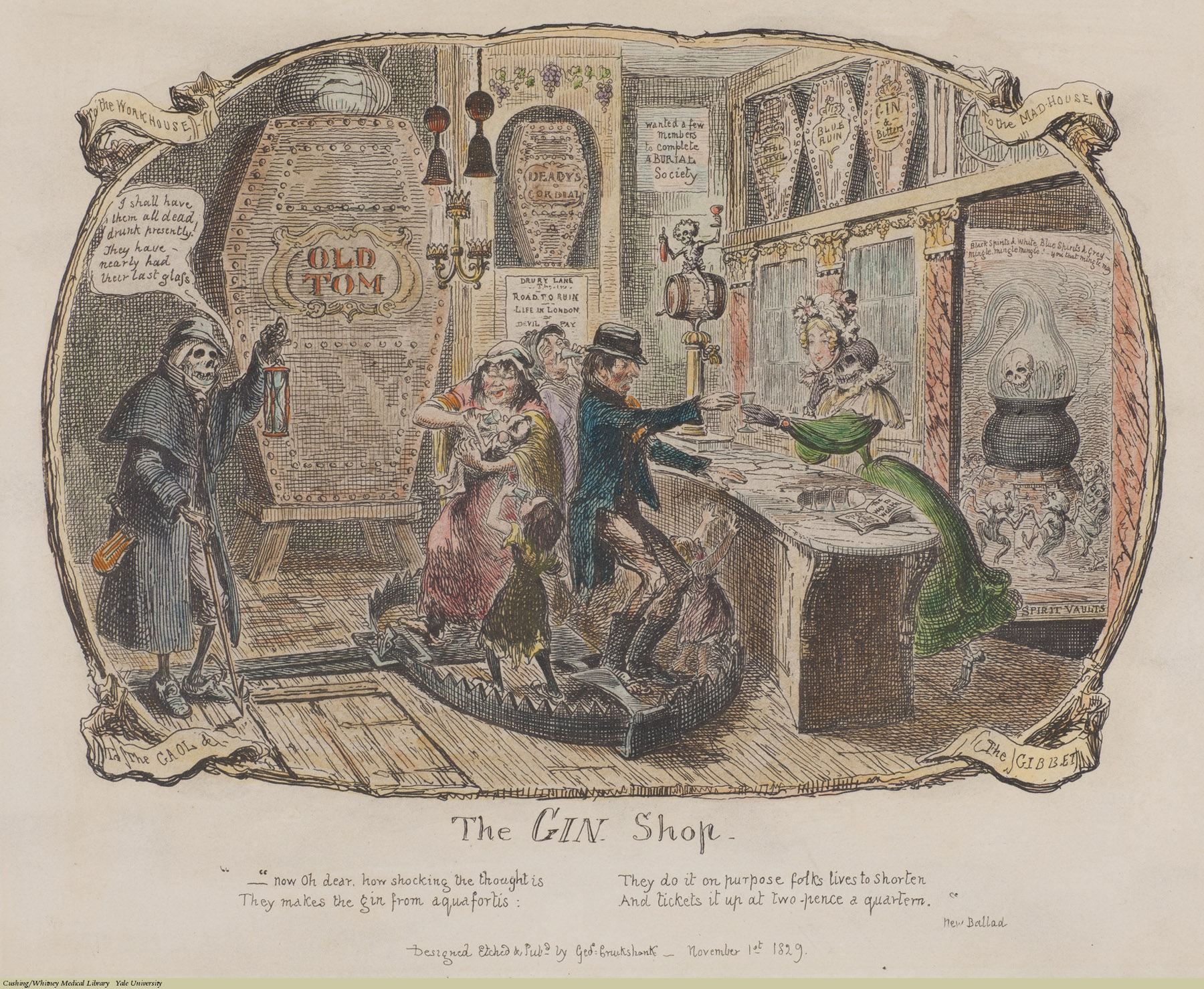
The Healing Arts: The Gin Shop.

George Cruikshank, click for full size.

The Gin Shop, George Cruikshank, Etching coloured, 1829. Subject: Alcohol, Gin, Drunkenness, Mother's Ruin, Children, Child Care.

The Gin Shop, George Cruikshank, Etching coloured, 1829. Subject: Alcohol, Gin, Drunkenness, Mother’s Ruin, Children, Child Care.

The GIN Shop –

—”Now oh dear, how shocking the thought is They makes the gin from aquafortis:

They do it on purpose folks lives to shorten And tickets it up at two-pence a quartern.”

New Ballad.

You can read more about the Gin Craze here.

Fairy Tale Art.

A wonderful site, full of enough fairy tale art to keep a person quite busy, sent along by rq: Art Passions. Fairy Tale art and artists encompass so very many styles, and the illustrations are crucial to the stories, they inflame the imagination, and illuminate the stories from within. In this particular case, serendipity strikes, as I brought home a book of short tales by Leigh Bardugo yesterday:

The first story, Ayama and the Thorn Wood, is a grand story which I enjoyed very much. I do have one noisy complaint however, and it has to do with the fairy tale art. In the story, Ayama is described thusly:

“Ayama was clumsy and apt to drop things. Her body was solid and flat-footed, short and round as a beer jug.”

Given this description, why in the fuckety fuck is Ayama drawn like this?:

This never should have gotten a pass from anyone, let alone the author. It is not a crime to depict characters correctly, and all girls do not need to be tall and thin with a teeny waist. FFS, seeing this sort of thing is infuriating, and it went a long way to souring a very good story. In the story, Ayama is strong, courageous, imaginative, and thoughtful. In the drawing, she’s just another generic pretty, skinny girl. That’s not doing anyone any favours. We all come in different shapes and sizes, and that’s a message all kids need. What they don’t need is yet another cookie cutter shape to try and stuff themselves into, regardless of fit.

The Healing Arts: A Man Mid-Wife.

An interesting piece, addressing what was a great controversy, with people hotly on one side or another, as male physicians encroached on the world of childbirth. Additional information and sources under the image. Click for full size.

A Man Mid-Wife, Isaac Cruikshank, Etching coloured, 1793. Subject: John Blunt (pseud. S.W. Fores), Midwives, Surgical Instruments, Forceps.

A Man Mid-Wife, Isaac Cruikshank, Etching coloured, 1793. Subject: John Blunt (pseud. S.W. Fores), Midwives, Surgical Instruments, Forceps.

The text reads:

“A Man-Mid-Wife, or a newly discover’d animal, not Known in Buffon’s time; for a more full description or this monster, see, an ingenious book, lately published, price 3/6 entitled Man-Midwifery dissected, containing a variety of well-authenticated cases elucidating this animals Propensities to cruelty & indecency sold by the publisher of this Print who has presented the author with the above [illustration] for the Frontispiece to his Book.”

From the same source:

Summary

This etching illustrated a book criticizing (male) physician birth attendants–“man midwives”–today’s obstetricians. The etching shows a figure that is male on one side, female on the other. The male half stands on a plain wood floor next to a large mortar and pestle, holding an instrument labeled a “lever” in his hand, which is pressed against his thigh. The background seems to be a shop, with shelves lined with vials, bottles, and frightening looking instruments labeled “forceps,” “boring scissors,” and “blunt book.”

In contrast, the female half of the figure stands in a homey room on a decoratively carpeted floor; in her outstretched hand she holds a small cup. Behind her, a fire burns in a grate.

Commentary

This etching was made in 1793, at a time when middle-and upper-middle class English women were being attended by physicians rather than midwives at the births of their children. Midwives were left to attend the beds of birthing women too poor to afford the services of physicians.

At the time, however, criticism was leveled at physicians who chose to demean themselves by doing “women’s work,” with some suggestion that their only motivations must be prurient ones. (This latter accusation is hinted at by one of the bottles on the shelves of the man half of the man-midwife; it is labeled “love water.”).

Today, while few would accuse male ob-gyns of perversion (although male medical students who choose this specialty probably still raise eyebrows in some corners), questions about the proper place, methods, and attendants at childbirth still are debated. Only in the past three decades, for example, has the presence of fathers at childbirth been considered proper, and we still argue about home vs. hospital births, the use of midwives, training for midwives, and the place of technology and medication in normal births.

You can read a fair amount of what was written in the 18th century by people on both the pro- and anti- sides here.

Historian Ruby has an excellent rundown of the great controversy, where once again we encounter the scandal of Mary Toft in this excerpt:

Hugh Chamberlen, as well as being a physician, was also a speculative businessman, and when his proposed business dealings failed, his creditors forced him to flee abroad.  With his credibility damaged, he was lampooned in verse in 1699 in Hue and Cry After a Man-Midwife, Who has Lately Deliver’d the Land-Bank of their Money.  It was noted that ‘great belly’d ladies have mighty respect for’ the man-midwife, demonstrating that the fashion for men-midwives commenced in the seventeenth century and was not just an eighteenth century phenomenon.  The verse also alluded to the outrage that was displayed in some quarters by opponents of men-midwives, ‘Among his profession he’s fam’d as a topper, By some call’d a midwife, by others a groper,’ hinting at sexual improprieties that the man-midwife could commit once alone with vulnerable females.

Public suspicion of the medical profession ran deep in the eighteenth century, in part due to the non-secular society believing that decaying bodies tainted the men who practiced medicine, but also, medicine was considered the least prestigious of the professions and the physicians’ failure to cure illness and stave off death impacted the public’s perception of them.  The man-midwifery profession was further disparaged after several eminent London men-midwives supported Mary Tofts, who in the 1720s claimed to have given birth to a litter of rabbits.  The absurdity of their support of Tofts in her fraudulent claim led to professional ridicule.  Not only were the men of the medical profession considered asinine for agreeing with Tofts’ wild claims, there was a growing suspicion of the practitioner as a ‘corrupter of morals, a threat to female modesty and even as a libertine.’

Blunt’s book, Man-midwifery dissected ; or, the obstetric family-instructor : In fourteen letters, is available to read at the Internet Archive. You can also see the above image properly coloured as the frontispiece of the book.