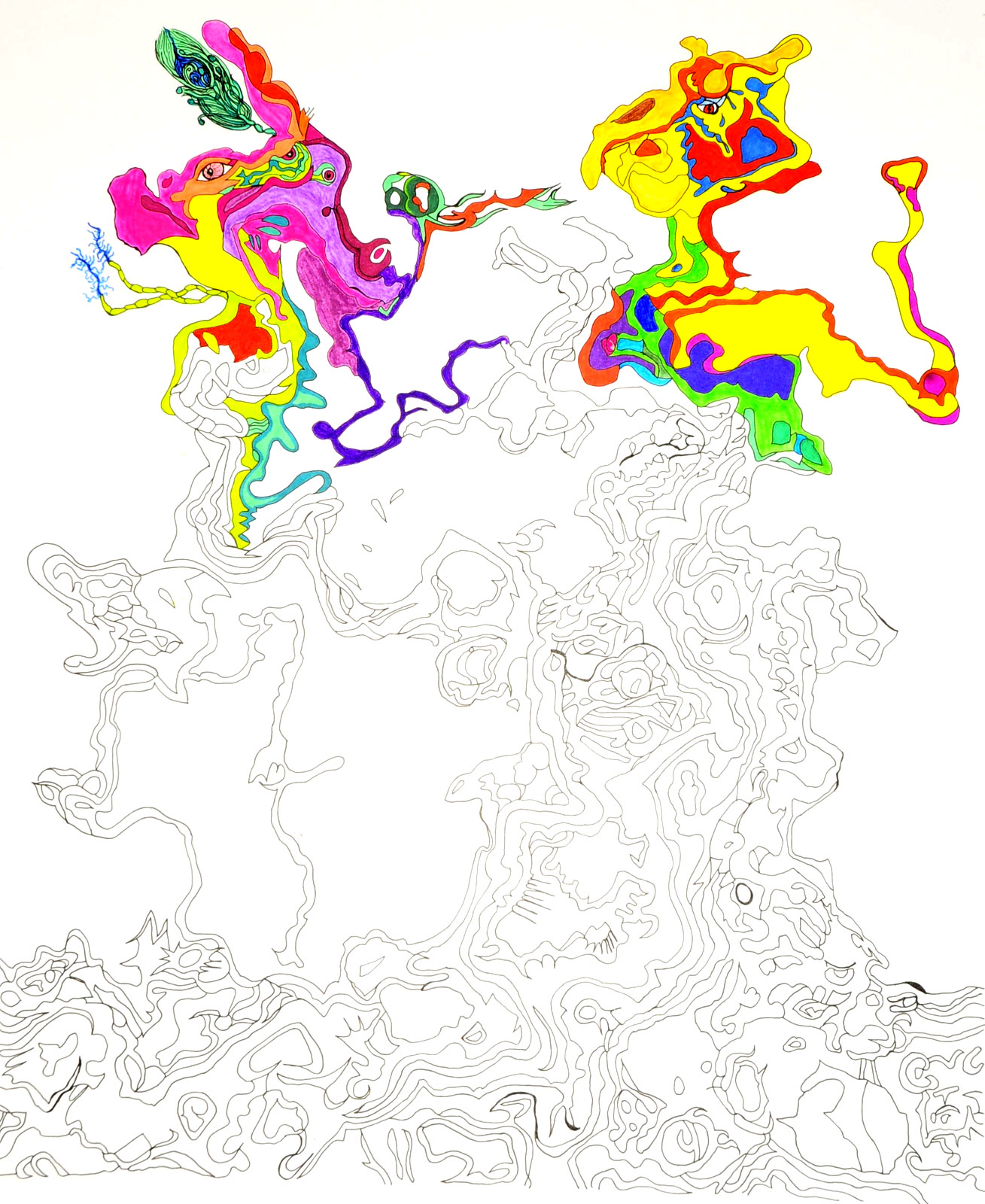
Creatures of Brain Sorbet, © C. Ford, all rights reserved.
A little while ago, I decided I needed a break from Thorns, a sort of sorbet for the brain. As it turns out, a good decision – I need something to focus on without investment because I have been a wretched heap of misery since Thursday morning. Upon waking Thursday, I discovered I couldn’t walk. My left leg went out from under me, accompanied by a scream. Trying again, I could sort of lurch if I took teensy tiny partial steps. The primary pain was to the side and down from my kneecap (outside of leg), a site well known to me, as it’s long been a sensitive one. That’s where the sciatic nerve splits off into the tibial and peroneal nerves. Standing, with no weight on the leg at all, the pain radiated down to my ankle, which was slightly swollen along with my foot, and radiated up the back of my thigh to my arse. Oh good, my sciatic nerve is on a fucking rampage. (Yes, I still went out that night to get shots of the storm, lurching and limping and dragging myself, with the aid of morphine.) Anyone who has ever dealt with sciatic pain, you know what I’m talking about, painwise. People infected with the photography bug know you have to be at least 15/16ths dead before you miss a possible once in a lifetime shot.
The last time I had sciatica, it lasted most of a year. I am just so fucked. The pain has been very near to insanity levels. There has been much yelling, a fair amount of screaming, and a lot of collapsing into a pile of sobs. Thanks to chemo brain, it wasn’t until Friday night that I did what I should have done immediately on Thursday morning – take aspirin. The aspirin helped much more than the morphine, helping to deal with the inflammation. It’s not helping as much now, but hey, at this point, I’ll take what I can get. I did have to fucking crawl into the lav on Thursday morning though, so I was bit preoccupied. Of course, another storm hit, and the circuit breaker which controls my studio lights keeps flipping off every hour or so. That means…stairs. Interesting to navigate when you can’t bend one knee without screaming. The breaker just went again. Fuck it, I’ll get it in the morning. Apparently, the pain and humiliation of the last four days wasn’t quite enough, as I have been called back into Cancerland early. My oncologist (first one) insisted I meet again with Cole (radiation doc) tomorrow (Monday the 18th). Just what I need, a nice long car ride to irritate the holy fuck outta my sciatic nerve. Ought to be fun. I suppose I’ll be getting my tats tomorrow.
Poor Jayne, he’s about a wreck, not knowing what to do with this screaming one second, racked with sobs the next person who appears to have eaten his regular person alive. Thanks to the confluence of morphine and aspirin, I can get 2 hours or so mostly pain free a day, but mornings are a nightmare, because after sleeping, I’m right back to where I was on Thursday morn. This is one situation where I’m truly thankful to be an atheist. To think or say to myself: the universe is pissed I didn’t take the hint and die, so it’s going to keep dropping big-ass bricks on my head is obviously sillier than fuck, and can be dismissed as a pity party moment. If I believed in a god though: god is pissed I didn’t take the hint and die, so he’s going to keep dropping big-ass bricks on my head, I think I would be in a very bad and dangerous place which would lead to very bad decisions, like stopping treatment and placing myself in “god’s hands”, going the “god’s will” route.
It’s now time to stop faking it (puttin’ on that brave face). I’m becoming increasingly fearful of showering, scared I’m gonna fall and kill myself in there. Think it might be time for some accessories in there, or at least a plastic chair I can sit on, or fall back on. Ah well, time to face the shower. Anyroad, I will be taking Monday the 18th completely off, I didn’t have time to schedule anything, either. Going to sleep as long as possible, take much aspirin and morphine, wrap myself in pillows, and try to get through the day without breaking the fuck down, and I’ve felt much too close to a breakdown the last few days. As far as I know right now, I’ll be back to Affinity sometime Tuesday. I know my blogging has been on the shitty side lately, really sorry about this, I’ll make it up to you all.