Making Kitchen Knives – Part 2 – Draw, Drill, Cut

©Charly, all rights reserved. Click for full size.

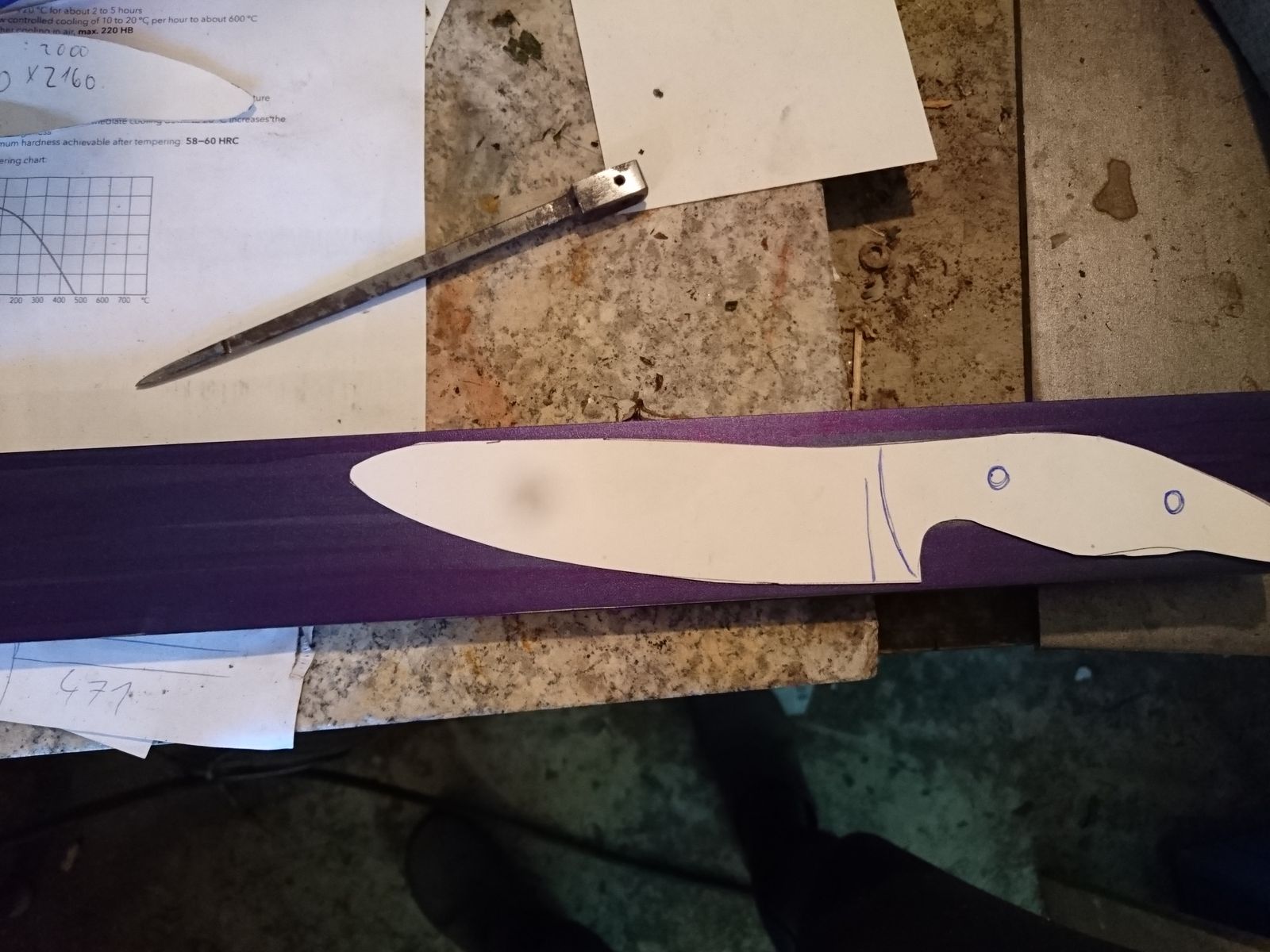
Each bar I have is big enough for two knives, but I cannot simply halve them – there is nearly 10 cm overlap towards the tips. That way I get longer knives whilst wasting less material. I have made a new paper template and here you can see how I laid it on the bar. To draw the outline I covered the whole bar in blue color using very thick (1 cm) marker. A much cheaper and more readily available option to machinist’s blue. You can also see that  I have lost my drawing needle somewhere in the 10 square meters of my shop so I have made a new one from an old shuttle bobbin. I hope I won’t lose it too.

When doing this I have wanted to test an idea how to improve my process already, so I have made another template which allowed me to mark not only the two holes for pins, but also a hole at the center of the finger groove. Unfortunately I did not make a picture of that.

©Charly, all rights reserved. Click for full size.

But here you can perhaps see why the third hole. After marking the hole positions with a center punch, I proceeded to the drill. But instead of a normal drill bit, I have spanned in it a step drill which allows me to drill holes from 4 to 22 mm. So I drilled 6 mm holes for pins and an 18 mm hole where the finger groove is. That way I do not need to mess around with some improvised way to grind a nice tight radius that I need. This is a big time and hassle saving in itself.

This is also first significant change in design to the prototype that I have given to my mother. She did not exactly complain, but she commented that a deeper finger groove would be more comfortable. So I am making the groove deeper and therefore the handle inevitably skinnier in this part.

©Charly, all rights reserved. Click for full size.

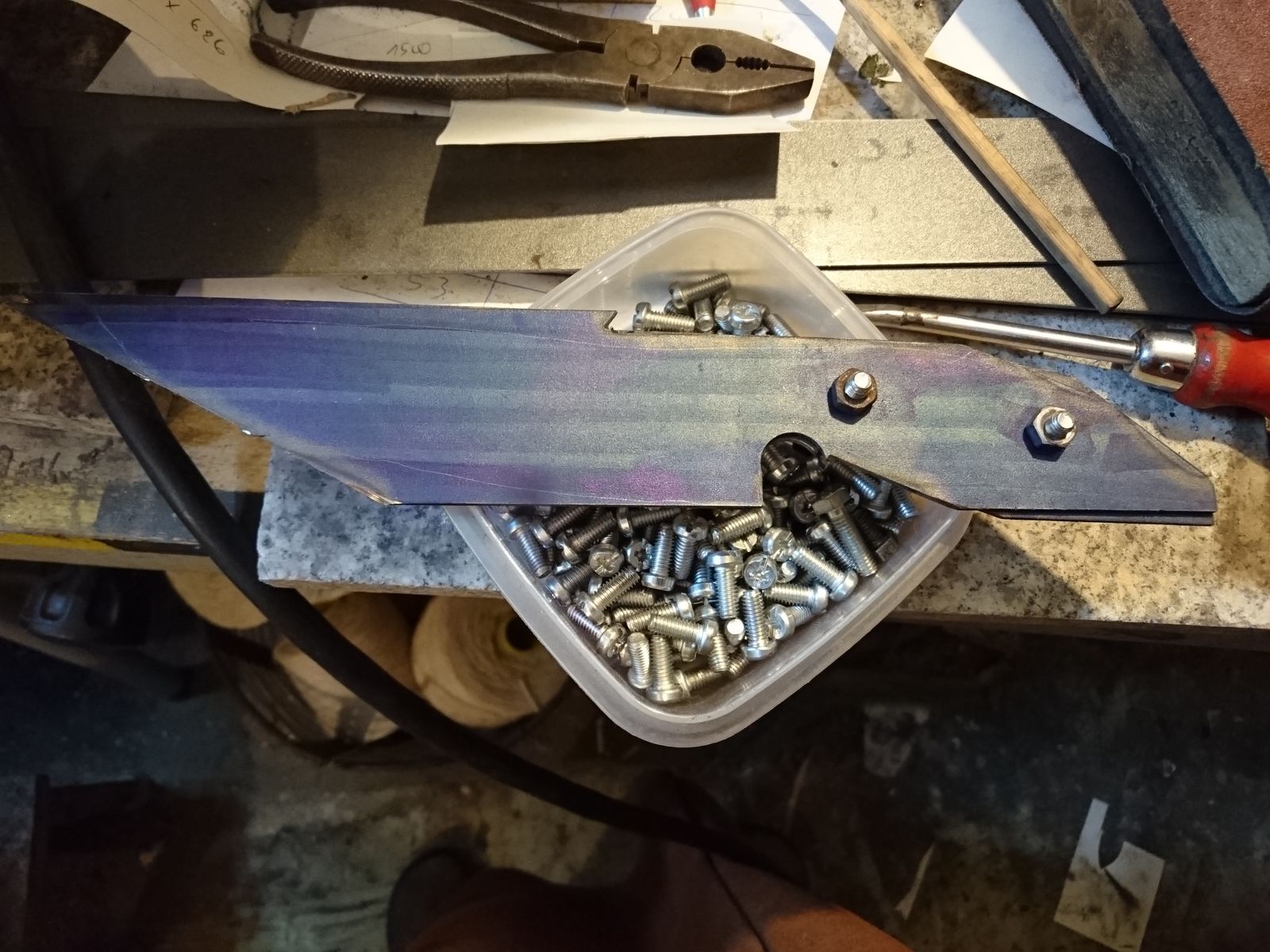
I have marked and drilled both halves, then I cut the bar diagonally with an angle grinder. Using an angle grinder I have also cut excess metal on both knives since I live by the rule – if you can cut it, do not grind it.  After that I have tried another time-saving measure that I have thought up in my idle time – I have connected both knives with screws through the pin holes. With that I proceeded to the belt grinder to grind the outline of the blades.

It worked very well and I had outlined two knives very quickly, in fact these three steps took a lot less time than I expected – just one hour overall. And I even see big time-saving potentials here:

  1. For drilling I could make a template for guiding 6 mm drill bit instead of punching the holes for each blade separately. So for next run I will first fish around in my scrap pile if I find a scrap piece of the right shape and size. Then I can stack and drill more pieces in one go. I will lose some time by stacking, but save time drawing and punching. Also next time I will first drill all stacked pieces with a 6 mm drill bit for the finger groove as well. That means changing the bit once, but I think it will be more than made up by the time saved from drawing and punching.
  2. I can probably stack at least two, maybe even five, pieces before cutting all the excess with the angle grinder.  Five pieces would be 9 mm thick, and an angle grinder should be able to grind through that without big trouble and without too much reduction in speed. And I will waste less time per blade by repositioning the piece in the vice for each cut.
  3. Ditto for the belt grinder. A new 40 grit belt should be able to grind five pieces at once with only marginal reduction in speed. That would also improve reproducibility.

So I am putting this in the “low hanging fruit” basket, since the 30 minutes per blade is significant 10% of my goal time and I estimate I can cut that easily down to half or maybe even less.

Verschlimmbessern

Verschlimmbessern, verb, German: Making something worse by trying to improve it.

I tried to somehow righten the mistakes I made with the first bracelet, but instead made matters worse, though I think it would have come to this eventually anyway. But I learned quite some things.

bracelet with matte top

Cut off top section

bracelet

Sticky front

I tried to cut off the sticky top section, round the edges and then polish it up to shine again. This didn’t work well for several reasons.

Most importantly:  If your resin didn’t cure properly, there’s not a lot you can do. Reflect on what you did wrong. Do better next time.

The soft spots were all over, and when I cut off the top, the fine dust stuck to the soft spots and made them matte. And since the whole thing isn’t as hard as it should be, it moved quite a lot so the resin and the stones separated in places, leaving more matte spots.

Another lesson: you cannot get around very fine wet sanding paper. All my mats and polishing stuff were still way too coarse to make it shine again. This will be very important since one of the projects that I’ve planned involves makeshift moulds* and requires grinding and polishing.

*Resin Obsession can speak many words to the wise about not being too ambitious in the beginning, but nobody ever accused me of being wise.

Even When Not in Doubt Marcus Knows

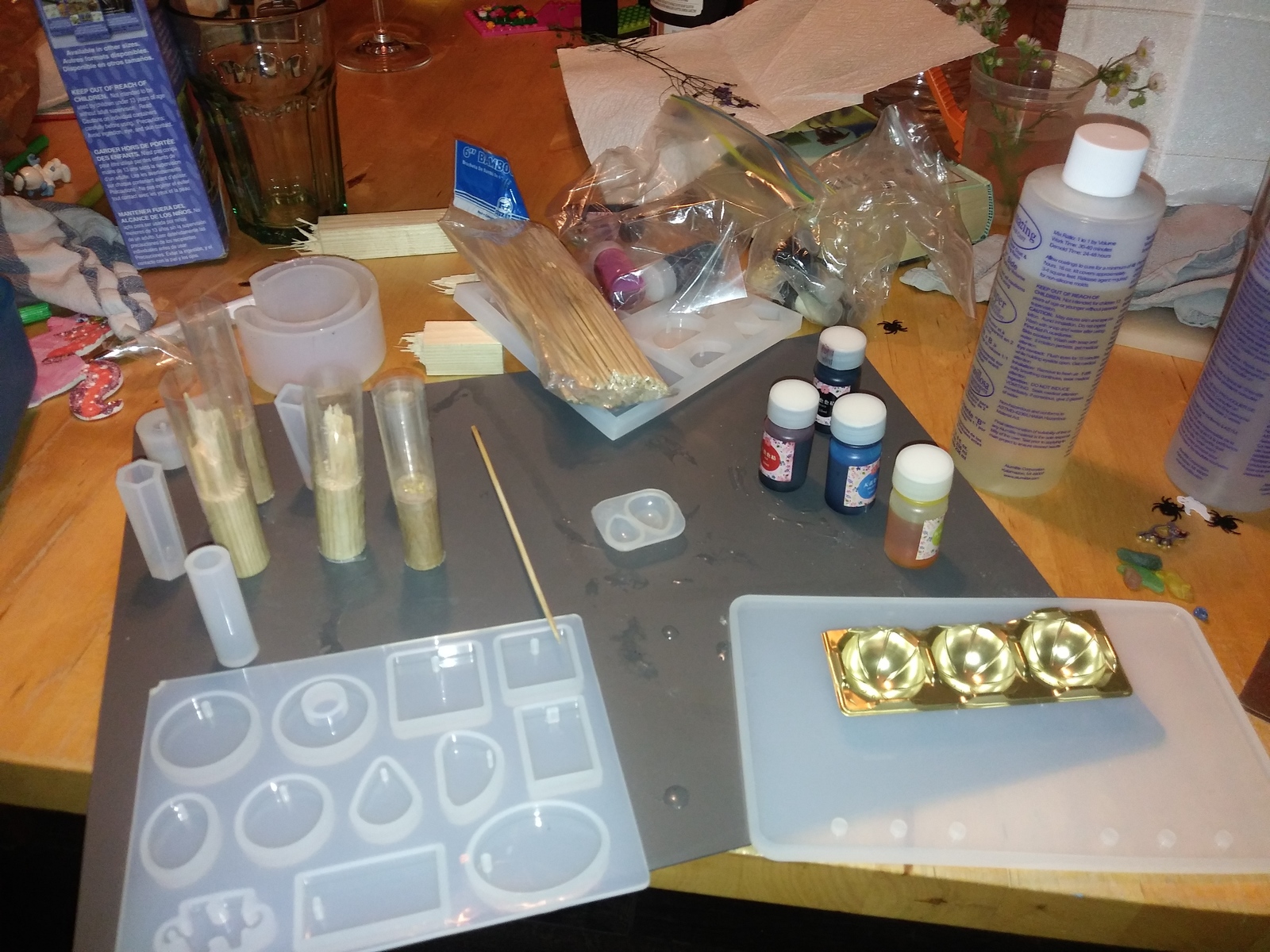
Yesterday Giliell posted about the wonderful gift of acrylic casting supplies that she received from Marcus, noting that she’d been considering trying this art form.  Well, I received the same gift from Marcus last week and I wasn’t even thinking about trying resin casting. Marcus just knows. He knows that I have a large collection of seaglass and that this is the perfect medium to pair with them. I can’t wait to try it, but I’ve been rearranging my cabinets and my work table is buried under a ton of paper crafting crap right now so I haven’t gotten past the gazing in wonder at it all yet. Well, I have watched a few how-to videos (link below) that have given me lots of ideas for using seaglass and more. I love the bracelet Giliell made and it’s made me even more anxious to try it. Alrighty then…time to clean up the mess and play. Tune in over the weekend to see if I can make something as pretty as Giliell did. Thanks, Marcus. You definitely spread sunshine.

Resin Obsession (a very good site)

Wow, Thank you Marcus

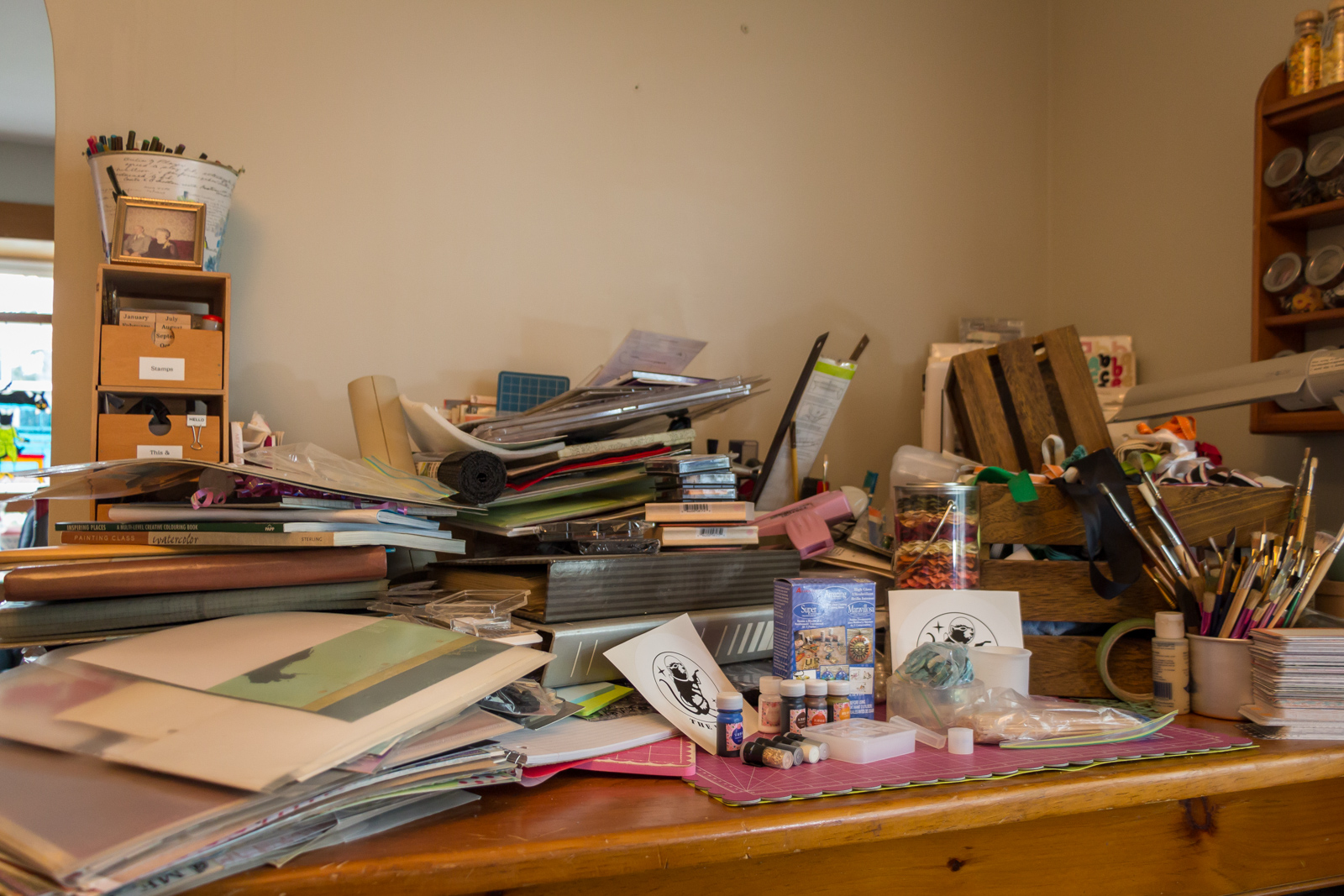
Yikes! The bigger picture (my work table is under there somewhere)


Making Kitchen Knives – Part 1 – In the Beginning…

… there was a bar of steel.


After a short break due to harvest I have started two knife making projects and I will share the progress on them as I go along.

The first one is about developing a viable process for making small-batches of kitchen knives.

The knife that I have given my mother for Christmas has proven itself to be an excellent cutter. It held an edge for half a year and still shaved hair when my mother requested honing the edge because it had a few blunt-ish spots. The handle does not show any sign of deterioration too. And it is used daily, by at least two people, on everything from fine chopping veggies to de-boning chicken. So I think that with some adjustments (mostly making it look prettier) it might be a saleable product.

I reckon (I will not bother you with the math and reasoning, some of it has solid rational basis, some of it I pulled out of my nether regions) that in order to be able to eventually barely survive whilst making knives, I would have to be able to make a passable kitchen knife in under five hours spending with the fun work, i.e. manual labor. The lower the better. Rest of the working day would in such a case be eaten by the unfunny part of the job, the actual business of business.

But developing a viable production process is something I have a professional experience with and so I want to have a go at it, even though right now making knives is just a hobby. And I will be sharing with you all the failures as well as the improvements in trying to achieve my time goal.

The first step is straightening the steel. For this project I am using N690 steel 1,8x50x500 mm and all the steel bars had a slight bend to them that had to be corrected. Currently the only way for me to do this is to use a vice and three thick screws. Had the plates had a kink, I would place the middle screw straight on that kink and bend it with ever-increasing pressure until after taking the steel out of the vice it would be straight-ish. However these did not have a kink, they were nearly universally bent in a very slight regular arc.  To straighten that, I first tried to bend the bars slightly at multiple points. It worked, but it was time-consuming and unreliable. Later I have tried to close the vice only slightly on the steel bar and then pulling it through the screws – essentially using it as an improvised roll bender. That worked much faster and reasonably well.

Even soo, all in all it took me less than 1 hour to straighten 12 knives worth of steel. That is less than 5 minutes per knife. I think that building a small roll bender specifically for straightening these thin long bars should not be difficult and it could potentially shave off quite a reasonable chunk off of that too. But right now, I am putting this into the “high hanging fruit” basket, since despite the clearly impromptu setting it takes only about 2% of my time goal. That means, I will ignore this step in the process for now and not bother about improving it.

For the first knife made let’s write down 5 minutes for this step and move on to the next.

Spring Tulips from Down Under

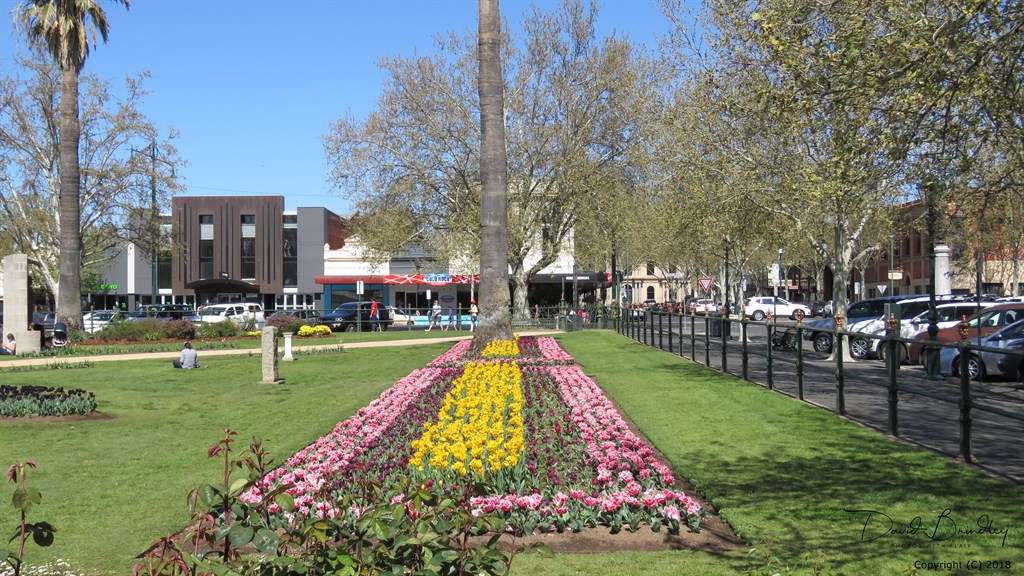
I never tire of autumn colours, but the sight of these gorgeous tulips sent in by David from Australia made me more than a little nostalgic for the season of new growth. The white ones in particular caught my eye. They look so fresh and crisp. David Says,

It may be Autumn/Fall up North, but here in the South, Spring has sprung, The Grass has riz. Shot these tulips last week in Bendigo, (https://en.wikipedia.org/wiki/Bendigo)

such a lovely sunny day it was impossible to shoot without humans getting in the pics. Enjoy.

Thanks, David. I am enjoying and so will everyone else.

©David Brindley, all rights reserved

[Read more…]

Youtube Video: Pictish Crossbow – discussion and shooting

I would love to someday to build a crossbow. It definitively is on my ever growing to-do list.

Not that I feel particular inclination to be armed, but the simple yet not easy to make mechanism of a crossbow (or even a bow) intrigues me.

Tod Todeschini not only makes crossbows, he also likes to share his extensive knowledge about them. Here he uses that knowledge to speculate a bit about how pictish crossbows could look like.

Equus

One thing people may or may not know about me: I luuuuuurrrrve horses. Sorry not sorry, I do. And while some of us have had very varied experiences with them, I would like to share something that tends more towards the wondrous grace and amazing beauty of this magnificent animal.

Mari Lwyd by Rhyn Williams, at DeviantArt

Okay, okay, that’s not the subject of this post, but seeing as Halloween season is approaching fast, here’s more info via HyperAllergic on the Mari Lwyd phenomenon. (Very pagan, and I love to see these spooky traditions still maintained today.)

Anyway.

So, in short, I am both happy and sad: I recently discovered a new documentary series on HORSES! on the CBC (Canadian Broadcasting Corporation, ha) website.

Here’s the trailer:

And oh my gosh, it’s horses, and wild scenery, and people, and dramatic music and slo-mos, and wow! I thought it was a four-part, but it’s a three-part mini-series (part one, part two, part three). Why so sad? Because the videos are only available in Canada (as anyone not in Canada might have already discovered by clicking those links). The CBC does have a youtube channel, but it’s been no more helpful, because from what I can tell, this hasn’t been posted yet (or maybe it’s because I haven’t subscribed).

The article that led me to this find is here, unfortunately for some reason I cannot find the actual article on my computer so you have to settle for the mobile version.

Our ancestors settled every corner of the planet on foot. But when we harnessed horsepower — roughly 6,000 years ago — the human story changed forever. For clever-but-slow Homo sapiens, the strength and speed of horses was a perfect complement. Horses transported us, pulled our loads, plowed out fields, herded our livestock, and carried us into battle (or sped us away from danger). In ways no other animal could, horses were our constant and irreplaceable companion.

In the age of machines, we still talk about “horsepower.” But horses have lost their central place in human life; we now keep them as pets and companions.

But while their importance in the human world is fading, there are some horse cultures that survive today. In Equus: Story of the Horse, we meet some of them.

The documentary visits Kazakh nomads, the Yakuts of Northern Siberia, the Blackfoot of the Western Plains, and the Bedouin. Some of those horses (the northern ones) are seriously cute.

In honour of all horses who inspire us (in one way or another), here’s a fusion of Mongolian throat singing and traditional Latvian folk music. It is quite something. Don’t forget to enjoy the gorgeous scenery, too!

Spider!

We’ve been on a roll here lately with spiders and Nightjar has sent us one more. This incredible set of photos showcases a spider preparing a meal. Photos are below the fold. Thanks for sharing, Nightjar.

I feel slightly guilty about what’s going on in these photos. I had seen a honeybee on our goldenrod and approached carefully with the camera. When I got there the bee flew away… and straight into an orb weaver’s web! The spider was very quick to wrap up the bee (1st picture) and to carry it along a thin strand of silk (2nd picture) into its hiding place among some dried chayote leaves (3rd picture). Fascinating to watch, but I couldn’t help feeling bad for the poor honeybee, it looked so pretty on the goldenrod… Oh well. [Read more…]

Bobbin Lace Masterpiece

I would like to share a both inspiring and gloomy story this time.

My grandmother was abandoned as a child by her family, who did not want to raise her – she has lost her leg and staunchly religious catholic matriarch of the family refused to take care of a “cripple”. So they gave her to a cloister to be raised by nuns. She learned there bobbin lace making style specific to that region of Domažlice.

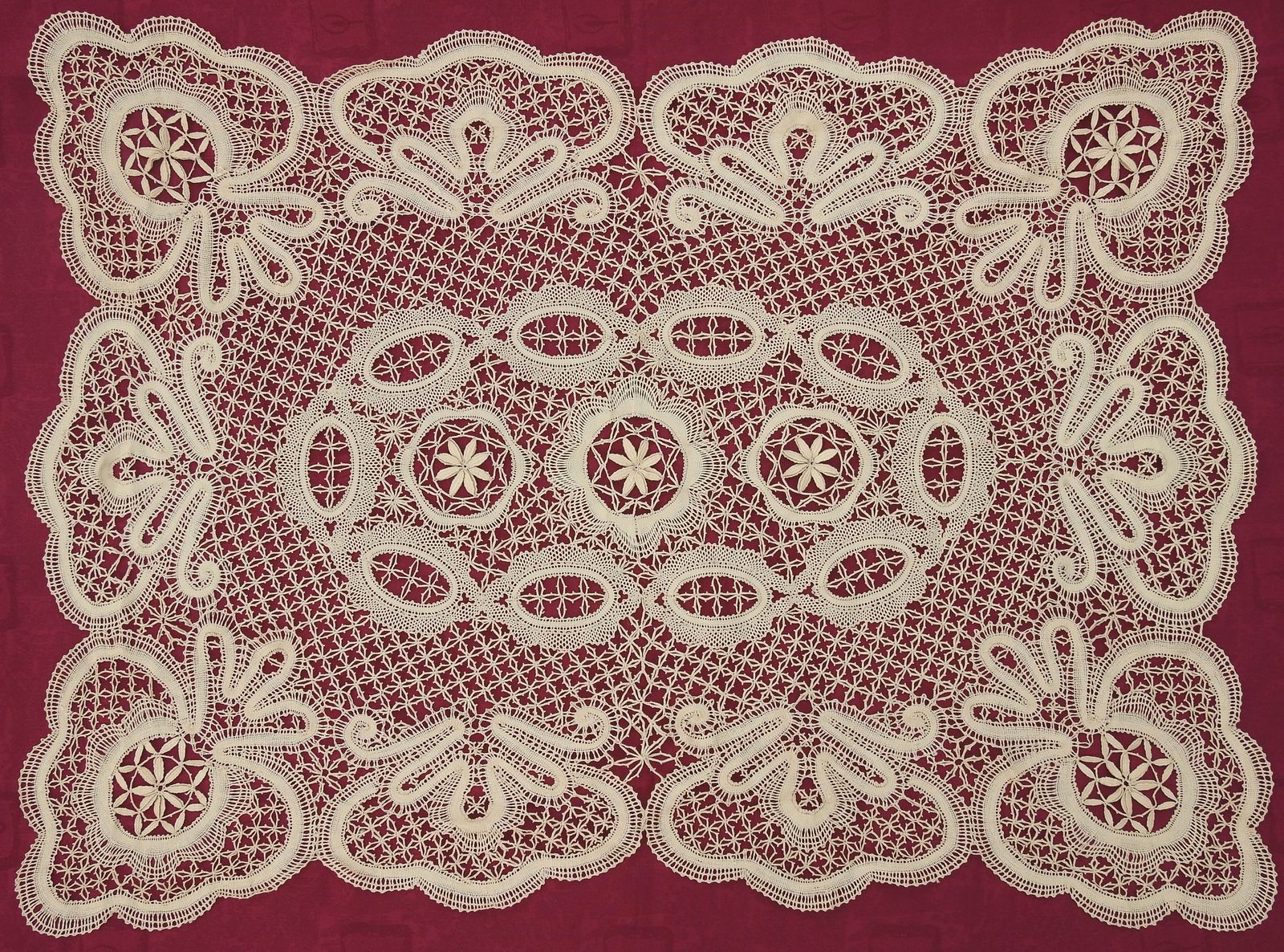
©Charly, all rights reserved. Click for full size.

This piece is a tablecloth circa 60×80 cm and was started by my grandmother in that regional style. But she managed to only make some of the edges and corners before she died. My mother has kept those pieces and she intended to finish it at some time, but she could not get the right thread. After decades of searching both in real life and on the internet she found a vendor still selling what appeared to be the correct thread and she bought it.

Unfortunately, the new thread pieces did have slightly different color than the antique 50 years old ones (to be expected), so she could not simply continue her mother’s work. Therefore she started from scratch, only using grandmothers template for corners and edges.

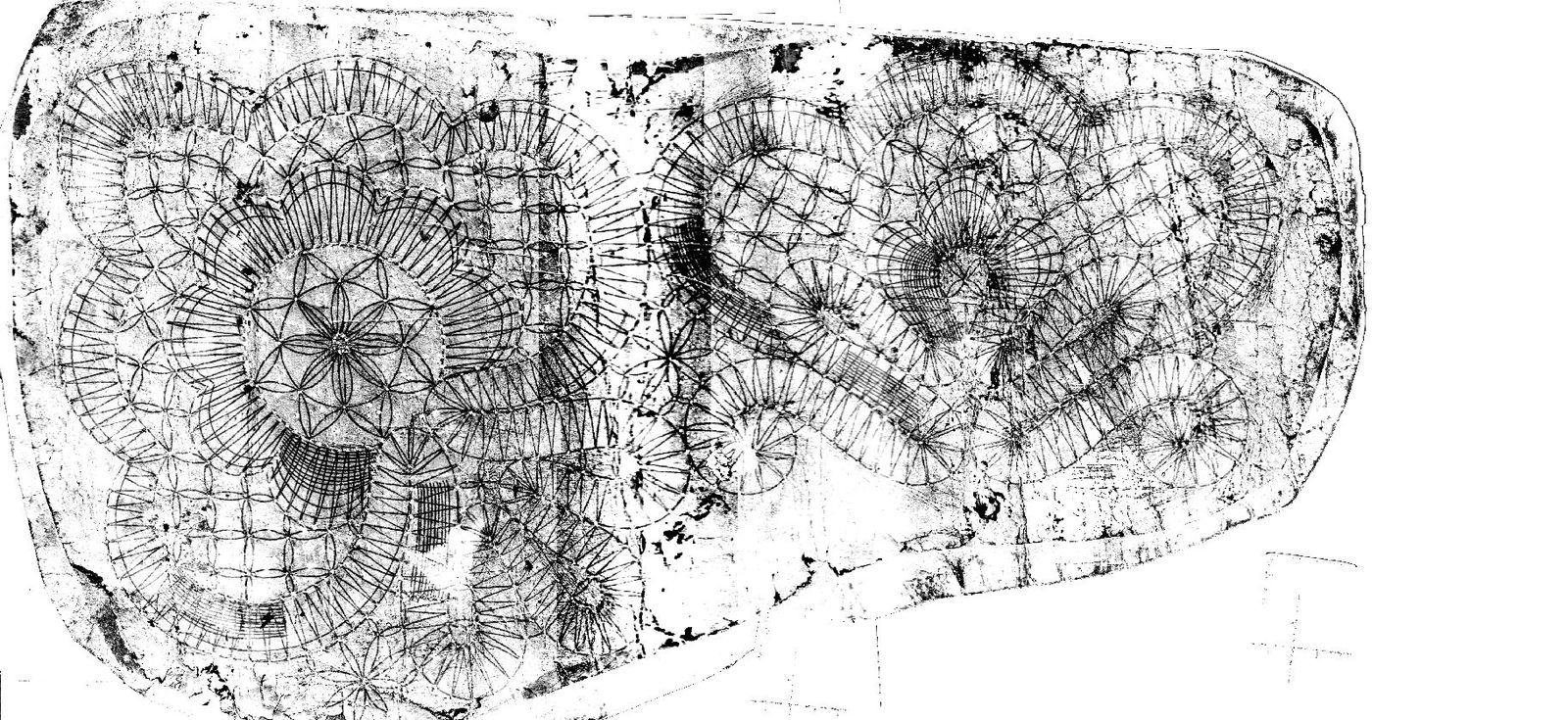
For that I had to scan the template first.

©Charly, all rights reserved. Click for full size.

And then make it black-white, so my mother can take it and draw a new one with the time-tested technique of taping it on glass under a new sheet of paper and tracing the lines per hand.

©Charly, all rights reserved. Click for full size.

When the edges and corners were finished, she had to design the center part. She was not satisfied with her attempts and she requested my creative input. I proposed that chain of ovals with lobed edges around three stars, and she went with that idea and expanded it. They have a slightly different style, but I think it all works together.

So you see in effect a piece of art that took three-generations to complete, if you count my minuscule input. In the end, my mother has spent over 100 work hours making it, and used up over 1 km of thread. It is absolutely invaluable – and she gave it to me for my birthday this summer. I do not wish to use it as a tablecloth, so I framed it as a picture and I am in search of a piece of wall big enough to hang it on.

Sadly with me the bobbin-lace tradition in our family will die. I tried to learn it as a child and I was not bad at it, but I have way too many interests as it is so I forgot it again – and since probability of me ever having family converges to zero every year, I would not pass it on anyway.

But in the meantime, you can enjoy the pictures.