A gorgeous Sandhill Crane from Kengi. Click for full size.


© Kengi, all rights reserved.

A gorgeous Sandhill Crane from Kengi. Click for full size.
© Kengi, all rights reserved.

AP photo.
Trump’s pandering to the religious right has gotten worse. He’s now brought on Santorum, in a bid to protect Catholics from the big, bad wolf of something or other.
Trump has hired the former U.S. Senator from Pennsylvania, Rick Santorum, as an advisor for his Catholic Advisory Council.
Santorum, who ended his campaign for president in February, is one of 35 people slated for the council. In a press release announcing the council, Trump included a list of “issues of importance to Catholics.” The topics on the list include religious liberty, pro-life, judicial nominations, education, healthcare, jobs and taxation, and safety and security.
In June, Santorum signed an antigay “pledge in solidarity to defend marriage,” that claims marriage should only exist “between one man and one woman.” Santorum has also said he would reinstate the ban on ‘don’t ask don’t tell.’ The former U.S. Senator has also defended ‘religious liberty’ in the past, and it is something that Trump comments on, in his list of “issues of importance to Catholics.”
On the topic of religious liberty, Trump said, “Religious liberty is enshrined in the First Amendment to the Constitution. It is our first liberty and provides the most important protection in that it protects our right of conscience. Activist judges and executive orders issued by Presidents who have no regard for the Constitution have put these protections in jeopardy. If I am elected president and Congress passes the First Amendment Defense Act, I will sign it to protect the deeply held religious beliefs of Catholics and the beliefs of Americans of all faiths. The Little Sisters of the Poor, or any religious order for that matter, will always have their religious liberty protected on my watch and will not have to face bullying from the government because of their religious beliefs.”
Nothing like announcing you plan to go backwards, as far and as fast as you can go.
The Advocate has the story.

Advice From a Caterpillar.
While glancing at Salvador Dalí’s paintings one might get the sense that they’ve tripped down their mind’s own rabbit hole, all of a sudden dropped within a barren wasteland filed with abstract objects and creatures. The pairing then, of Dalí and Alice in Wonderland writer and mathematician Lewis Carroll, seem perfectly matched—two men whose minds travel far beyond the cutesy corners of an average fairytale. In the 1960s an editor at Random House realized this genius partnership, commissioning Dalí to illustrate an exclusive edition of Alice in Wonderland, of which Dalí signed every copy.
This rare edition of Alice was long coveted by rare book collectors and scholars, making only occasional appearances for study or the auction block. However, for the 150th anniversary of Lewis’ surrealist tale, this one-of-a-kind collaboration has finally been printed for the public by Princeton University Press. The deluxe edition, Alice’s Adventures in Wonderland, features an introduction explaining Dalí’s connection to Carroll by Lewis Carroll Society of North America President Mark Burstein, and exploration by mathematician Thomas Banchoff of the mathematics found in Dalí’s work and illustrations.

Mad Tea Party.
There are many more photos of Dali’s artwork at Colossal Art. I’ll definitely be adding this book to my overburdened book collection.
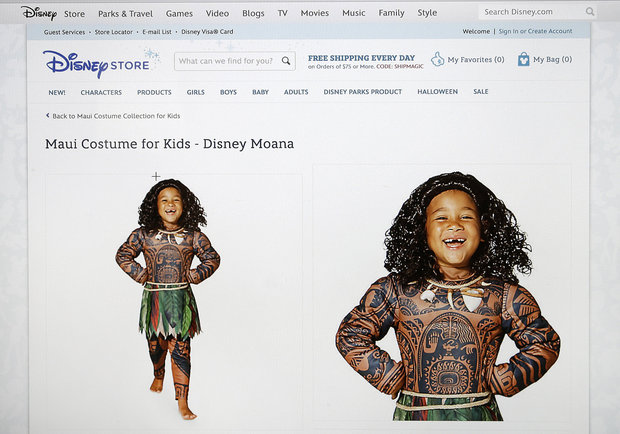
DisneyStore.com’s Halloween costume depicting the Polynesian demigod Maui from the upcoming movie ‘Moana.’ Disney said it would stop selling the costume which some had compared to blackface. (DisneyStore.com via AP).
Disney is pulling a Halloween costume from its website and stores after accusations of racism.
The costume, which is based on a character from the upcoming movie “Moana,” is a body suit with Polynesian tattoos. The character, Maui, is inspired by a Polynesian demigod.
In “Moana,” due out in November, the titular character, played by Auli’i Cravalho — a native Hawaiian — follows a teen who meets the muscled Maui, played by Dwayne “The Rock” Johnson, on a journey through the Pacific.
CNN reports that Disney has issued an apology for the costume.
“The team behind Moana has taken great care to respect the cultures of the Pacific Islands that inspired the film, and we regret that the Maui costume has offended some,” the company said in a statement.
I really wish I could believe that last sentence. Once again though, when it comes to an Indigenous people, the thinking is less than stellar. If there was so much care to respect the cultures, then why wasn’t there at least a discussion about the deep significance of the cultural tattoos prior to a costume being manufactured? Where was the discussion of slipping on a cultural skin as a plaything, to be discarded at will? Indigenous people are not costumes. I’ll just go with the assumption that this was basic Disney, engaging the marketing machine without a single thought in that collective, not so respectful head. I’d really love it if Disney would just fucking stop trying to constantly make more money on the backs of Indigenous people. Try coming up with your own original stuff for once, maybe? At least until you figure out how to deal with Indigenous peoples and cultures in an appropriate manner.
Why yes, I do know there were mixed reactions to the film, I posted about it.
Via NJ.com.
This is not the first time Ms. Rowling’s bigotry has come up, far from it, but it turns out it it’s much worse than I thought. Ms. Rowling is now far past the doubling down stage, she’s pretty much etched her bigotry and indifference in stone now. I would never have read any of the Potter books if it hadn’t been for the astonishing reaction of Christians, all in a frenzy of “Witchcraft and Demons, Oh My!” I was an adult, and don’t have kids. Anything that got Christians so remarkably riled up deserved a look, though. I enjoyed the books, even though they were repetitive, and on the problematic side of seriously white and straight along with tokenism. I probably enjoyed the movies more, which were fun, because who doesn’t like magic? They were fun, a nice nerdy escape. Also, I’m a massive Maggie Smith fan, I’ve had a crush on her since early sproghood. I had planned on seeing Fantastic Beasts and Where to Find Them, but that’s not going to happen now. I already know just how angry and upset that would make me.
In April this year, I posted about Dr. Adrienne Keene’s post on Native Appropriations regarding Magic in North America. If there’s one thing I’d like to make very, very clear, it’s that there are many Indiginerds who love the Potterverse, which makes it all the more heart-breaking and infuriating to see Ms. Rowling’s use of bigotry to further her own ends, and refusal to listen to the many Indigenous fans she has, and her apparent indifference to all the bullying and stereotyping she is subjecting Indigenous people to by sticking to her bigotry. As Dr. Keene said:
It actually makes me kind of want to cry. Harry Potter was such a formative series for me, and holds such a deep place in my heart–and to see and hear this feels like such a slap in the face to me and other Native Potter nerds.
So, if you’re a Potter fan, all prepared to be bristly in offense or defense, don’t. Just listen, please, because these criticisms are not coming from a place of hate. They are coming from a fellow place of love, and a deep well of disappointment. The Problematics of Potter came up on Ask N NDN at ICTMN, and Loralee Sepsey answered, in passionate detail. Here in the States, a great many people think Indians are dead and long gone, an almost mythical race of people, so everyone can play and be as bigoted as they like. I’ve encountered the belief of “oh, I thought Indians were dead” myself. There’s an article up at ICTMN about a young Indian, 12 years old, who wants to cut his braid off, because he lives in a primarily white suburb, and it’s not acceptable to be an ethnic Indian, and he’s tired of being teased, bullied, and stereotyped, at 12 years old. Non-native people, no matter how well intentioned, rarely think about such things. If they happen to be aware of the fact that Indians are not dead, they are rarely interested in the particular cultures, traditions, or languages of Indians. A great many non-natives are content to enthuse about “Native Americans” in the most embarrassing manner. There’s no knowledge to be had there, either. Quite the opposite, in fact. The ignorance can be appalling, and no, enthusiasm does not make up for it. Learning about a particular people, that would be a good thing to do. Understanding that there’s no such thing as one lump of ‘Native Americans’ would be a good thing. Understanding that Indigenous people care about how they are represented, and how their particular mythologies, cultures, and traditions are represented, that would be a great thing.
Ms. Rowling had a great opportunity in front of her. She could have not only learned herself, and met with members of the tribes she planned to write about, she could have helped to empower native people, along with showing basic respect, by allowing natives to own their own stories, their mythologies, their cultures, and their traditions. This story could have been a rich, strong, empowering, respectful, and accurate one. Instead, it’s the same old business of stealing from native people, disrespecting them, and promoting an appalling ignorance, deliberate lies, and propagating stereotypes. What will this latest installment teach children about Indigenous peoples? Nothing true. Ms. Rowling chose to go with using people as costuming, and having the same old colonial, white “saviours”, while not even bothering to give any native character a prominent role, let alone names, as only one native character is deemed worthy of a name. We get to be Ms. Rowling’s red shirts.
J.K. Rowling, with the release of the Ilvermorny School and Magic in North America stories on her website Pottermore, has joined the long list of people who portray indigenous cultures in a contextless and offensive manner, but she could become one of the most dangerous people on that list.
Billboard: "JESUS IS LORD! Mayor Cornell Harvey and City Council" is set to come down after the private owner says got push back from city. pic.twitter.com/l3ialRTvuu
— Letisha Bereola (@LetishaANjax) September 23, 2016
The facepalm is not the billboard, that’s all too standard fare. The facepalm is here:
We found out that no public money was used for that religious message. The money came from a local business owner, who’s now taking the billboard down.
She said even though she had permission from the mayor to use his name, she felt pressure from the city manager.
“I got a call from the city manager that said he had some calls and there were some issues with some people. They didn’t want it up, and something called separation of church and state,” said business owner Victoria Hightower.
Emphasis mine. “Something called separation of church and state.” Given the near constant moaning of religious conservatives over their rights, is it really too much to expect Americans to be aware of the separation of church and state? Plenty of them are aware enough of it to twist about all over the place. This level of ignorance is…well, deplorable.
Via KRMG.

Bird diagram from Robert Ridgway’s ‘A nomenclature of colors for naturalists : and compendium of useful knowledge for ornithologists’ (1886) (via Smithsonian Libraries).
WASHINGTON, DC — An effort to describe the diversity of birds led to one of the first modern color systems. Published by Smithsonian ornithologist Robert Ridgway in 1886, A Nomenclature of Colors for Naturalists categorizes 186 colors alongside diagrams of birds. In 1912, Ridgway self-published an expanded version for a broader audience — Color Standards and Color Nomenclature — that included 1,115 colors. Some referenced birds, like “Warbler Green” and “Jay Blue,” while others corresponded to nature, as in “Bone Brown” and “Storm Gray.”
Ridgway wrote in his 1912 preface that “the nomenclature of colors remains vague and, for practical purposes, meaningless, thereby seriously impeding progress in almost every branch of industry and research.” He railed against confusing trade names like “‘zulu,’ ‘serpent green,’ ‘baby blue,’ ‘new old rose,’ ‘London smoke,’ etc., and such nonsensical names as ‘ashes of roses’ and ‘elephant’s breath.’”
Personally, I have a great fondness for those old trade names. They are wonderfully imaginative, and that sort of thing tends to appeal to artists. Ashes of Roses and London Smoke conjure up wonderful imagery. I also quite like the odd colour that is Ashes of Roses.
A copy of Ridgway’s 1912 book is on view in the Smithsonian Libraries’ Color in a New Light. Installed in two large display cases on the ground floor of the Smithsonian National Museum of Natural History, the exhibition examines the point at which art, history, and science blend through color. Ridgway’s research is joined by the work of 19th-century painter Gerald Handerson Thayer, whose studies of animals disguising themselves influenced military camouflage; a discussion of Fiestaware, which was painted with orange-red uranium oxide glaze and thus became unintentionally radioactive; and the history of Tyrian Purple pigment, made by mashing up snails.
Color systems date back centuries, at least to Richard Waller’s 1686 Tabula colorum physiologica. Yet bird-watching hones a sharp eye for color differentiation, so Ridgway had an edge — as well as a drive for perfection enabled by 19th-century synthetic dye advancements. This new color technology wasn’t without its dangers. One sample in Ridgway’s book is labeled “Scheele’s Green,” a reference to Wilhelm Scheele’s toxic mix of arsenic and copper.
[…]
The Smithsonian Libraries’Color in a New Lightcontinues at the Smithsonian National Museum of Natural History (10th & Constitution Avenue NW, Washington, DC) through March 2017.

Colors from Robert Ridgway’s ‘A Nomenclature of Colors for Naturalists : And Compendium of Useful Knowledge for Ornithologists’ (1886) (via Boston Public Library/Wikimedia)
Hyperallergic has an in-depth article, with many more photos on this always fascinating subject.
Sun bright, from Giliell. The detail is stunning, be sure to click on images for full size.


© Giliell, all rights reserved.
A beautiful Cardinal, from Kengi. Click for full size.
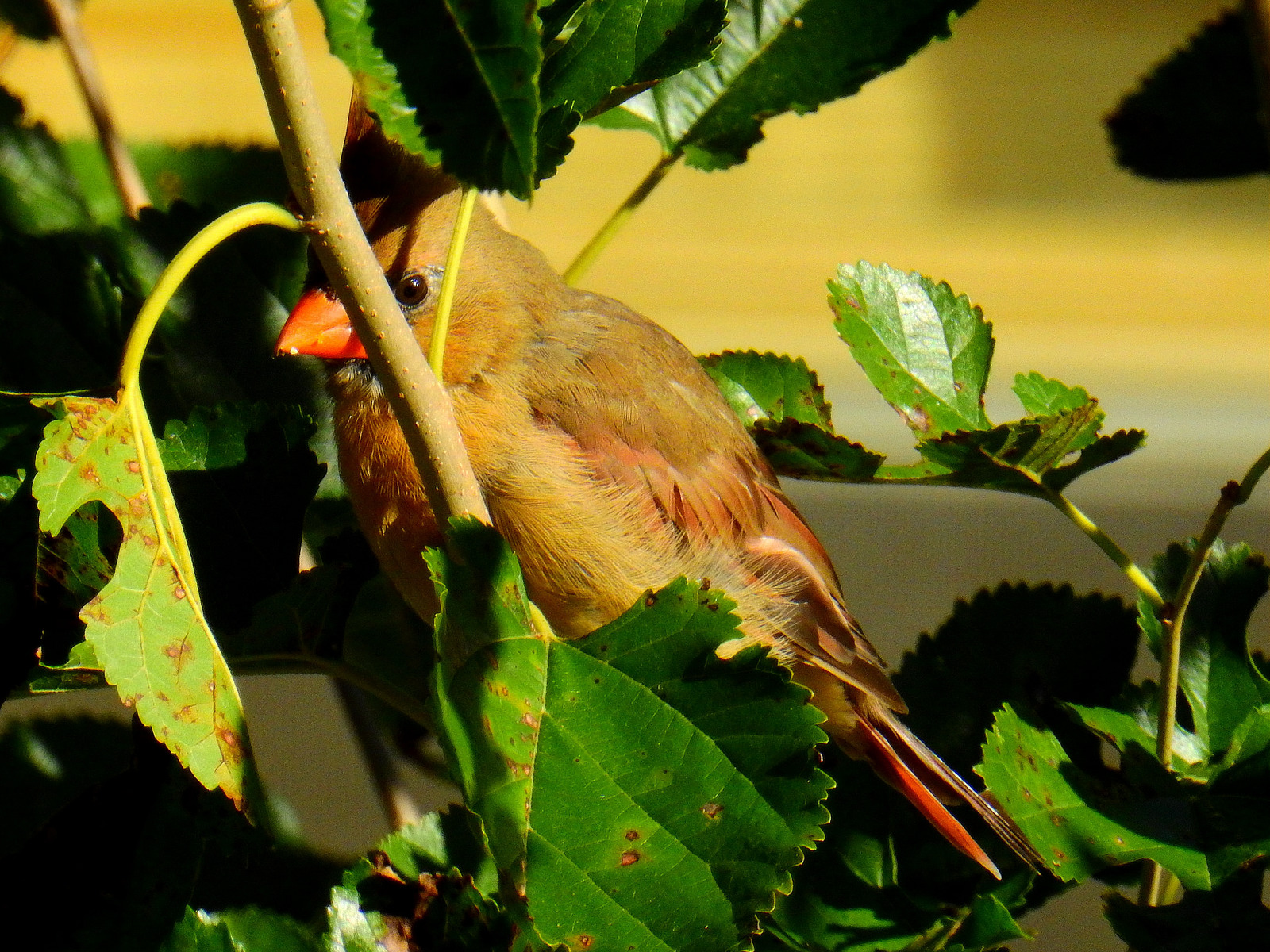

© Kengi, all rights reserved.

The bed of the Chuitna river is littered with several-ton lumps of coal. Paul Moinester/Alaskans First.
Oil is hardly the only threat to Indigenous people. Along with oil billionaires, there are many other people who don’t need another dollar to see them through 10 lifetimes who seek to not only destroy Indigenous land, but the very life of those people. This is going on all over the world, not just in uStates and Canada. The rapacious desire for Coal, oil, gold, and more is threatening Indigenous populations everywhere. Corporations destroy everywhere they set their sights, with no thought past the bottom currency. The Tyonek have been waging a fight against coal for a very long time. You can start with this search page at ICTMN, just for some background. Almost every tribe in uStates who have depended on salmon for their main source of food, and have done so for thousands of years, have either lost that, or are fighting against that loss. Everywhere, it’s either coal, or a state damming rivers in order to steal water, leaving one tribe after another resourceless. There’s a very long article at the Grist about the current fight the Tyonek in Alaska are facing. I’m just to include a small bit here, click over to read the whole thing.
Art Standifer is talking about the Chuitna mine project at a tribal council meeting in a log cabin in July. He’s wearing a shirt that says “World’s Greatest Papa.” There’s a gumball machine to his right, and he’s eating Pringles.
I want to take a moment, and point out a fine example of colonial thinking and implicit racism in the above. It must be pointed out that “oh, look – those Indians are using modern things, and eating modern stuff, but fighting for all that primitive traditional stuff!” If you happen to be a writer, and wish to cover indigenous issues, you might want to ask yourself why you think it’s ever so necessary to write something like that. You must be willing to confront your own colonial thinking and implicit biases. Yes, Indigenous people are a part of the world, just like everyone else. There’s more than a whiff of “eh, they could just assimilate if they really wanted to” there.
“What will we be left with?” he asks, his white mustache in contrast with his straight black hair. “The leftovers of their tailings, their coal dust? No salmon, no moose, no nothing.”
If approved, the Chuitna coal mine would be a leviathan. Standifer and the rest of the council painted the scene throughout the meeting: PacRim’s power shovels and dump trucks would trundle over the grasses, pulling down the shore pines and balsams, rolling them over the river’s watery bogs. The drills would dig into 14 miles of stream and send salmon fleeing one of two ways: upriver, back toward the spawning grounds where they were born, or downriver, toward the ocean where they spend their adult lives. One group will die, trapped upriver; the other will never make it back to reproduce.
Where the salmon once swam would sit an enormous coal mine, surrounded by an access road, a 10,000-foot elevated coal conveyor, an airstrip, a logistics center, and a brand new export terminal. The machines would burrow into the surface to reach a sparkling, black seam of ultra-low sulfur sub-bituminous coal — 300 million metric tons of it, to be exact. Layer by layer, the coal would tumble into trucks that would drive it to a conveyor belt to the sea. Some 500 workers in hard hats would gut the land like a salmon, and then float its innards 3,000 miles away to be burned in “countries in the Pacific Rim, Indonesia, India, and Chile,” according to PacRim’s website.
The first stage of the project is scheduled to last 25 years, but that wouldn’t be the end of it. The surrounding land, leased from the Alaska Mental Health Trust property, is expected to yield 1 billion metric tons of coal. PacRim owns a total of 20,571 acres of coal leases in the area — a swath that it could continue to mine decades into the future.
Tyonek is what’s known as a “closed tribe,” meaning outsiders cannot visit tribal property without signed consent from tribal leadership. But once a guest is invited onto the tribe’s land, that intimidating veneer slides right off. The residents are welcoming and friendly, though not overly eager to appease outsiders. The coastal village is pleasant and sleepy, with soft winds blowing down from the mountains, off the beach, and over the dusty roads. Members of the tribe meet at the tribal center, where women sit, share waffles, and chat about this year’s salmon run.
“Taking everything from the land is like taking the blood out of your vein,” says Janelle Baker, a member of the tribal council. She pulls up her sleeve and gestures to her wrist. “You can only take so much before it shuts down.”
PacRim has promised that the salmon run will be recreated decades from now, after the coal has been extracted. Mark Vinsel, executive administrator of the United Fishermen of Alaska, tells me that the project would “obliterate” the fishery, and that he is “not confident that it is possible” to restore the river after the damage is done.
In the near-pristine wild of Alaska, it’s not easy to dig something up and then put it back together, as Lance Trasky, a now-retired habitat biologist with the Alaska Department of Fish and Game, wrote in an email. “I am confident that the salmon habitat that would be mined in the proposed Chuitna coal lease area could not be restored to its former level of productivity after coal mining,” he says, adding that what PacRim is proposing has never been done before.
Another looming specter: The Chuitna region is one of many coal-rich sites in Alaska, and opening a mine there could open the floodgates for more down the line.
The full article is here.
Thankfully, I’m well past periods. I started very young (10 years old), but I was one of the fortunate people who had short duration, light periods most of my life. Even so, I was more than happy to see them go. Like many people, I used tampons, and I don’t like to think just how much I spent on them, either. Back in the day, the tubes were cardboard, not plastic, so at least that build up of waste isn’t on my shoulders. Tampons are handy, easily carried about and all that, but they do carry risks, and the plastic tubes are now a serious environmental problem. I never had the opportunity to use a menstrual cup, but if I were still dealing with periods, that’s definitely the way I’d go.
Via AsapScience.

More University of North Dakota students wear blackface (Photo: Facebook).
Just what in the fuck is being taught at UND? How to be the very best racist you can be?
The University of North Dakota is investigating another racially-charged photo that was posted to social media. This time, the photo contains four white people wearing black facial masks with the caption “Black Lives Matter”.
A facebook user posted the picture on her page, tagging UND saying “the problem is growing worse here at UND.”
UND spokesperson tells Valley News Live that police and administration were notified Wednesday about the picture and they are investigating. The spokesperson tells us the students in the picture attend UND.
This picture comes just 24 hours after another one. The first picture was posted on snapchat. It showed three white students smiling and holding up a peace sign with the caption of “locked the black b*tch out.”
UND President Mark Kennedy sent out statement on Thursday saying he is appalled that within 48 hours two photos have been taken and that the university has much work to do.
Nice you think so, Mr. Kennedy. I’d say you haven’t been paying much attention to what’s happening right under your nose. I’m really not sure why you’re all of a sudden appalled, as you do live Ndakota, and surely you must be aware of the rampant racism problem here, first and foremost against us Prairie ni**ers (Indians), then anyone else who isn’t a lovely shade of pasty white.
The following statement is from UND President Mark Kennedy:
I am appalled that within 48 hours two photos with racially-charged messages have been posted on social media and associated with the UND campus community. It is abundantly clear that we have much work to do at the University of North Dakota in educating our students, and the entire University community on issues related to diversity, inclusion, and respect for others.
The UND Police Department and the Office of Student Rights and Responsibilities are going through their processes in investigating these two incidences. We are moving as fast as we can. I understand that we all would like a swift resolution. However, our society, our legal system, and campus conduct processes are predicated on due process. We must maintain the integrity of our policies and procedures by following due process.
I have been disappointed to learn that we have people in our university community who don’t know that the kind of behavior and messaging demonstrated in these two photos is not ok, and that, in fact, it is inexcusable.
Our mission is educational in nature. Our student conduct process is educational in nature. This is our opportunity to provide an education to all members of our campus community, especially those who may not understand the gravity of their actions. Based upon my conversations with students and others, I can assure you that the messages of the two photos are painful to many individuals.
I have heard from many within our campus community, as well as alums and individuals not directly connected to the University, who are encouraging us to use this situation as an opportunity to address what some see as long standing issues within our community and across the country.
We must demand better of ourselves and our university community. I am directing my team to explore best practices for diversity education amongst premier institutions and will work collaboratively with the AVP for Diversity and Inclusion and University Senate to bring it to reality at UND.
As I have said before, we value diversity and inclusion and take seriously respect for others as well as the exchange of different thoughts and ideas. To achieve the vision of One UND, we must take steps to demonstrate these values across our university community.
You really want to do something, Mr. Kennedy? First, dump the UND cops. There isn’t a cop shop anywhere in Ndakota that isn’t a hotbed of bigots. Next, lose the mealy-mouthed, “well, we must investigate for a really long time” bullshit, because what that says is that you’re going to use that line until this conveniently blows over, assuming more open bigotry doesn’t pop up on student social media. For once, stand up, tell the truth, and fucking do something, because you have a bigger problem than you think – not only are you rife with white students who are asshole bigots, they appear to be quite fucking stupid, too. At the very least, you may wish to seriously up the standards for white students, just to insure minimal intelligence.
Via KYFR.

Standing Rock Sioux Chairman Archambault (left) and Chief Arvol Looking Horse.
…North Dakota is not the whitest state in America, but it’s arguably the most segregated. More than 60 percent of its largest minority population, Native Americans, lives on or near reservations. Native men are incarcerated or unemployed at some of the highest rates in the country. Poverty levels for families of the Standing Rock tribe are five times that of residents living in the capital city, Bismarck. In Cannon Ball, the heart of the tribal community, there are rows of weathered government homes, but no grocery store. Tucked behind a lonely highway, this is where mostly white farmers and ranchers shuttle to and from homesteads once belonging to the Sioux.
Add to that a contempt that many Native Americans say they feel from North Dakotans and particularly from police, and many people of Standing Rock are not surprised by the extreme response of law enforcement against activists.
“We’ve run on empty for a number of generations,” said Phyllis Young, a former tribal councilwoman for the Standing Rock Sioux, the community that’s vowed to stop the pipeline in its path. “But now we’re taking a stand. We are reaching a pinnacle, a peak.”

_(14757823116).jpg)