Textile Maps.

Image: Generation.

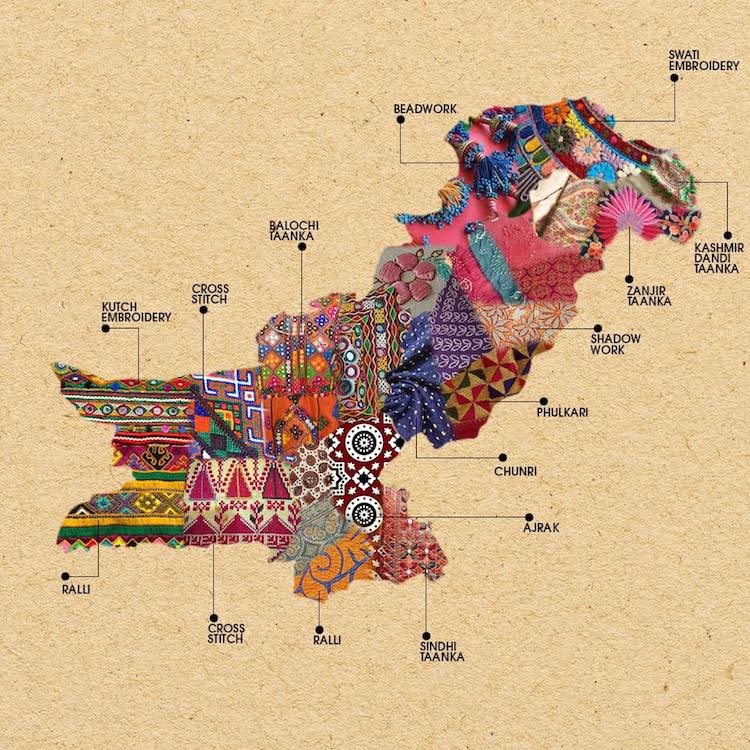
This is very cool, textile maps of the textile arts of various parts of Pakistan, which has a rich heritage when it comes to textile art.

Pakistani clothing company Generation has found a clever way to remind us how much textile art can demonstrate the richness of culture. Their textile map of Pakistan, which uses native embroidery techniques to mark different regions, has become a viral sensation, with more than 20,000 shares on Twitter.

From traditional Swati embroidery to the balochi taanka stitch, the map is a beautifully visual way to explore Pakistan’s cultural heritage. And this isn’t the first textile map to catch our eye. Generations may have been inspired by Craftsvilla, India’s largest online ethnic store, which put out their “fabric tour of India” several months ago. Using a similar concept, the map explores different hand-woven textiles by Indian state.

And if you really want to delve into things, Craftsvilla also breaks out each state and its respective textile, giving a little historical insight across the country. Certainly, both maps are a good reminder of how traditional textiles and textile art help shape culture across different countries.

You can read and see much more at The Met.

Basilisk, Carrying On.

Getting back to work on the basilisk. The white is just gesso. In today’s art assistant tales: Vala takes a break from trying to burrow down the back of my jeans, to get a drink of paint water, then she dunks her whole effing head in the water, then shakes all over. Sorry, I didn’t get pics ’cause the card wasn’t in the camera. Clickety for full size.

© C. Ford, all rights reserved.

Perfectly Preserved: 400 Year Old Sac of Fluke Eggs.

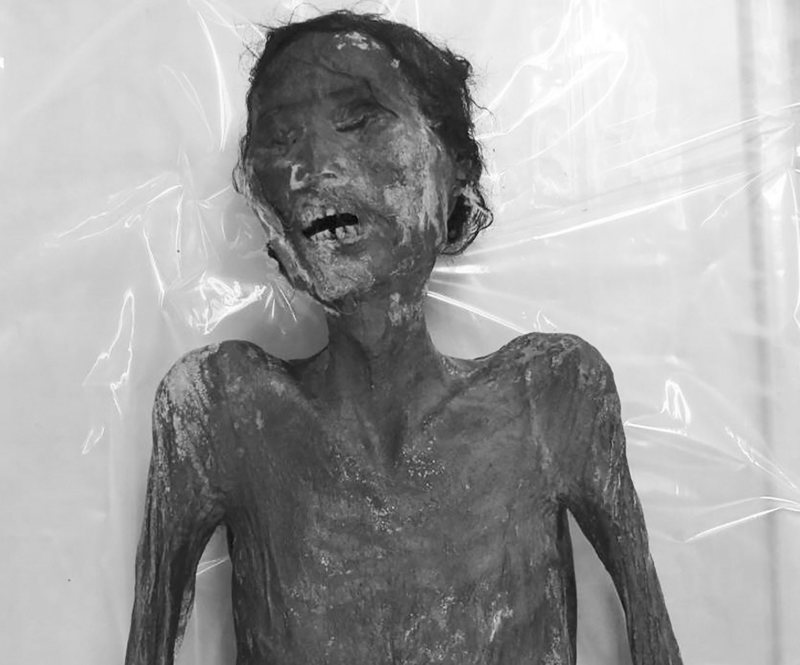
Jing Lee, a 17th-century Korean mummy. D. H. Shin, Y.-S. Kim, D. S. Yoo.

Jing Lee was born in 1580, during Korea’s long-lasting Joseon dynasty, and died in 1642, at the age of 63. At some point in his long life, he ate a raw, freshwater crustacean, in one form or another. Most likely, he was indulging in a fresh, seasonal treat—raw crabs with soy sauces—or was trying to rid himself of disease, with a dose of crayfish juice, thought to help treat the measles. (Joseon food culture was not to be trifled with.) However, as it happened, his crustacean meal left a lasting legacy in his body: a sac of liver fluke eggs growing happily in his liver, as Haaretz reports.

Four hundred years later, as part of a parasitology study of pre-modern Korean societies, a team of scientists found that egg sac mummified on Jing Lee’s liver. They report their findings in a new study in the Journal of Parasitology.

You can read all about this fascinating find at Atlas Obscura.