
Where are fossil fuels most useful? Here’s a hint: it’s one of the dumbest reasons you could possibly think of.
One of the big differences between World War I and WWII is the scope of motorized operations. If you study the strategic application of naval power you’ll realize quickly that when and where ships were able to take the downtime to load coal was one of the big problems in naval strategy. Once you were done coaling, your crew was degraded physically for at least a week, and some men died outright. A ship that was coaling usually had their boiler heat down for safety, and had to scramble to get fighting steam up if a hostile force appeared on the horizon.
After WWI, the winners divided up the imperial prizes, but – now – with an eye toward oil. When Winston Churchill was first lord (head of the admiralty) he and Jacky Fisher pushed hard to switch the fleet to oil power instead of coal. Everything was switching to oil – air forces, navies, motorized armies, tanks, etc. I don’t need to belabor the obvious but can you imagine flying a 4-engined bomber to the Ruhr, shovelling coal frantically into the boilers the whole way? Imagine the black streaks from the smokestacks on the bombers, visible 15 miles away? Or, as if being in a Russian T-34 wasn’t already a bad day, the loader had to double as coal-shoveler before an engagement? Now, think about todays’ militaries – electric F-35s? They’d need hours to recharge and their fighting range would be a standup comedy routine. Electric tanks? Tee hee. Imagine standing by your long-range stealth bomber waiting for the batteries to re-charge while a strike is inbound?
Sorry but “green warfare” is a non-starter and always will be. Fossil fuels smell like victory.
So, if humanity wants to survive the climate crisis, we’re best off getting over wars for the next 150,000 years or so. There, what was simple, wasn’t it? Also, everyone spinning down their military capacity frees up a lot of money (in some places) for renewing the power grid and fully funding fusion research? The US, right now, is in the middle of a “refresh” of its nuclear arsenal – which means buying a new arsenal and scrapping the old one – tada! Look it’s renewed! [The US, being a democracy, does not even consider bothering the people to see if they want to spend their money that way] Anyhow, the world’s greatest experts on nuclear fusion are devoted to producing mostly uncontrolled air-bursts. Obama said it would cost $1tn over the course of a decade but maybe we could save that money for something slightly less stupid?
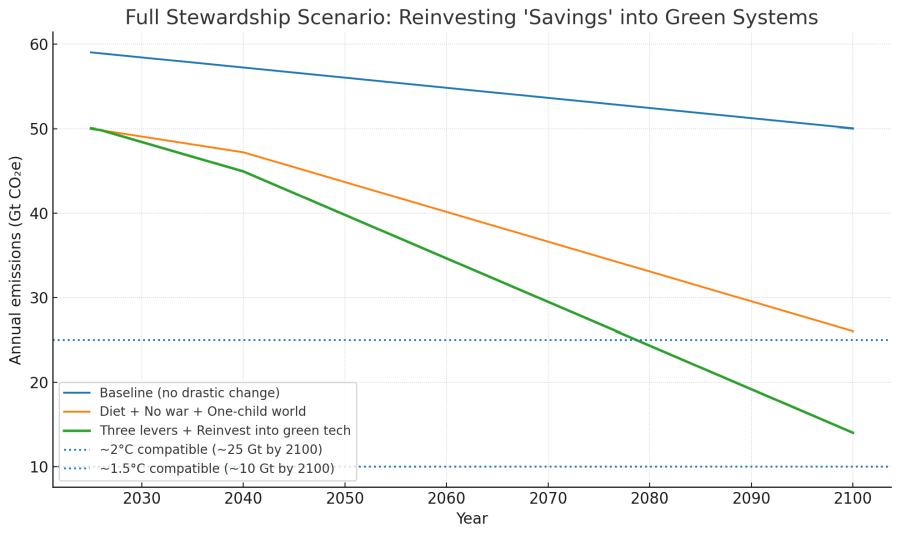
Because this subject interests me and always has [I had an early vasectomy because I didn’t want kids to have to protect during a nuclear war. Ha ha joke’s on me!] I decided to get ChatGPT to help me with some rough models. I sort of expected this, but I asked it if cancelling nuclear weapons might be enough. The know-it-all replied that it might get us 2% of the way there. Uh-oh. What if everyone stood down their militaries? 20%. Around then I started feeling a bit queasy in the pit of my stomach. And, yes, since that evening I have been a “doomer” – sure that humanity is heading toward +3.5C to +4C. I started running a few of my favorite options into the scenario. One of those involved releasing all the pigs and cows and chickens and allowing them for hunting until the populations were gone. That was impressive – chopping a chunk of the agricultural revolution got of 35% of the way there. Cutting out air travel and replacing it with sail boats (Imagine a first class cabin on the Cutty Sark II blasting across the Atlantic to Europe). Basically, it sounded a lot like Badgeria [stderr] I agree – it sounds like the paths to human survival are not powerful means like recycling plastic bags at grocery stores; they are more substantive and involve discarding capitalism and nationalism, along with war, recreational travel, and frequent fancy foods. If I ate pork spare ribs only once a year, I’d be more slender and comely, but I’d probably obssess over them for the 6 months before, and reminisce for the 6 months after.
But, oh yeah, I forgot a big piece of the model. Here’s the problem: most of the CO2 release is per-capita. One obvious “solution” to that is to reduce the population. It’s a “solution” that kicks in slowly but basically solves the problem, except for the climate damage that has already been caused. That damage is going to last for hundreds of thousands of years if humanity keeps on doing humanity stuff, but if we change course dramatically, that’s not strictly required. I have floated this idea before, but briefly: I am not talking about lining people up and shooting them (except for the republican congress and all political donors who have more than 10bn in disposable wealth) I am talking about allowing population to die back less immediately. Just 200 years would do it.
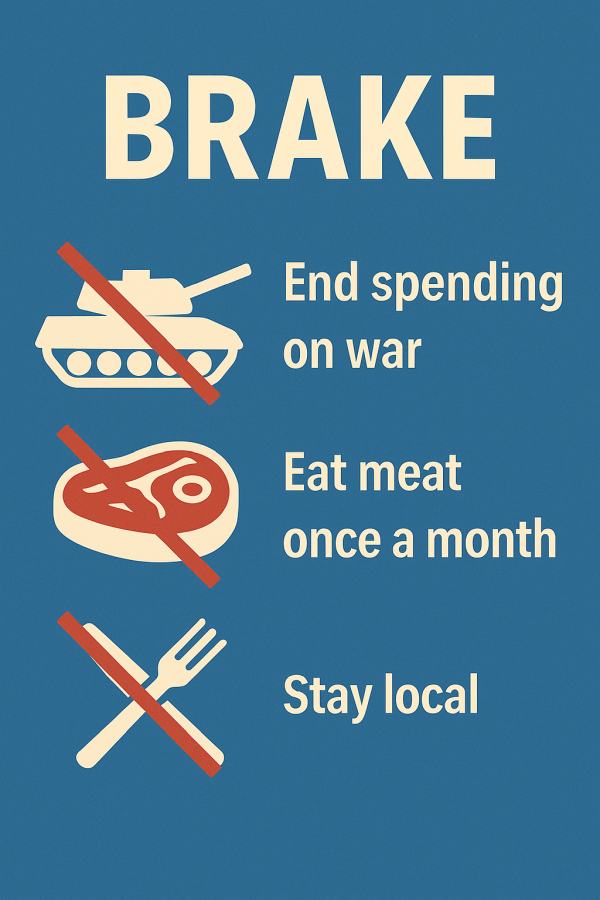
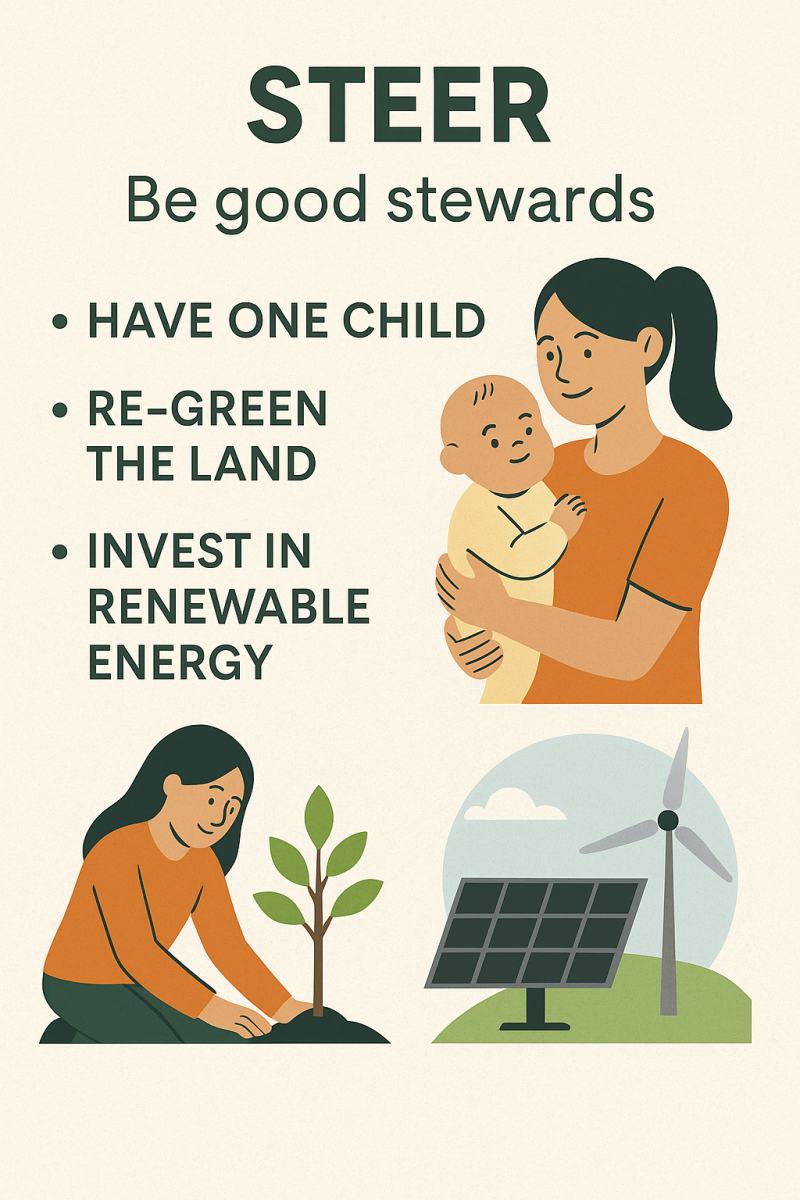
GPT and I came up with a model I called “brake and steer” – the idea is if you’re in a car heading toward a cliff at high speed you’re equally stupid if you depend solely on your brakes or your steering. Humanity has to stop doing dumb things at about the same rate as it has to start doing smart things. Let me note that GPT’s model does not show that we’d get out of the situation we are in, smelling like a rose, but we’d be much less likely to come out a smouldering wreck. Let me be clear, in case I haven’t gotten my point across: on our current trajectory we are highly likely to lose about 6 billion humans of our population of 8-9, and in the process of trying to survive that, we’ll do so much catastrophic damage that the remaining 2-3 billion are going to suffer some mass deaths. In the proceeding paragraph I introduced the idea of allowing humanity to die off gently – the alternative is the fact that 2-3 billion people will not go gently. What everyone has to get into their head is that the writing is already on the wall, we’re arguing about how not if.
There is a philosophical question worth going into: do we owe the unborn a good life? Fuck all the stupid abortion debate, a more raw form of the question is: is life so amazingly great that we should offer as many potential people as possible a chance at an enjoyable life? Is it a sin against human nature to decide to keep the population at 1 billion? I picked that number because it’s absurdly big; according to GPT and my figuring, 50-100 million is still pretty huge. If we’re willing to shovel the unborn and nonexistent out the airlock, we can make the number arbitrary. What if the population is 5 million – 10? Again, it gets ugly: GPT and I went back and forth on the model, and 5 million is kind of a sweet spot. I believe I wrote about this in my piece about Badgeria: if our problems are per capita, we could die back to 5 million, localize the population someplace beautiful and safe (Paris, France, comes to mind), and let the rest of the planet lie fallow for 20,000 years. Meanwhile, think what the hunting would be like! First: build a longship, then sail to North America, then kill and salt some pork, then try to get back alive. There are some other things we probably should do in this situation, such as have the Medical College decide what constituted “extreme measures” versus “normal interventions” and stop spending so much time and money and energy on saving the guys who got bashed up hunting tuna with a spear, etc. If you step back and look at what’s going on, virology gives huge benefits at a low cost, so the civilization could produce flu vaccines, COVID-222, etc. Cancer? Yeah, that helps one person at a time, maybe it’s not worth it. Until the population stabilized, children would be special subjects of affection, and a rarity. Eventually, elders might be.
Eating meat every month might be too much – 4 times a year? Whatever.
Of course none of this is going to happen. Capitalism and nationalism are going to combine to prevent anything from actually working. Nationalists will scream “we must keep our population up!” (for war) and capitalists will want a captive workforce from whom they can skim the best work. Destroying nationalism and capitalism, together, would be the greatest fight mankind ever undertook. Remember: feudalism was killed by plagues and the crusades and religious wars, not anything the peasantry did. Monarchism was killed by the rising middle class – of capitalists – who took over government (let’s say during the reigns of Louis XIV, Napoleon, Louis XVIII) Europe’s brief flirtation with empire was ended by the Europeans’ love of inter-family fighting. Anyhow, all of that has to be thrown overboard.
Humans’ love of having children seems to me to be the part that will never work. This has always perplexed me: people are perfectly willing to go drinking at the local watering-hole, have a bit too much tequila, and create a new life with the person at the other end of the bar. It’s such a reverential, almost holy, process. Add some practical delay into the loop, like a lottery (this would only be needed during the 200 years of die-off) and it wouldn’t be too complicated. What do do with the old people? Not much different from what we do with them now: send them out golfing, elect them to congress, let them do whatever they want except breed.

In my piece on Badgeria I proposed some mechanisms I believe are practical for building civilizations that do not have heritable wealth. It’s my opinion that political and economic terraforming is impossible as long as there is heritable wealth. I’m a socialist anarcho-syndicalist. That’s a nice way of smugly saying “I think I have it figured out but all the gomers on earth are going to fight over it anyway, and they can fuck themselves.”
Nice to have you back! Dream On…..
That whole analysis resonates. I’ve not bothered checking numbers, because the historical forces which govern human civilisation do not include austerity or self discipline, but I’d be happy to stipulate yours. It’s interesting to speculate about a humanity capable of self governance, and would probably make for some excellent alt-fiction, but I’m pretty sure we were fucked the moment we came out of the trees. Oh well, eat, drink and be merry.
On the subject of the importance of oil in modern warfare, I’d be interested in your opinion on the idea that the great war was in no small part precipitated by the construction of the Berlin-Baghdad raillway.
Longer response later, but for now I’m enjoying the irony inherent in talking about how to solve climate change, and including the detail that you used AI to help you refine the numbers.
@3 sonof…
Seconded.
It seems like everyone likes to spin these doomsday scenarios where AI kills all of the humans, but I am not a big proponent of the “Skynet” ending to it all. If it happens, I think it will be more prosaic: AI, along with crypto, could kill us due to their energy/environmental footprint. Another possibility is that we could repeat what happened to the Krell in the 1950s classic “Forbidden Planet” (AKA monsters from the id).
Per capita numbers on pollution are meaningless when you have a few billionaires willing to waste the equivalent of a small nation GDP for a joy ride of a few minutes above the clouds.
Also, while this is only incidental to your main points, the recharging speed is not the main issue for not having electric tanks and other electric equipment. You could have battery packs that can be replaced in a few minutes. Of course, you still need to whole infrastructure for storing and charging the packs but down time during charging is not the main issue.
@5 Jean
Very true regarding recharging. I was thinking about this a few years ago regarding consumer EVs (I’m a retired electrical engineering prof so it’s up my alley). It occurred to me that one possible solution is to standardize battery packs. To wit, no one gets their grill propane tanks refilled anymore. You just go to the store and trade it in towards a new one that’s full. Do the same thing for the EVs. Wouldn’t you know, a few months back I read that BYD, the big EV manufacturer from China, is looking at doing exactly that.
I think that fossil fuels have been the dominant source of power for industrial societies since the nineteenth century simply because they have so much chemical energy packed in them, and it is easy to extract (simple combustion), and they are quite portable. These advantages apply to both military and civilian uses.
If human societies had been wiser we would have started massive investment in improving renewable energy technology and batteries and electric motors 50 years ago instead of waiting until well into the twenty-first century, but that’s what you get when most of the powerful people have an interest in continuing doing things the old way.
jimf.
https://thedriven.io/2025/11/10/new-a22000-ev-takes-88-seconds-to-have-a-fully-charged-battery/amp/
Several Chinese EV makers are going down this path.
You can still plug in to charge normally if you want.
Not about who?
—
Maintain humanity under 500,000,000 in perpetual balance with nature.
That’s from the Georgia Guidestones.
—
Two aircraft nuclear propulsion prototypes rest in the parking lot of the EBR-I facility. The plan was to develop a jet engine powered by the heat produced through nuclear fission to remain in flight for extended periods of time.
@8 Nick
That is an amazing video. It is pretty much what I had envisioned but takes less time than I thought it would. You can’t refill a gas car in a minute and a half. And of course, there is no mention of this in the US news media. It’s just another example of us falling behind while we’re kept ignorant by the moneyed interests of the USA.
I’ve been toying around with some fertility data from the World Bank and so far almost every country in the wold has a falling birth rate. (data 1950–2025)
For a lot of developed countries we are well below replacement value now which is generally considered to be 2.1 child per woman.
For any number of countries, Australia, Canada, France, Germany, Italy, UK, USA among many others , we are well below replacement. If populations in any of these countries are going up—I have not cross-referenced with population data for most of them— it is solely due to immigration.
Have just been looking at the electricity consumption and emissions here in Australia.
All regions of Australia (NEM and SWIS)
Sept 1999
Demand = 8,002 GWh/month
Emissions = 1,000kg/MWh
Sept 2025
Demand = 18,853GWh/month
Emissions = 477kg/MWh
So consumption has doubled while emissions per GWh have halved. I think that we are making slow but steady progress in this area.
Data available here:
https://explore.openelectricity.org.au/energy/au/?range=all&interval=1M&view=discrete-time&group=Detailed
I wish we could do better with inequality, housing affordability, etc. but capitalism…
And according to https://www.abs.gov.au/statistics/people/population/population-clock-pyramid Australia’s population grows by one every 70 seconds with growth driven by net migration. Without immigrants our population would be falling (and the homegrown neonazis would need a different target).
Ian King@#2:
It’s interesting to speculate about a humanity capable of self governance, and would probably make for some excellent alt-fiction, but I’m pretty sure we were fucked the moment we came out of the trees. Oh well, eat, drink and be merry.
It’s certainly a fun point for speculation. I used to imagine a life-form where the key to their aggression behavior was a small evolutionary pathway that could actually be turned off from a mutation. Is it possible to imagine advanced technological species that are nice? I remember back in the 80s there were some “futurists” (sounds better than “sci fi writers”) going around saying that any planet-dominating species with advanced technology would have learned the value of peaceful cooperation. Basically, the “United Federation of Planets” was inevitable. Tempting as “fucked the moment we came out of the trees” is, to an old cynic like me, I think low-tech civilizations still have a lot of plasticity until they start forming organizational models that embed themselves and reinforce themselves. We’re stuck with religion, nationalism, and capitalism. At various times organizational models can co-exist and reinforce each other, i.e.: capitalism and nationalism both can serve to make the other look more legitimate than it is. But look now at the responses – there’s already a knee-jerk anti-globalism meme in the right wing and I can’t imagine where it came from. I’m going to say that any effective response to the climate crisis would require re-structuring nationalism and capitalism worldwide. There are too many sociopaths in line to try to keep that from happening, since it would represent a diminuation of their personal privilege. I’ll bet a dollar that there isn’t a politician who has been in the field for more than 10 years, who wouldn’t immediately start trying to figure out all situations so “keeping hold of my constituents” was high on the priorities list. This situation happened because of power, and its portable form: wealth.
sonofrojblake@#3:
including the detail that you used AI to help you refine the numbers
There’s a lot going on around AI (duh!) but human patterns in doing computing have always been horrible. I pointed out in a talk I did at my first USENIX that making code more efficient pays off cumulative benefits over time (this was back in the UNIX versus DOS days, when DOS still did spinlocks on the CD device drivers) Yes, I was one of the old grognards arguing against 3D looking bit-mapped windows. Two things are going to happen with AI: 1) the useless frip-a-licious AI embeddings will eventually go away or become useful – but there will be less of them and they will be more targeted 2) the giant AI roll-outs will become smaller and more efficient in all ways (memory, electricity, drive performance…) and it will proportionately cost less than whatever stupid thing the programmers of the future decide needs to be added into a browser.
AI checkpointing will eventually become a creative field of its own and there will be very, very, fast ways of getting them to/from various speeds of memory. There will be various algorithmic improvements in doing the checkpoint-walks. (There are great ones, but they require the data not to change) Anyhow, they will get more efficient. Unfortunately, the way humans work, they’ll keep making them bigger and bigger until finally someone has one bigger than all the others.
It gets more complicated because AI uses a lot of “cloud computing” which trades scale for wasteage. You can make cloud storage as useful as local storage if you have smart expensive software that gobbles network bandwidth like ${something}. So the AIs are being run on machines that are easier to duplicate and manage, but less efficient because of layers of virtualization. That’s not the AIs’ fault – that’s sloppy developers.
I’m not saying inefficiency is OK – it’s inevitable. I’m not saying spending energy on stupid AI-amplified browsers is OK – it’s inevitable. We’ve got a bad habit of making out problems structurally worse before we take them seriously. AI’s just another example of that glorious paradigm.
Nick Wrathall@#12:
So consumption has doubled while emissions per GWh have halved.
That seems to be a paradigmatic exchange. Back in the 70s when the Club of Rome guys were talking about everyone starving (before Norman Borlaug pulled a mouse of of his hat) it seemed that whenever we improved agriculture, we didn’t get the end of starvation – we just got more people hanging on the edge of starvation.
I’m hoping a chunk of that increased consumption is a result of shifting to renewable-based power for things that used to be fossil fuel-based or powered by internal combustion.
Marcus. I share your well-placed pessimism. The fact that consumption has doubled while emissions per unit have halved shows that we are emitting the same volume of co2 from electricity generation that we were 25 years ago. While there is a shift away from gas for cooking and heating (in fact reticulated gas supply to new homes is now illegal in Victoria), this is but a small component.
People just seem to be using more energy. In a recent conversation with a colleague we compared our electricity bills. We both have grid tied solar PV, he lives alone while mine is a home for two, yet his power usage is twice mine. When he asked me why my power bill was so much less than his I replied with “why the fuck is your so high?” He had no idea. He certainly didn’t appear to equate his ignorance of his own enegy use as a clue to the problem, but he was happy to complain about how much his quarterly electricity costs are.
Meanwhile emissions from transportation are well up over the past 20 years due to the ever increasing numbers and size of motor vehicles on our roads.
And we have to consider the rise of skynet. Data centres are popping up all over. We rent one cabinet in our local data centre which we use for hosting virtualised MS terminal servers for those of our customers whose tools need to be running on a local server. Our cabinet is about 60% populated. Every couple of weeks the data centre operators send my boss an adjustment to his rental because we are consistently drawing more power than we have been provisioned in our lease.
So yeah, while we are stepping up with the renewables roll-out here in Australia, we still have a long way to go. The people are the problem. Not the number of people as such, more the attitude.
Oh yeah, one more thing. Oz has an enormous rooftop solar fleet. So much so that wholesale electricity prices on many days are negative. If we are serious about reducing emissions we should be rolling out free EV chargers everywhere. Not high-speed chargers, just 2kW will do. Then let people plug in for the day while at work. 8 hours at 2kw provides 70 – 100km of driving range depending on EV model and driving habits. As most people commute less than 20km to work (mine is 5km each way – I drive a company EV that I charge at work where we have a large PV system on the roof), they need only do this a couple of days a week.
https://www.facebook.com/share/v/1D2ysQwkCA/
Worth your time.
Ian King@#2:
On the subject of the importance of oil in modern warfare, I’d be interested in your opinion on the idea that the great war was in no small part precipitated by the construction of the Berlin-Baghdad raillway.
There are many many many theories why the great war started. I’m pretty strongly, I suppose, in the camp of David S. Landes, (ref: “The Unbound Prometheus”) whose belief is that economic growth and imperialism during the industrial revolution triggered a pumped-up arms-race which collided with the great imperialist powers nasty web of secret diplomacy that balanced the whole global system on a bunch of nitwits who had been raised in “The Great Game” and were dead set on taking their turn. Post-war Landes would also come down strongly on the view that the Treaty of Versailles left too much undecided when there were Prussians around.
I am also sure that Landes would say “yeah, sure” regarding the many disruptions that were affecting the arms race, because they helped fuel it.
In those many secret rooms where negotiations happened and plans were made, parting-out “the Sick Man of Europe” – the Ottoman Empire – was end-game division of spoils, but anything that brought the Turkish and Middle Eastern economy closer to European status was an inherent threat or reward. Most of us cynics are aware that the British and French were making plans for dividing up the Ottomans basically every time they were left alone in the dark. There was also a lot of parceling out who got to deal with the Japanese, who were opening their purse to buy a very expensive navy, and had just thrashed Russia’s very expensive navy – so thoroughly so that Americans were asking if Japanese people might actually be white. (We were their oil dealer, which made their expensive navy contingent on our pleasure, oops.)
The industrial revolution triggered a scramble among the imperial powers for control of resources, as it represented a massive way of turning resources into pure and simple power. The question of who got to control that power was what the great war was supposed to answer, and didn’t.
Nick Wrathall@#16:
I share your well-placed pessimism. The fact that consumption has doubled while emissions per unit have halved shows that we are emitting the same volume of co2 from electricity generation that we were 25 years ago. While there is a shift away from gas for cooking and heating (in fact reticulated gas supply to new homes is now illegal in Victoria), this is but a small component.
I have not done this experiment and will not because the very idea makes me have nightmares. So, I read a thing about that if you take a couple cockroaches and drop them in a mason jar without food or water, they’ll die, but the survivors will eat the dead and if they have the right equipment they’ll produce another generation of roaches that are just smaller. That’s where the story breaks down, because surely some mad scientist would have achieved subatomic cockroaches and unnecessarily irradiated them before releasing them on an airplane.
Joking aside, I think we are touching on a fundamental tenet of conservatism: the idea that poor people will expand to fill any opportunity. What if we give 100 poor people $10mn each? There’s a contradiction there because they’re no longer “poor people” they are “well-off people” and would spend all their money on cocaine and Pommery to wash down their caviar, whereas conservatives imagine that they would multiply their number 100-fold. So instead of 100 poor people you’d have 1000 banging on the windows of the rich people’s houses demanding their share of the caviar. I will say for the record that there have been times I have tried to understand “conservatism” and it’s generally perplexing – financial authoritarianism, which is level 1 economics.
Reginald Selkirk@#9:
Not about who?
I have started replies to this about 4 times. None of them work. Flip is inappropriate, serious is grim, etc.
I think the writing is on the wall because the wealthy (people, nations, etc) will use their wealth to prolong their comfortable survival and more or less dispassionately let everyone else die. Of course, the cost of comfortable survival will skyrocket and there will be complaints. Then, the rich will watch the less-rich complain that they can’t get into and out of Beaver Creek resort in the winter anymore, and they’ll smile and tell themselves they did well to buy a private resort while they were still affordable. Etc. Captain Kirk died, and Adrian Veidt lost his mind. Superman is working for Chippendales, now. I think Jerry Cornelius is running for Labor.
That’s a less horrific version than the real one. The real one involves exactly what we are doing now: sitting by and worrying about our cryptocoin investments and whether we can get good cocaine anymore (the answer is “no”) etc. etc. Meanwhile, sometime in the next decade there will be a heatwave and a flood. They will hit together. They will hit Calcutta or Mumbai. Millions of people will die. There will be some pro-forma hand-waving that sounds like, “gee, someone ought to do something about this!?” shot down with “we already had to cut the budget for ten commandments posters, we are tapped out saith the lord.” Because the disaster is massive but local, in a place where people are poor, the wealthy world will try very hard to forget about it, while it turns into something that makes a zombie horror movie look like high class entertainment. Who chose them to die? The weather did, of course. It’s climate change. The weather is bad in Calcutta, it’s not bad in Beaver Creek.
So, I read a thing about that if you take a couple capitalist cockroaches and drop them in a mason jar without food or water, they’ll die, but the survivors will eat the dead and if they have the right equipment they’ll produce another generation of roaches that are just smaller. As the general collapse kicks in, influencers will become smaller and smaller and less influential until somebody’s dog eats them in a moment of curiousity. By the way, if you put socialist cockroaches in the exact same mason jar situation, the same thing will happen.
The decision about who is going to die first has already been made. In the US it was made in the 20s. It was probably made in the 20s and 30s in most of the world. The industrial revolution turned out to be a narrow revolution, led for the well-being of a new ruling class which wanted to get out from under slobbering inherited monarchs and their pinheaded offspring. That plan is not working great in England but it’ll get there eventually.
I used to believe that a great threat to humanity would bring out our best and brightest but, nope, it’s gonna bring out our fastest and loosest and most ruthless. You could contextualize what is happening in the USA as a dry run for what will happen independently and individually as each nation separately stands to confront this disaster we could only meet together.