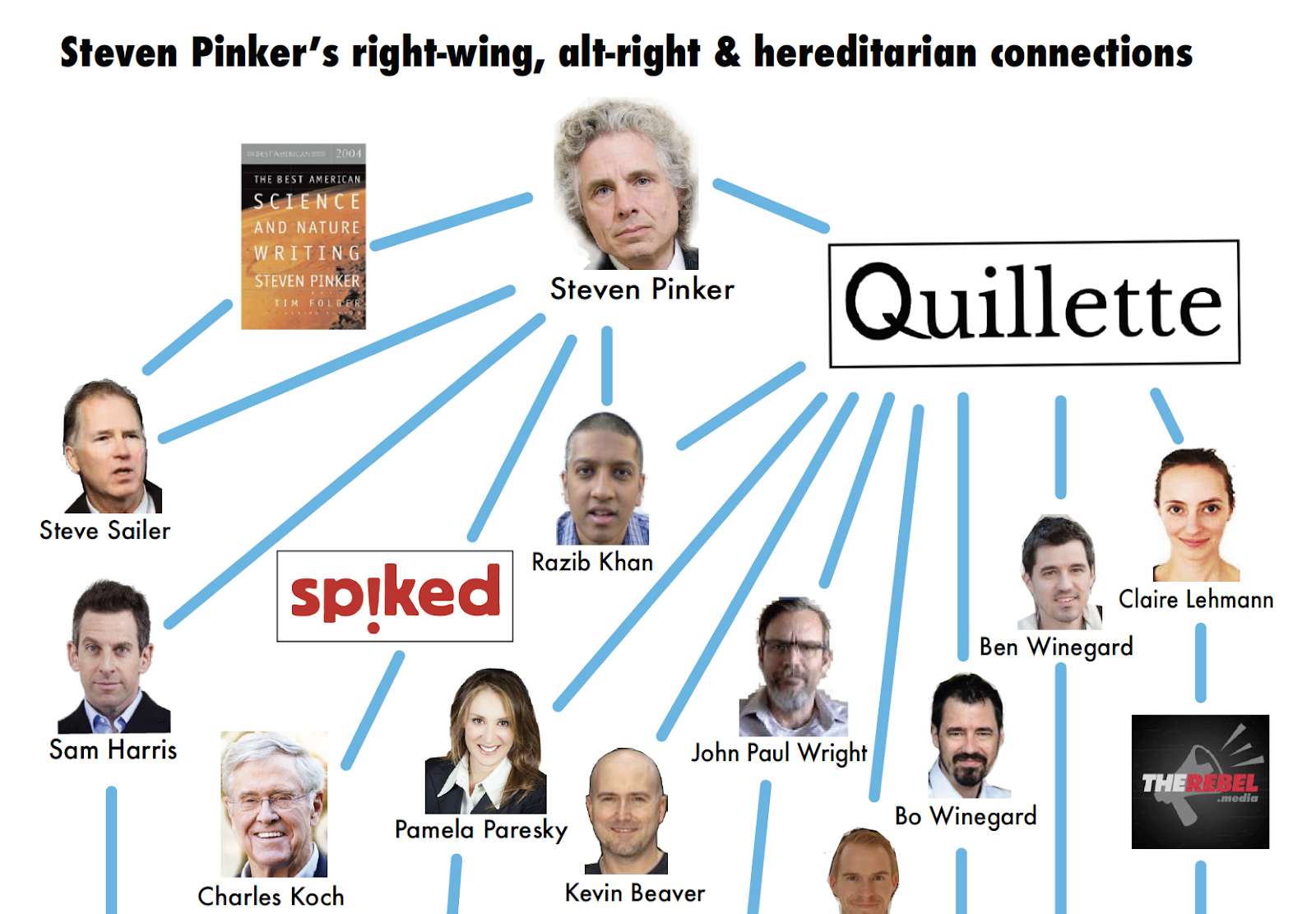
Lawrence Krauss stands exposed as a gullible fool, and it’s sad to see. He’s reduced to publishing in Quillette, of all places, and his claim is that “Racism Is Real. But Science Isn’t the Problem”. He has always had this simplistic view of science as a pure ideal that isn’t touched by, you know, humanity. He’s now irritated that, in the wake of George Floyd’s murder, people are turning their eyes towards racism in all kinds of social institutions, and have even dared to demand that the American Physical Society address the failings of physics (I imagine poor Larry stuttering in outrage that I would even write that physics as a discipline has failings). His precious physics doesn’t have a problem!
It sounds laudable. But as argued below, mantras about systemic racism are hard to square with the principles and necessary protocols of academic science. And in any case, overhauling university hiring and promotion aren’t the way to address the fundamental underlying causes of racism in our society. The APS and other scientific organizations have adopted dramatic anti-racist posturing in sudden response to George Floyd’s homicide and the protests that followed. But in so doing, they risk unwittingly demeaning science and scientists, as well as trivializing the broader and more vicious impacts of real racism in our society.
Science has principles! And protocols! Nope, no racism here. The implementation of those principles and protocols is flawless. Nope, no racists in physics (or any other scientific discipline, like biology), and if there were, they certainly wouldn’t be rewarded with the highest honors, like the Nobel prize, for their work. No way. You see, we just apply the Scientific Method, and presto, racism is gone.
Krauss is not alone, but he is certainly relatively rare in that kind of naïve scientific idealism. Most of us are totally aware that science is a human enterprise, constructed and maintained by flawed people, and that we are part of the social structure of the world. Sublime abstractions might be appealing, but they have little to do with the dirty jobs of funding and hiring and interacting with people, all things that Krauss had to have experienced, and must realize have little to do with formulas and recipes and computer programs.
Really, he has this delusional idea that because Scientists do Science, they can’t possibly be racist or sexist. Just possessing the tools of science makes you immune!
Science is furthered by the development of theories that better explain nature, that make correct predictions about the world, and that may help develop new technologies. A scientific theory that can be supported by rigorous empirical observation, theoretical analysis, and experimental results; and which withstands scrutiny and critique from peers; will be adopted by the scientific community, independent of such theories’ origins. If the system is functioning properly, the people who develop these ideas and experiments rise in prominence. The nature of the scientific process requires it to be color-blind, gender-blind, and religion-blind.
This means that science can unite humanity in a way that’s unmatched by any other intellectual endeavor—for it transcends cultures, languages, and geography. Physicists in China and the United States may have vastly different political views and experiences. But at a physics conference, they interact as colleagues.
Somebody should have a word with that Albert Einstein fellow.
The Chinese, Einstein wrote, were “industrious” but also “filthy.” He described them as a “peculiar, herd-like nation often more like automatons than people.” Even though he only spent a few days in China, Einstein felt confident enough to cast judgment on the entire country and its inhabitants, at least in his private journal.
“It would be a pity if these Chinese supplant all other races,” Einstein wrote. “For the likes of us the mere thought is unspeakably dreary.”
The problem is that science isn’t a cure-all. Often it can be used as a tool for rationalizing one’s biases, and one of the great dangers is when some people, like Lawrence Krauss, get it in their head that being a scientist lofts one above the petty problems of the mob. This is not the first time Krauss has made these ridiculous assertions.
Some scientists, especially vociferously atheist scientists like Krauss, pride themselves in their ability to rise above certain biases, in their work and in social systems at large. They believe that science, as a concept, will safeguard against them.“Science itself overcomes misogyny and prejudice and bias. It’s built-in,” Krauss said last year during a promotional event for one of his books.
It’s outrageous to claim scientists, hard as they might try, are immune to biases. In fact, scientists’ fierce belief that they are exempt from such pitfalls risks blinding them to the possibility that there may be a chance, however small, that they’re not. In the wake of the allegations, Krauss acknowledged that his demeanor may have “made people feel intimidated, uncomfortable, or unwelcome,” and recognized that “the current movement makes clear that my sensitivity, like many others’, can be improved.”
Krauss is also good at kicking the blame to someone else. Physics in higher ed is pure and unsullied, therefore any underrepresentation of black physicists must be the fault of the leaky pipeline.
During the academic strike called for by the APS, it was emphasized that the proportion of black physicists in national laboratories such as the Fermi National Laboratory in Illinois (where one #strike4blacklives organizer works) is much smaller than the percentage of blacks in the population at large. It was implied that systematic racism in the profession was responsible for this, although no explicit data supporting this claim was presented.
In fact, there is a simpler explanation. There are fewer tenured black physicists at universities and laboratories because there are fewer black PhD physicists. There are fewer black PhD physicists because there are fewer black physics graduate students. There are fewer black graduate students because there are fewer black undergraduates who major in physics. This latter fact is a cause for concern. But the root cause lies in inequities that arise far earlier in the education process. These cannot be addressed by affirmative action policies at the upper levels of practicing professional scientists.
He doesn’t cite any explicit data supporting his claim, either. Because he didn’t look, however, doesn’t mean the data negating his assertion isn’t there; the sociology of science gets studied out the wazoo, it’s just that some scientists let their biases dictate what they see. Here’s one example.
Women and men of color represent growing populations of the undergraduate and graduate student populations nationwide; however, in many cases, this growth has not translated to greater faculty representation. Despite student demands, stated commitments to diversity, and investments from national organizations and federal agencies, the demographic characteristics of the professoriate look remarkably similar to the faculty of 50 years ago. Many strategies to increase faculty diversity focus on increasing representation in graduate education, skill development, and preparation for entry into faculty careers. While these needs and strategies are important to acknowledge, this chapter primarily addresses how institutions promote and hinder advances in faculty diversity. Specifically, extant literature is organized into a conceptual framework (the Institutional Model for Faculty Diversity) detailing how institutional structures, policies, and interactions with faculty colleagues and students shape access, recruitment, and retention in the professoriate, focusing on the experiences of women and men of color. A failure to address these challenges has negative implications for teaching, learning, and knowledge generation; consequently, this review also presents research documenting how women and men of color uniquely contribute to the mission and goals of US higher education.
If it were just a leaky pipeline, then increases in recruitment at lower educational levels ought to translate into increasing proportions of minority employment at the topmost levels. It doesn’t. It’s almost as if there is some invisible force suppressing minority participation at the level of practicing professional scientists…I wonder what it could be? Some kind of invisible dark energy? I wonder what we should call it?
Of course, this is Larry Krauss, whose powers of discernment are remarkably limited…while at the same time, he argues that the powers of science are so great that he’d be able to see such a limiting factor. He’s notorious as the persistent defender of Jeffrey Epstein — man, that position hasn’t aged well — who claimed that Science would enable him to instantly detect pedophiles.
“If anything, the unfortunate period he suffered has caused him to really think about what he wants to do with his money and his time, and support knowledge,” says Krauss. “Jeffrey has surrounded himself with beautiful women and young women but they’re not as young as the ones that were claimed. As a scientist I always judge things on empirical evidence and he always has women ages 19 to 23 around him, but I’ve never seen anything else, so as a scientist, my presumption is that whatever the problems were I would believe him over other people.” Though colleagues have criticized him over his relationship with Epstein, Krauss insists, “I don’t feel tarnished in any way by my relationship with Jeffrey; I feel raised by it.”
Apparently, his racism-detection sense is just as finely honed and acute as his underage-girl sense. It was that sense of what is right and proper and just that seems to have gotten him fired from a prestigious position, after all. It has now led him to write an essay denying racism in Quillette.
I wonder if he now feels raised by his association with Quillette? He doesn’t have a very good track record in his friendships.