It seems to be one English-speaking* place that still has some sense.
*More or less, but that’s OK, because Scottish accents are a marvel.

It seems to be one English-speaking* place that still has some sense.
*More or less, but that’s OK, because Scottish accents are a marvel.

I thought the rough clip I mentioned earlier was horrifying, but take a look at the official Showtime promo for Sacha Baron Cohen’s show.

Some excerpts from Sacha Baron Cohen’s next show are leaking out. watch this bit if you want to see the gun lobby willingly exposing their delusional ideas about putting guns into the hands of kids.
The intensive 3 week Kinder Guardian course introduces specially selected children from 12 to 4 years old to pistols, rifles, semi-automatics, and rudimentary knowledge of mortars. In less than a month — less than a month! — a first grader can become a first grenadier.
Ha ha, Joe Walsh, very clever. Of course he has an excuse.
Like accused sexual predator Roy Moore, who threatened to sue Baron Cohen this week, Walsh was invited to receive an award in Washington, D.C., for being a friend to Israel and while he was there sat for an interview in which a documentary crew asked him to endorse various Israeli innovations—including the idea of arming four-year-olds to defend themselves against terrorists.
His excuse is that if Israel thought it was a good idea, then arming pre-school kids must be a good idea. He now says that he was duped, and that he said some really stupid things, but it hasn’t yet sunk in that maybe he should question his own beliefs that make it easy for him to be duped and say stupid things.

I know I’m not. I’ve disliked the posturing phony from day one, so it just confirms my suspicions to learn Musk has been a major Republican donor — he just keeps quiet about it.
Tesla and SpaceX CEO Elon Musk has been revealed as a top donor to a Republican PAC aimed at keeping control of Congress. Filings published by ProPublica this weekend show Musk contributed $38,900 to the Protect the House PAC, joining the likes of casino magnate Sheldon Adelson and Houston Texans owner Robert McNair in the PAC’s top 50 donors. The PAC raised more than $8 million in the second quarter for Republican lawmakers hoping to fend off Democratic challengers. Musk has a history of donating to both parties, but contributions to the Republican Party raised eyebrows on Twitter, where many questioned how the “socially liberal” billionaire vowing to fight climate change could support the GOP’s platform.
I’m going to guess that Jon Rosenberg wasn’t fooled, either.
I’m also going to guess that people will pop into the comments to defend him by saying that the wealthy tend to donate to both parties all the time. I will ask…why? Doesn’t that tell you the system is broken already? It should also tell you that both parties tend to favor the rich, so the rich are happy to keep the wheels churning — they know that no matter who wins, the bankers and trust-fund babies and Wall Street will prosper, no matter how much the economy is wrecked otherwise.

I watched scattered bits of the Strzok grilling yesterday (if you weren’t paying attention, Wonkette has the most interesting interpretation/”transcript” of the day). The one thing that struck me was how all the Republicans were hammering on one point: Strzok had his own opinions of Trump, and that his presence in any investigation means they were biased and unfair. It reminded of how the media goes flocking to “undecided voters” in every election, as if ignorance and vacillation and equivocation are some kind of ideal state of mind. As Strzok pointed out over and over, what matters is how he acts; does he act objectively, does he work with others who have different biases to reach a consensus? You are not going to find any intelligent person whose mind is devoid of opinions.
But there the Republicans sat, insisting that everyone who participates in any difficult analysis is not allowed to have any kind of independent perspective. There seems to be a total lack of understanding that everyone has biases, including goddamned Republicans, and that we have mechanisms to try and overcome them. But no, they want mindless lackeys doing all the work for them (which does, I admit, tend to give Republicans an edge in working for the government).
What we really have to worry about, though, is more mind-reading dentists running for congress.
Wow, they saved the stupidest part of the hearing for last. "I'm a dentist, Okay. So I read body language very, very well." https://t.co/puFFJFVdzn pic.twitter.com/ZmbzSzju8U
— Josh Marshall (@joshtpm) July 12, 2018
I had no idea dental schools were a predecessor to the Psi Corps.

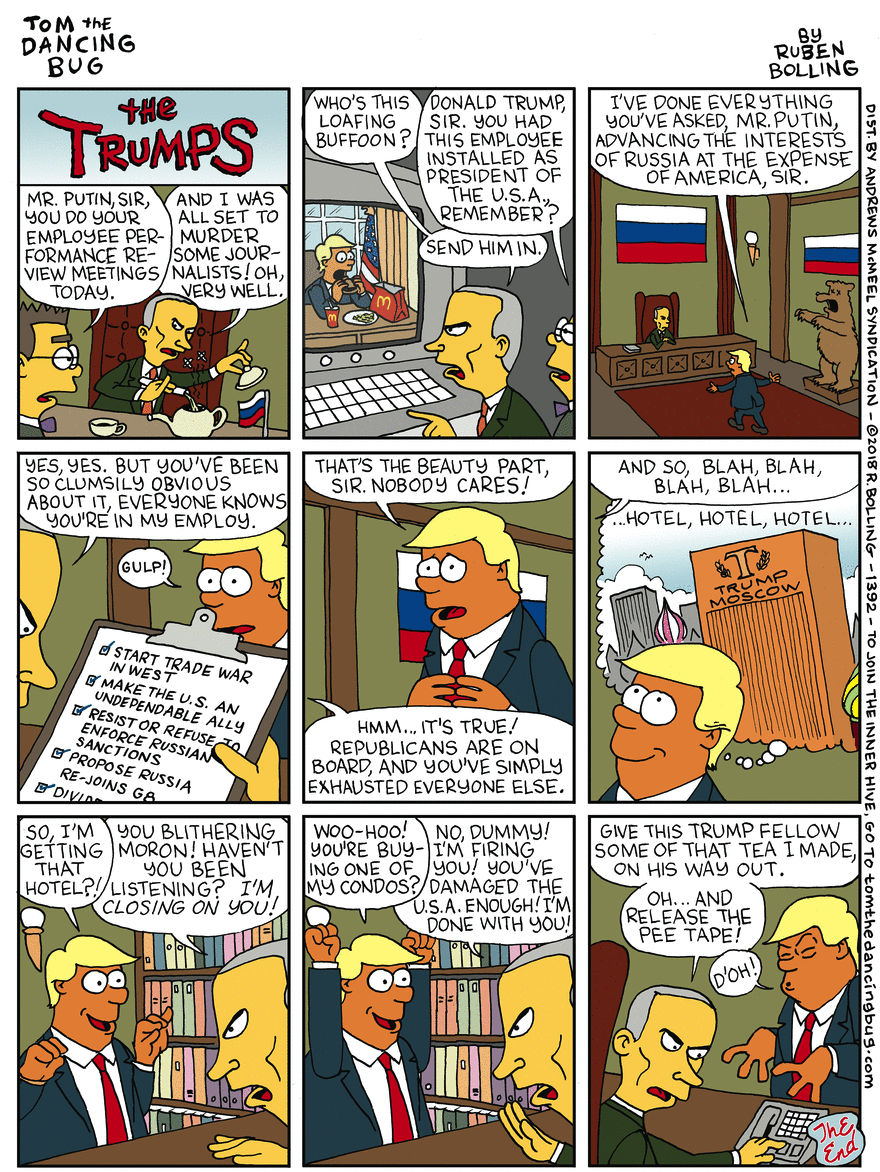
Trump is currently in the process of thrashing around, wrecking NATO, but next he’s going to be summoned to stand before his master, and I suspect it’ll go a bit like this.
He doesn’t have to worry for long, though — shortly after that he’ll be back in the embrace of his Republican enablers/incompetents/traitors, and all will be well for him again.
In other words, the status quo will be reset at the beginning of next week’s episode.

Down in Texas, they’re digging up mass graves of immigrants.
LORI BAKER: They’re unmarked, they’re unidentifiable, and there’s no information on these individuals. We anticipate at least several hundred may still be buried within the cemetery.
JOHN CARLOS FREY: As I investigate why so many lost migrants are dying in Brooks County, I hear about forensic teams from Baylor and Indianapolis universities, who have spent the past two years exhuming migrant bodies.
KRISTA LATHAM: I just feel like everybody deserves to be mourned properly. They still have parents or siblings or spouses or children that are wondering what happened to them. So we’re doing this for the families.
JOHN CARLOS FREY: For years, the previous sheriff would give the bodies to a funeral home, that charged taxpayers over a thousand dollars per body, then buried them, anonymously, in a corner of this cemetery.
Can you describe what kinds of bags the individuals were buried in?
LORI BAKER: They’re biohazard bags, trash bags. One was—
JOHN CARLOS FREY: Just regular trash bags?
LORI BAKER: Trash bags. What we found last year, there were coffins that were right next to each other on all four sides, because there were so many people buried in that area. We took one of them down, and we found skulls in between the burials. And so, we just can’t leave any dirt unturned, or we might miss somebody.
JOHN CARLOS FREY: Wait, you have coffin, coffin, coffin, and then, in between coffins, you have skulls.
LORI BAKER: Skull, sometimes.
JOHN CARLOS FREY: These are mass graves.
LORI BAKER: These are mass graves. They’re commingled. Every one is different.
JOHN CARLOS FREY: So you shouldn’t just dump a bag into a hole in the ground.
LORI BAKER: You know, would you want your son buried that way? Or your mom? Or your sister? Or your brother? I mean, this isn’t how you want someone you love to be buried.
We’re supposed to be reassured, though.
Texas says there is “no evidence” of wrongdoing after mass graves filled with bodies of immigrants were found miles inland from the U.S.-Mexico border.
Hang on. You’ve got hundreds of unidentified bodies in a mass grave in a single town, with people buried in garbage bags, and yet somehow they don’t think this is indicative of any wrongdoing.
People dying in such numbers at the border that they’ve resorted to mass graves is telling us there is something seriously wrong.

I’ve been seeing examples of those old bills of mortality going around — the lists of causes of death, week by week, in 17th century London. I thought you should know you can go straight to the source and find all the death statistics you could dream of. It’s shocking how often infectious disease is slaughtering people — plague, fever, tiffick (tuberculosis), cholera, spotted fever, smallpox, the French pox, etc. — and you wouldn’t want to be an infant, they were dropping like flies.

What’s interesting, too, is what isn’t killing them. Cancer is rare. You can find an occasional murder (or rather, “murther”), but it isn’t common. Gun deaths are noted with details (“Shot with a pistol at Saviours Southwark”) and are less frequent than executions. Everything else was killing them first. Apparently, if you really hated someone back then, it was a greater revenge to sit back and wait for them to die a miserable death from worms or a bloody flux.
There are definitely some advantages to living in the 21st century.

I really don’t understand the logic of Trump’s trade war. Throwing up trade barriers might be a great idea if you’re trying to build up an internal industry in a relatively undeveloped economy, but the US has a mature economy. I could sort of see it if we were looking at how our homegrown semiconductor manufactory had declined and moved to Asia, and we wanted to build it back up, but that’s not what we’re doing: Trump seems to think we need to grow our coal and oil industry. Is our future tied to work that doesn’t require much education or deep, complicated infrastructure? It’s looking backwards.
But I’m not an economist. Feel free to explain the logic here, if there is any.

Also, now that the Chinese trade retaliation has kicked in, it seems to be having all kinds of unexpected side effects…like on the geoducks. The Washington state geoduck harvest is in trouble!
The People’s Republic of China announced last month a 25 percent tariff on American seafood products, including geoduck, in response to tariffs instituted by The Office of the U.S. Trade Representative. China’s announcement that the tariffs would take effect July 6 came shortly after a May 30 auction by DNR, which awarded eight companies the rights to harvest wild geoduck from tracts in Puget Sound between July 3 and Sept. 28, 2018.
DNR auctions the right to harvest geoduck from state-owned aquatic lands four times a year, generating more than $21 million annually. That money is used to restore and enhance Washington’s aquatic lands. The May 30 auction generated $5,491,256.
To minimize the impacts from the tariffs on Washington’s geoduck industry, DNR notified successful bidders on June 26 they may be entitled to refunds if the tariffs hurt geoduck sales.
This is a big business, and it’s focused largely on Asian markets.
According to the National Marine Fisheries Service, the U.S. Customs counted over five million kilograms of geoduck leaving Washington last year, for a total of $75.8 million in geoduck exports. Of that amount, $69.5 million were made in shipments to China and Vietnam alone. Increasing demand has encouraged shellfish farmers to pressure the state to expand access to geoduck beds.
Meat from a geoduck is considered a delicacy in China and it can be sold for around $100 per pound in foreign markets. Stateside, companies bid hundreds of thousands of dollars to gain access to plots of land for harvesting.
On the bright side, this ought to have some positive environmental benefits — less commercial mollusc murder. But our current administration doesn’t exactly have a reputation for caring about the environment. It does have a reputation of supporting business interests uber alles, but this kind of decision actively harms capitalist exploitation. Somebody explain this to me, because it all sounds stupid and backwards and destructive of any principles this Republican fascism might have.
Maybe the simplest explanation is that they don’t have any principles.

I wonder if he thinks that is a way to avoid prosecution for corruption?