
This is Prinerigone vagans.
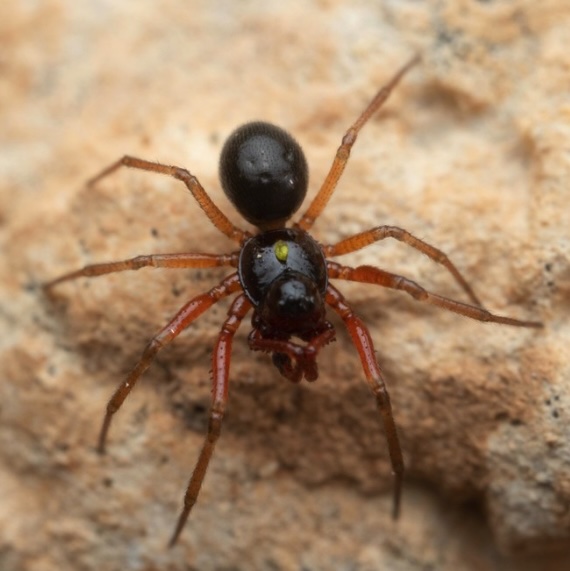
I’ve never seen one — that’s a European species. I have seen other Linyphiidae in my neighborhood. They’re quite small sheet web weavers.
Now this one I have seen frequently around here: Tegenaria domestica, the barn funnel weaver.
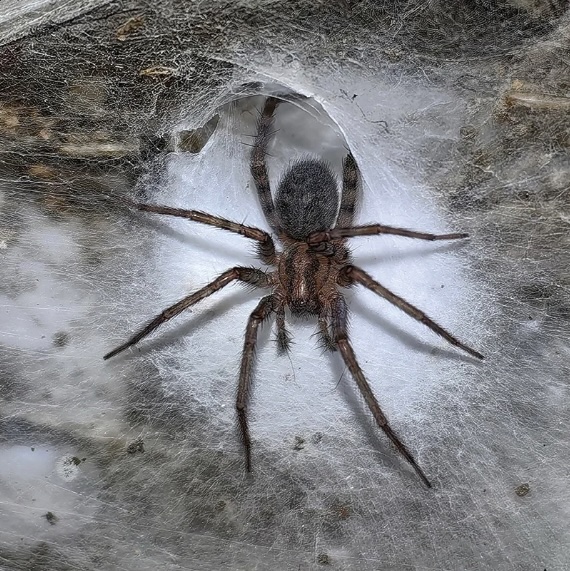
They’re one of the bigger spiders around here. They’re funnel web weavers, and they like dark corners of your garage or basement, where they build dense sheet webs with a characteristic funnel, where they live. I’ve been startled by these guys — if you poke around and disturb them they will leap out to run away. They’re very fast.
If you combine 69,000 Tegenaria and 42,000 Prinerigone, with a rich food source, this is what you get, the world’s largest known colonial spider web, found in a cave on the Albania/Greece border.
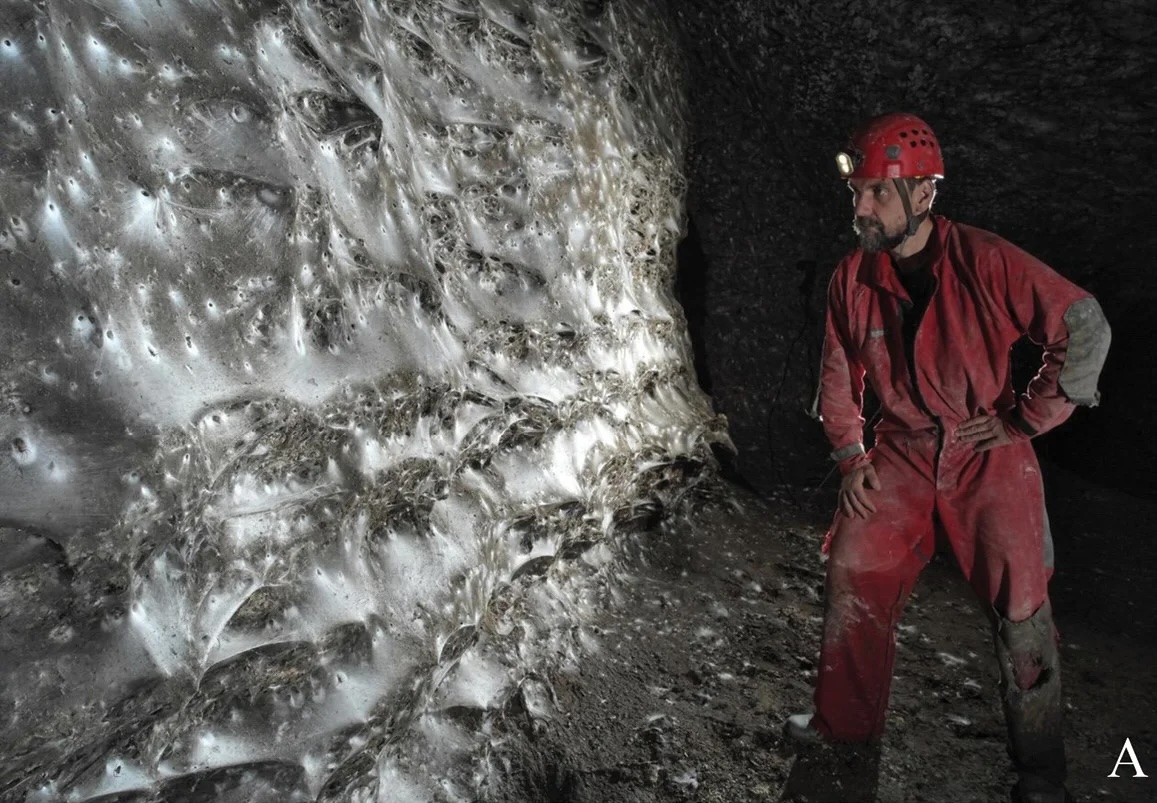
(human added to provide scale)
You can read all about it in a paper, An extraordinary colonial spider community in Sulfur Cave (Albania/Greece) sustained by chemoautotrophy, in a journal named Subterranean Biology, or in a more general article in Scientific American.
We report the discovery and detailed analysis of an extraordinary colonial spider assemblage in Sulfur Cave, a chemoautotrophic sulfidic ecosystem located on the Albania-Greece border. The colony, comprising an estimated 69,000 individuals of Tegenaria domestica (Agelenidae) and more than 42,000 of Prinerigone vagans (Linyphiidae), spans a surface area of over 100 m²—representing the first documented case of colonial web formation in these species. Stable isotope analyses (δ¹³C and δ¹⁵N) revealed that the trophic web sustaining this assemblage is fueled by in situ primary production from sulfur-oxidizing microbial biofilms then transferred through chironomid larvae and adults to higher trophic levels. Morphological and molecular data confirmed the identity of the two spider species and revealed that their populations in Sulfur Cave are genetically distinct from other populations. Regarding T. domestica, we found a seasonal pattern in fecundity, with significantly larger egg clutches in early summer. Microbiome analysis of this species also revealed a lower Shannon diversity in the cave population compared with a surface individual captured nearby. Our findings unveil a unique case of facultative coloniality in this cosmopolitan spider, likely driven by resource abundance in a chemoautotrophic cave, and provide new insights into the adaptation and trophic integration of surface species in sulfidic subterranean habitats.
I have a practically empty basement, it would be an interesting project to persuade the local funnel weavers to move in and build a web wall. Unfortunately, it also requires pools of putrid sulfurous water for breeding midges — in the particular cave this comes from, they’re provided by streams cutting through Vromoner Canyon (Vromoner means “Smelly water” in Greek), with bacterial biofilms living on the sulfur and providing food for the midges, which then fly into the spiders’ web. We do have a capped sewer line in the basement, I wonder…
We’re going to need millions of midges continuously spawning deep in the basement and air currents that flush them out into the rest of the house.
I think Mary is going to squelch that plan. But wouldn’t it be glorious?

To have dreams is to live. Happy New Year
I used to cave on weekends when I was younger and saw the occasional spider and harvestman but no webs. Burned into my memory is one cave we were exploring during bushfire season in Australia. The main cave area was closed due to the fires so we explored some small caves nearby. In one of them I crawled down a passage after everyone else had exited it. As I got to the end they called out to watch out for the spiders. I shone my headlamp on the ground and a few inches from my hand were two of the biggest funnelwebs I had seen. Thankfully they decided to ignore my juicy hand.
https://en.wikipedia.org/wiki/File:Sulfide_oxidation_reactions.jpg
Apparently, at least in one of the reactions the oxidation is an actual real (literal) oxidation.
Autotrophic caves are amazing; of course, there also exist autotrophic systems near the famous vents of inner earth material in the oceans.
Are you sure about the Greek? Water means νερό at least in modern Greek.
How could your wife possibly object? It’s obviously the perfect plan to become an true Mad Scientist and raise your spider horde for world domination.