
The Probability Broach, chapter 17
This chapter begins with another of the fake quotes L. Neil Smith loves. This one is attributed to his fictional anarchist philosopher Mary Ross-Byrd:
Nine tenths of everything is tax. Everything you buy has a complicated history of robbery: land, raw materials, energy, tools, buildings, transport, storage, sales, profits. Don’t forget the share you contribute toward the personal income tax of every worker who has anything to do with the process.
Inflation by taxation: there are a hundred taxes on a loaf of bread. What kind of living standard would we enjoy if everything cost a tenth of what it does? What kind of world? Think of your home, your car, your TV, your shoes, your supper—all at a 90% discount!
Government can’t fight poverty—poverty is its proudest achievement!
—Mary Ross-Byrd
Toward a New Liberty
We’ve been over this before, but this quote offers an especially vivid example of Smith’s ideologically-driven economic illiteracy. He thinks that all the money we pay in taxes vanishes into a black hole, providing no value in return.
How did that loaf of bread get to the market or to my house? By truck? Those trucks travel on highways, bridges and tunnels—how did those get built? Who paid the costs of construction? When it snows, who plows the roads to keep them open? When there’s a pothole, who fills it? When there’s an accident, who clears it?
Was there any kind of food safety inspection at the bakery, to make sure they’re not putting toxic alum, chalk or sawdust in the dough to save money? Or do you just have to take the company’s word for it?
Where does the factory get electricity to keep the lights on and run the appliances? Who generates it and how? Who regulates the utilities to make sure their reactors don’t melt down and they don’t spill toxic waste into the drinking water?
Even in a hypothetical scenario where there’s no government and private corporations perform the same services, those services have a cost that isn’t zero. Why wouldn’t those costs be built into the price of bread in the anarcho-capitalist utopia, just like they are now?
Smith’s assertion that everything would cost “a tenth of what it does” if not for government is pure magical thinking. It’s on a level with saying all the money we pay farmers is wasted because crops just spring out of the ground on their own.
In this chapter, Win and his friends are doing their best to alert the world to the Hamiltonian threat, and their efforts have borne fruit. The North American Confederacy’s version of Congress has agreed to meet, and our protagonists are traveling to the seat of government (which isn’t Washington, D.C., as we’ll see shortly) to testify in person.
Rather than one of the NAC’s jet liners (“thousand-passenger fusion-powered titanium monsters that bash their way through near-space at five times the speed of sound”), they’re taking a zeppelin, because zeppelins are cool. Smith describes them as enormous and luxurious—a mile long, like floating cruise ships with lavish suites, shopping malls and restaurants on board, with power supplied by fusion reactors which also generate helium for buoyancy.
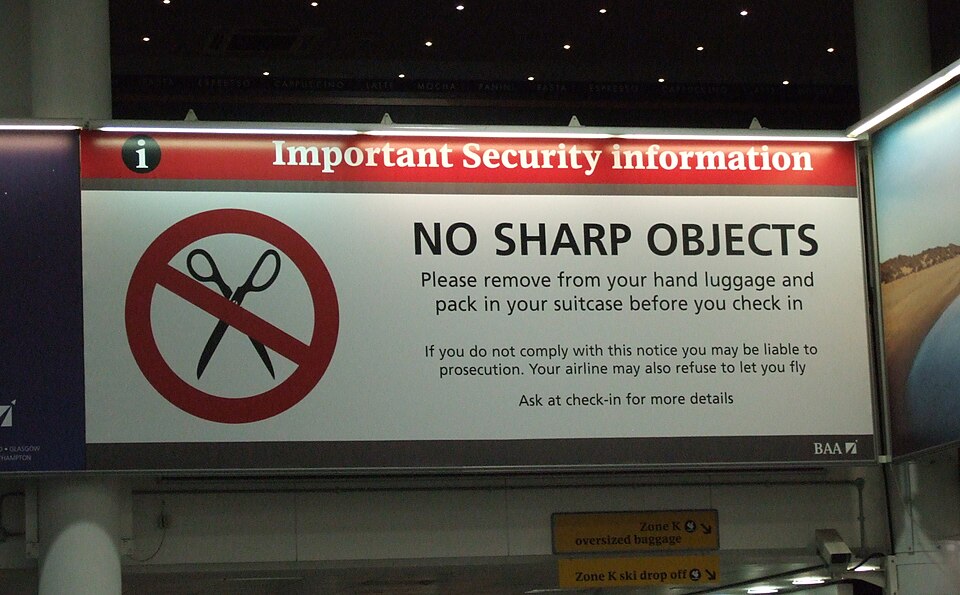
However, there’s a tiny problem. As you may remember, everyone in this anarcho-capitalist world goes heavily armed at all times. How does that work with air travel?
Riding the corridor to the elevators, we encountered a security setup not too different from the ones back home. Ed bellied up, drew his Browning, pulled the clip and chamber round. Lucy’s horse-pistol materialized from some region of her person, and Clarissa unsheathed her Webley Electric. Following their example, I unholstered my Smith & Wesson, wondering what would happen next.
At home, the officer would lose control of her sphincters, and forty thousand federal marshals would trample in and haul us away for the next several eons…. Whatever happened to the Fourth and Fifth Amendments at U.S. airports? Or the First, for that matter?
This is one of those spit-take moments you keep running into while reading this book. Smith thinks people have a constitutional right to carry guns on airplanes? On zeppelins, even?!
Note that he mentions the Fourth Amendment—i.e., the right to privacy—implying that it’s a violation of his rights to be searched, even at an airport security checkpoint.
“Excuse me, sir,” the attendant said politely. “Is your ammunition in compliance with aeroline policies?”
Ed nodded. “Frangibles, at under nine hundred feet per second.”
Even a gun-worshipping fanatic like L. Neil Smith recognizes the problems that would ensue if people started blasting away in an airplane cabin. This is his answer to that. In his ancap utopia, you’re allowed to bring guns on planes, but only if they’re loaded with special ammunition that kills people but won’t damage the structural fabric of the vehicle.
Everyone’s weapon passes the safety check except Win’s pistol, which is an antique by the standards of this world:
The official took a hard look at my revolver. Naturally, she couldn’t find it in any of her references. “I’m terribly sorry, sir, would you mind if we took your, er, gun, until you reach your destination?”
Ed grinned smugly. “See the trouble that museum piece causes? Use the cartridges in the yellow box.”
…I reloaded cylinder, speed-loaders, and my derringer—which caused another round of dithering—with this new stuff: bright-yellow plastic bullets. They’d explode into harmless powder on aerocraft-tolerance materials.
Thank goodness. Now we can riddle other passengers with bullets without causing midair explosive decompression. Much better.
Note, however, that the attendant makes only a cursory effort to verify this. She asks them to take out their weapons, inspects them, and asks if the ammunition they’re loaded with is compliant with airline policy. No one gets patted down; no one has to go through a security scanner or send their luggage through an X-ray machine. It all seems to be voluntary.
It’s fair to assume that people who outright refuse to cooperate with inspection would be denied boarding. But if you wanted to bring a noncompliant weapon on board, could you just keep it under your coat and not produce it when asked, like teenagers smuggling outside snacks into a movie theater? Or what if you took regular ammunition, but in the box of a frangible brand? Would anyone check or be able to tell?
In the real world, air rage is a problem every airline has to grapple with: angry, disorderly passengers assaulting each other or the crew. It’s almost inherent to the industry. Expensive tickets, stressful travel plans, uncomfortable seats, jet lag, and alcohol create a pressure-cooker environment in which some people’s worst impulses explode. There’s no scenario in which this gets better if everyone is armed, even if Smith makes the token concession of ensuring they can’t accidentally shoot down the entire aircraft.
Much like the section on traffic regulation (or lack thereof), these are wildly dangerous policies that would cause mass death and devastation if they were ever implemented in the real world. But Smith waves these problems away through the power of authorial fiat, scripting a world where they (somehow) lead to greater safety and security, and then holding that world out as an appealing place where we should want to live. It’s a circular argument, using a fictional scenario as proof of itself.
Image credit: Edward Betts, released under CC BY-SA 3.0 license

New reviews of The Probability Broach will go up every Friday on my Patreon page. Sign up to see new posts early and other bonus stuff!
Other posts in this series:
Leave a Reply