The Probability Broach: Do no harm

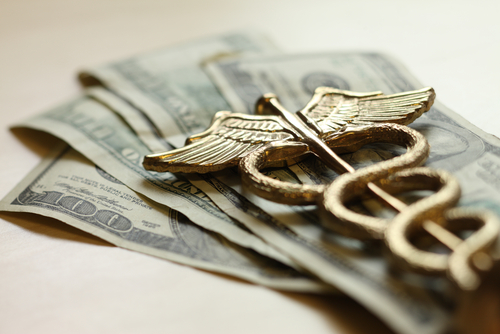
A medical caduceus laid on top of a stack of dollar bills

The Probability Broach, chapter 16

We previously read that, while Ed and Win were burgling John Jay Madison’s house to get evidence of his evil plan, he returned the favor by sending his thugs after their friend Clarissa Olson. In this week’s installment, Clarissa explains what happened:

“I’d stayed late with a client who’s having a rough regeneration—geriotic complications to be cleared up before the limb can replace itself… Anyway, I went home and freshened up, intending to come over here and see what mischief these two had accomplished at Madison’s. Just as I was starting out the front door, a couple of huge men smashed it in. I ran back through the house, but someone was there with a machine gun, shattering my windows.”

“How many were there?”

… “Two in the front, and the one out by the pool, with the hideous scars—I turned around again and practically ran into them. I had my Webley out, and sort of waved it around with the trigger held back.”

Lucy chuckled. “Walked right into it, the jerks.” She held one of the wicked little projectiles, eleven caliber, an inch or so long. “A thousand of these a minute, ten thousand feet a second. It’d ruin your whole day, wouldn’t it?” I examined the pistol with considerably more respect. Its barrel was a single massive coil, driving little steel needles by linear induction. There were hundreds in its magazine.

In case you’ve forgotten, Clarissa is the doctor who operated on Win and saved his life when he was gunned down and almost killed. She never asks him to pay for this, which is arguably in keeping with medical ethics, although it’s puzzling in an anarcho-capitalist world where money and profit is supposed to rule everything.

But in this chapter, we see a different side of her. She’s a healer who saves lives, but she’s also a stone-cold killer who wields a deadly flechette gun (sci-fi sometimes calls this kind of weapon a “needler”), and shoots men dead without a qualm.

Obviously, this is an indulgence of authorial fantasy on L. Neil Smith’s part: the sexy blonde doctor who’s also a badass gunslinger. But what about the ethics of this? Isn’t there an inherent contradiction in the idea of a healer who goes armed to kill?

The Hippocratic Oath is famous for its clause to “do no harm“. That vow is echoed in modern medical oaths, like the Declaration of Geneva, in which doctors swear to “maintain the utmost respect for human life”.

This even applies to military medics, who, according to the Geneva Conventions, are supposed to be noncombatants. They have a moral duty to render aid to anyone in need, including wounded soldiers from the other side.

Doctors aren’t forbidden to defend themselves if they’re in danger, of course. But you’d think a good doctor would be at least a little conflicted about having to shoot two people dead. That ethical conflict is never alluded to or explored in this book.

This raises a related question: Are there pacifists in the North American Confederacy? Is it possible to exist in this society while abstaining from violence—or are such people easy pickings for the first thug who knows they won’t defend themselves? This is another of those questions that a gun fetishist like Smith never considers.

Clarissa explains that she got away unscathed, but her home was destroyed:

“I stepped over the bodies, ran out front, and drove away. There was a blinding flash in my rear viewscreen and a huge ball of fire”—she shook her head sadly—”pointless destruction for its own sake. They’ll pour me a new house, and my professional records are transmitted every day to the insurance company, but my furniture, clothes—everything is gone.”

Lucy invites Clarissa to stay with her in the meantime, while Ed gives orders to increase their private guard (yet again). Win, still outraged, says: “Madison couldn’t get to us, so he decided to pick on you, probably as a threat to hold over our heads. As far as I’m concerned, it would have worked, too.”

He’s still fuming that they can’t just round up some goons and go repay Madison in kind, but his friends again tell him that that’s not the way it works here. However, Lucy says she has another idea. She has a connection that’s about to pay off:

“Ladies and gentlemen…” Lucy announced from the hallway, “The President of the North American Confederacy!”

The president entered, pausing a moment to commiserate with Forsyth, expressing pleasure at meeting Deejay, nodding grimly over the news while being introduced to Clarissa, greeting Ed like an old friend. Under the peculiar circumstances, I had to be introduced to the president, too. But no one had to introduce her to me.

I know Jenny Noble when I see her.

This is the NAC’s alternate version of Jenny Noble, the libertarian activist Win met in his own world (although her name is Jenny Smythe here, for avoidance of confusion).

In this world, she’s the president of the North American Confederacy. The NAC has a president and a legislature, although they’re symbolic figures with no real authority or power, as you’d expect in an anarchy. However, she’s apprised of the situation and she says she can help:

“I’ve been trying to tell you that, with any luck, the Confederacy’s going to pay for everything!”

Lucy narrowed suspicious eyes. “How y’figure that, girl?” I was interested, too, since there didn’t seem to be enough government on the whole planet to buy Forsyth a box of ammunition.

Jenny laughed. “It’s really very simple. In a week or so, there’ll be people standing in line to contribute. You see, I’ve decided there’s only one way to deal with the Hamiltonians. I’m calling a session of the Continental Congress.”

Is this anarcho-capitalist Congress going to show an unprecedented burst of community spirit? Will they come together to save the day through collective action?

Here’s a hint: Take your best guess about what would happen in real life when a bunch of selfish individualists assemble to argue about which one of them should deal with a threat. That’s pretty much how it plays out in this book.

New reviews of The Probability Broach will go up every Friday on my Patreon page. Sign up to see new posts early and other bonus stuff!

Other posts in this series:
New on OnlySky: The stupidity of the Iran war

I have a new column this week on OnlySky. It’s about the war with Iran and Trump’s continuing efforts to go down in history as the worst president America has ever had.

As a candidate, Trump’s only good idea was to oppose new foreign wars. Now he’s thrown that aside, just like he’s discarded every other principle he ever paid lip service to, and started an unprovoked war with Iran in the middle of peace talks. He’s committed all the evils he promised, plus all the evils he denounced.

But rather than the conflict ending in easy victory just because we killed some of their leaders, Iran refused to surrender. They’re bombarding American bases and allies all over the Middle East with ballistic missiles and drones. They’ve closed the Strait of Hormuz, causing a worldwide oil price shock, inflation, and likely an economic recession or even a depression.

Obviously, I’m not on the side of the mullahs, who are a gang of brutal and repressive fanatics who slaughter their own people for protesting. I wish Iran could be reconstructed as a secular democracy. But theocratic fundamentalism isn’t a problem that can be solved by dropping bombs from a plane.

Read the excerpt below, then click through to see the full piece. This column is members-only, so consider signing up! Members of OnlySky also get special benefits, like a subscriber newsletter:

The sheer stupidity, incuriosity, and smugly self-satisfied ignorance of this administration defies belief. Even Trump doesn’t know why we’re at war. He and his henchmen have offered a fog bank of shifting justifications about why he did this—to bring about regime change? to end Iran’s nuclear program? to heed Israel’s wishes? or something else entirely?

Whatever the reason, we started this war with no forethought, no plan, and no preparation. Trump and his lackeys seemed to think they could drop some bombs, kill the ayatollah, and immediately impose a new, compliant ruler. It was a wildly delusional fantasy of easy victory, similar to Vladimir Putin expecting to conquer Ukraine in three days.

Continue reading on OnlySky…

The Probability Broach: Turf wars

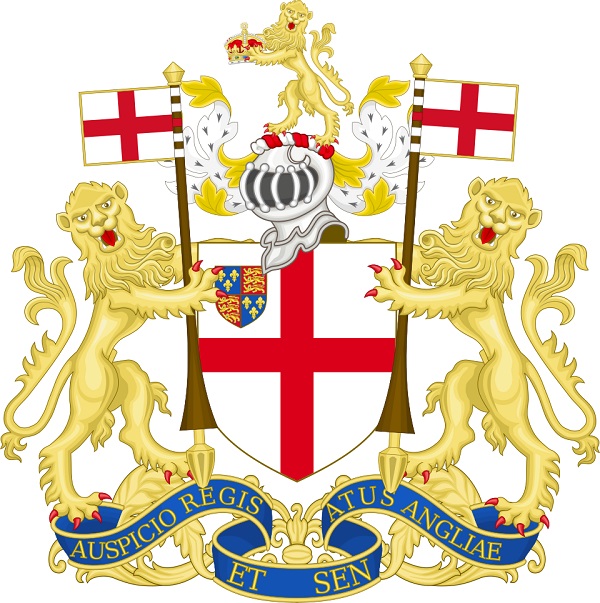
The coat of arms of the East India Company

The Probability Broach, chapter 16

Ed and Win Bear have burgled the house of their enemy, John Jay Madison, and successfully retrieved proof of his evil schemes.

At the same time, Madison sent his goons after their friend Clarissa Olson. She escaped, shaken but unharmed. But she’s outraged—they all are—because Win is showing his friends the military training films from his world that he took from Madison’s place. Specifically, the ones about the atomic bomb:

Horrible!” cried Clarissa. Ed sat paralyzed, his face a frozen mask.

… “They purpose doing that to us?” Deejay trembled with anger as the films showed buildings, automobiles, ships resting innocently at anchor, vaporized beneath the mushroom cloud.

“Only if you don’t knuckle under. It’s pretty simple. An old game where I come from. They finish their Broach, bring in troops and weapons, and the Hamiltonians are suddenly in charge—under SecPol supervision, of course.”

Win grimly explains that there’s no chance of fighting the bad guys when they make their move. Once they have their own Probability Broach, they can appear anywhere, and with nuclear weapons, they can hold entire cities for ransom. He concludes, “Give them a week and they’ll own this world. With the resources and the technology available here, they’ll own mine, too.”

Fortunately, Dr. Deejay Thorens, the scientist, tells them there’s still time. She reviewed the recordings that Win made in Madison’s house, and she’s concluded that they’re weeks away from getting their Broach working. (In this book, as in Atlas Shrugged, all smart and competent people have the same politics. Only libertarian capitalists can invent anything, and people with other ideologies can only clumsily copy what they come up with.)

But they’re still under a deadline. Win is exasperated that they know what Madison is planning, but under the laws of this anarchist society, they can’t do anything about it. Captain Forsyth, the chimpanzee bodyguard-for-hire, explains why:

“I don’t understand! These people have shot me, attacked Ed and the captain, murdered their own hitman, and now this latest outrage on Clarissa! Why don’t we just round up some muscle and—”

Lucy sighed. “Winnie, ain’t a body in this room—least of all me—wouldn’t do that in a minute, ‘specially after what happened to Clarissa last night, but… nobody’s gonna break into that fortress of theirs twice.”

“That’s right,” the captain said. “My dispatcher says they’ve ordered three squads from Brookstone’s, and a weapons specialist. That means lasers—big ones.” He wrinkled his upper lip and bared his teeth—definitely not an expression of good humor among his people.

In the last chapter, Ed suggested that once they had the evidence in hand, they could sue Madison for attempted world domination. Even L. Neil Smith seems to realize how ludicrous this is, as it’s never brought up again. (Even if they sue him and he loses, what stops him from just bringing in the nukes and conquering the world anyway?)

“Why not get four squads, then, and even bigger lasers? Once everybody understands, every security company in Laporte will—”

“Companies don’t fight each other… Nobody’d last five minutes in this business—wouldn’t deserve to—if all justice amounted to were ‘My thugs’re tougher’n yours!’ We’re supposed to preserve the peace—otherwise, we’d just go back to your arrangement, and have some real wars.”

“What the captain isn’t saying,” Ed added, “is that there’s simply no profit in smashing one another to pieces. That was settled, long ago.”

As a historical howler, this ranks right up there with Ayn Rand claiming there were no “fortunes by conquest” in America.

Smith says that only governments wage war, and because there’s no government in his anarcho-capitalist world, war is nonexistent. There are private security companies with armies at their disposal, but they only deploy them to protect their clients. They don’t fight each other directly, because it wouldn’t be profitable to do so.

Really? Private wars aren’t profitable? History begs to differ.

In 1600, Queen Elizabeth I granted a charter to a group of merchants to manage trade with Britain’s Asian colonies. This became the British East India Company, one of the world’s first corporations. It was run by a board of directors and sold shares of stock to the public to raise capital.

The East India Company was immensely profitable, and it used those profits to form private militaries to protect its trade routes and enforce its brand of law and order in the colonies it administered. At the height of its power, it commanded a quarter-million soldiers—more than the actual British army. It had infantry, cavalry and artillery, as well as its own navy.

Its “branch officers” wrote the laws and controlled the justice systems in the British colonies it managed. As Dave Roos writes on History.com:

This would be the equivalent of Exxon Mobil drilling for oil in coastal Mexico, taking over a major Mexican city using private armed guards, and then electing a corporate middle manager as the mayor, judge and executioner.

The East India Company’s most infamous exploit was the Opium Wars. Chinese porcelain, silk and tea were in high demand in Europe, but there was little that China wanted in exchange. British merchants had the bright idea to export opium to China, getting people addicted and raking in the cash. When the Chinese emperors tried to outlaw the drug, the East India Company called in the warships. China was defeated and forced to agree to one-sided terms.

Also, the U.K. wasn’t the only colonial power at the time; other European nations had similar trading companies. Did these firms fight each other? Yes, yes they did.

To gain control of India, the British East India Company had to elbow out its colonial competitors. It defeated the Dutch East India Company in the 1759 Battle of Chinsurah, and the French East India Company in the Carnatic Wars.

Granted, in this era, the line between corporation and state was blurry. The trading companies served the interests of their monarchs, and could call in the mother country’s military at will. But to say that capitalists found war unprofitable is utterly false.

Colonialism was very profitable for the colonizing power—which, of course, is why it happened! With so much money at stake, those who stood to profit were more than willing to go to war, to gain control of a rival’s turf or to defend their own. L. Neil Smith has to ignore vast swaths of history to say otherwise.

Back in the book, Win’s friends give him a mini-history lesson about why security companies don’t fight each other:

Lucy nodded. “Little village off the East Coast—one gang decided they’d try running things, four or five other companies objected. Before the dust settled, they’d nearly wiped each other out. Manhattan, if I recall correct. Ever since, security outfits—and their insurance companies—have been big supporters of adjudication.”

This is Smith’s explanation of why there’s no New York City in the North American Confederacy, although it doesn’t explain why it was never rebuilt. (It’s an excellent natural harbor that connects the Atlantic Ocean to the Hudson River, making it an ideal shipping port. That’s why the city was built there in the first place.)

But I see a bigger problem with this. If two security companies go to adjudication, and the bigger, better-armed one loses the case, is it going to peacefully accept that? Again, it ignores history and human nature to say yes.

The reason it works this way in our world is because the state, which operates the judicial system, also has a monopoly on force. If you ignore a court’s ruling, it can deploy state power to enforce it. Litigants are compelled to accept judicial settlements, rather than continuing their argument by other means.

Smith assumes that if you remove the state backstop, judges will still have unquestioned authority, even though they have no way to enforce their judgments. This is more libertarian cargo-cult thinking.

When powerful and unaccountable entities don’t get their way, they pull out the big guns. In addition to the colonial trading companies, a modern example is drug cartels who go to war in the streets over turf.

These are privately owned, profit-driven firms in the libertarian sense, so why do they fight and kill each other? According to L. Neil Smith, there’s no profit in that. Why don’t they just work out a peaceful arbitration process among themselves and voluntarily agree to respect the results? It sounds absurd—but that’s exactly what Smith expects to happen.

New reviews of The Probability Broach will go up every Friday on my Patreon page. Sign up to see new posts early and other bonus stuff!

Image credit: Wikimedia Commons

Other posts in this series:

New on OnlySky: Reforestation

I have a new column this week on OnlySky. It’s about some surprisingly hopeful news: the planet’s forests are growing back.

As agricultural technology becomes more efficient and more people move to cities rather than rural villages, marginal land has been returning to nature. Planet-wide, the rate of deforestation peaked in the 1980s, and it’s been decreasing ever since. In many places, like North America, Europe and China, there’s been a net gain of forest cover since 1990. It turns out nature can regenerate surprisingly fast, if only we give it the opportunity.

Some countries are still cutting down forests, especially tropical developing nations like Brazil and Indonesia. However, a majority of that destruction comes from domestic demand – not cash crops grown for export, as you might assume. That too is a hopeful sign, because it means these countries might soon go through the green transition that many industrialized nations have already completed.

Read the excerpt below, then click through to see the full piece. This column is free to read, but members of OnlySky also get special benefits, like member-only posts and a subscriber newsletter:

While Western-style consumption on a mass scale is unsustainable for the planet, it’s also true that more advanced economies have less environmental impact.

As technology continues to improve, we can adopt more planet-friendly methods—like vertical farming, or agrivoltaics that provide both food and renewable energy, or even precision fermentation and other advanced biotechnology to grow meat substitutes.

These green technologies are a step above fossil-fuel-driven industrial agriculture, which is a step above slash-and-burn farming or subsistence agriculture that requires cutting down trees for firewood. As societies move up this technology curve, their impact on the planet decreases.

If we disseminate these technologies to countries that haven’t yet adopted them—and especially if all us privileged Westerners eat a few less hamburgers—it’s very possible that global deforestation will slow to a halt and then go into reverse. We may well see reforestation on a planetary scale occurring within our lifetimes.

Continue reading on OnlySky…

The Probability Broach: You won’t have Nixon to kick around anymore

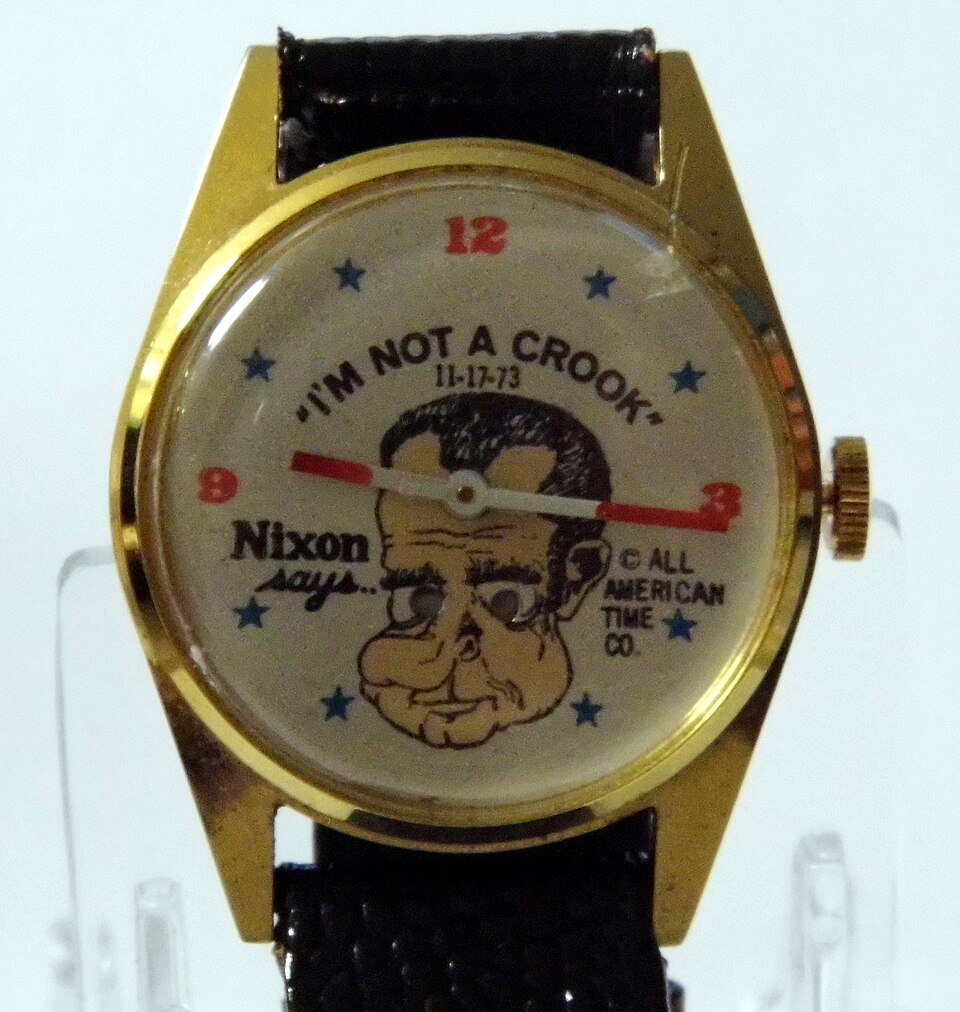
A novelty watch with Richard Nixon's face and the text 'Nixon says: I'm not a crook'

The Probability Broach, chapter 15

Ed and Win Bear are committing crimes in the name of justice. They’ve broken into the house of their archenemy John Jay Madison to find proof of his schemes. They’re both sweating bullets as they move through the darkened mansion, because what they’re doing is completely illegal in this anarcho-capitalist society. If Madison returns and catches them in the act, he has every right to shoot them on the spot.

They split up to search the place. Win’s first discovery is a room where the bad guys have built their own Probability Broach, using the plans Deejay gave to Vaughn Meiss that the villains stole when they killed him:

I drew my revolver, lifted the hook with its muzzle, and opened the door carefully. Nobody home, but it seemed very familiar: same cabinets, same tangles of wire, a replica of Deejay’s cluttered lab, and of the infernal machinery that had propelled me here.

…The sight, surrounded as I was with dormant Broach machinery, made me uneasy. If I went through a hole in this world, where would I end up?

This isn’t a surprise to him, since he saw some old foes palling around with Madison during their stakeout. It’s confirmation of what he suspected: the government thugs from his world and the Hamiltonian wannabe dictators from this one have joined forces to conquer the North American Confederacy.

After taking pictures of everything, he heads upstairs. In Madison’s private office, he meets Ed, who’s found some damning evidence:

“In the lecture-hall closet, carefully tucked into a pile of table linens – these…” Three canned reels of sixteen millimeter film lay on the desk, half concealed in a fancy napkin. I struck another match:

TF 53-9354
CLASSIFIED
MOPPING UP IN THE ATOMIC AGE
POST-STRIKE TACTICAL DEPLOYMENT
PROPERTY OF U.S. GOVERNMENT

Win recognizes them as military training films from his world. One is about how hydrogen bombs work. Another concerns “anti-guerrilla counter-insurgency”.

They’re running short on time, but there was a room off the kitchen that Madison conspicuously avoided showing them when he gave them a tour of his house. Naturally, Ed and Win both want to see what he was hiding:

Huddled on the floor between two hanging beef carcasses was a body, frozen stiff. Oddly, it didn’t seem cold in the tiny room. “What is this place?”

“Paratronic freezer. Something like a microwave oven, only the other way around. Shuts down when the door opens.”

…Ed rotated the body onto its face. Clothing and flesh were tattered at the back, as if blasted with a shotgun – nothing fatal, just messy and painful. Some of those gleaming particles wouldn’t be ice, but glass from my bedroom window. We’d found our intruder.

It’s the frozen corpse of the hitman who broke into Ed’s house at night and almost slit Win’s throat. Whether as punishment for his failure, or just to keep him from talking, Madison locked him in the freezer until he froze to death.

This is standard Hollywood-villain stuff, but what tips this scene into black comedy is the identity of the dead man:

“Tricky Dick Milhous,” Ed said, “a third-rate second-story man. He’s no assassin, just a petty crook. Nice way they paid him off. Couldn’t have been pleasant, freezing in the dark.”

Okay, that’s pretty funny.

In our world, Richard Nixon is best known for plotting to burglarize and illegally wiretap his political rivals, then when he got caught, resigning the presidency in disgrace rather than face impeachment. (Those were the days when Republicans at least pretended to believe in the law, as opposed to now, when they’ve enthusiastically embraced crime as long as it’s their guy doing it.)

L. Neil Smith pays tribute to Nixon’s rotten legacy of lawbreaking by making him a petty criminal for hire. I have to admit it’s fitting.

Ed and Win have run out of time. The discovery of Nixon’s body delayed them for too long. Ed’s defeater is no longer able to suppress Madison’s burglar alarms, which start blaring.

They make a beeline for the exit. But by the time they get outside, Madison’s private security has shown up and has the place surrounded. Rather than try to run or fight, Win pulls a Bavarian Fire Drill:

I turned the corner, strode deliberately down the sidewalk, Ed dithering along behind me for once, and right up to the front door of the Alexander Hamilton Society. Guards were milling in and out.

“Bear Brothers, consulting detectives,” I rapped. “We’re staking out a burglar. Find him yet?”

The patrol boss looked us over with a grudging smile. “Ed! Might’ve known you’d show up. Didn’t know you had a brother…”

Ed opened his mouth, I barged ahead with “Win Bear, Captain, just in from, uh, Tlingit. It’s Tricky Dick Milhous we’re looking for. Busted into a place we’re… responsible for the other night, and damn near killed a resident.”

Since these guards are on Madison’s payroll, they have a right to search his house. Ed and Win wait tensely, with Madison’s stolen training films stashed under their coats. After forty-five minutes, the guards find Nixon’s body. Madison’s alarm system locks all the doors in the house automatically when it goes off, so they assume he got trapped in the freezer after breaking in.

All in all, Ed and Win’s burglary was a success. They found the proof they needed and got away clean. They know Madison’s guards will report everything to him, including the fact that Ed and Win were at the scene. But even if Madison discovers what they took, he won’t be able to contradict their story without tipping his hand. (Win imagines the conversation: “And if it isn’t a burglar, Mr. Madison, what’s he doing here?”)

But when they get in the car, they get unwelcome news:

The Telecom lit up, Lucy’s worried face crammed in the focus beside Forsyth’s. “Get back here quick, boys! While you were doin’ it to them, they’ve gone an’ done it to Clarissa!

The villains weren’t idle, as Ed and Win assumed. While they were stealing from Madison, he sent his thugs after their friend Clarissa Olson, the doctor who treated Win. It’s enough to make you think there might be some advantage to having dedicated law enforcement, instead of having to guess which of your friends might get attacked next and then hiring private security to protect them!

Image credit: Joe Haupt, released under CC BY 2.0 license

New reviews of The Probability Broach will go up every Friday on my Patreon page. Sign up to see new posts early and other bonus stuff!

Other posts in this series:
New on OnlySky: The Bible is too woke

I have a new column this week on OnlySky. It’s about the arrival of a day you always knew was coming: evangelical Christians have swung so far right, the Bible is now too liberal for them to tolerate.

This isn’t satire or the punchline of a joke. When John Piper, a staunchly conservative Baptist theologian with a decades-long reputation for orthodoxy, quoted a biblical verse about welcoming immigrants, his fellow evangelicals instantly turned on him and attacked him in a wave of berserk fury. Does this show that MAGA Christians are on the verge of abandoning the Bible entirely to push their white supremacist theology?

Read the excerpt below, then click through to see the full piece. This column is members-only, so consider signing up! Members of OnlySky also get special benefits, like a subscriber newsletter:

In all fairness, the teachings of Jesus as depicted by the New Testament gospels were never popular among Christians. With a tiny handful of exceptions, they never followed his commands to refrain from violence, to pray in private, to give away all their wealth to the poor, or to abandon their families and live as wandering mendicant preachers.

But most theologians, however conservative, at least paid them lip service. This is the first instance I’m aware of where a Christian faced a barrage of attacks and hostility from his peers, not for making an interpretation that others found tendentious, but merely for quoting the Bible. This feels like a crossing-the-Rubicon moment, one where Christians explicitly reject a biblical moral because they dislike it.

Conservative theology erodes this verse away to meaninglessness. In the tortured ouroboros of their interpretation, immigrants are only welcome as long as they obey all of the host country’s laws—including the laws being wielded to say they’re not allowed. It’s a perfect catch-22 of absurdity.

Continue reading on OnlySky…