
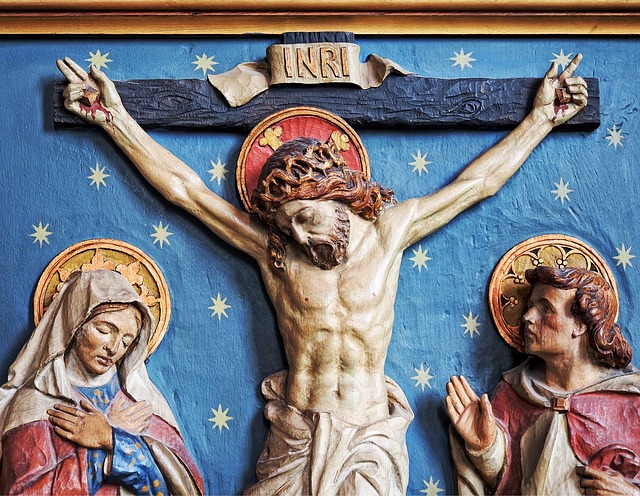
“Under the law almost everything is purified with blood, and without the shedding of blood there is no forgiveness of sins.”
—Hebrews 9:22
I’ve been an atheist for a quarter-century, and there’s something I’ve never understood about Christianity: Why is the crucifixion so important to them? Why do they believe it’s needed for God to forgive sin?
Is there a rule that says so? If so, who made that rule and why?
If someone wrongs me and regrets it, I can simply forgive them. I don’t need anyone’s blood to be spilled: not mine, not theirs, and certainly not the blood of an unrelated third person. It makes no sense to demand such a gory ritual as the precondition of accepting an apology. That doesn’t undo the misdeed; it just creates a new, separate harm.
So why does it work differently in Christianity? How do Christians justify this cruel doctrine, when no ordinary, decent, moral person would ask or expect this in objective reality?
It’s not that Christians never address this question—it’s that they act as if they’ve answered it, when they haven’t. Many Christian apologists claim to have an explanation, but end up merely reiterating the idea as if it were self-explanatory. Here’s an example:
Why did the sacrificial system require a blood sacrifice?
…A “sacrifice” is defined as the offering up of something precious for a cause or a reason. Making atonement is satisfying someone or something for an offense committed. The Leviticus verse can be read more clearly now: God said, “I have given it to you (the creature’s life, which is in its blood) to make atonement for yourselves (covering the offense you have committed against Me).” In other words, those who are covered by the blood sacrifice are set free from the consequences of sin.
But again—why blood? They don’t come anywhere near justifying this. Why does God want blood to be spilled, rather than some peaceful means of atonement?
This article starts off better. It gives a clear statement of the problem, pointing out that blood sacrifice is violent and irrational:
For example, I forgive people all the time without requiring that they shed blood for me. And I’m really glad that people forgive me all the time without asking that I open a vein or kill my cat for them.
So if I can offer forgiveness without the shedding of blood, and so can other people, what is going on with God? …I mean, if God is the one making the rules, and sin is a serious affront to His holiness, then why did He decide that blood would appease Him? Why not require … I don’t know … spit? Or hair? Yes, I like the hair idea.
Why didn’t God simply say “Without the cutting of hair, there can be no forgiveness of sins”?
This author at least tries to give an explanation:
Instead, the blood was for the enactment of the Mosaic Covenant. The author of Hebrews could not be more clear. He says that a testament, or will, is not put into effect until the one who wrote it dies (Hebrews 9:16-17). My wife and I have Wills, and as is the case with all Wills, they do not go into effect until we die. A “Last Will and Testament” has no power while we live.
…Whose “Last Will and Testament” was this? It was God’s! It was God’s covenant to the people.
It’s true that the Bible proposes this answer, in the referenced verse of Hebrews 9:16-17: God made a “testament” with humanity, and a last will and testament only goes into effect upon the creator’s death. However, this is just a play on words. It doesn’t reflect any underlying principle or rule.
A will is a species of legal document, but in general, legal documents only require mutual agreement. If I sign a contract with someone, no blood needs to be spilled and no one needs to die. It goes into effect when we both sign on the dotted line, that’s all.
My “last will and testament” isn’t anything special or different than any of the other choices I make during my lifespan. There’s nothing about my death that gives it special force or added power. It’s called that because it’s the last choice I can make that goes into effect; that’s all.
The author goes on to suggest a second explanation, that death is the gateway to freedom from a past life of sin:
So the redemption enacted as part of the Mosaic covenant was the redemption of the slaves from Egypt. The death of the calves and goats symbolized the death of the Israelite people to their former life of slavery in Egypt.
Through the Mosaic covenant, the people of Israel died to their old identification as slaves to the household of Pharaoh (i.e., Egypt), and were raised again to a new identification as members of the household of God. This is why the water and the blood was sprinkled not just on the book of the covenant, but also on all the people (Hebrews 9:19).
…God’s holiness did not demand that Jesus be put to death. No, it was the devil that demanded death and blood (cf. Hebrews 2:14-15). Sin was the certificate of ownership which the devil held over the heads of humanity.
By dying, Jesus cancelled this debt of sin so that the devil could no longer have any claim upon us. This happened because just as all sinned in Adam, and so became slaves to death and the devil, so all died and were raised to new life in Jesus, and so were liberated and redeemed from our slavery to death and the devil.
This explanation has the same basic problem. It treats a metaphor as if it were a binding rule.
You can speak of a momentous change in metaphorical terms, by saying the old person is “dead” and someone new has taken their place. But to claim this requires a literal blood sacrifice is stretching the metaphor to hyperliteral absurdity. You can also describe a change by saying you’ve turned over a new leaf, but that doesn’t mean you have to go out into a forest and flip over fallen leaves to make that change effective in your own life.
A person doesn’t have to die, either symbolically or literally, to be freed from slavery. No one died because of Abraham Lincoln’s issuing the Emancipation Proclamation, but it was still effective. Obviously Union soldiers did die to make those words a reality, but that bloodshed wasn’t a necessary ingredient of the proclamation itself. It was only required because the South resisted and had to be subdued by force. If the Confederacy had peacefully surrendered and freed its slaves voluntarily, the result would be the same.
Neither slavery nor debt is a fundamental aspect of a person that requires radical surgery to remove. It’s a status imposed on them by others, and it can be removed the same way. If God is more powerful than Satan, he could have just cancelled that “debt of sin” without any death or bloodshed, the same way a president might cancel student loan debt. So why didn’t he?
It’s obvious where this idea actually comes from. It’s derived from the ancient religious notion of the scapegoat.
In this primitive theology, God is a hot-tempered tyrant who’s enraged by human disobedience. Once he’s angered, he has to take that anger out on someone—and his punishments are so indiscriminate, there’s often collateral damage.
To protect themselves from God’s wrath, ancient societies believed that they could perform a ritual to magically transfer the guilt from wrongdoers into an animal. That animal was either slaughtered or driven out into the wilderness, taking the punishment on people’s behalf and satisfying God’s hunger for vengeance (as in Leviticus 16:21-22).
Because of moral progress, we now understand that scapegoat theology makes no sense. Guilt isn’t a substance that can be moved from one being to another. However, Christianity is frozen in place as a derivation of this idea. All the philosophical ink spilled by theologians is an attempt to put a rational gloss on that ancient and bloody superstition. They’re casting about for a sophisticated explanation where there isn’t one. They’re seeking profundity that doesn’t exist.
It’s not just that Christians cling to the idea of their deity’s sacrifice to itself (the story goes that Jesus willingly sacrificed himself to God…who Jesus is considered a part of) to appease itself, but also that the more extremist sects absolutely relish the fact and repeatedly insist that humans don’t belong to themselves because they were bought through this blood sacrifice (that they didn’t ask for) as a way of keeping their followers enslaved and feeling beholden to the deity. Classic abuse.
The all-powerful, all-knowing deity created beings that he somehow couldn’t foresee would so enrage it that it needed part of itself to make that sacrifice. To itself. But since it’s immortal, that wasn’t actually a sacrifice because it can’t die. So what is the point of any of that except cheap theatrics?
This deity also tried to trick Abraham into sacrificing his son Isaac to him, only to yell “PSYCH!” at the last moment. How is this a deity anyone would want to worship?
That “Redeeming God” article is even dumber. Are they claiming that the Hebrews didn’t belong to God when they slaves in Egypt? That implies that human laws made by tyrants can supersede divine law! Why would God be bound to acknowledge Pharaoh’s claim on the Israelites as his slaves? It makes no sense.
Come to think of it, maybe you could do a deep dive on how these writings became scripture in the first place? It appears that the decision was wholly circular, saying they were divinely inspired “because I said so,” providing no evidence that the authors were who they are claimed to be, which of course, makes the whole idea untenable now that we know the Pentateuch was not written by Moses.
The Jewish view is that God made several covenants, first with Adam, then with Noah, then with Abraham, and finally with all the Israelites at Sinai. The Israelites in Egypt would be bound by the covenant of Abraham, which really only adds circumcision to the Laws of Noah.
As for human sacrifice – the non-sacrifice of Isaac was supposed to have put an end to it. Jephthah is considered a bad guy for sacrificing his daughter.
There’s a lot said here which could have been more efficiently answered by focusing here:
By being extraordinary, indecent and immoral people.
Simple.
“Whose ‘Last Will and Testament’ was this? It was God’s!”
I don’t follow this. Are they arguing that God needs to die before we’re forgiven, since his “Last Will and Testament” doesn’t go into effect before then?
.
It’s not just the Middle Eastern cultures that believed in the power of blood for gaining their god(s)’ favor or forgiveness. That idea can be found around the world.
.
I’ve likewise wondered where the idea of original sin (all sinned in Adam, sins of the fathers, etc.) came from. Where’s the justice in making your blameless relatives pay your debts? Who thought that was a good idea? People who thought the leopards would never eat their faces?
To say nothing of that the Old Testament was written before Jesus was born, let alone died.
Funny how folks get all twisted up in this male blood-letting. I’m a woman: in my fertile years I bled monthly for the benefit of procreation, and all my blood-letting just seems to terrify men, while not absolving me of anything.
Turning over a new leaf refers to a leaf (page) in a book or diary. It means a new start.
But again—why blood?
And also again — what wrong did anyone do against God that any of us have to “atone” for in the first place? God is (allegedly) all-powerful, therefore there’s nothing any mortals can do that will harm him or frustrate any of his plans; and no amount of blood or other sacrifice will do any good, since he has no material needs that we can satisfy. So that’s TWO layers of sadism and derangement we’re looking at here, not just one.
Oh, you know how it is. God says Adam should avoid a couple of specific trees, snake tells Eve this fruit is good, Eve gives Adam some of the fruit, so now all humans and snakes have to be cursed forever. And that curse can be suppressed by blood sacrifice, because, I dunno, reasons. Then later by God sacrificing himself to himself, but only so long as you accept the sacrificed version of himself as a personal savior. Because rules?
Apologists will tell you that man offended God’s dignity by disobeying him, and that is why we all deserve punishment. It literally does not matter that God cannot actually be harmed.
@5: women’s monthly bleeding is considered deeply offensive to the Abrahamic religions and in at least one, the women are treated as filthy pariahs while it’s happening and have to atone afterward for the sin of being a woman.
To be fair, men’s nocturnal emissions were considered just as bad.
I’m a bloke, and I assure you every one of my “emissions”, nocturnal, diurnal or crepuscular were not spontaneous.
(Nicer with a partner, to be honest)
@ anat: did men have to provide their underwear to their rabbi for inspection each and every time before they were allowed back into society? Or not be allowed to pass things to their wives? Or be forced to take a ritual bath every time? Or not be allowed to sit on a chair lest it contaminate the rest of the family? Are men considered unclean for a week (for a boy) or two weeks (for a girl) after their wife gives birth?
Women inspect their own underwear (or not, depends… there are circumstances when inspection is encouraged and others when it is discouraged). Rabbis are only consulted if a woman notices odd-colored stains and isn’t sure about their classification. Also, in Orthodox Rabbinical Judaism menstruating women are not excluded from society (or not more than non-menstruating women), and they keep their menstrual status private. This may be different in other related religious groups such as Karaite Jews, Samaritans, Ethiopian Jews, etc. The only interactions that are different are between wives and husbands (of course strictly speaking among Orthodox Jews direct physical contact between men and women who are not first degree relatives is forbidden at all times because it is considered immodest). Again, the ‘no passing objects’ is supposed to be because any skin-to-skin contact may be arousing and sex is forbidden during this time. The rules about impurity due to standing on the same surface or sitting in the same chair etc are meaningless in the absence of a temple. IOW the basic rule that exists today is no sex when a wife is menstruating nor during a few days later, until she immerses in the women’s ritual bath (no rabbis involved, though there is a woman who serves as an attendant, whose job is to make sure women shower before immersing, and make sure women are fully immersed). Everything else is intended to prevent arousal at a time when sex is forbidden.
As for non-Orthodox Jews – Conservative Jews in practice only avoid sex during forbidden times and let people decide for themselves what strictures or structures they need to make this happen, whereas Reform, Reconstructionist, Renewal and any other liberal forms of Judaism don’t care.
So men’s emissions: In antiquity a man who became impure this way had to wash and immerse himself completely in order to participate in assorted rituals. There were all kinds of rules of permitted and forbidden manners of touching one’s own genitals in relation to this rule. Said rituals stopped being practiced when the temple was destroyed, but were replaced with prayer. So different groups have different interpretations about what level of cleanliness is required for prayer. Generally most Orthodox Jews only require handwashing before prayer, though some Hassidic Jews practice daily full immersion before prayers. (And others immerse once a week, before the Sabbath) Also, it is customary for fathers to immerse before their son’s circumcision. (And plenty other occasions).
Also, being ritually clean or unclean is not supposed to have moral or other implications. People are not encouraged to avoid becoming ritually unclean. Everyone becomes unclean as part of normal life. And some forms of uncleanliness cannot be undone until someone manages to produce the ashes of a purely red heifer.
A couple weeks ago I was re-reading one of Will Cuppy’s books and reflected on how Aristotle rather famously wrote that the brain’s primary function is to cool the blood (which it does admirably), but the seat of the intellect was in the heart.
While I had laughed at Aristotle’s ignorance before, this time I tried to figure out how Aristotle might have made such an error. Well, to begin with, Aristotle was repeating what other savants taught. But that doesn’t really answer the question, it only moves it further back in time to earlier people.
So what did people know about physiology prior to modern medicine, prior to William Harvey’s work on the circulation of the blood? I’ve read the medical treatises of Maimonides, and parts of the works of Ibn Sina, and they did know quite a bit. Some of the advice on healthy body weight, diet, and exercise could have been written today. They were keen observers of the affects of ingestion of different materials, and capable of some pretty advanced medicine mainly based on centuries of trial and error. Some of the cruder surgeries were understood, with a pretty good chance that the patient would live, but mainly concerned with extremities. Taking off an arm or a leg, cutting off the hand of a thief or the ears of a perjurer, was not uncommon. However, little was known about the inner workings of the abdominal cavity or the chest cavity. Without modern anti-septic compounds making an opening in either of those cavities either resulted in very painful infections (leading to death), or a rapid bleed-out (leading to death). So they were rarely attempted.
However, while head injuries were often fatal, there were plenty of examples of head injuries where even the brain was exposed (or even damaged) and the patient lived. A modern example is Phineas Gage. Apparently the brain was less important to keeping a person alive than the heart/lungs, and the blood which could pour out of the chest cavity if it was broached.
It is not really much of a stretch, after all, for people who are unfamiliar with the functions of the organs of the human body, and the function of blood, to assign to blood the characteristic of life. Without blood animals (and people) die. As long as the blood continued to flow, unimpeded, through the body, the body is healthy. Interrupt that flow, with a tourniquet or even an infected wound, and that limb would die. I’m certain that people were aware from a very early time that the mechanism which moves blood through the body is the heart. So, Aristotle saying that the seat of reason was the heart, as silly as it may sound to us, isn’t that uncanny when we try to imagine how savants of the day understood the function of blood and the heart.
Blood animates the body, the heart pushes the blood.
To sacrifice blood is to sacrifice life.
We still have a lot of this belief buried in our culture. We speak of the “lifeblood” of a novel or neighborhood. We create various styles of vampires, and they show up in almost every culture, who need to drink blood to survive. The mythological vampire arose long before the discovery of actual vampire bats in central and south America. Some of the more horrific serial killers drink the blood of their victims, from Gilles de Rais on. Why would they do so if it wasn’t for an underlying belief in the power of blood? Even today there are rich lunatics getting blood transfusions from younger people in the forlorn hope it will restore their youth. The animist belief in the magic powers of blood survives.
Babies are born covered in blood. Clearly the blood was what animated the child. Woman are to be feared or shunned when menstruating; they involuntarily discharge the animating substance of life, and are not harmed by it. The blood which women discharge during menstruation must be tainted, impotent, not animating, drained of power. That’s powerful, powerful, magic. Blood is the fluid a person, aside from the magical menstruating woman, needs to keep inside their body to stay alive.
It shouldn’t really be a surprise that as far as sacrifices go, human blood is the most powerful. It is, literally, a the greatest sacrifice a person could make, the sacrifice of the fluid which animates them. A voluntary sacrifice, made in full knowledge that they will not survive the blood-letting, has always been seen as the most powerful sacrificial action a person could make.
@ flex, I’m coming back with the joke I heard a comedian say once, that women can bleed for days and not die…and that’s why men are afraid of them.
So true, so true.
And because men are terrified of women–particularly in the Abrahamic religions–they made up all kinds of stupid rules like women not being able to pass things back and forth or sit on chairs at certain times of the month. Or having hair on their heads, which some sects require married women to cover with wigs or shave altogether and wear wigs.
But getting back to other stupid and misguided things: blood sacrifice of the creations to atone to their creator for being the way their creator created them in the first place.