Regarding consent in nightclubs

Content note: abstract discussion of sexual assault, and by implication rape and CSA.

One of my perpetual complaints about gay nightclubs is that people think it’s okay to grope strangers without getting any permission. However, many people are unwilling to acknowledge this as sexual assault, because they argue that they themselves would enjoy being groped. I think this is besides the point.  Inspired by a recent post by coyote, I’m trying out a new approach (and this is really a way of explaining a model of consent by way of application).

Under conventional models, consent is an expression of permission. A person asks if they can touch me, and if I say “yes” then I’ve consented, and if I say “no” then I haven’t consented. However, sometimes I might only says “yes” because I felt pressured. Or sometimes I might say nothing at all. And so we have multiple fixes to this model, such as “affirmative consent” or “enthusiastic consent”.

Most of these consent models fail to allow for the situation where nobody asked for my consent, but I’m still okay with it. This situation often occurs in nightclubs–people don’t ask for permission to grope, and yet sometimes the people being groped are okay with it.

So here’s a different model of consent: consent is an internal state. If someone is okay with being groped, they are consenting, and if they are not okay with being groped they are not consenting.  Someone may also feel violated after the fact, and this also qualifies as non-consent.
[Read more…]
Non-binary people who aren’t trans

As it says on the sidebar, one of my most important activist projects has been analysis of ace community demographics. More specifically, I volunteer expertise for the AVEN Community Census. As far as activism goes, it isn’t as glamorous as blogging, but IMHO the glamour of survey analysis is way underrated.

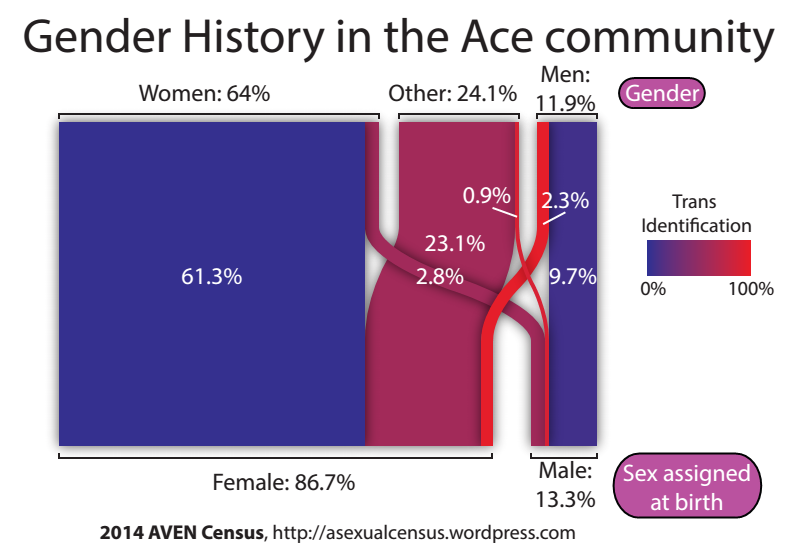
Anyway, let’s talk about the results on gender from 2014:

gender history

This figure was originally published here, but I made a slight revision. The width of each line is proportional to the percentage of the ace community. The color of each line indicates how many people in that subgroup identify as trans or unsure. “Other” refers to people who indicated that they were neither men nor women, but throughout this post I will refer to this group as non-binary.*

Within this figure is a cross-section trans politics. The biggest surprise to me was how few non-binary people identify as trans. But I should first offer brief comments about other features of the data.
[Read more…]

Love is chemicals, and I am grateful

The problem with a naturalistic world view is that everything is just a bunch of chemicals bouncing around, and nothing means anything. The only way to produce any meaning is if there are a few supernatural spirits bouncing around too.  You know, so they can moan about the meaning of life, the nature consciousness, and objective morality.  Or something like that.

But let’s be real. Chemicals are not “just” chemicals. Quarks and leptons can be quarks and leptons, while at the same time forming chemical structures. Likewise, a chemical can be a chemical, while at the same time forming a person. When we say that love is “just” chemicals, it is not a statement of fact, it is an aesthetic.

A common criticism of naturalism is that it forces us into the “just chemicals” aesthetic. But that’s just one of many aesthetics available to us. If you want to say “love is free yet binds us“, I don’t entirely know what that means, but it seems consistent with reality too. Aesthetics are a matter of preference.

“Love is just chemicals” is an aesthetic I prefer, and I think you should prefer it too. The chief point is that chemicals permit diversity. Love can be experienced in a variety of ways, or not at all, and that’s okay.
[Read more…]

Sexual revolution = sexual assault?

In 2015, I saw an article called, “I’m A Gay Man Who Loves Sex (And Here’s Why That’s Suddenly A Problem)“, by Noah Michelson. Most of the article is about defending the sexual openness and promiscuity of gay men. But I just want to talk about this one line:

Caramanno is disturbed by “the male gaze” and the way that he has been groped in gay clubs and “eyed by guys the way a hungry CrossFitter stares down a packet of bacon” (which, if you ask me, sounds pretty hot)…

Here, Michelson is criticizing another article by someone named Caramanno.  The groping that Caramanno is complaining about is unwanted groping. Not that the Michelson could be bothered to mention the unwanted part. He simply dismisses Caramanno’s complaints in one throwaway line in an otherwise trite article about the sexual revolution.

You know what, guy? I don’t give a shit about your sexual revolution, because apparently you don’t give a shit about sexual assault. You didn’t show the slightest awareness that you even knew you were talking about it. Somehow, for you, complaints about sexual assault are the same as complaints that gay men get around too much. The fact that promiscuity involves consent but sexual assault does not was somehow too subtle a point. Fuck you.

[Read more…]

Rational ideals

This post is for the Carnival of Aces, whose theme this month is “Questioning your faith“.

Leaving religion was a rather unemotional process for me. There was no catalyzing event. I was interested in skepticism. I learned about philosophical arguments for God, and found them unpersuasive.  Without any real urgency, I spent a whole year thinking to myself, “Gee, there’s really no justification for belief in God, and there may never be.” At the end of the year, I considered myself an atheist.

Unlike leaving religion, leaving straightness was a far more emotional experience. And yet, I tried to treat it the same way. “Am I straight or am I asexual?” was an intellectual puzzle, to be approached under the same rational ideals.  It is not clear to me, after the fact, that this approach was a good idea.  Here I give a taste of my thought process.
[Read more…]

Signaling in social justice language

Social justice activists like myself have a tendency to construct a lot of rules about which words to use or avoid. For example, “gay” is preferred to “homosexual” because the latter is too formal, clinical, and distant. On the other hand, “homosexual” may be acceptable when it’s used in parallel with “heterosexual”, or if it’s contrasted with “homoromantic”. These rules can be frustrating to learn, but they have some rationale behind them.

And then there are other rules which just don’t have any clear rationale. For instance, “gay” is to be used only as an adjective, never as a noun, and certainly never as a plural noun (i.e. “the gays”). Why? We don’t have a problem with using plural nouns for other identities, such as “Americans”, “liberals” or “atheists”. Even other sexual orientations are usually acceptable, as in the case of “lesbians”, “bisexuals”, or “asexuals”.

On an individual level, the only rationale is that “the gays” just sounds wrong, and conjures negative associations. It makes me think of conservative preachers talking about all the evil things the gays are up to.

On a broader scale, this is a clear example of signaling. Following arbitrary language rules indicates that a person has taken the time to educate themselves and exercise a little empathy.
[Read more…]

I’m glad it has come to bathrooms

This may be a contentious statement given that I am: a) not trans, and b) not living in North Carolina, Mississippi, or Alabama. But I am glad that bathroom bills have brought discrimination and harassment against trans people to national attention.

The fact of the matter is that denying trans people access to public restrooms did not start with bathroom bills. It was already an ongoing problem.

In the last few years, when US marriage equality was imminent, LGBT activists were worried about what would come next. For so long, marriage equality has been the LGBT issue in the US, as perceived by allies and outsiders. Activists themselves knew there were plenty of other issues like employment discrimination, trans healthcare, and de facto health and economic disparities. But if the general public starts to believe queer issues have already been solved, just like they believe for racism and sexism, then activists would run out of steam and funding.
[Read more…]