I released my game

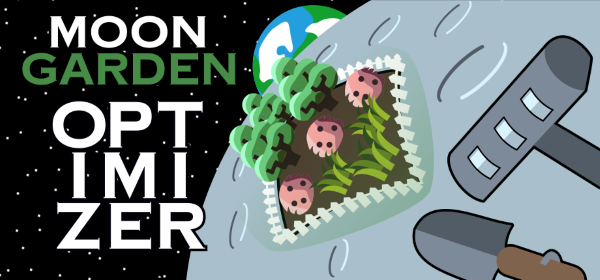
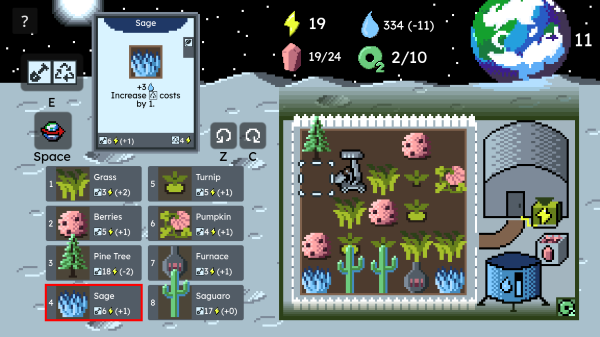
I released my game, Moon Garden Optimizer.  It’s a puzzle strategy game about growing a tiny garden on the moon while optimizing water usage.  It’s inspired by deckbuilders like Dominion, but it supports unlimited undo.

Screenshot of moon garden optimizer

You can play for free in browser on itch.

Most people are here because they like my writing, so I’ll mention that the game has writing!  As a reward for beating challenges, there’s philosophical dialogue between the robot protagonist and her human manager.  It’s fairly silly, but takes a bit of inspiration from modern AI.  For example, the human has unwarranted confidence in the robot’s expertise.

Reviewing 6 conlang games

A conlang game is a game that asks the player to learn a fictional constructed language. Recently there have been a few well-known examples, namely Heaven’s Vault (2019) and Chants of Sennaar (2023). And so we may speculate about the emergence of a new “genre” of conlang games. Of course, two games does not a genre make. So I am here to tell you that I have played no fewer than six conlang games, and I’m going to briefly review each one.

[Read more…]

How I developed a game

I made a video game. I have not published, but I’m currently looking for playtesters.  In fact, I’m trying to get playtesters right here and now, please let me know if you’re interested!

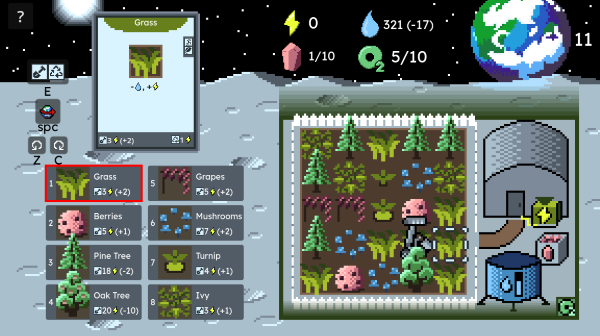
It’s a small puzzle strategy game titled “Moon Garden Optimizer”. I’m sure say more about the specifics of the game design at a later time.  Today I’m sharing my development process up to this point.

moon garden optimizer, recent screenshot

A screenshot of my game

[Read more…]

That time a cozy game triggered me

Gather round, it’s anecdote time.

Unpacking is a critically acclaimed indie game from 2021 that asks the player to unpack items from boxes, as if they had just moved. From this basic idea, a low key narrative emerges, following an off-screen character as they move from place to place at different stages of their life. And you can track their interests and circmstances by the various tchotchkes they bring with them.

Perhaps it’s a bit hyperbolic to say Unpacking triggered me. However, I did find it so unpleasant that I DNF’d it, despite its short run time.

[Read more…]

My economic simulation of spacefaring kittens

Kittens Game is a clicker game that you can play in your browser. It makes a strong first impression, as it tempts you into choices that will kill off your kittens within twelve minutes. But I’m not here to review the game, I’m here to talk about spreadsheets!

Clicker games often support passive gameplay (e.g. leave it running overnight), active gameplay, or any combination of the above. On the very active end, you could try to optimize it, setting up spreadsheets to run calculations. So, I spent a thousand years tinkering with spreadsheets, and I liked it. There’s a story there, a mathematical story.

[Read more…]

Mysteries do not need to be solvable

In the past year I’ve gotten into reading mystery novels, and this has reinforced one of my strongly held opinions about the genre. There is a mistaken preconception about mystery novels, that the reader ought to be able to solve the mystery. This simply is not true. There are some mystery stories that are meant be solvable, but it’s a minority of mystery stories that I’ve seen. Solvability is not the primary appeal of the genre, or at least it’s not the appeal to me.

The reason I know this, is because when I was young, we had a “complete works of Sherlock Holmes” book, which had all the short stories. I didn’t read them all, but I read enough to know that Sherlock Holmes stories were not solvable. Usually, Sherlock Holmes would pull some clue out of thin air, that hadn’t been mentioned before; or else there would be an event that led to the mystery being solved. It was unambiguous that most stories were not even trying to be solvable. The mysteries were trying, first and foremost, to be stories. There’s something the reader doesn’t know (rising tension), and then Sherlock Holmes explains it (releasing tension), and that’s a simple but effective narrative arc.

[Read more…]

The information theory of Mysterium

A question that keeps me up at night is “What is the theoretical best you can do in Mysterium?” I’m exaggerating a bit, but it is a pointless question about a silly board game that I nonetheless spent too long thinking about. I went so far as to watch a series of lectures about information theory–listening to it in the background while in dance class, as one does. I never solved the problem, but let me at least explain what the problem is.

Mysterium

Mysterium is a cooperative board game where the players are trying to solve a murder mystery via psychic communication with the victim. One player takes the role of the ghost, and the rest take the role of psychic mediums. The ghost is not allowed to speak, and may only communicate through cryptic visions. The visions are represented by cards with surreal artwork. For example, one card has two people climbing into a giant fish mouth, another has a tarantula-like thing over a chandelier. After the mediums receive their visions, they discuss what they mean and make their guesses; and the whole time the ghost giggles about how wrong they are.

Example visions: two people climbing into a fish's mouth; a polar bear and spirit owl read a book; a chandelier hanging from strings from a tarantula's mouth

Examples of vision cards.  Source: Mysterium rulebook.

[Read more…]