The last bloom of Nightjar’s early winter flowers series and it’s a beauty.

Speedwell (Veronica sp.),©Nightjar, all rights reserved
Thanks, Nightjar. It’s been lovely to have so much sunshine and colour at this time of year.

The last bloom of Nightjar’s early winter flowers series and it’s a beauty.
Speedwell (Veronica sp.),©Nightjar, all rights reserved
Thanks, Nightjar. It’s been lovely to have so much sunshine and colour at this time of year.
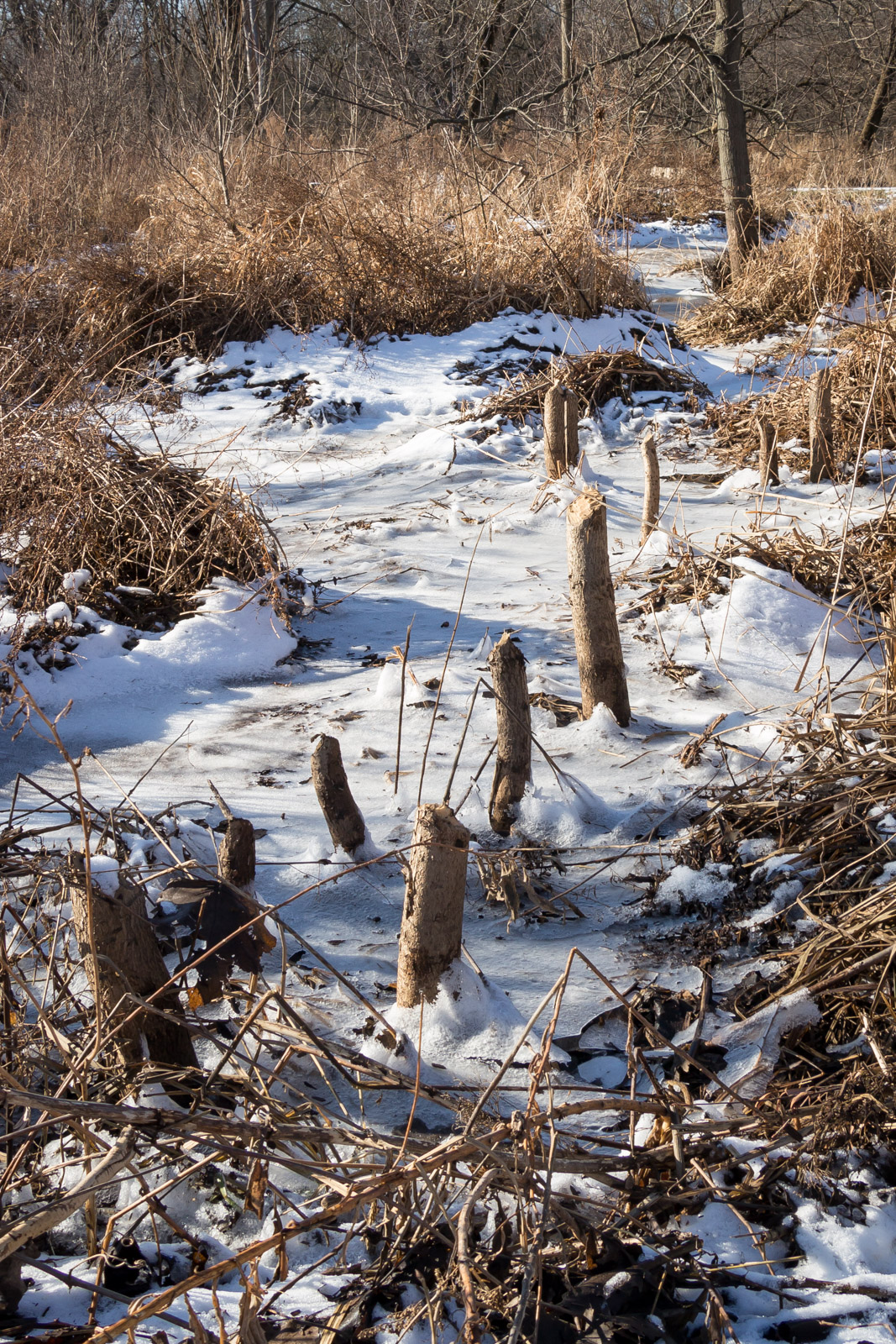
©voyager, all rights reserved
Jack and I put on our voyageur berets this morning and went hunting for beavers in the wetlands of Canada. The morning air was frosty and a constant westerly wind bit at our cheeks as it blew past us. Conditions on the ground were challenging with large muddy areas lightly covered by a wafer thin sheet of snow and ice that easily buckled under the weight of the dog. We picked our way upstream with me slipping and sliding and Jack looking anxiously over his shoulder to make sure I was still upright. We didn’t get too far though when the route became clogged with tangled brush and reeds that ultimately forced us to retrace our steps in retreat. I think we were getting close to the lodge in this area. We found several gnawed trees and a whole patch of gnawed off saplings. At first, I thought the sapling patch would lead straight to the den, but nope. The beavers haven’t set up shop here, but I think they’re close by. Maybe tomorrow we’ll try the other bank of the river to see if we can get farther.
I thought that Nightjar’s sunny Marigold photo from yesterday couldn’t be beat, but today she’s sent us an entire field of bright yellow Marigolds. I love the way the focus fades and the flowers start to look like bright yellow balloons bobbing in the breeze.

Marigolds (Calendula arvensis), ©Nightjar, all rights reserved
Thanks, Nightjar
Just goes to show, Estonians are show-offs. Even their rivers make perfect circles of ice (article in Latvian, but it’s the visual that’s important).
Video here, I can’t seem to embed it, except like this: .
At any rate, it’s another interesting natural ice phenomenon known by various names, and observed in various parts of the world. Here’s National Geographic:
While the Russian ice circle is rare for its large size, the phenomenon isn’t quite as unusual as it might seem. Ice disks have been filmed in North Dakota, Washington state, and Michigan.
Early theories of why the disks formed centered on erosion. Ice disks observed in 1987 and 1994 were in the path of flowing river waters. A paper published in 1997 by the Royal Meteorological Society theorized that flowing river water created a whirlpool effect. As the ice spun, researchers theorized, the borders eroded into a circular shape.
A study of ice disks performed in March of last year modeled how this wasn’t quite the case.
Published in the journal Physical Review E, researchers from the University of Liege in Belgium found that temperature changes—and not flowing rivers—prompted the spinning. As water warms it becomes less dense, and as it’s cooled by surface ice, a vortex forms.
Neat!
I was stuck between two songs, but this seems the most obvious choice:
(runnerup)
A gorgeous, bright yellow Marigold from Nightjar’s series of photos, Early Winter Flowers from Portugal. This photo even a wee visitor taking advantage of all that sweet, sticky pollen.

Marigold (Calendula arvensis), ©Nightjar, all rights reserved
Thanks, Nightjar.

Even my favorite resting spot seems uninviting today. ©voyager, all rights reserved
The warm, welcome sunshine of yesterday has given way to dark and gloomy skies today. It’s hard to tell what time it is outside because it always looks the same. There isn’t even any grainy mist or fog to enhance the mood. It didn’t seem worth going back to the river because the ground is still muddy so Jack and I went exploring around the neighbourhood instead. I hope it gets colder soon (wow, I can’t believe I just said that!) because I think I know which direction the beaver den is, but I need firmer ground to get there. It’s winter. In Canada. It’s supposed to be cold.
I’m working on it. It doesn’t help that I have writings planned out in my head and keep choosing not to put them down in writing when I have half a chance.
In the meantime, see this excellent winter weather (this is Sunday morning around 11, in case anyone is wondering about my early rising habits).

©rq, all rights reserved.
Another of Nightjar’s beautiful winter flowers from Portugal.

Hawkweed, ©Nightjar, all rights reserved
Gorgeous. Thanks, Nightjar.
Another early winter flower from Nightjar. The colour and light in this shot are enough to melt my cold winter heart.

Geranium molle, ©Nightjar, all rights reserved
Thanks, Nightjar.

Sunshine at last, ©voyager, all rights reserved
Zip-a-dee-doo-dah, zip-a-dee-ay
My, oh, my, what a wonderful day
Plenty of sunshine headin’ my way
Zip-a-dee-doo-dah, zip-a-dee-ay!

©voyager, all rights reserved
It’s another gray day with skies so dull it’s looked like early evening all day long. We did find a few pockets of snow to reflect some light, but even that seemed thin and wan. Nonetheless, we had a pleasant walk together in companionable quiet on the trail of our favourite forest path.
Yesterday we saw the hair ice, today it’s needle ice. I had never seen that before either, and Mr still didn’t because he stomped past it without noticing. But I made sure he saw it the next day.

©Giliell, all rights reserved

©Giliell, all rights reserved

©Giliell, all rights reserved

©Giliell, all rights reserved

©Giliell, all rights reserved

©Giliell, all rights reserved
A little star, caught on an invisible strand of spider silk.

©Giliell, all rights reserved
These images show hair ice, a phenomenon that happens when very wet wood, usually colonised by fungi, freezes. I have never seen this before and man is it gorgeous. It can happen on wood lying on the ground, but also on dead twigs still attached to the tree.

©Giliell, all rights reserved

©Giliell, all rights reserved

©Giliell, all rights reserved

©Giliell, all rights reserved

©Giliell, all rights reserved