Project Badgermascus – Part 12 – The Final Badgering

The knife is finished, although not sharpened, and here are the final pictures. I am going to make more knives of this design because I think it is a good knife for forest walks, especially mushroom hunts. And I am naming the design “Badger”.

© Charly, all rights reserved. Click for full size.

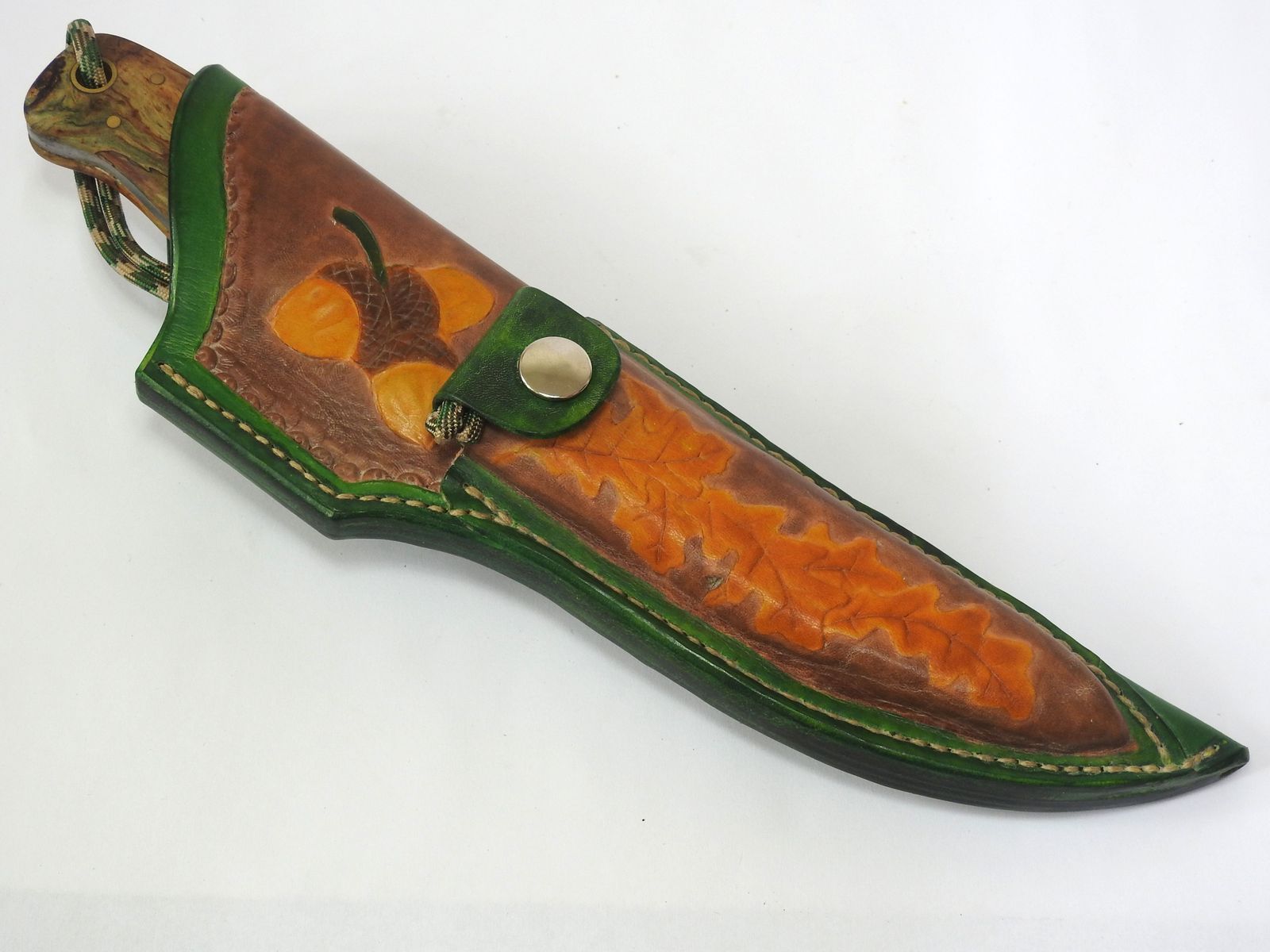
The overall length in the sheath is 205 mm. The sheath is from vegetable-tanned leather, carved (badger paw print, frame edge), stamped (leather weave, edge trimmings) and dyed, thoroughly infused with beeswax, oiled with olive oil on the inside and buffed with dubbin outside.

© Charly, all rights reserved. Click for full size.

The sheath has a metal belt clip. This allows the knife to be worn not only on the belt but also clipped onto/into the pocket or boot. The pommel sticks out of the sheath far enough for a comfortable grip with index finger and thumb when pulling the knife out. The knife clicks into the hardened leather firmly enough to not fall out of it with its own weight, but can still be pulled out comfortably.

Stitching is made with a two-needle saddle stitch with artificial sinew. The end knots are melted together and hidden.

© Charly, all rights reserved. Click for full size.

Brass fittings have a black patina with clear brass badger paw-prints over the pins. Scales are from naturally aged cow bone, slightly larger than the tang and wider than the brass fittings. The right scale is adorned with scrimshaw engraving of a badger head – this is a new skill that I had to learn but kept secret since I had no guarantee it will work out. I think it did work out OK. I may add a bit more pigment once this hardens, but maybe not, I like it the way it is. The badger is colored black with coal dust, the patterns, and the frame, with ochre (rust).

© Charly, all rights reserved. Click for full size.

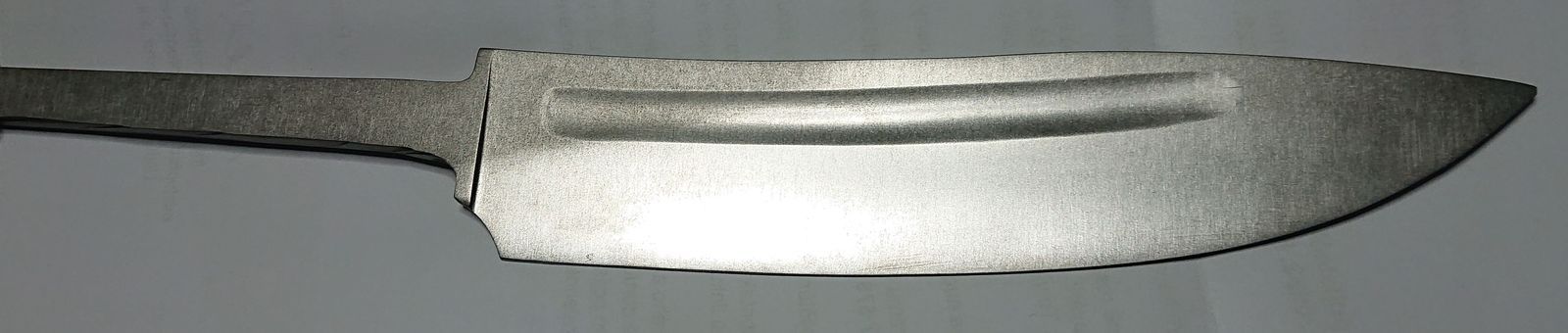
Handle length 100 mm, drop-point style blade 87 mm length, 3 mm thick at the ricasso. Point of balance just behind the first two pins in the handle scales, also between the index finger and middle finger. It feels a bit handle-heavy but nimble. The steel has dark-grey patina from an oak bark extract.

© Charly, all rights reserved. Click for full size.

The left side of the handle is unadorned except a few scratch grids around the pins. The left side of the blade has significantly different steel pattern due to how the san-mai was hammered at the Badger Forge.

© Charly, all rights reserved. Click for full size.

Back of the tang has a row-of-crumpled-leaves fileworks, the belly has a simple triangle pattern.

Overall, I am satisfied with my work here. There are things that I am critical of, there are things that I definitively might have done better – it is not a masterpiece yet, but I think I am getting there. I have learned a lot again and many of the things that took me several days this time should be just a day or even less the next time (the leatherwork for example).

Project Badgermascus – Part 11 – Stitch This!

The day before yesterday I had to make the leatherwork all anew, because I spilled some glue on the forefront of the sheath and it has proven to be irreparable damage, it completely ruined the leather. So I have made a new piece, this being, therefore, the fifth attempt. And when I was at it, I have improved my tools to make a better job.

© Charly, all rights reserved. Click for full size.

I have re-filed the basket-weave stamp to make it crisper and bite more deeply. That has allowed me to better feel the position of the stamp when moving it along the edge and positioning it in the next point on the pattern grid. I have also used a straight edge and I scribbled a faint line for each row before stamping along it.

To get the dye better into the tips of the claw marks I have needed a very fine brush, so I had to make one. And since I do not have any weasel hair, I have used a few strands from a goose feather. It has worked perfectly.

This is my first attempt at a sheath with a metal belt clip. I have first riveted the belt clip to a piece of leather and then glued/stitched that piece of leather onto the sheath. Only then have I glued and stitched the rest of the sheath together. This avoids any contact between the knife and the metal of the clip and secures the clip very firmly in place.

For making the holes I have used 2 mm drill bit in my drill press since I found that to be by far the most convenient method. For stitching, I have used saddle stitch, and I hope I have used it correctly. I had trouble finding a comprehensive tutorial on how it is done.

BTW, holding the work between my knees is really uncomfortable, I will have to make myself a proper tool for this. So many tools that I still need… Anyway, back to the stitching.

© Charly, all rights reserved. Click for full size.

Saddle stitching is made with two needles and here you can see how I do it. First I am pulling the right needle through the hole all the way to the end (top). Then I put the left needle in the hole whilst wrapping the thread from the right needle around it in a loop (middle). When carefully pulling the left needle through the hole (taking care to not stitch through the thread already inside) it creates a knot that gets tightened inside the hole when both threads are pulled to the limit (low). This kind of stitching is very strong and it does not unravel even when the thread is worn/cut/breaks in one spot.

© Charly, all rights reserved. Click for full size.

The almost last step in making the sheath was wet forming. I have put the whole sheath into lukewarm water and let it soak in there as long as bubbles were coming out of it. When it was all soft and pliable, I have wrapped the knife in food wrapping foil, put it in the sheath and formed it around it simply by finger pressure until it had a shape that I wanted. I have used clamps too, but only for a few minutes around the edge, I did not leave in clamps until it was fully dried, it was not necessary. In fact, to let it dry I have simply hung it on a window handle as you can see in the picture.

Today was the final day of this project. I did make some minor mistakes when making the sheath, so I had to glue a little wedge of leather inside with five-minute epoxy, but that is simply a lesson learned for the future and not something to worry about aesthetically or functionally. I must simply remember next time to make the blade portion shorter (and slimmer) and the handle portion longer. But it was working just fine, the knife holds in it strong enough to not fall out, but it can still be pulled out with just two fingers by the pommel. So I have infused it with beeswax and dubbin*, so it is hard almost like plastic, but still with a pleasantly natural and organic feel to it. That made it a lot darker and I applied some black patina too to make it look a bit aged, to fit the knife.

So, after a month of procrastination interspersed with bouts of hectic work and attempts at learning new skills, at least one piece of steel out of three has made it into a final product. I am going to try and make some nice pictures and tomorrow I will post them.


  • The dubbin that I have made almost two years ago and which I stored at room temperature the whole time did not go rancid or moldy or bad in any noticeable way, and the leather on the products I used it on did not degrade in that time either.


Project Badgermascus – Part 9 – Almost Done

The knife is done about 95% now. I have peened and ground flush all the pins on scales without some major failure, although there did appear one tiny crack near one of the pins ‘sigh’. I have sealed the crack with super glue and sanded it over, there is nothing else that can be done about it.

I did not do a very good job at the pins, I must say. I think the mistake that I make is leaving myself way too much material to move, which leads to a lot of problems later on. I must remember that for 3 mm pin it is quite enough to peen less than 1 mm material into a recess just 0,5 mm deep. It is not as if the pins need to hold extra-strongly.

But, it is done and it is what it is. I applied a little bit of patina to the pins. Not to make them black, just to make them ever so slightly aged. Funnily enough, the patina has highlighted some of the imperfections – and that made the whole assembly to look actually better. Only you must forgive me for now for not revealing the whole knife yet. There is still a lot of work to do before I consider it publication-worthy, do not expect that very soon.

© Charly, all rights reserved. Click for full size.

I am thinking now how to best seal the surfaces and the patina. Either beeswax, or drying oil. Or both. Any suggestions? I have zero experience with patina on metal jewelry, which essentialy is what this is.

Project Badgermascus – Part 8 – To Peen or Not to Peen…

Today was very stressful, although I did not, in fact, do too much work. But I was agitated about it so I procrastinated a lot, putting off each step for fear of mangling the work and losing a lot of progress. That will also be the case tomorrow.

Today was the day of gluing the scales to the tang. And because I wanted to peen the pins from the beginning, I also had to prepare for that.

For I lack proper ball-peen hammer for this kind of job. I have a wide variety of cross-peen hammers, but only one, big, ball-peen hammer. And that is way too big and chunky for 3 mm brass pins. They are not sold in any stone shop around here, and ordering one online would again put me in the age-old problem – is it worth buying something if the shipping costs more than the product?

So I have to make do with my smallest cross-peen hammer and a few thingamajigs that I have made myself to make the job easier and, hopefully, better.

© Charly, all rights reserved. Click for full size.

Peening pins in bone is kinda dangerous. Bone is hard, but not particularly strong and it can easily split. To try and reduce the risk of splitting I have therefore pre-peened one side of each pin before assembly, so the pins are shorter and thus less likely to bend when I am peening the other side. To make a better job of this I have taken a piece of mild steel from a failed attempt at burner diffuser and I drilled in it 3 mm hole, chamfered to about 5 mm recess on one side. Then I held the pins in a vice and peened one end into this recess.

The second tool that I have made is from an old hook-nail. It is very old and therefore good medium carbon steel, hardenable, although not to the highest degree, and very tough. If the tool works, I am going to carburize the surface and quench it.

© Charly, all rights reserved. Click for full size.

First I have cut off the hook and the tip. Then I have center-punched the center of the square where the tip used to be and dished it out first with a 3 mm bit and then 7 mm bit in a hand-held cordless drill. Then I put a big diameter ball burr for die-grinder into the drill and rounded the inside of the dish and I ground the edges round with a file. I have tried it and it seems to work well when used after the hammer for the final touches on the edges. So I hope to get nice round peened pins tomorrow.

With that done, I have also repaired one of the scales – two holes were a few tenths of a millimeter off so I could not put the pins comfortably through all holes. Not a big problem, I have filled the two holes with quick-curing epoxy mixed with bone dust and drilled them new. You would not notice there was a mistake there if I did not tell you about it.

Then I was ready for the job that I was putting off – the glue-up.

© Charly, all rights reserved. Click for full size.

I have used slow curing epoxy, with work-time 1,5 hours, instead of the 10-minute one that I have used previously for kitchen knives. The reason for this was not only to reduce stress and the possibility of a complete fuck-up, but also the fact that this simply could not be done quickly. Mixing the epoxy, slathering it over the tang and attaching the pins and the scales was simple enough, but after that came the difficult part – to clean all the squeezed-out epoxy from the fileworks. I have used first small pieces of kitchen towels soaked up in denatured alcohol to wipe out the biggest excesses and then a toothbrush soaked in the same to tease-out glue from al the nooks and crannies. I do hope I have made a good job because there is no way back now except either take it as it is or to drill out the pins, smash and grind out the bone and start with the handle scales all over again, which would not be fun at all.

Project Badgermascus – Part 7 – The Pinkening

For the next attempt at the patina, I had to think of a more fool-proof way to mask the areas of the assembly that are not allowed to come in contact with the chemical solution. I have used plastic packaging tape in the past, so I tried it this time. But the one I bought this time is extremely difficult to take off because the glue is too strong. That makes it also difficult to apply tightly around the blade since once it gets stuck, it cannot be corrected. And, the masking around the filework was a major headache-inducer, there the tape was totally insufficient.

So I needed something that is resistant to water and water-soluble chemicals both acidic and basic, hot and cold, something that will show me clearly what is masked and what is not, something that can be applied with high precision and good adhesion to complex surfaces and simultaneously can be removed easily later on without damaging the patina.

And after some thinking, I did come with a solution that worked really well. I made everything pink!

© Charly, all rights reserved. Click for full size.

That is the cheapest nail varnish that I have seen at the local drugstore (2,-€ per bottle). Afterward, I have added the packing tape on big surfaces, but I think it was unnecessary and just me being overcautious.

© Charly, all rights reserved. Click for full size.

I proceeded to make the patina on brass fittings by alternating between acid bath (HCl, very diluted) and polysulfate bath (with occasional brushing with a soft brush under running water) until I have received a color that I was content with, which is sort of metallic blue/brown/dark gray, very similar shade to the oak-tannin patina on steel.

Cleaning off the varnish was a bit of a hassle and used up a lot of paper towels and acetone, but the important bit is that it could be done, could be done well (it was easy to spot uncleaned places) and did not scratch the patina on either the fittings or the blade. I will probably buy heaps of cheap nail varnish, it opens up great possibilities.

Project Badgermascus – Part 6 – Trials and Tribulations

I have spent both Monday and Tuesday finishing flattening, drilling, and fitting the handle scales and the brass fittings.

© Charly, all rights reserved. Click for full size.

First I have sieved some bone dust that I have collected through a fine nylon mesh (from pantyhose – I do not wear them, but they can be quite useful in the workshop, so I have indeed several in a drawer). I mixed then the bone dust with five-minute epoxy, filled the hollow back of the bones with it and heated it with a heat gun to about 70°C (not so hot you cannot touch it, but hot enough you cannot press your hand against it for a longer time, a hairdryer would suffice too for this particular task) for quicker curing and stronger bond.

After it completely hardened I ground the back flat again and proceeded to drill the holes for pins.

© Charly, all rights reserved. Click for full size.

Drilling the holes was relatively uneventful. Double-sided tape was very useful in holding the scale on the tang and the whole assembly on a flat piece of wood for drilling to avoid chipping of the bone on exit. Also, I have used blunted and overheated drill bits to hold the scales in place for a good fit and I did not mess up the job terribly. I did make minor mistakes on the left handle scale, but those should be correctable when fixing everything together.

With the scales drilled and fitted against the bolster, I proceeded to make the brass pommel fittings. That went really well, and everything went smoothly. Too smoothly you might say. I glued the brass fittings in place, peened the pins and ground, and polished them over.

That is where the problems started, and I must say – they are not all my fault.

The first problem was that the round stock I have used for pins apparently has different chemical composition than the flat profile used for fittings. Had I known this, I would not file them flush and I would leave them slightly proud of the surface (“admitted” instead of “hidden”). However, there was no way back once I ground them flush, so I was hoping they will get hidden under the patina.

But the patining did not go well too, in three ways.

© Charly, all rights reserved. Click for full size.

The first  – I have made a mistake – I have not masked the steel properly. I thought I did, but I just did not. And as one Czech rather rude but astute saying goes – ” myslet znamená hovno vědět” – “to think (assume/mean/guess) means to know shit-all”. So when I was giving the brass a nice hot bath to copper plate it, some of that bath leaked under the masking and copper-plated and etched the blade in some places too.

The second – the different brasses did not take copper plating identically, it was a lot more difficult to copper plate the pins than the rest. It took over an hour to do on the pins what took mere minutes on the rest (which exacerbated the problem with poor masking later on).

The third – when blackening, I have made the solution probably way too concentrated. It has covered the parts in a nice jet-black matt color almost instantly. But that color has completely rubbed off when I washed it with water and brush. I did not realize the true cause of this so I tried it two more times, but it just did not take, especially not on the pins, After the third attempt I thought I am done on the pommel at least, but it flaked off the next day again.

These mistakes are not catastrophic, but they are a major setback. I had to re-polish everything (done), re-etch with ferric chloride (done), give the steel new tannic-acid patina (in progress), and only after that is done to my satisfaction, can I again try to patina the brass.

However, I have to deal somehow with the pins now. They are ground flush already, but since they will not take the patina the same way the rest does, I must leave them visible. And that means probably leaving them polished and not applying patina to them at all. I will do that and then I will decide whether I like it or not. If not, then I will have to drill them out and either replace them or, if I bungle that job (which is very likely) to make completely new fittings. Either way, it is at least one day, and possibly several days, of work before I can progress further.

However, there did come one good thing out of this – I found two new recipes for black that do not require copper-plating the brass first. One requires hot-bath with ammonia (CuSO4+Na2CO3 – precipitates basic copper carbonate which after filtering and washing with water can be dissolved in hot water by adding ammonia), so it is a major stink and not exactly easy or quick. The second one works at room temperature but is rather caustic and dangerous to handle (HCl + potassium polysulfide). I will probably try the second one now, although I do not like very much working with caustic solutions, since my equipment, as you have seen, is not exactly suited for that kind of job.

Project Badgermascus – Part 5 – Handle Scales

Tomorrow you will get a break from this project, I promise. But today, the Great Flattening from yesterday has continued.

After some deliberations I have decided to try and go for fully blackened brass fittings. That means that the blade will be dark grey, and the fittings really, really dark gray. What kind of handle material should I use? Marcus has sent me a nice piece of stabilized spalted maple, but I do not think it is the right material for this project. Ditto, any of the dark woods that I have. I think the blade deserves the poshest material I have available – bone. I think it will provide a nice contrast to the dark metal.

© Charly, all rights reserved. Click for full size.

Which meant I first had to rough-cut the scales with a hacksaw, which is one hell of a job, let me tell you. Bandsaw or any electrical saw is a big no-no for cutting bone, this has to be done manually. Including pre-cutting he flat sides, before grinding them truly flat.

Thus I had to spend the whole working day with a respirator and my fingers are all sore now. Because the grinding had to be done manually too. Belt sander does work on bone, but it destroys belts way too quickly for my liking and as I learned in the past, these thin flat pieces would have a tendency to be dragged out of my grasp, increasing the risk of injury or bungled work. So flatstone+glue+sandpaper it was. Maybe after I build myself a disk-grinding attachment this work will be easier, but now it is not.

© Charly, all rights reserved. Click for full size.

The scales are ever so slightly bigger than the tang and thicker than the bolster now, and they will remain so. I do not intend for a flush fit, but for a proud one ( I have seen English-speaking knife-makers refer to it as “heirloom fit” although I was not able to find anything specific about it, so I am not sure that is the correct term).

The principle is the same in carpentry – whenever two surfaces join, you can make the joint either hidden or visible, but it should not be visible because you failed to hide it. So if you make it visible, it should be apparent that it was intentional. Like gluing in spacers, making the surfaces meet in a groove and not on a flat, etc.

© Charly, all rights reserved. Click for full size.

Today’s work ended in the kitchen, where the two rough-ground scales ended in a pot at 60°C for an hour or so with circa a teaspoon of washing soda and one spoon of washing powder in 1 l of water to dissolve and wash out as much of remaining fat as possible. In the end I have added a teaspoon of hydrogen peroxide to whiten the bones a bit, although complete whitening is not possible on these.

Tomorrow when they are dry I shall fill the hollows on the inside (where marrow used to be) with epoxy to make them flat. After that, I can start the remaining works, i.e. fit and polish the pommel, drill all the holes, and finally, the glue-up. We will see how that goes.

Making Kitchen Knives – Part 16 – Human-knife Interface

Last time I did this, I shaped the handle-scales first, then I fumed them wit ammonia and then I glued them onto the knives. This time I have changed the order of doing things, but time comparison should still be possible.

After taking the pieces of wood out of the solution I have left them dry. First for a few days outside, out of direct sunlight and out of the wind, with both end-grain ends covered with plastic to reduce cracking (still insufficient, next time I will have to try something more drastic). After they were dry and stink-free, I put them for a few days into the direct sunlight to dry even more, and then I left them to stabilize in the workshop for a few days. That way the wood should be neither too wet nor too dry and hopefully, it won’t change in size too much.

When I started to polish the pieces to sort them out properly – any markings were taken out by the solution – I could not find the oak pieces anywhere. So I took an offcut that was not in the solution and I polished that a bit and I realized that it is not, in fact, oak, but an especially dirty and grimy piece of black locust. I do not even remember where I got it and why I thought it is oak in the first place…

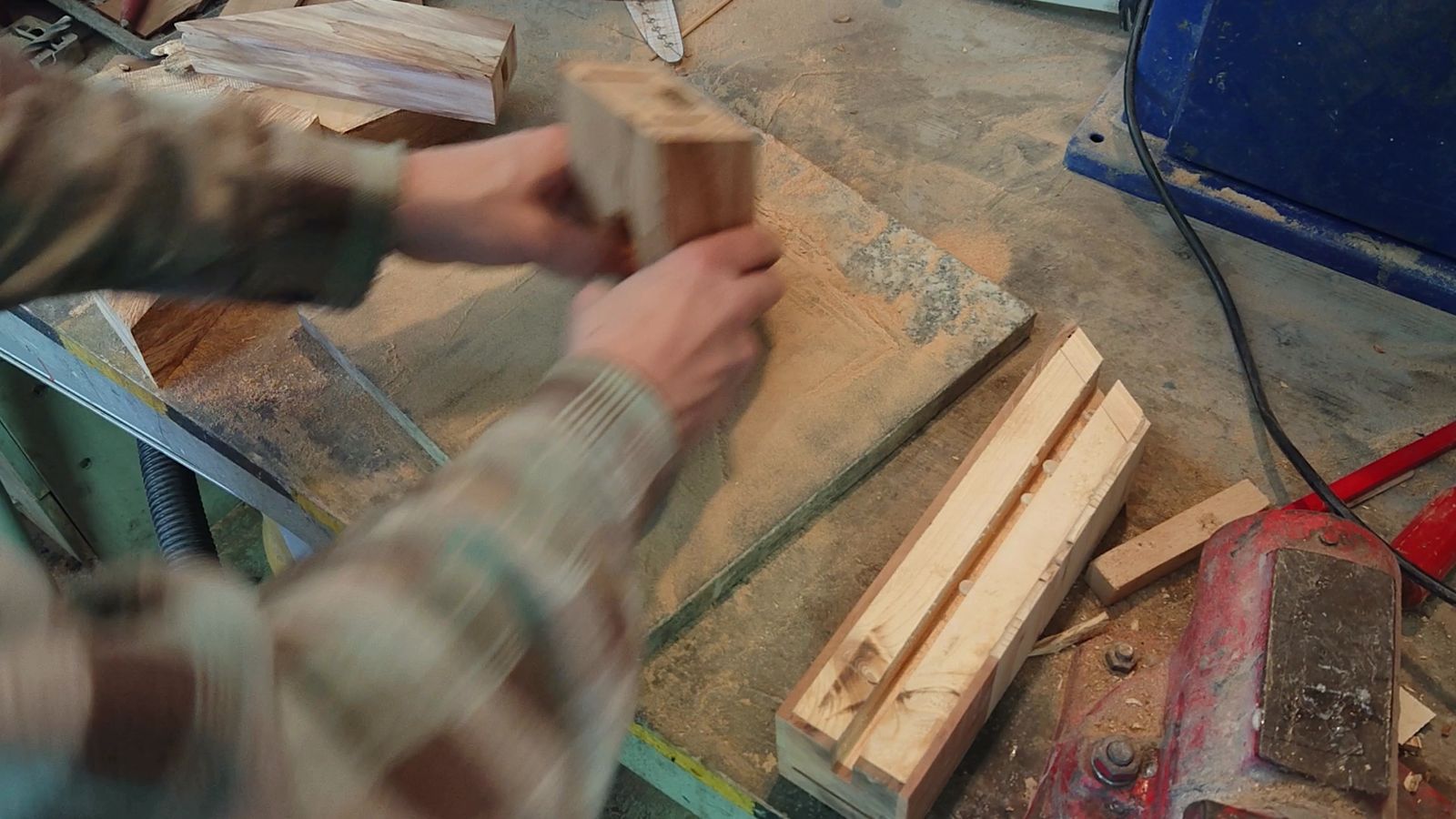
Anyhoo, after grinding all the pieces to flat and parallel, I drilled the holes for pins, cut all pieces to a rough shape on the bandsaw and I paired them up and I shaped and fully polished the forward-facing facets since those won’t be accessible once the scales are glued on. What I learned here was that I will need some finer scaled drill bits, since different woods react differently and when you drill with a 6 mm drill bit, the resulting hole can be anywhere between 5.5 and 6 mm. And trying to force the 6 mm brass pins through some pieces was a real pain in the nether regions. I have to drill the holes in wood ever so slightly bigger than the intended pin, but whilst 6.5 mm was fine for the softer woods it was almost too much for the harder ones.

The next step was glue-up.

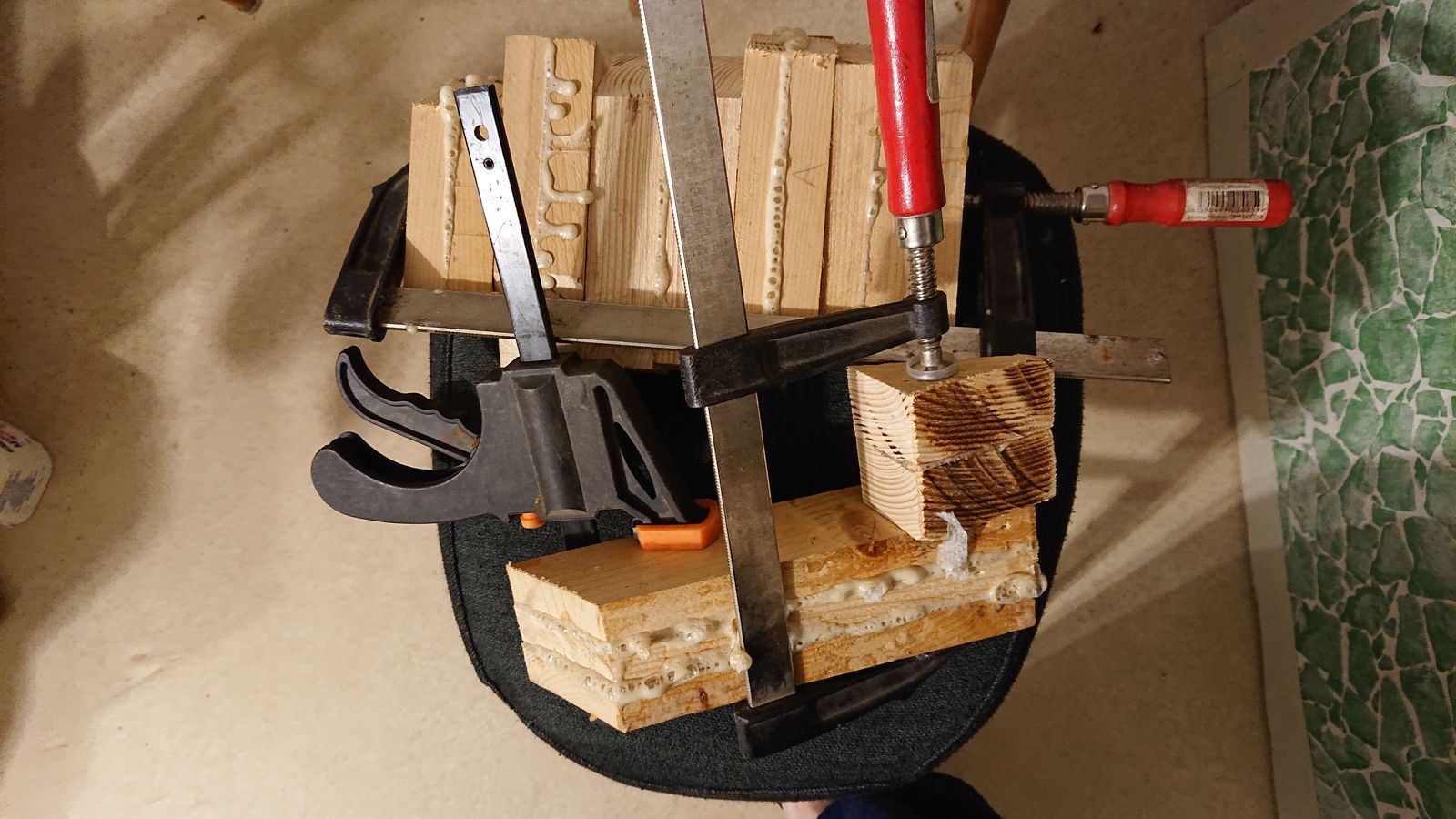
To get as near perfect flat surfaces as I can, I have bought a spray-on glue and I used ti to attach a piece of coarse sandpaper to a granite tile. It worked really well, I have got a very nearly perfect match between the tangs and the scales on all twelve knives, the best result I have got yet for this type of handle construction. But I also managed to get a lot of glue on my hands and I lost the spray nozzle when wiping it off and it took two days before it resurfaced under the shop vacuum. So yeah, not my finest hour and the good came with some bad-ish.

During the glue-up, I have suffered from a common ailment –  the insufficient clamping power syndrome. I had to do it in two stages, gluing six blades in the evening and the remaining six in the morning next day, Which was not too much of a problem this time,  since I was tired and I would have to call it quits anyway, but I will probably need some more clamps or maybe even some thingamajigs for gluing the scales on the tangs more efficiently.

© Charly, all rights reserved. Click for full size.

And this is what I got in the end – a pile of roughly shaped handles attached to the finished blades.

During the subsequent grinding to shape with a 40 grit belt, I still could not do too much to evaluate the real effect of ammonia fuming on these woods, but I did get some inkling of what the results might be already. And let us say that for some of the woods I have preliminarily considered the results promising, for some surprising and for some completely “meh”. More about that when the knives are finished.

This whole step took me approximately 73 minutes per knife, and that is a significant improvement against last time – 38 minutes, 34%.

The last step is polishing the handles up to ~300 grit (already done) and putting on a protective coat of boat lacquer. That will take about a week, an hour or so a day. We shall see how that goes, but that part should be relatively free of any surprises.

The Results are in….

©kestrel, all rights reserved

The tiny horse painting competition has been judged and Kestrel tells us,

I did not win anything but I got an honorable mention in the Gallery division, and the judge – a very well respected top level artist in the hobby – made nice comments about my entry. So that was nice, I appreciated that she made comments. Thought you’d like to know! 

Thanks for the update, kestrel. It’s too bad my vote doesn’t count because I think you should have won first place.

The Finished Little Horse(s)

Kestrel has finished her little horse(s) and I think they’re all fabulous!

I finished my last horse, and in time for the deadline. I’ve already sent in my entries; it’s all over but the crying, as they say.

The final work is pretty subtle; the whites have been altered so they are not so stark, there is slight pinking in the area by the elbow where the hair is thinner, and in that second photo, finally, we have eyes!

©kestrel, all rights reserved

©kestrel, all rights reserved

He looks like he’s saying, “Are you lookin’ at me?” In case anyone wonders: those dark dots on the legs are to represent the chestnuts (as they are called) on a living horse. These are the remnants of a toe, because equids were originally 5-toed.

I’m including the photos I sent in for the contest, posted here in order of my painting them – so this sorrel horse is the first one I painted, and the bay pinto I’ve been working on is the last. Taking clear, focused pictures of something this small is pretty difficult, at least for me. When you get it focused right, the photos are brutally honest, and the artist can see every last tiny flaw and mistake. Well, this is to be expected for a novice like myself – I will hopefully learn a lot here and do better in the future. The dapple grey (third photo down) was particularly difficult for me. That color terrified me because I’ve seen so many people get it wrong; but I like a challenge so I tried it. It was, as I thought it would be, really tricky, particularly at this scale.

I’m not sure when the judging will take place but I will try and keep Voyager informed as to the outcome. I hope you’ve enjoyed getting a glimpse into an admittedly very weird hobby!

©kestrel, all rights reserved

©kestrel, all rights reserved

©kestrel, all rights reserved

©kestrel, all rights reserved

Excuse me, I’m a Little Horse

Kestrel’s little horse is looking better, bit by bit.

Progress! I thought it might be interesting to see how the layers of fine pastel dust build up. People who have never done this before don’t realize that it just takes time and patience; you don’t have to glob the pastel on there, thin tiny layers are the way to go. The nice thing about pastels is they are very slow and you have a lot of control, but it takes many layers to get a nice deep rich color. I’d also like to point out that I changed the markings from the living horse a little bit. It’s one of the nice things about painting; if you don’t like where a particular thing is, you can just move it over a little, or add on an extra blob here and there! 

©kestrel, all rights reserved

©kestrel, all rights reserved

©kestrel, all rights reserved

©kestrel, all rights reserved

Aaaand… now it’s time for some details with acrylics! Acrylics kinda scare me because they are very fast. They dry out so quickly in my area I sometimes can’t even get the paint on to the model, because it dries on the brush as I’m trying to apply it. There are products that slow down the drying time on acrylics and I am using them here.

Although the acrylics are perfect for details, you just can’t get that same degree of blending and shading as you do with pastels. Some people use an airbrush for the blending, but I don’t have one, so it’s pastels for me.

©kestrel, all rights reserved

He’s starting to look like a horse now. In case anyone wonders, eyes are about the last thing you do. It would be very sad indeed if you did the eyes, got them perfect (NOT easy, especially at this scale!) and then the model fell over into a puddle of paint and ruined them. So, you save them for the very last. They really help to bring the piece to life.

It’s starting to look like I’ll be able to get him done by the deadline!

You Need a Steady Hand To Do This

Kestrel has decided to enter a painting competition for a micro mini model horse and she’s bringing us along on the journey.

There is a novice model horse painter contest coming up and I want to enter. The contest is specifically for the category of “micro mini” resin model horses – this is 1/64 of live size, and these little horses are made by a sculptor who then either casts or 3D prints them, depending on who is producing them. I’ve painted only 4 of these micro minis and I’m going out on a limb here – this horse is not done, so I have no idea at this point how he will turn out. I need to hurry though – entries close the last day of March! 

©kestrel, all rights reserved

Here is my painting area cleaned up and ready. I have pastels, acrylic paints, the model I’ll paint, some water, my glass palette, various brushes, a tiny piece of flexible sanding paper, a blade to clean the palette and toothpicks, which I use the way some would use a palette knife. 

©kestrel, all rights reserved

Now for safety! People are supposed to breathe air, not pastel dust or paint fumes, so here is my respirator and a pair of gloves. I also wear a visor on my head that goes down over my eyes, and glasses under all that. Hopefully no one comes to the door while I’m so accoutered… The model has to be scrubbed down with something like Comet. Paint won’t stick to finger prints, grease, or dirt, so from now on I won’t touch this model with my bare hands, I’ll always be wearing gloves until I put the final finish on him. 

©kestrel, all rights reserved

My model is already “prepped and primed”. The little donkey resin is not; he has holes and flaws in the casting, seams and rough areas, and all of that has to be filled in, filed down and fixed so that he has a perfectly smooth surface for painting. After the prepping, I spray the model with primer, in this case I used white primer. 

©kestrel, all rights reserved

I’m using this horse as my reference for how the markings will look on the finished model, although I’ll paint the marking as she is in the summer, all shed out and slicked off, not all hairy and dirty like she is here in the spring. Fortunately she lives right here at my house, so if I get stuck on how exactly a marking goes, or the right color, I can just go outside and look. (Plus I have about a million pictures of this little horse on my computer!) It’s very important to use a reference photo or photos. People show these models, once they’re finished, and the judges know very well how a horse should look. If I just made something up, I might accidentally put markings on a horse that are genetically impossible, and that would get marked down in the show ring.

I can’t take photos while I’m painting, so just imagine me putting the first layer of pastel on the model.

©kestrel, all rights reserved

Now I go to my spray booth, to put a layer of fixative on that first layer of pastel paint. The spray booth has a super powerful motor that pulls air through the filter, up through the hose on top and out the window. That way I don’t have paint all over inside the house, there are no fumes inside the house, and I can paint even when it’s cold or snowing/raining outside. The reason the model is on a piece of tape is because these tiny little things don’t weigh much at all, and as gently as I puff the fixative on the model, it will blow right over, possibly messing up the paint I’ve so painstakingly applied. You can see the white primer I used on the filter of the spray booth. I truly am a novice painter; this will be the 5th model horse I’ve ever painted, and that spray booth is brand new.

©kestrel, all rights reserved