The Illustrations to Tales of Mystery and Imagination, by Edgar Allen Poe, by Harry Clarke, 1919. Click for full size.
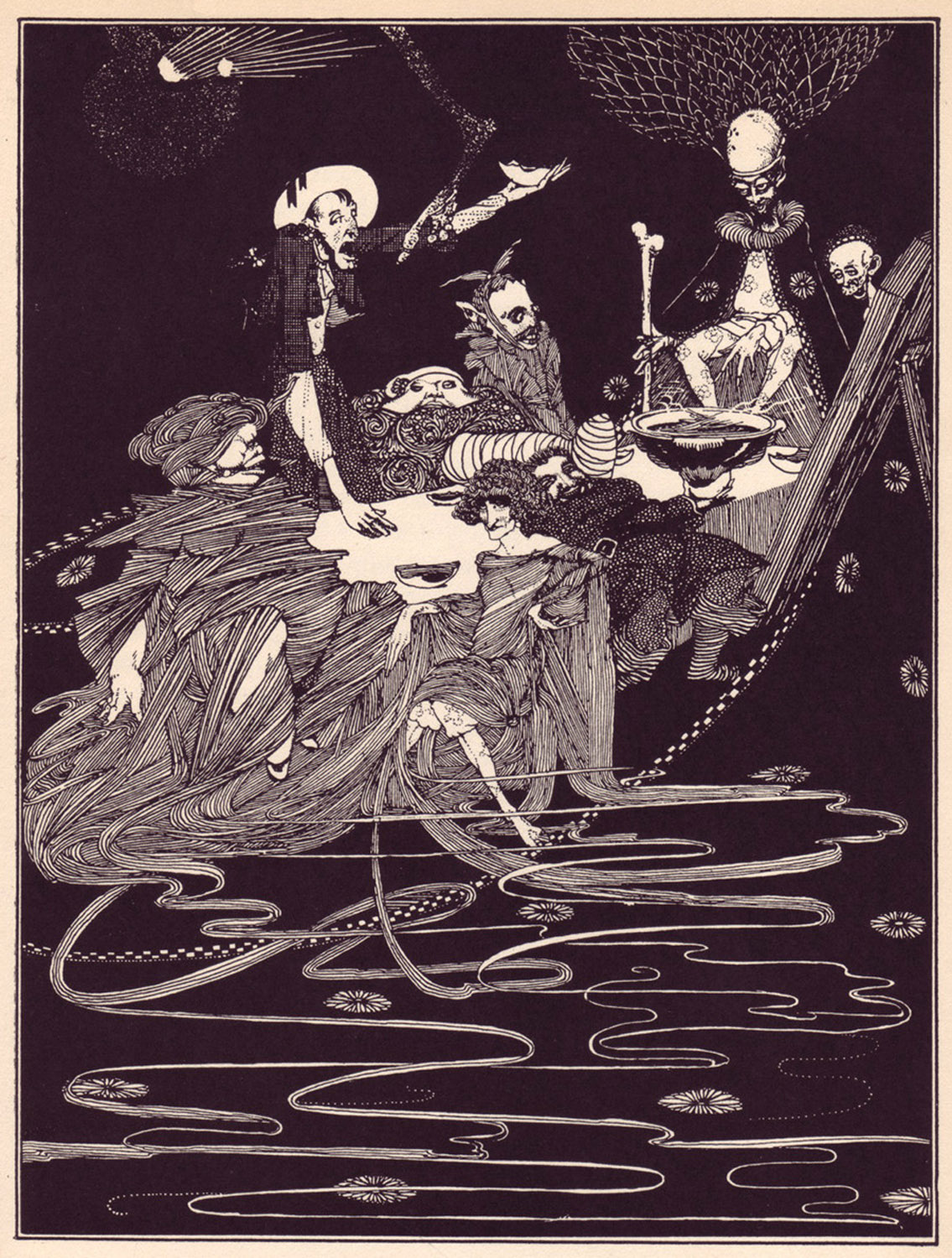
“Avast there a bit, I say, and tell us who the devil ye all are!”

The Illustrations to Tales of Mystery and Imagination, by Edgar Allen Poe, by Harry Clarke, 1919. Click for full size.
“Avast there a bit, I say, and tell us who the devil ye all are!”
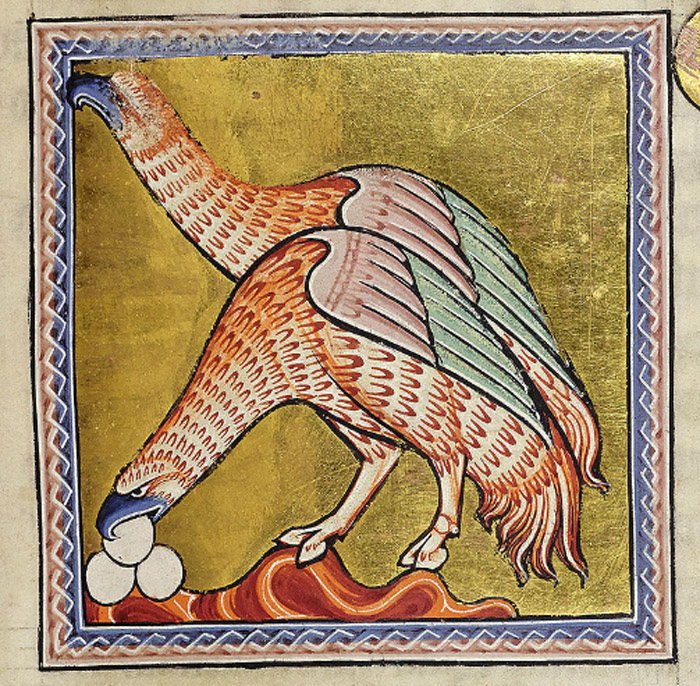
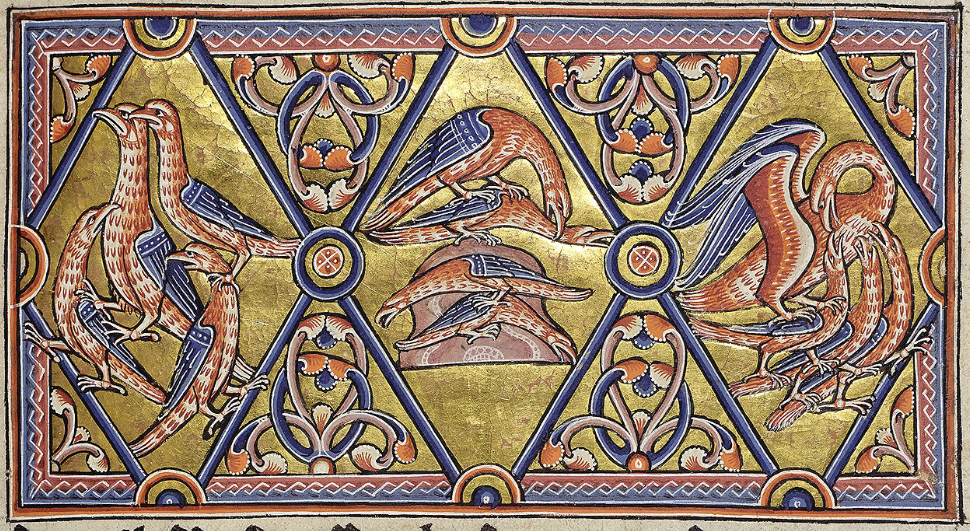
One ostrich looks at a star in the margin while the other buries eggs in the sand with its beak.
Text Translation:
Of the ostrich There is an animal called assida which the Greeks call stratocamelon, but Latin-speakers strucio, the ostrich. It has wings but does not fly, and its feet are like those of the camel. When the time comes for it to lay eggs, it raises its eyes to the sky and looks to see if the star called Vergiliae, the Pleiades, has appeared, for it will not lay its eggs until that star has risen. When the ostrich sees the star, around the month of June, it digs in the ground, deposits its eggs in the hole it has made and covers them with sand. When it gets up from the hole, it immediately forgets the eggs and never returns to them. The effect of the calm, mild air seems to be that the sand in the summer heat hatches the eggs, bringing forth the chicks.
The Illustrations to Tales of Mystery and Imagination, by Edgar Allen Poe, by Harry Clarke, 1919. Click for full size.
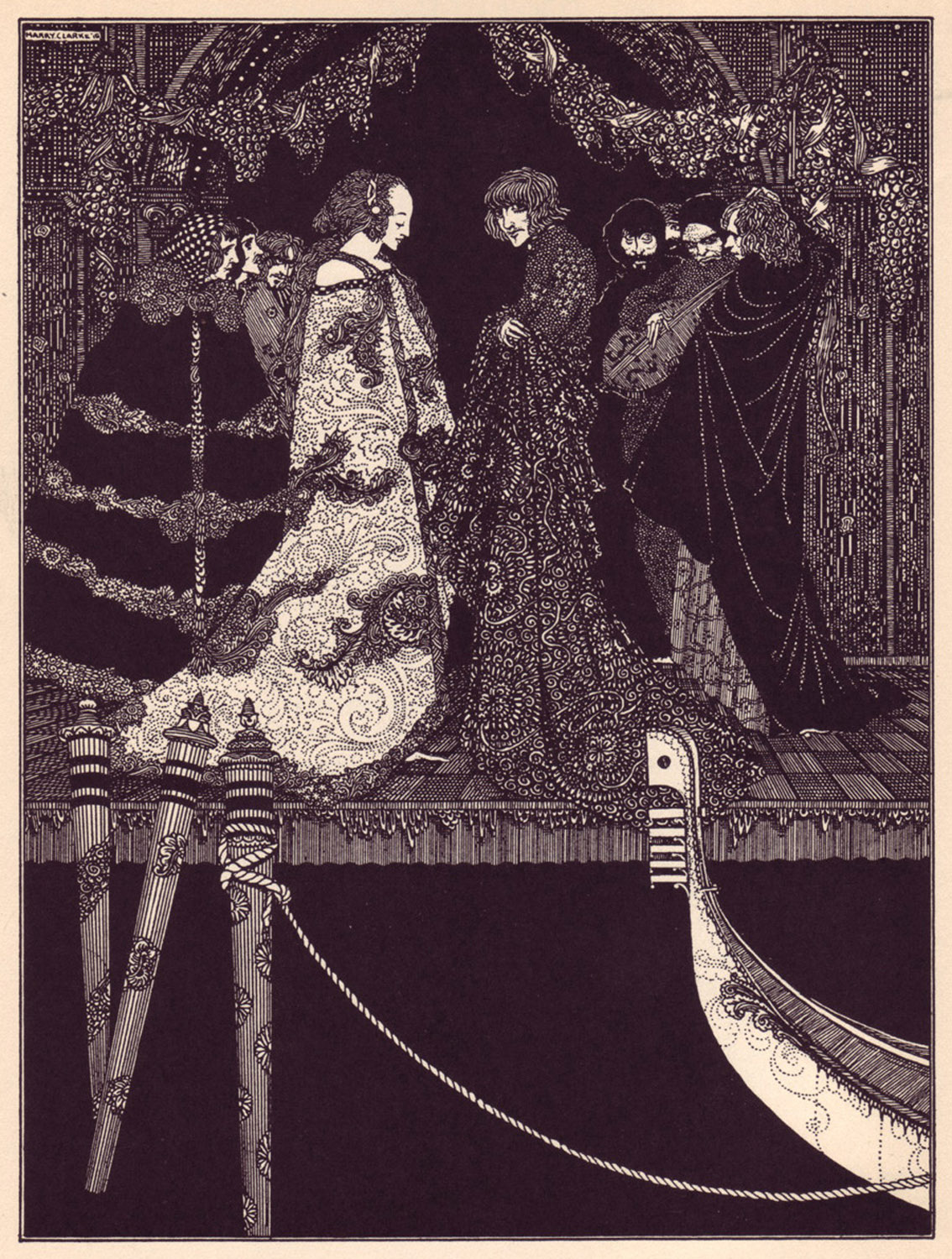
It was the Marchesa Aphrodite – the adoration of all Venice.
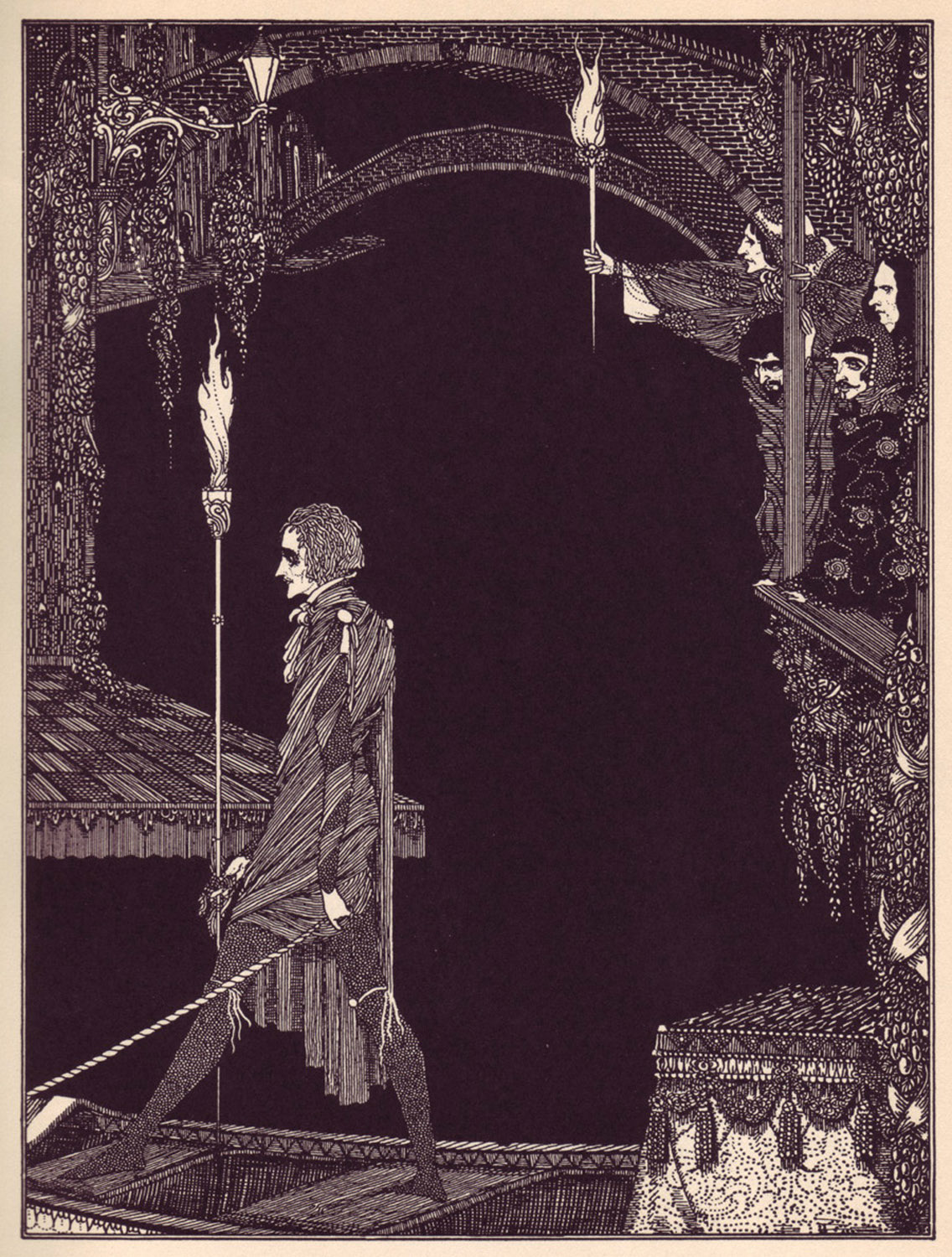
“I had myself no power to move from the upright position I had assumed.”

Pardon the title, this was to avoid ‘Cock’. Most below the fold, because this does go on. And on.

Koninklijke Bibliotheek, KB, KA 16, Folio 88v.
Text Translation:
Of the cock The cock, gallus, gets its name from the act of castration. For alone among other birds its testicles are removed, and the ancients called castrated men galli. As from the lion the lioness gets her name leena, and the she-dragon dracena from the dragon draco, so the hen gets her name gallina from the cock. People say that the cock’s limbs, if mixed with liquid gold, are consumed by it. The crowing of the cock at night is a pleasant sound, and not only pleasant but useful; like a good partner, the cock wakes you when are asleep, encourages you if you are worried, comforts you if you are on the road, marking with its melodious call the progress of the night. With the crowing of the cock, the robber calls off his ambush; the morning star itself is awakened, rises and lights up the sky; the anxious sailor sets aside his cares, and very often each tempest and storm whipped up by evening winds moderates.

image by sean fennessey.

image by sean fennessey.

image by sean fennessey.
Beginning december 15, 2017, the inaugural National Gallery of Victoria Triennial will open its doors to the work of over 100 creatives from 32 countries. Among the artists, designers, technologists, architects, animators, and beyond is Australian hyper-realist sculptor Ron Mueck, who is presenting his largest ever work to date. ‘Mass’ is an installation of 100 individual human skull forms piled up on the gallery floor, each which engage with the architecture of the site.
Amazing! I want those as furniture. You can read and see much more at design boom. You can see more of Ron Mueck’s amazing work here – this is one of my faves:

Angel, 1997
Mixed media
Figure: 110 x 87 x 81 cm / 43 1/2 x 34 1/4 x 31 7/8 in
Stool: 60 x 40 x 38 cm / 23 5/8 x 15 3/4 x 15 in.
The Illustrations to Tales of Mystery and Imagination, by Edgar Allen Poe, by Harry Clarke, 1919. Click for full size.

“Has no copy been taken?” he demanded, surveying it through a microscope.
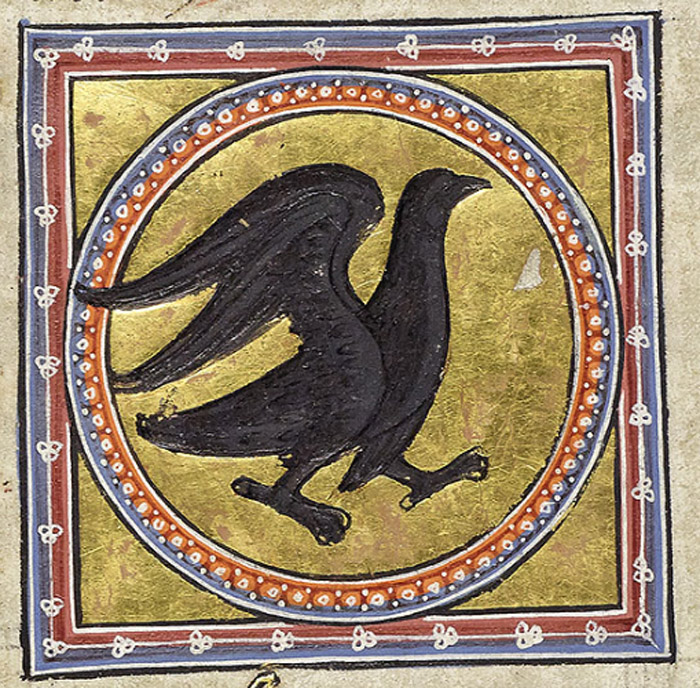
Portrait of a black raven.
Text Translation:
Of the raven The raven gets its name, corvus or corax, from the sound it makes in its throat, because it utters a croak. It is said that when its young have been hatched, this bird does not feed them fully until it sees that they have black feathers similar to its own. But after it has seen that they are of dark plumage, and has recognised them as of its own species, it feeds them more generously. When this bird feeds off corpses, it goes for the eyes first. In the Scriptures, the raven is perceived in a variety of ways; it is sometimes taken to mean a preacher, sometimes a sinner, sometimes the Devil.
In his book of Etymologies, Isidore says that the raven picks out the eyes in corpses first, as the Devil destroys the capacity for judgement in carnal men, and proceeds to extract the brain through the eye. The raven extracts the brain through the eye, as the Devil, when it has destroyed our capacity for judgement, destroys our mental faculties.
The Illustrations to Tales of Mystery and Imagination, by Edgar Allen Poe, by Harry Clarke, 1919. Click for full size.

“The earth grew dark, and its figures passed by me, like flitting shadows, and among them all I beheld only -Morella.”
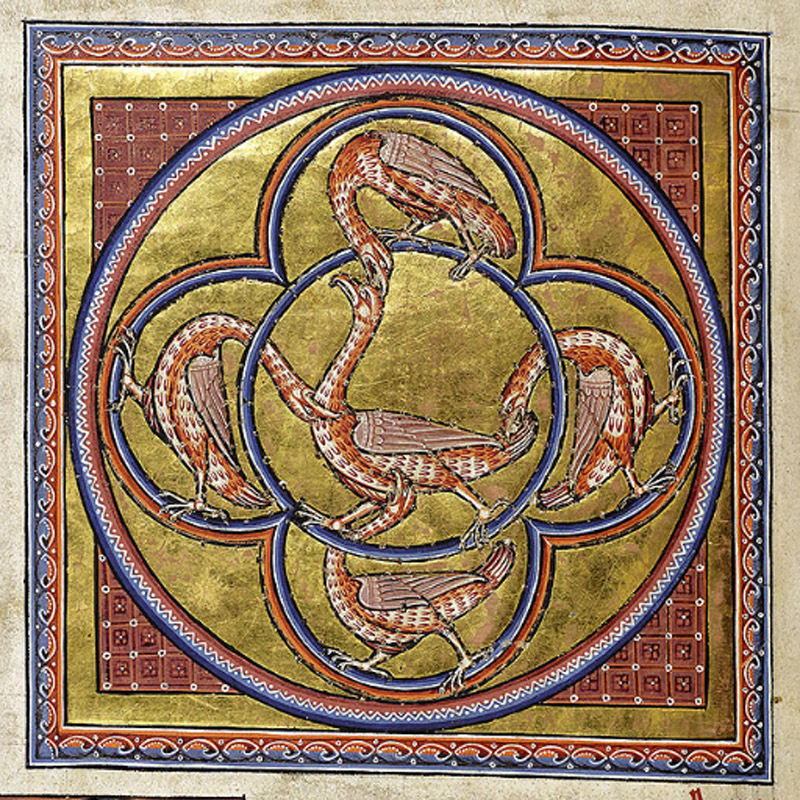
Four young hoopoe, rhythmically placed in a roundel, clean the eyes and pluck the feathers of their ageing parent.
The Illustrations to Tales of Mystery and Imagination, by Edgar Allen Poe, by Harry Clarke, 1919. Click for full size.
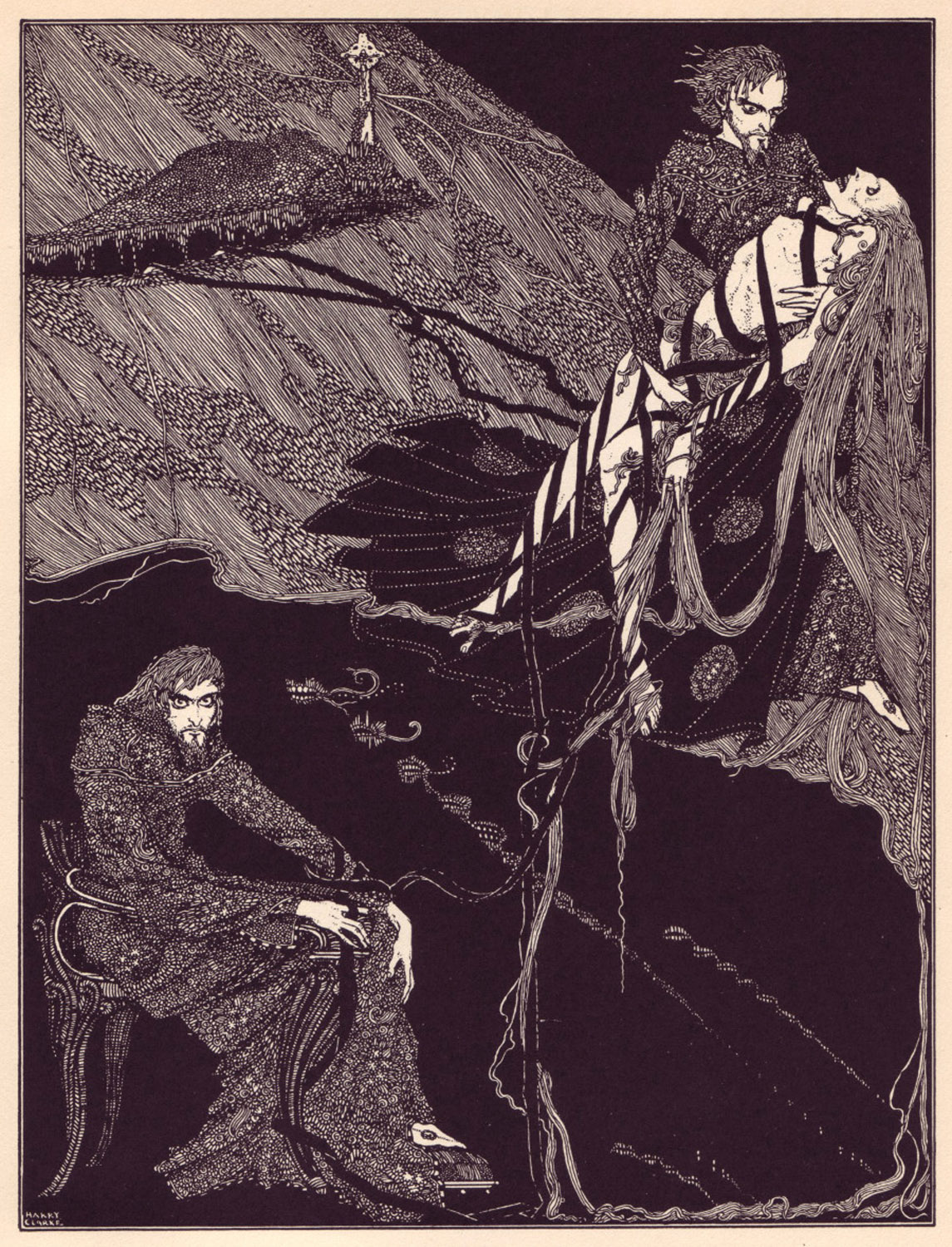
“It was a fearful page in the record of my existence.”
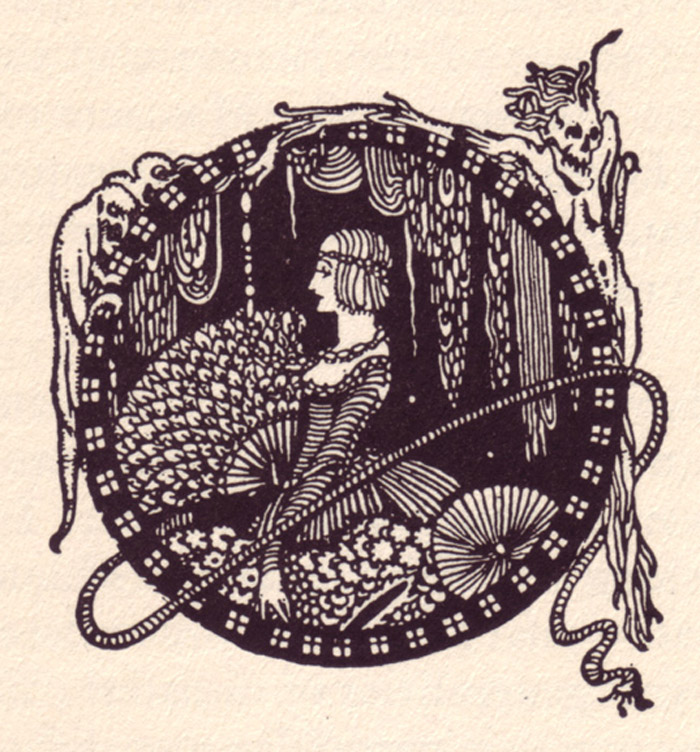

The bird is illustrated by its portrait in a roundel.

Morgan Library, MS M.81, Folio 62r, The kind of owl called nictocorax, the night-raven.
Text Translation:
Of the night-owl ‘I am like the night-owl in its dwelling-place’ (BSV, Psalmi, 101:7; NEB, Psalms, 102:6). The night-owl is a bird that loves the darkness of the night. It lives in decaying walls because it sets up house in the ruins of roofless dwellings. It shuns the light, flying at night in search of food. In a mystic sense, the night-owl signifies Christ. Christ loves the darkness of night because he does not want sinners – who are represented by darkness – to die but to be converted and live (see Ezekiel, 18:32). For God the father so loved the world that he gave his son to death for the redemption of the world (see John, 3:16-17). That sinners are called ‘darkness’, is borne out by the apostle, saying: ‘For ye were sometimes darkness, but now are ye light in the Lord’ (Ephesians, 5:8). The night-owl lives in the cracks in walls, as Christ wished to be born one of the Jewish people, saying: ‘I am not sent but unto the lost sheep of the house of Israel’ (Matthew, 15:24). But Christ is crushed in the cracks of the walls, because he is killed by the Jews. Christ shuns the light in the sense that he detests and hates vainglory. For when he cared for a leper, in order to give us a lesson in humility, he said to the leper: ‘See thou tell no man’ (Matthew, 8:4). Of this light it is said: ‘And from the wicked their light is witholden’ (Job, 38:15), that is, the glory of present life. He himself is the light inaccessible ‘which lighteth every man’ (John, 1:9). The light, therefore, shuns the light, that is, the truth shuns the vanity of worldly glory.
The night-owl flies at night in search of food, as Christ converts sinners into the body of the Church by preaching. In a moral sense, moreover, the night-owl signifies to us not just any righteous man, but rather one who lives among other men yet hides from their view as much as possible. He flees from the light, in the sense that he does not look for the glory of human praise. It is said of this light: ‘Will the light of the wicked not be put out, and the spark of his fire not shine?’ (see Job, 17:5). ‘Light’ here signifies the prosperity of present life. The light of the wicked is extinguished, in the sense that the prosperity of our fleeting life ends with life itself. Will the flame of his fire not shine? ‘Fire’ here is the passion of temporal desires. Its flame is the splendour or outward show of power which comes from its inner fire. But it will not shine because on the day of death all outward splendour and power will perish. The night-owl keeps watch in the night, as when the righteous man, alert to the darkness of sinners, avoids their errors. It lives in the cracks of walls, in the sense that he considers the weakness of the world and awaits its downfall. It seeks food by night, as when he reflects upon the life of sinners and uses their example to nourish the mind of the righteous.
The owl is not visited until Folio 50, which also sees the Hoopoe and Night Owl written about again.
Folio 35v – the pelican, continued. De nicticorace; the night owl.
The Illustrations to Tales of Mystery and Imagination, by Edgar Allen Poe, by Harry Clarke, 1919. It took quite a while to set these up. While I really appreciate people who take the time and trouble to scan images from these old books, I’d appreciate them more if they included what story they relate to also. So, I bought the e-book, and even with that, there were a few bumps along the way. The black and white illustration to The Colloquy of Monos and Una was not included in the scans, and it’s nowhere to be found on the ‘net either, except for two instances, with the image being very small indeed, so that one will not be the best. The scans also had two images for The Pit and the Pendulum, while my book only had one. Any errors belong to me.
Anyroad, we start with MS. Found In A Bottle: “Incomprehensible Men! Wrapped up in meditations of a kind which I cannot divine, they pass me by unnoticed.” Click for full size.


“Incomprehensible Men! Wrapped up in meditations of a kind which I cannot divine, they pass me by unnoticed.”
The narrative is divided into three scenes showing the babies attacking their parent, the parents killing the babies and the mother piercing her side to resurrect her offspring. Possibly the idea of mother pouring sustenance over her babies comes from the birds’ habit of regurgitation.
Text Translation:
Of the pelican ‘I am like pelican of the wilderness’ (Psalms, 102:6). The pelican is a bird of Egypt, living in the wilderness of the River Nile, from which it gets its name. For Egypt is known as Canopos. It is devoted to its young. When it gives birth and the young begin to grow, they strike their parents in the face. But their parents, striking back, kill them. On the third day, however, the mother-bird, with a blow to her flank, opens up her side and lies on her young and lets her blood pour over the bodies of the dead, and so raises them from the dead. In a mystic sense, the pelican signifies Christ; Egypt, the world.
The pelican lives in solitude, as Christ alone condescended to be born of a virgin without intercourse with a man. It is solitary, because it is free from sin, as also is the life of Christ. It kills its young with its beak as preaching the word of God converts the unbelievers. It weeps ceaselessly for its young, as Christ wept with pity when he raised Lazarus. Thus after three days, it revives its young with its blood, as Christ saves us, whom he has redeemed with his own blood. In a moral sense, we can understand by the pelican not the righteous man, but anyone who distances himself far from carnal desire. By Egypt is meant our life, shrouded in the darkness of ignorance. For Egiptus can be translated as ‘darkness’. In Egypt, therefore, we make a wilderness (see Joel, 3:19), when we are far from the preoccupations and desires of this world. Thus the righteous man creates solitude for himself in the city, when he keeps himself free from sin, as far as human frailty allows. The pelican kills its young with its beak because the righteous man considers and rejects his sinful thoughts and deeds out of his own mouth, saying: ‘I said, I will confess my transgressions unto the Lord, and thou forgavest the iniquity of my sin’ (Psalms, 32:5). It weeps for its young for three days: this teaches us that whatever we have done wrong by thought, word or deed, is expunged by tears. It revives its young by sprinkling them with its blood, as when we concern ourselves less with matters of flesh and blood and concentrate on spiritual acts, by conducting ourselves virtuously. It is also a characteristic of this bird, they say, that it always suffers from thinness, and that whatever it swallows, it digests immediately, because its stomach has no separate pocket in which to retain food. Food does not fatten its body, therefore, but only sustains it and gives it strength. Indeed, the life of a hermit is modelled on the pelican, in that he lives on bread but does not seek to fill his stomach; he does not live to eat but eats to live.
Folio 34v – cedars, continued. De pellicano; Of the pelican.