The Illustrations to Tales of Mystery and Imagination, by Edgar Allen Poe, by Harry Clarke, 1919. Click for full size.


The Illustrations to Tales of Mystery and Imagination, by Edgar Allen Poe, by Harry Clarke, 1919. Click for full size.

Portrait of the Crow in a Roundel.
Text Translation:
Of the crow The crow is a long-lived bird, called cornix in Latin and Greek. Soothsayers assert that the crow can represent by signs the concerns of men, show where an ambush is laid and foretell the future. It is a great crime to believe this – that God confides his intentions to crows. Among the many omens attributed to crows is that of presaging by their caws the coming of rain. Hence the line: ‘Then the crow loudly cries for rain’ (Virgil, Georgics, 1, 388).
Another strike against the christian god. What’s wrong with confiding in crows?
Let men learn from the crow’s example and its sense of duty, to love their children. Crows follow their young in flight, escorting them attentively; they feed them anxiously in case they weaken. A very long time passes before they give up their responsibility for feeding their offspring. In contrast, women of our human race wean their babies as soon as they can, even the ones they love. Rich women are altogether averse to breastfeeding. If the women are poor, they cast out their infants, expose them and, when the babies are found, deny all knowledge of them. The rich themselves also kill their children in the womb, to avoid dividing their estate among many heirs; and with murderous concoctions they destroy in the uterus the children of their own womb; they would rather take away life than transmit it. What creature but man has taken the view that children can be renounced? What creature but man has endowed parents with such barbarous rights? What creature but man, in the brotherhood created by nature, has made brothers unequal? Different fates befall the sons of a single rich man. One enjoys in abundance the rights and titles of his father’s entire heritage; the other complains bitterly at receiving an exhausted and impoverished share of his rich patrimony. Did nature distinguish between what each son should receive? Nature has shared things equally among everyone, giving them what they need to be born and survive. Let nature teach you to make no distinction, when dividing your patrimony, between those whom you have made equal by the title bestowed by brotherhood; for truly as you have bestowed on them the equal possession of the fact of their birth, so you should not grudge them the equal enjoyment of their status of brotherhood.
The Illustrations to Tales of Mystery and Imagination, by Edgar Allen Poe, by Harry Clarke, 1919. Click for full size.


Portrait of the quail. This rather characterless and legless portrait shows the correct tawny colour of the quail but is the wrong shape. The quail has a plump body and minimal tail.
Text Translation:
Of the quail Quails are so called from their call; the Greeks call them ortigie because they were first seen on the island of Ortigia. Quails have fixed times of migration. For when summer gives way to winter, they cross the sea. The leader of the flock is called ortigometra, ‘the quail-mother’. The hawk, seeing the quail-mother approaching land, seizes it; because of this, the quails all take care to attract a leader from another species, through whom they guard against this early danger. Their favorite food is the seed of poisonous plants. For this reason, the ancients forbade them to be eaten; for alone among living things, the quail suffers, like man, from the falling sickness.
The Illustrations to Tales of Mystery and Imagination, by Edgar Allen Poe, by Harry Clarke, 1919. Click for full size. The second image is the Finis. This is the end of the black and white illustrations. There are eight colour plates, however I don’t know which stories they belong to, so anyone’s guess.


A caladrius looks towards a sick king, indicating that he will recover.
Text Translation:
[Of the caladrius] The bird called caladrius, as Physiologus tells us, is white all over; it has no black parts. Its excrement cures cataract in the eyes. It is to be found in royal residences. If anyone is sick, he will learn from the caladrius if he is to live or die. If, therefore, a man’s illness is fatal, the caladrius will turn its head away from the sick man as soon as it sees him, and everyone knows that the man is going to die. But if the man’s sickness is one from which he will recover, the bird looks him in the face and takes the entire illness upon itself; it flies up into the air, towards the sun, burns off the sickness and scatters it, and the sick man is cured.
The caladrius represents our Saviour. Our Lord is pure white without a trace of black, ‘who did no sin, neither was guile found in his mouth’ (1 Peter, 2:22). The Lord, moreover, coming from on high, turned his face from the Jews, because they did not believe, and turned to us, Gentiles, taking away our weakness and carrying our sins; raised up on the wood of the cross and ascending on high, ‘he led captivity captive and gave gifts unto men, (Ephesians, 4:8). Each day Christ, like the caladrius, attends us in our sickness, examines our mind when we confess, and heals those to whom he shows the grace of repentance. But he turns his face away from those whose heart he knows to be unrepentant. These he casts off; but those to whom he turns his face, he makes whole again. But, you say, because the caladrius is unclean accoording to the law, it ought not to be likened to Christ. Yet John says of God: ‘And as Moses lifted up the serpent in the wilderness, even so must the Son of man be lifted up’ (4:14); and according to the law, ‘the serpent was more subtil than any beast of the field’ (Genesis, 3:1). The lion and the eagle are unclean, yet they are likened to Christ, because of their royal rank
because the lion is king of the beasts; the eagle, king of the birds.
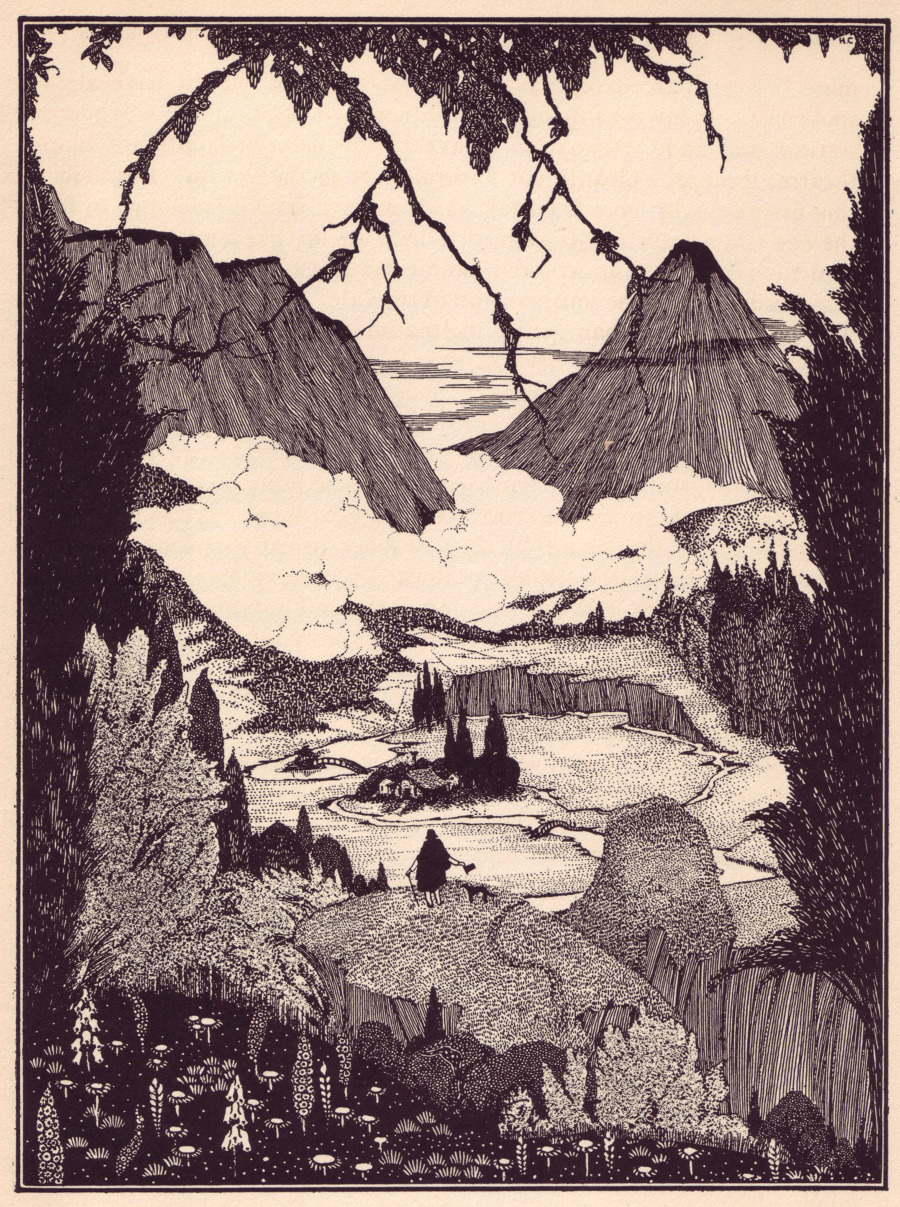
The Illustrations to Tales of Mystery and Imagination, by Edgar Allen Poe, by Harry Clarke, 1919. Click for full size.

“For the love of God! Montresor! “Yes,” I said, “for the love of God!”

A ventral view of the bird between two trees, with wings out stretched and head to one side, beating its wings and looking for the sun.

The phoenix turns to face the sun, beats its wings to fan the flames and is consumed. The image may equally show the bird rising from its own ashes, a symbol of the resurrection.
Text Translation:
[Of the phoenix] The phoenix is a bird of Arabia, so called either because its colouring is Phoenician purple, , or because there is only one of its kind in the whole world. It lives for upwards of five hundred years, and when it observes that it has grown old, it erects a funeral pyre for itself from small branches of aromatic plants, and having turned to face the rays of the sun, beating its wings, it deliberately fans the flames for itself and is consumed in the fire. But on the ninth day after that, the bird rises from its own ashes.

Standford Lecture Handouts.
The above reads:
Better be a beggar than king, better practice vice
And perfidy than be a bigoted, pious puritan;
Better make love with many mistresses in the street
Than make piety and abstinence in public show.
– Amīr Khusraw Dihlavī (d. 725/1325)
I couldn’t agree more.
The dominant attitude of the anti-clerical rhetoric in Persian poetry is permeated by criticism of judges, lawyers, aesthetics, spiritual advisors, and authority figures of that nature. This is one of the reasons that makes this poetry still relevant. A lot of people today can’t read Milton, because anti-clericalism is no longer part of the normal vocabulary. In the West, we live mostly in a secular society, so the conflict between clerics and anti-clerics does not exist. But that is not the case in the Middle East at all, which makes this conflict very relevant.
Dr. Leonard Lewisohn is Senior Lecturer in Persian and Iran Heritage Foundation Fellow at the Institute of Arab and Islamic Studies of the University of Exeter where he teaches Islamic Studies, Sufism, history of Iran, as well as courses on Persian texts and Persian poetry in translation. He specializes in translation of Persian Sufi poetic and prose texts.
This is fascinating, and I learned a great deal. The lecture is below, and the Stanford Lecture Handouts for Anti-Clericalism in Medieval Persian Poetry are here.
Via Medievalists.

Ground views of different Border Wall Prototypes as they take shape during the Wall Prototype Construction Project near the Otay Mesa Port of Entry (photo by Mani Albrecht via US Customs and Border Protection/Flickr).
Jesus Fucking Christ, some people…
…The paper [NYT] published Michael Walker’s “Is Donald Trump, Wall-Builder-in-Chief, a Conceptual Artist?,” a clickbait headline for a piece about Swiss-Icelandic conceptual artist Christoph Büchel’s “nonprofit” MAGA which has created an online petition to have the prototypes for Trump’s border wall declared National Monuments. This aligns with a broader effort by Büchel/MAGA to frame the models as Land Art: since December 2018 they’ve been offering onsite tours of the prototypes, which a press release claimed “have significant cultural value.” Value, of course, is not the same as meaning. The broad-strokes inferences of a facile transference of historical meaning into cultural value are obviously both political and artistic; in both contexts their implications are pretty toxic.
Politically, with its arch tone and conceptual trappings, Büchel’s project normalizes and sanitizes the man stoking tensions about nuclear war via Twitter (it’s reminiscent of Jimmy Fallon petting his hair) and actively threatening the livelihoods and futures of DACA recipients while undermining the US’s longstanding diplomatic relationship with Mexico (also: undermining all Mexicans as human beings). Artistically, it does a disservice to the real work of serious artists by promoting what, evaluated on the merits, is the worst kind of incoherent conceptual art — flawed in both concept and execution.
Per the Times, Büchel “is adamant he has no creative stake in the project” (which seems an odd way for an artist to establish integrity). He claims that “This is a collective sculpture; people elected the artist.” For Büchel, writes Walker, “Americans, by electing Mr. Trump, allowed his obsessions to be given form that qualifies as an artistic statement.” This kind of convoluted philosophizing to legitimate a flimsy artistic premise wishes to align itself with, or at least to appropriate, the Duchampian honesty that claims “It’s art because I say so.” Büchel seems to be doing something more insidious: using art-speaky language to prop up something I suspect he must know is pretty empty as a conceptual artwork (even if the prototypes themselves are visually imposing), while contributing to, and deriving press coverage from, a dangerously violent political context.
Not all Americans elected the Tiny Tyrant, Mr. Büchel. Actually, the majority of them voted against him. Büchel typifies the exact type of shallow, pretentious asshole, who, with nothing else to market, jumps on something they think is trendily controversial, coated with enough bullshit to engage the fleeting attention span of the ‘art world’, the one inhabited by people with less depth than a puddle. The most one could say about the wall prototypes is that they are a monument to unthinking bigotry and hatred; that they glorify isolation and dehumanisation. In the current time, when people have finally decided, rightly, that monuments to slavery and those who defended it are not appropriate, why in the fuck would these monstrosities be considered to have any value? This is a disgusting, infuriating story, and I’m going to go help myself to more tea and go feed the birds instead of risking a blown artery. You can read the whole thing, with all relevant links at Hyperallergic.
The Illustrations to Tales of Mystery and Imagination, by Edgar Allen Poe, by Harry Clarke, 1919. Click for full size.
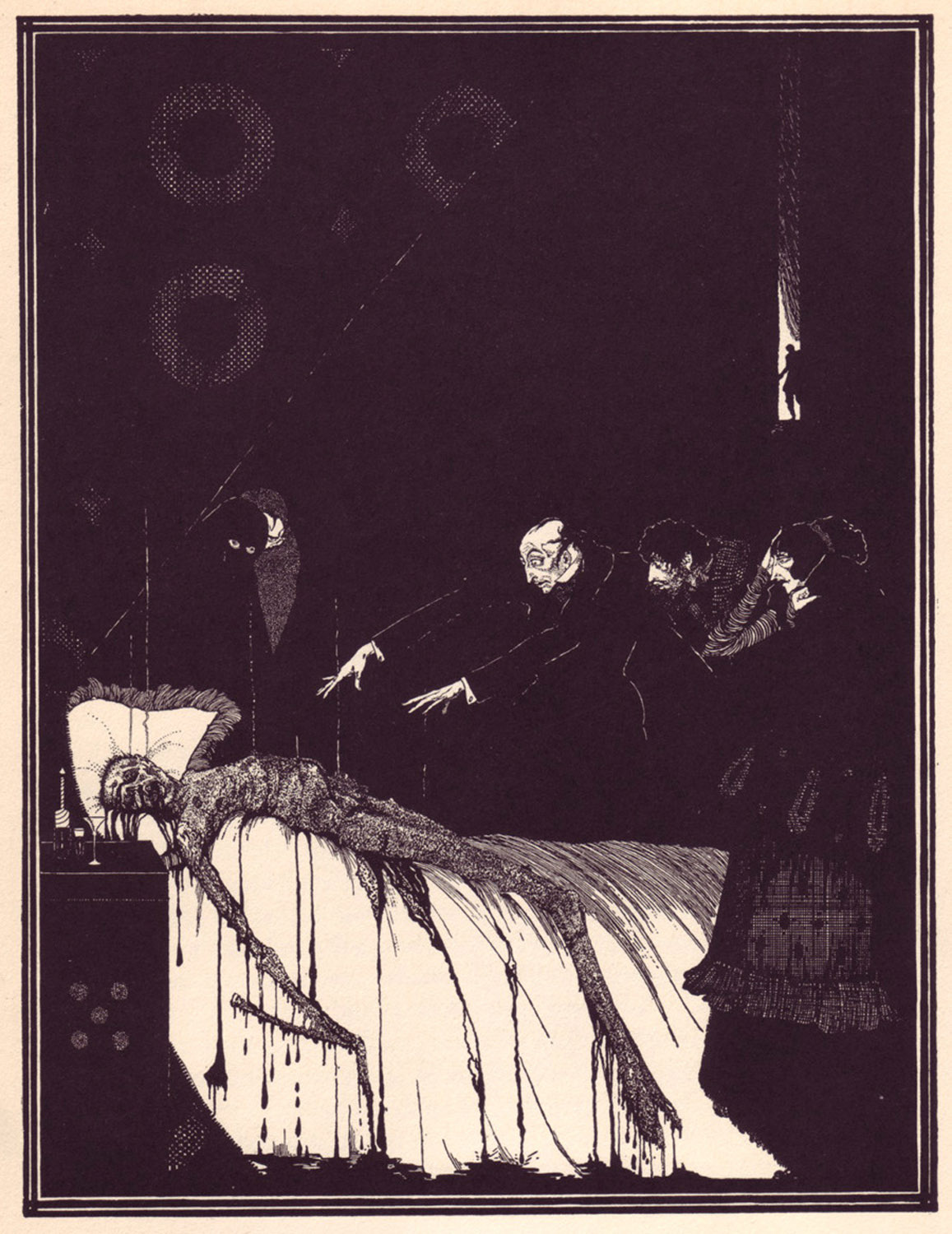
Upon the bed there lay a nearly liquid mass of loathsome – of detestable putridity.

The coot has a similar pose to the halcyon, f.54v, with its head turned back, biting its wing. It is shown correctly with clawed feet.
Text Translation:
[Of the] coot. It is a winged creature, fairly clever and very wise; it does not feed on corpses and it does not fly or wander aimlessly but stays in one place until it dies, finding both food and rest there.
Let every one of the faithful, therefore, maintain himself and live like that; let them not scurry around, straying this way and that, down different paths, as heretics do; let them not be enticed by the desires and pleasures of this world; but let them stay in one place, finding peace in in the catholic Church, where the Lord provides a dwelling-place for those who are spiritually in harmony, and there let them subsist daily on the bread of immortality, drinking the precious blood of Christ, refreshing themselves on the most sweet words of the Lord, ‘sweeter than honey and the honeycomb’ (Psalms, 19:10)
Folio 55r – the halcyon, continued. [De] fulica]; Of the coot. [De fenice]; Of the phoenix.

Albrecht Dürer, The Rhinoceros, 1515.
Ganda the Rhinoceros was going to be the Pope’s rhinoceros, that is Leo X, but Ganda drowned in 1515. Ganda was immortalized by Dürer, and so remains the most famous European animal of the renaissance. And I don’t blame the elephant for running away. I’d run too. There’s a short video below, but you can read all about Ganda at Medievalists.