Crucifix! Crucifix! Crucifix!

Evangelist Joshua Feuerstein is all upset again, this time demanding a crucifix icon as some sort of rebellion (or possibly protection) against all those evil rainbows. Facebook has no intention of providing a crucifix for all the christians to mount themselves on, so good for them.

One user wrote:

“Remember GOD used the rainbow as a promise never to flood the earth again…but he will burn it with fire…so get ready…you can’t use a symbol that God created and pervert it without repercussions,”

Oh, christians are always so gosh darn loving, it just oozes out. Like poison. Such puerile whining! Where in the fuck is your faith? Why doesn’t that sustain you in the absolutely unbelievable torment and anguish of a rainbow icon? Isn’t suffering good for the soul? It’s all “god’s” plan or will or whatever? Mysterious ways, all that shit? Well, if I have to go up in flames, you’ll go too, if that vaunted flood of yours is any example. Unfortunately, any flames we see are more likely to be those of our own doing, in regard to climate change.

Via Raw Story.

Oh, Trumpholes.

A rather large “oops” on the part of Trumpholes yesterday. Apparently, every 4th of July, NPR reads the entire Declaration of Independence. So far, so good, if you like that sort of thing. Unfortunately, the next thing NPR did was to tweet out the whole text line by line, and the Trumpholes took exception to it, thinking it was yet another horrible leftist move which was saying terrible things about the Tiny Tyrant.

D.G. Davies, replying to @NPR: So, NPR is calling for revolution. Interesting way to condone violence while trying to sound “patriotic”. Your implications are clear.

Parker Molloy: NPR tweeted out the entire Declaration of Independence, and wow…uh…the responses are…something.

Via Raw Story, where you can see more of the tweets in question. Raw Story also has an interesting article up about a young reporter who turned a bit of the Declaration of Independence into petition form, and tried to get people to sign it in 1951. One person signed it, having recognized the origin. All the other people accused him of perpetrating a commie plot.

Word Wednesday.

Fulsome

Adjective.

1a: characterized by abundance: copious. b: generous in amount, extent, or spirit. c: being full and well developed.

2: aesthetically, morally, or generally offensive.

3: exceeding the bounds of good taste: overdone.

4: excessively complimentary or flattering: effusive.

– fulsomely, adverb.

– fulsomeness, noun.

Usage: The senses shown above are the chief living senses of fulsome. Sense 2, which was a generalized term of disparagement in the late 17th century, is the least common of these. Fulsome became a point of dispute when sense 1, thought to be obsolete in the 19th century, began to be revived in the 20th. The dispute was exacerbated by the fact that the large dictionaries of the first half of the century missed the beginnings of the revival. Sense 1 has not only been revived but has spread in its application and continues to do so. The chief danger for user of fulsome is ambiguity. Unless the context is made very clear, the reader or hearer cannot be sure whether such an expression as “fulsome praise” is meant in sense 1b or in sense 4.  [Merriam-Webster.]

[Origin: Middle English fulsom, copious, cloying, from full + –som -some.]

(13th century.)

“Glad to meet you, sir. I have heard your name mentioned in connection with that of your friend. You interest me very much, Mr. Holmes. I had hardly expected so dolichocephalic* a skull or such well-marked supra-orbital development. Would you have any objection to my running my finger along your parietal fissure? A cast of your skull, sir, until the original is available, would be an ornament to any anthropological museum. It is not my intention to be fulsome, but I confess that I covet your skull.” – The Hound of the Baskervilles, Arthur Conan Doyle.

*Dolichocephalic

adjective: having a relatively long head with a cephalic index of less than 75.

[Origin: New Latin dolichocephalus long-headed, from Greek dolichos long + – kephalos, from kephalē head.]

(1852)

The League of Lonely Geologists.

No, it’s not a hyper-specialised dating service, but a game. It’s only downloadable for Windows, but you can browse the archive no matter the choice of your os.

After digging in the dirt on a solo quest for digital rocks in the “The League of Lonely Geologists,” you may decide to toss one of your finds into the mysterious space portal situated in the otherwise mundane landscape. Immediately, another rock will be hurled back out of this strange gateway, but it won’t be yours. Instead, it’s one found by a previous wanderer of the game, their annotations and specimen name left behind in an ongoing catalogue of the terrain.

Created by Takorii and recently shared by Rock Paper Shotgun, “The League of Lonely Geologists” is available as a pay-what-you wish download for PC. It’s billed as a game of “awkward & uncomfortable rock collection,” yet rock collecting is only part of its mechanics, which are revealed through experimentation. Toss a plant into the portal, and get a phonograph cylinder back, which may play some jaunty tune, or just an eerie hum. Throw in the phonograph, and the moon-like vista may spit out a shiny badge.

While the game can only be played in Windows, anyone can flip through the online catalogue of finds. As of this writing, 669 “geologists” have discovered over 2,000 rocks, such as the “dented lid” that’s “just a trash can lid someone spray painted gold,” and the “unstoppable rock” that’s constantly in motion, and “no obstacle can stop this movement.” Some players take their naming and description more seriously than others, but it’s surprisingly enjoyable to have this kind of anonymous sharing. And like any scientific survey, albeit one steeped in absurdity, it keeps you curious about what else is out there.

Via Hyperallergic. The League of Lonely Geologists.

A Perfect Summer Fan.

I could use a good, beautiful summer fan, given that are temps are in the withering range.* These not only express a specific concept, they are also part a very old papermaking process, and with my deep and abiding love for paper, makes this an even more enticing item.

Komorebi (木漏れ日) is one of those uniquely untranslatable Japanese words. It means “sunlight filtering through the tree leaves” and embodies a poetic appreciation for nature and its changing seasons. Capturing that aesthetic, and embedding it into a beautiful handheld fan (uchiwa), is designer Kotoko Hirata, who created the Komorebi Uchiwa.

Escape the summer heat with this beautiful handheld fan made from Echizen Washi paper, a traditional Japanese craft with a 1500-year history. Artisans steeped in the tradition create leaf patterns by hand so when sunlight hits the fan a silhouette of tree leaves appear. It’s a lovely reminder that there are ways of appreciating the summer, rather than escape into air conditioning.

Once the paper is completed it’s transported to Kyoto where fan makers, known for their kyo-uchiwa, create the radial wooden skeleton of the fan and merge it with the paper.

More at Spoon & Tamago, where you can buy this beautiful fan.

*On the bright side, this is the quietest 4th ever, with none of the months of assholes setting off fireworks preceding it. The silence is lovely.

Different Takes.

You may have seen Japanese illustrator Mizumaru Kawahara and his comical-style illustrations on Japanese magazine covers, or illustrated film reviews. He also illustrated the book Young Adult U.S.A. and is a self-proclaimed Star Wars fan. So it was only appropriate that he created this adorable and playful tribute to the U.S.A on the 4th of July.

You can see more at Spoon & Tamago and Mizmaru’s Twitter Feed.

ETA: If you’re the type of person to get offended by these, please be good enough to fuck off. Thanks.

Wondrous Weiners.

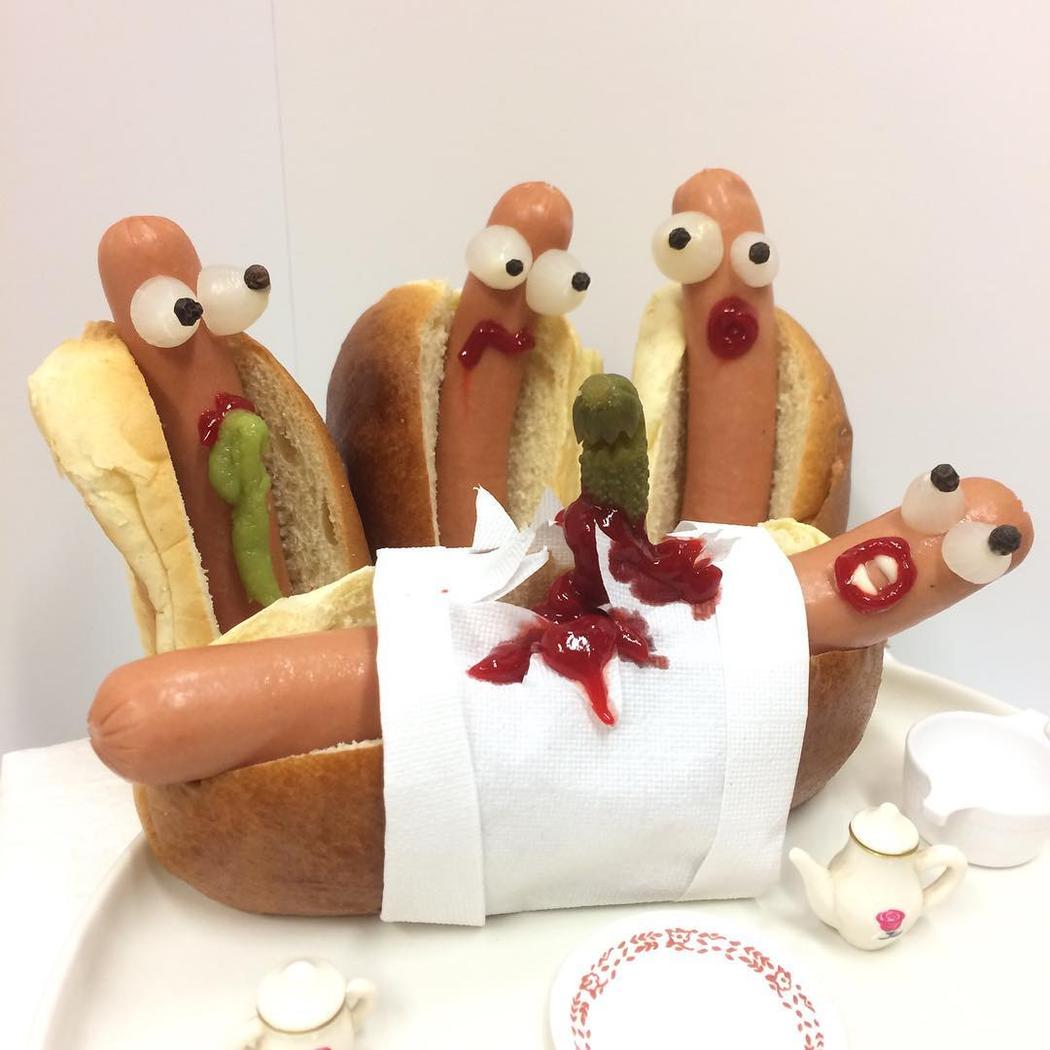
I think many artists have a tendency to hit boredom quickly and often. I certainly do. Thus, there’s a need to play, to invent, and reinvent. The men behind Burpzine are still playing with their food, but have a recent focus on wieners, fabulous wieners. And sometimes, pickles.

WonderWiener.

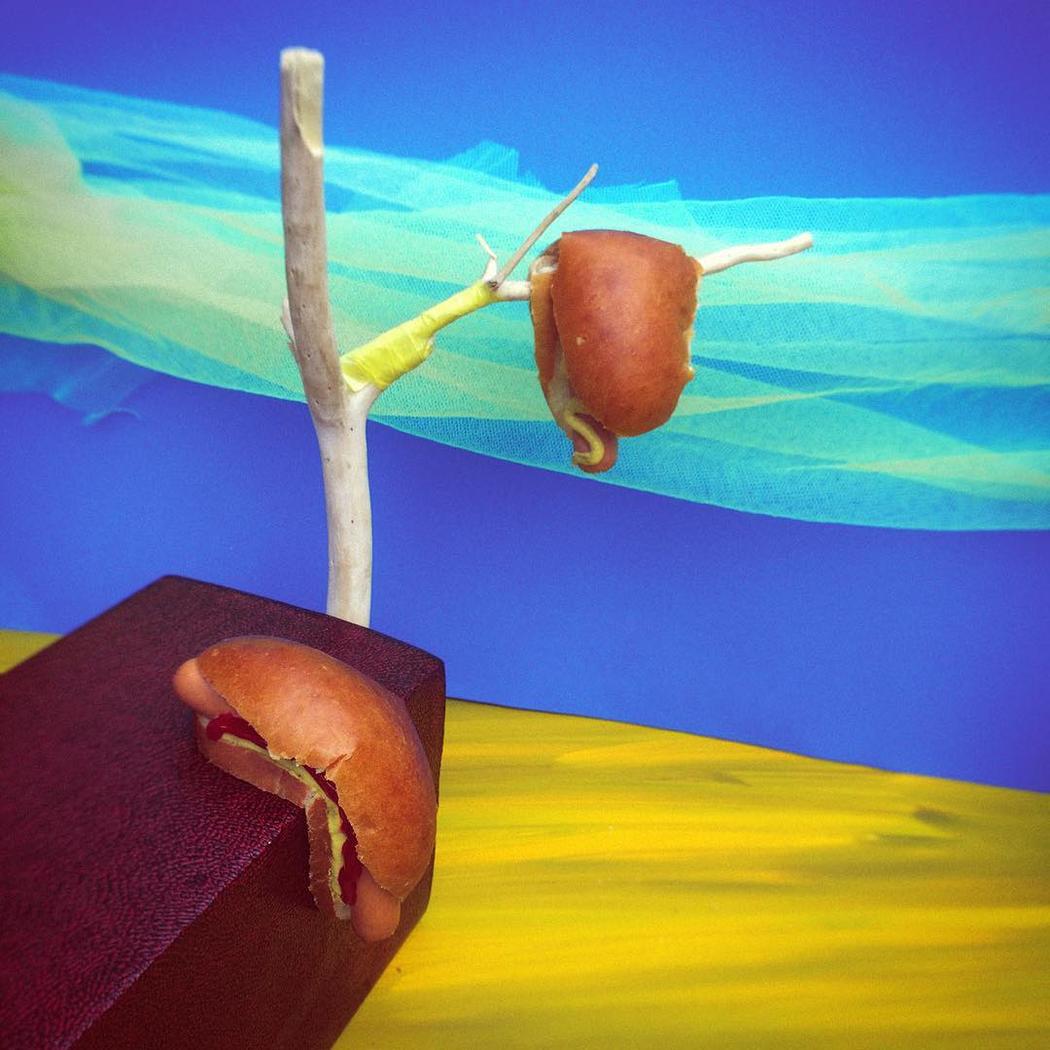
If these wieners look familiar, it’s because Belgian food stylist Erik Vernieuwe is obsessed with turning them into the most famous faces on the planet. In the digital pages of his Burp Zine, classic artworks and movie scenes become delectable edibles under the trained pasty chef, food historian, and recipe tester’s careful gaze. A work is complete when Vernieuwe gives it a punny name like Wiener de Milo or Robodog. “It’s becoming a bit of an obsession,” he tells Creators. “I see something and think, ‘Can I turn this into a hot dog?'”

Vernieuwe works with his husband, photographer Kris De Smedt, both professionally and when they play with their food. A fashion photographer in their hometown of Antwerp, De Smedt turns Vernieuwe’s pun-filled creations into sleek, Instagram-worthy images. “His way of looking at things and how he sees light and color really works for the kind of food pictures we do together,” Vernieuwe says. They often collaborate on “stupid things” between gigs because, as Vernieuwe puts it, he gets bored really easily.

Burp Zine is their longest-running “stupid thing” so far, perhaps because it’s unabashedly dumb and playful. “It’s just for fun. No depth to it whatsoever,” Vernieuwe says proudly.

I’d argue that it isn’t dumb at all. People need play, and they need playful. We need to be delighted in creativity for its own sake, not always concerned over messaging or significance. Play greatly reduces stress, anxiety, and hostility, and engages imagination, boosts curiosity, brings laughter and joy.

Alien.

Wiener Spock.

The Persistence of Wienery.

You can lose yourself in the delights of Wienerdom here, or get lost in other play here.

Via The Creators Project.