From Giliell, click for full size!

© Giliell, all rights reserved.

From Giliell, click for full size!
© Giliell, all rights reserved.
An amazingly beautiful woodpecker from Giliell, click for full size!
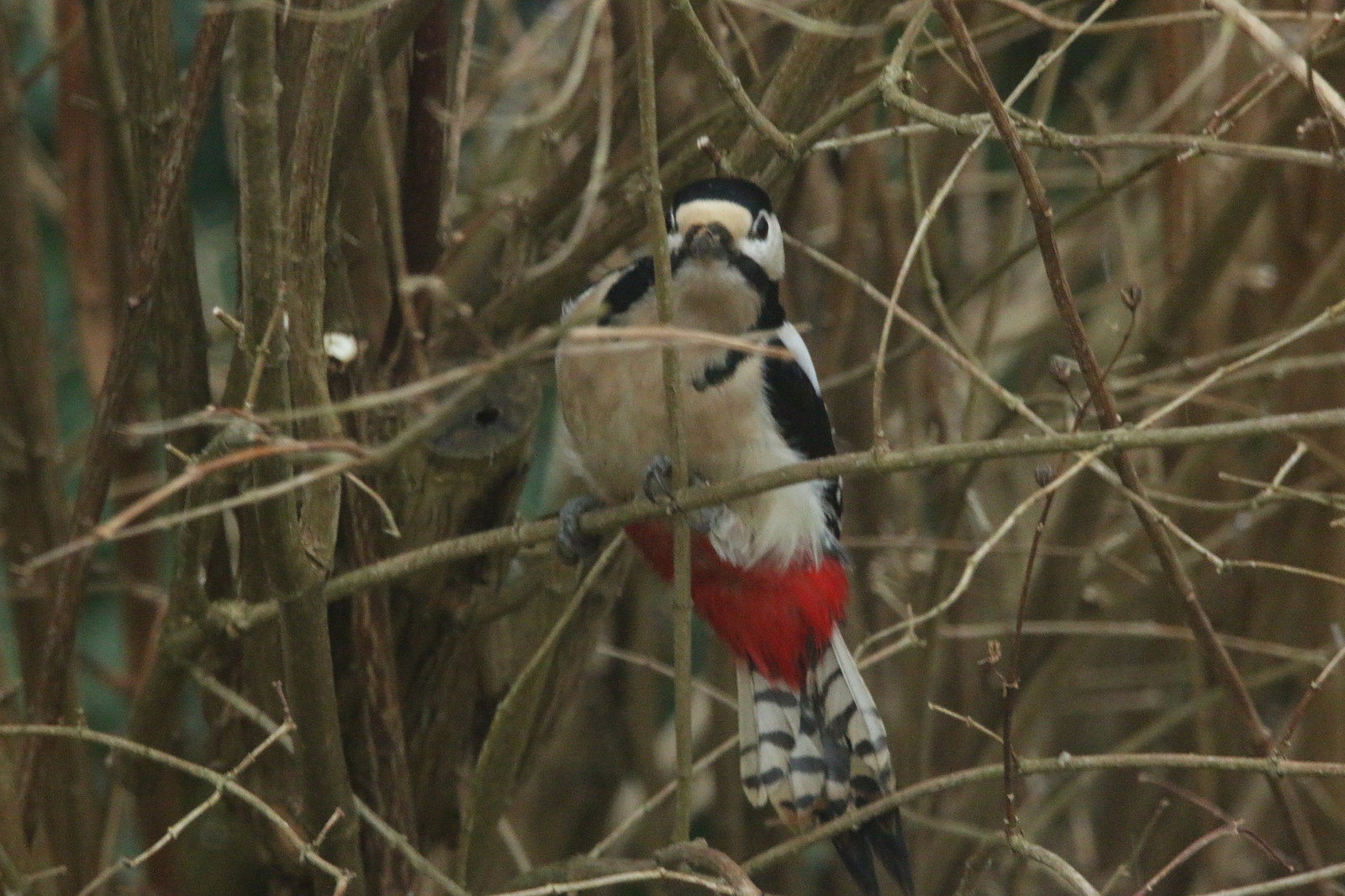

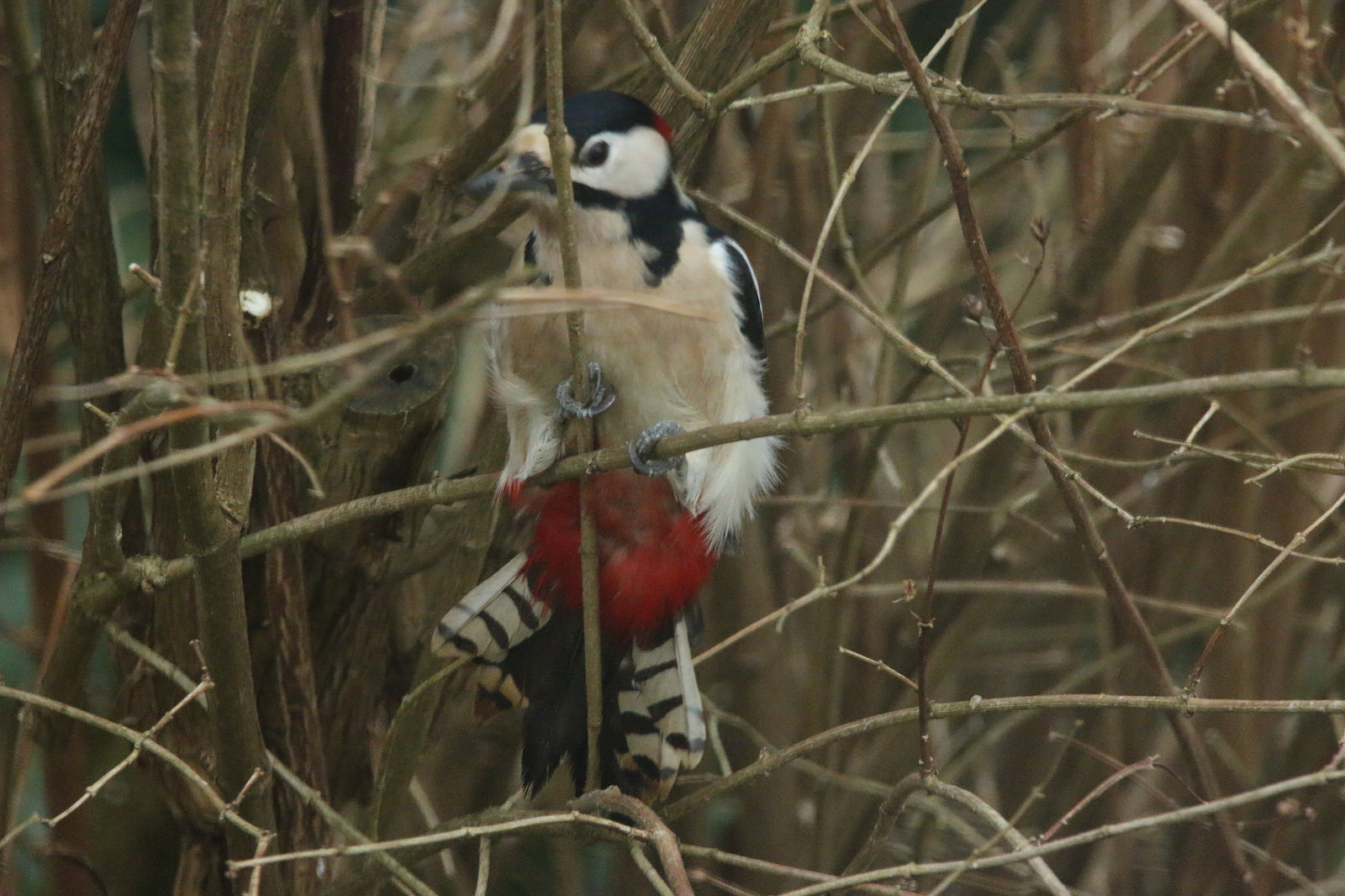
© Giliell, all rights reserved.
 Scapegrace / Lucubrations / Odium
Scapegrace, noun: an incorrigible rascal; a habitually unscrupulous person; a complete rogue.
(1763)
“In 1890 and 1891, the scapegrace Walter James Chadwick lived in Hulme, Manchester.”
Lucubration, noun: laborious or intensive study; also: the product of such study, usually used in the plural.
[Origin: Latin lucubration-, lucubratio study by night, work produced at night, from lucubrare to work by lamplight; akin to Latin luc-, lux.]
“There were some initial police lucubrations that it might not be a case of murder at all, since the drunk Annie Yates might have slipped and struck her head against the furniture; when she wanted to bandage her wound with the towel, she had passed out, and been suffocated by the towel slipping over her nose and mouth.”
(1595)
Odium, noun.
1: the state or fact of being subjected to hatred and contempt as a result of a despicable act or blameworthy circumstance.
2: hatred and condemnation accompanied by loathing or contempt: detestation.
3: disrepute or infamy attached to something: opprobrium.
[Origin: Latin, hatred, from odisse to hate; akin to Old English atol terrible, Greek odyssasthai to be angry.]
(1602)
“Two professional translators were employed to prepare French and German versions of the police placard, for insertion in the main newspapers of those countries; there was odium when the German version was found to contain a long list of linguistic lapses, and Dr. Althschul, the professional translator, had to submit a ten-page memorandum in his defence, saying that it was all just jealousy from colleagues who envied his position.”
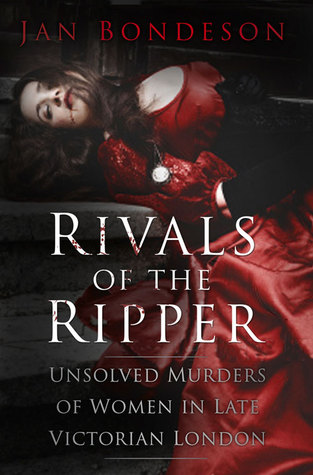
All from Rivals of the Ripper: Unsolved Murders of Women in Late Victorian London, Jan Bondeson.
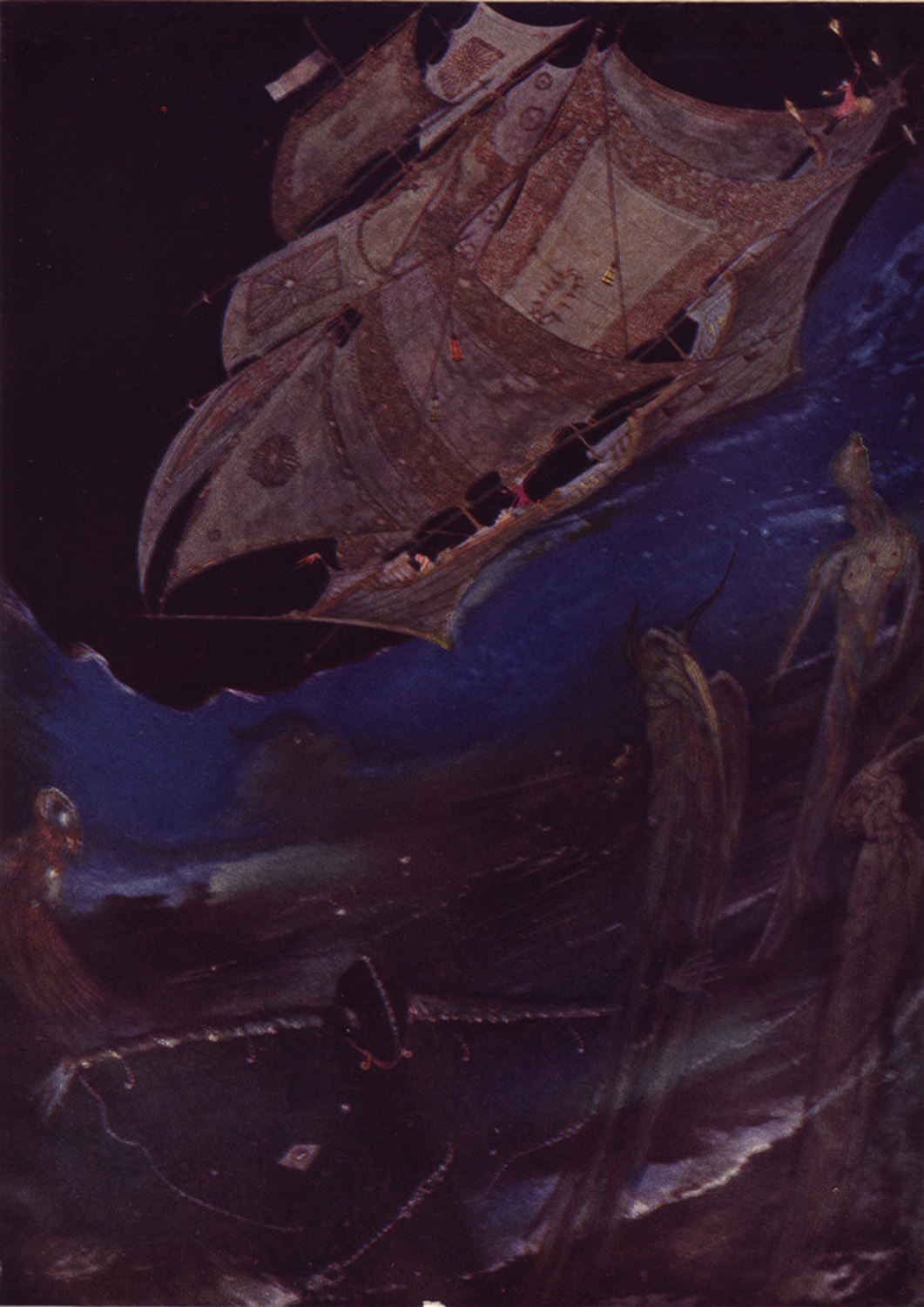
The Illustrations to Tales of Mystery and Imagination, by Edgar Allen Poe, by Harry Clarke, 1919. Click for full size. There will be a break from here to the next set of Horton; I apologize, but my schedule is bordering crazy right now, and it’s going to get much worse over the next couple of weeks. I simply have had not had enough time to get the Andersen fairy tales set up, because like the Poe, I had to buy the books so I could relate the images to the proper story, and I need time to do all that. I’ll do my best to pull myself together over the weekend.

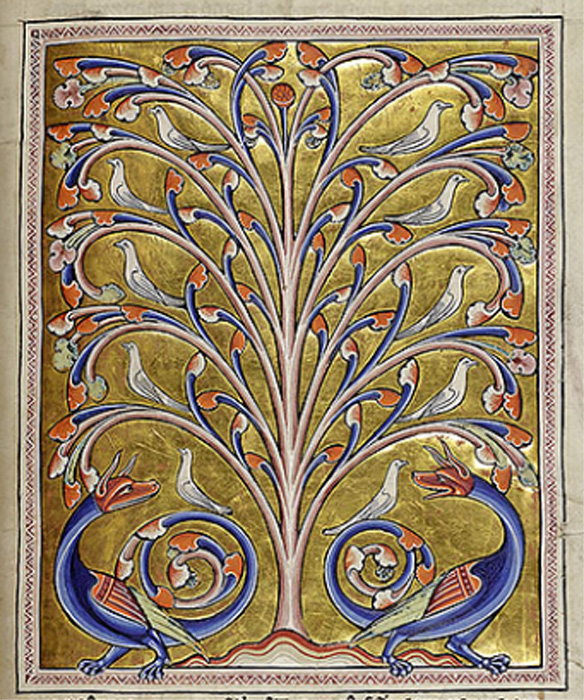
A symmetrical arrangement of doves in the branches of the tree and two dragons at its base.
Text Translation:
Of the tree called perindens The perindens is a tree in India. Its fruit is sweet throughout and exceedingly pleasant; doves delight in it and live in the tree, feeding on it. The dragon is the dove’s enemy; it fears the tree and its shadow, in which the doves dwell; and it cannot approach either the tree or its shadow. If the shadow lies towards the west the dragon flees to the east, and if the shadow falls towards the east, the dragon flees to the west. If it should happen that a dove is caught out of the tree or its shadow, the dragon kills it. Take the tree as God, the shadow as his son; as Gabriel says to Mary: ‘The Holy Ghost shall come upon thee and the power of the Highest shall overshadow thee’ (Luke, 1:35). Take the fruit to be the wisdom of God, that is, the Holy Spirit. Therefore see to it, O man, that, after you have received the Holy Spirit, that is the spiritual, apprehensible dove, descending and remaining upon you, you are not caught outside eternity, set apart from the Father and the Son and the Holy Spirit; and that the dragon, that is, the Devil, does not kill you. For if you have the Holy Spirit, the dragon cannot cannot come near you.
Take heed, therefore, O man, and stay within the catholic faith, live within it, remain steadfast within it, within the one catholic church. Be as careful as you can that you are not caught outside the doors of that house, that the dragon, the serpent of old, does not seize you and devour you, as Judas was at once devoured by the devil and perished, as soon as he had gone forth from the Lord and his brother apostles.
Folio 64v – Of bees, continued. De arbore que dicitur perindens; Of the tree called perindens.
Krokus – Screaming In The Night. Back to the ’80s, y’all!

© C. Ford, all rights reserved.
From Giliell, click for full size!


© Giliell, all rights reserved.

The latest book in Genevieve Cogman’s Invisible Library series is out, as is the second book in Neal Shusterman’s Scythe series. I had only mentioned Cogman’s book in a thread it seems. If you haven’t picked up the series, I recommend it. Cogman has the gift of good storytelling, and there’s nothing quite like the satisfaction that comes with good storytelling. The books are fast paced with intriguing characters, the principals being Irene, a librarian, her assistant Kai, a dragon, and Vale, a version of Sherlock Holmes on one of the alternate worlds. There is a nebulous, overarching villain of course, and plenty of minor villains to keep everyone busy trying to stay out of trouble. The Lost Plot is the fourth book, the first one is called The Invisible Library.
The Illustrations to Tales of Mystery and Imagination, by Edgar Allen Poe, by Harry Clarke, 1919. Click for full size.

The bees, all identical in appearance, zoom into their hives in three orderly rows.
The text here is…imaginative.
Text Translation:
Of bees. Bees, apes, are so called either because they hold on to things with their feet, or because they are born without feet (the Latin word for ‘foot’ is pes). For afterwards they acquire both feet and wings. Expert in the task of making honey, they occupy the places assigned to them; they construct their dwelling-places with indescribable skill, and store away honey from a variety of flowers. They fill their fortress, made from a network of wax, with countless offspring. Bees have an army and kings; they fight battles. They flee from smoke; they are irritated by noise; many are found to have been born from the corpses of oxen. To produce them, you beat the flesh of dead calves, so that worms come forth from the putrefying blood; these later become bees. Properly speaking, however, only the creatures that come from oxen are called bees; those that come from horses, are hornets; those from mules, drones; wasps, from asses.
:D From Raucous Indignation, click for full size.


© Raucous Indignation, all rights reserved.