Of The Age of Man.

Isidore sits on a chair, writing on a sloping desk the words '(ysid)oris (de) natu(ra) hominisI' Isidore, Concerning the Nature of Man.

Isidore sits on a chair, writing on a sloping desk the words ‘(ysid)oris (de) natu(ra) hominisI’ Isidore, Concerning the Nature of Man.

Quite the misogynistic treatise.

Text Translation:

Of the age of man There are six stages of life. Infancy, childhood, adolescence, youth, maturity and old age. The first age is infancy, which lasts from the time the child enters the light till it is seven. The second is childhood, that is, when the child is pure and not yet old enough to generate young; it extends to the fourteenth year. The third is adolescence, when the child is old enough to generate children; it lasts until the twenty-eighth year. The fourth is youth, the the most robust of all the ages; it ends in the fiftieth year. The fifth age is that of riper years, that is, of maturity, and represents the movement away from youth to old age; you are not yet ancient, but you are no longer young; the Greeks call someone at this age of maturity presbiteros, an elder; an old man they call geron. This age, beginning in the fiftieth year, ends in the seventieth. The sixth age is that of old age, which has no end-date; whatever of life is left after the five Previous ages is classed as ‘old age’. The final part of old age is senility, senium, so called because it marks the end of the sixth age, sexta etas.

Philosophers, therefore, have categorised human life in these six periods, during which it is changed and runs its race and comes to an end, which is death. So, let us proceed briefly through the above-mentioned categories of the ages, pointing out their etymology in the context of man.

[Read more…]

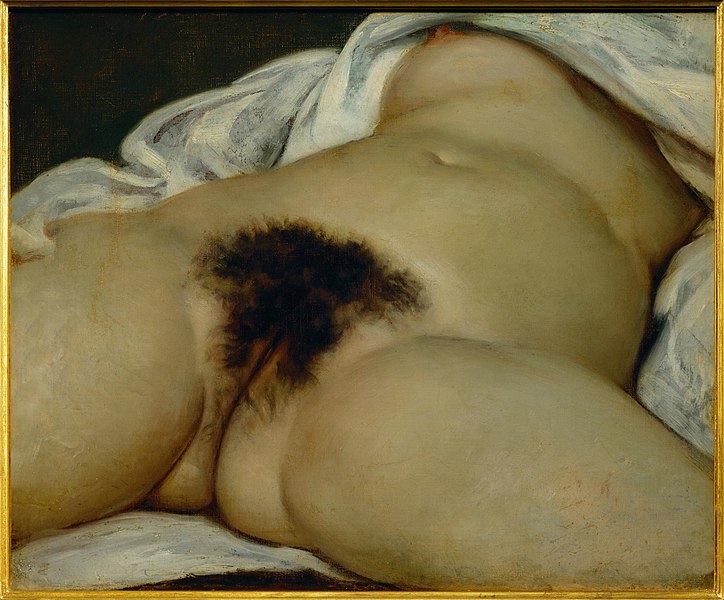
Facebook, Oh Facebook: L’Origine du monde. (NSFW)

L'Origine du monde, Gustave Courbet, 1866.

L’Origine du monde, Gustave Courbet, 1866.

L’Origine du Monde, The Origin of the World, is a famous and well known painting by Courbet. It’s a beautiful work, and housed at Musée d’Orsay, Paris. Facebook France decided that a small thumbnail of this work was deserving of censorship.

The dispute around Gustave Courbet‘s graphic 1866 oil painting “L’Origine du Monde” (The Origin of the World), has escalated with teacher is taking Facebook to a Parisian court over allegations of censorship. Frédéric Durand-Baïssas says the social media network blocked his account without notice when he posted a thumbnail with footage and information about the painting.

The incident took place in 2011 but it has taken years of wrangling to establish whether or not Facebook is liable to French law, as it regards itself as a U.S. company. The art-lover posted a clip of the Courbet work after the account of Danish sculptor Frode Steinicke went down for a similar violation of the website’s rules on nudity. The company reactivated Steinicke’s account, although without the allegedly offending piece.

“On the one hand, Facebook shows a total permissiveness regarding violence and ideas conveyed on the social network,” the teacher’s lawyer, Stéphane Cottineau, told the Associated Press in 2016. “And on the other hand, [it] shows an extreme prudishness regarding the body and nudity.”

I would think, at this point, with Facebook being up to their neck in unethical and questionable activities they refuse to do anything about might have given them a bit of a wake up call over their astonishing prudery. They don’t care about threats. They don’t care about people being harassed. They don’t care about people using their service to steal. They don’t care about fakery of any kind. Oh, but if there is even an implied nipple, they are on the case, you betcha! There isn’t even an attempt to understand that the rest of the world does not have such puritanical views. There is nothing wrong with the human body, and it’s past time Facebook stopped acting like it’s the biggest shame of all.

Via Raw Story.

Flu Shot Jesus.

If you know who to credit, let me know.

Gloria Copeland, wife of Kenneth Copeland, who was recently boasting about the Gulfstream plane “Jesus bought” for him, has something to say about influenza.

A video was posted on the ministry’s Facebook page featuring Copeland’s wife, Gloria, telling people that there is no such thing as flu season and that they don’t need to get a flu shot because “Jesus himself gave us the flu shot.”

“Listen partners, we don’t have a flu season,” Gloria Copeland said. “And don’t receive it when somebody threatens you with, ‘Everybody is getting the flu.’ We’ve already had our shot, He bore our sicknesses and carried our diseases. That’s what we stand on.”

Right, it’s all part of Jehovah’s plan when people get sick and die, so no worries there. These idiots tangled with measles in the recent past, and measles won. A person might think they would have learned something, but no.

Praying for those who may already have the flu, Copeland proclaimed, “Flu, I bind you off the people in the name of Jesus. Jesus himself gave us the flu shot, He redeemed us from the curse of flu.” Those who don’t have the flu, she promised, can protect themselves by simply declaring, “I’ll never have the flu.”

“Inoculate yourself with the word of God,” Copeland advised.

Oh, I’m so sure “I’ll never have the flu” works a charm. The curse of flu? Okay, that’s a new one, where in the bible is that little gem, because I’d like to read it. What else do you tell people who do have the flu, that Jesus doesn’t love them as much? He got behind with the inoculations? As for “binding” the flu, uh, isn’t that kind of a witchcraft thing? While the bible doesn’t mention influenza, it does mention witchcraft. Might want to watch your step there, Ms. Copeland.

And while I don’t care if you want the misery of flu, you have no business inflicting it on others, you nasty, thoughtless ass.

You can see the whole mess at RWW.

Black Room.

The first landscape encountered in the Black Room interactive game (all images screenshots by the author for Hyperallergic).

The first landscape encountered in the Black Room interactive game (all images screenshots by the author for Hyperallergic).

The second landscape of Black Room.

The second landscape of Black Room.

Here’s an interesting game, Black Room:

The first few minutes of Black Room are a twist on my expectations. I know I’m not playing a traditional game. In fact, according the game’s homepage, I’m playing a “browser-based, narrative game about falling asleep while on your computer, on the internet,” where I play as “an insomniac on the verge of sleep, moving through shifting states of consciousness.”

Created and developed by Cassie McQuater, Black Room is free to play (with the option to donate money), and was “conceived as a feminist dungeon crawler, [and] features a majority female cast of video game sprites from the 1970s–current day.” After the game’s opening sequence — a blue light descends through a heron-filled sky before crashing to the ground and turning into a woman — my fingers are only allowed to do one thing: move my character to the right. As I do, the background comes alive with stars and fantastical birds. I’m moving through this dreamscape, alone. When I click on the “?” in the upper-right corner of the screen, I’m told, “The sky is vast. Yawning, you feel as though you’ve just woken from a long sleep. There is only one direction to travel.” Onward it is.

As a lifelong insomniac, I might have to give this one a try. You can read and see much more at Hyperallergic.

Design Crime: Art & Social Justice.

Stickers by Stuart Semple.

From spikes installed on window ledges to bars that divide benches into a set number of seats, examples of disciplinary architecture — otherwise known as hostile urban architecture — are all around us. Such designs deliberately restrict certain behaviors in public spaces, and while they affect everyone, they especially target homeless individuals, who cannot rest on these surfaces.

The UK-based artist Stuart Semple has created a campaign to try and raise awareness about these often subtle forms of social control. Today, he launched a website, Hostile Design, as a platform where people can easily and quickly spread word about these designs. It simply calls for anyone to photograph examples anywhere in the world, and share them on Instagram with the hashtag #hostiledesign. The website then aggregates these in a “design crime gallery.”

“Hostile design is design that intends to restrict freedom or somehow control a human being — be that homeless people, a skater or everyday humans congregating to enjoy themselves,” Semple told Hyperallergic. “The danger of hostile design is it’s so insidious. It’s so quiet, so camouflaged, that unless you know what it is, you accept it. And that blind acceptance makes things grow and spread.”

To further inform people beyond the digital sphere, he is also distributing stickers he created, which are available on the website. These “design crime” stickers are intended for pasting on offending surfaces and are available through pay-what-you-can pricing.

A bus stop in Bournemouth.

Living rural, I don’t see things like the above bus stop, which honestly shocked me. I’m about the size of a twig, and trying to sit on that “bench” would be very uncomfortable for me. Has it become so important to us to keep the afflicted and unfortunate out of sight that we willingly go along with being punished by this “disciplinary architecture”? This certainly strikes me as immoral and unethical, making every surrounding hostile because oh my, someone might actually find a place they could lie down and sleep, the horror! Par for the course, there’s zero effort to do anything about the problem of homeless people, but there’s a whole lot of effort going into driving them away from all public spaces. Certainly does not speak well of us. This isn’t just about driving the unfortunate out of sight, there’s also a public stair handrail, which has a block placed on it, just in case anyone had a fit of happy and wanted to slide on the railing.

I can’t say I’ve noticed anything like this in Bismarck, but I’m arming myself with stickers, and I’ll be looking.

There’s much more to read and see at Hyperallergic.

Abdominal Organs, Genitals, Semen, Menstrual Blood, Fetus, Heredity.

Isidore sits on a chair, writing on a sloping desk the words '(ysid)oris (de) natu(ra) hominisI' Isidore, Concerning the Nature of Man.

Isidore sits on a chair, writing on a sloping desk the words ‘(ysid)oris (de) natu(ra) hominisI’ Isidore, Concerning the Nature of Man.

Oh, I have to say that this entry is most entertaining, in a trainwreck sort of way.

Text Translation:

Only women have a womb; in it they conceive as in a small cup; but there are writers who assign a womb to either sex, often calling it venter, belly – and not just poets, but others also. The womb is called uterus because it is double and divides itself into two parts which bend in different and opposing directions like a ram’s horn; or because it is filled inside with a fetus. For this reason it is called uter, a bag, because it has something inside it, such as limbs and intestines. Paunch, aqualiculus, is properly the word for a pig’s belly. For this reason it is translated as venter, belly. It is called the matrix because the baby is generated in it. It fosters the semen it has received, and by cherishing it, turns it into flesh; and what it has turned into flesh, it separates into parts of the body. The vulva is so called as if it were a folding-door, that is, the door of the belly; either because it receives the semen or because the fetus goes forth from it.

[Read more…]

Bellicorum instrumentorum liber (1420).

Bellicorum instrumentorum liber,  Book of warfare devices, is a fascinating and absorbing inventor’s notebook. The title was bestowed by someone else, and it’s misleading as to the contents, which cover a very wide range of ideas.

Sometimes we try to invent something new by exploring within the bounds of what is known to be possible, and sometimes we invent by expanding those limits. For an imaginative engineer in the early fifteenth century — working more than two hundred years before the discoveries of Newton — the process of invention would be often a curious mix of the two. You would know so little about mechanical force that you could conjure up almost anything and believe it to be practical. Of course, attempts to bring the designs to reality would often fail, but they might, on occasion, also succeed.

Suppose for a moment that you were such a person possessing a talent for gadgets in the early fifteenth century, or an engineer hoping to build marvelous machines and clever structures no one else had yet dreamed of — how would you go about showing your talents? And what if you were someone who wanted to own wonderful and mysterious devices, such as a prince — how would you find the person who could make these things? A remarkable testimony to this meeting of engineering skill, technological ignorance, individual initiative, and public demand can be found in the Bavarian State Library, in the sketchbook of an Italian inventor of the early fifteenth century. It is a volume of sixty-eight drawings advertising the inventions that Johannes (or Giovanni) de Fontana (ca. 1395–1455), who was both the engineer and the artist, hoped to sell to patrons. Thought to have been created sometime between 1415 and 1420, the work has no title by Fontana that has survived, but a later owner gave it the title Bellicorum instrumentorum liber — the Book of Warfare Devices — despite the fact that most of it does not concern military matters.

This is an absorbing insight into thought, knowledge, and the desire to create, and you can see the whole thing here, or see selected bits along with text at The Public Domain.

Diabolus artificiosus, artificial devil.

Diabolus artificiosus, artificial devil.

Heilender Baum, Healing Tree.

Heilender Baum, Healing Tree.