The Art of Book Design: When Molly was Six

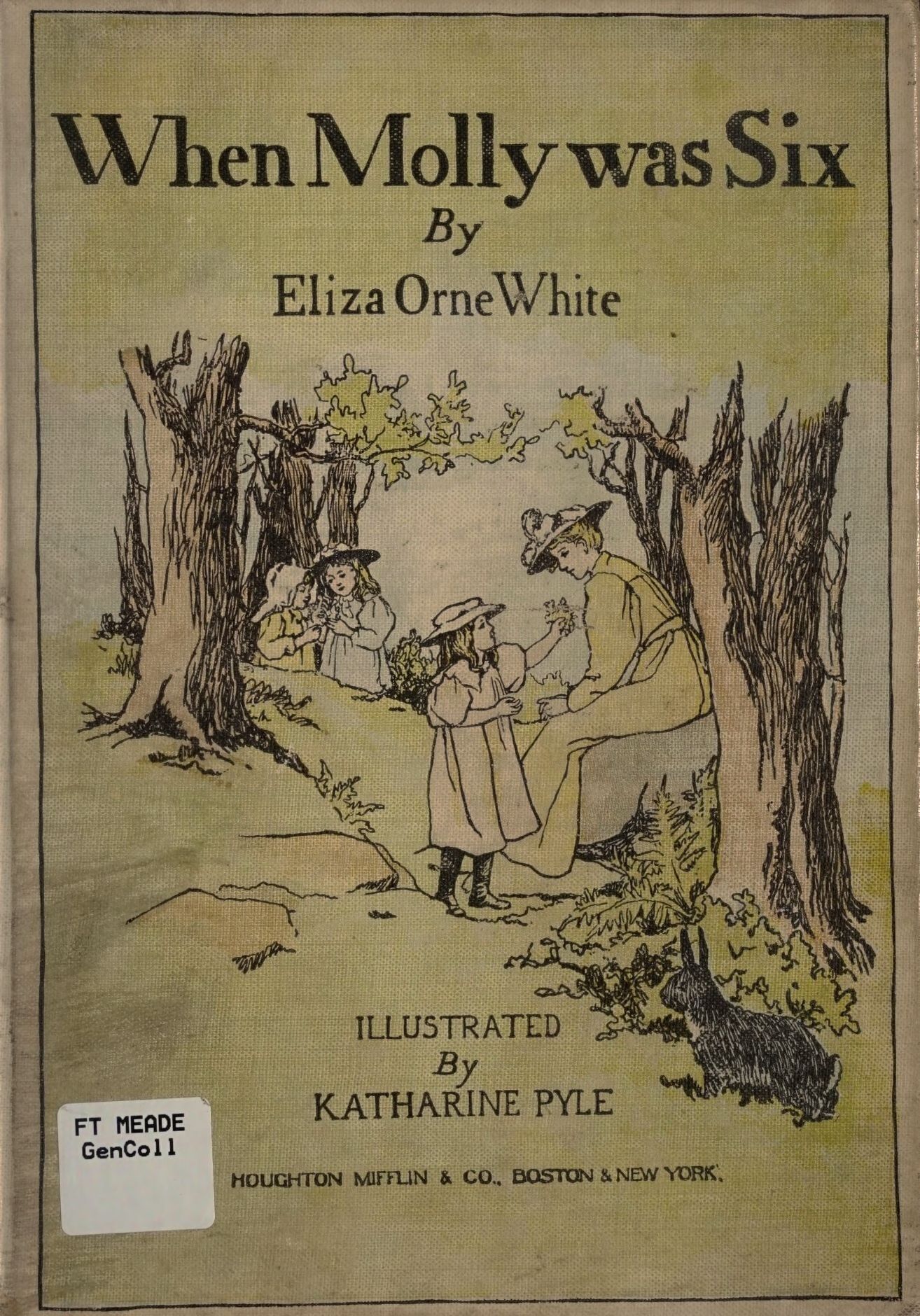
Eliza Orne White. When Molly was Six. Boston, New York, Houghton, Mifflin and company, 1894.

This week’s children’s book isn’t a fairy tale, but it is full of charming stories about a young girl named Molly, whose birthday falls on New Years Day. There are 12 stories in all, one for each month, but there are only 2 illustrations, which is a shame because I rather like the loose simplicity of them.

page 58, Molly feeding the chickens, When Molly was Six.

page 82, Digging down to China, When Molly was Six.


via: The Library of Congress

Bonsai Tree – Wake up Already Dammit!

Previous post.

The persimmon tree did not change leaves color at all in the fall, which is a bad sign, but eventually, they fell off and did not dry on the plant, which is a good sign. I have stored it together with my citruses and other subtropic plants at 10-15°C, but about a month ago I have re-potted it together with my Ulmus parvifolia bonsai because those both started to grow already due to the abnormally warm winter.

© Charly, all rights reserved. Click for full size.

© Charly, all rights reserved. Click for full size.

During that, the plant had very nice and healthy roots. The main root was not overly long and it was not carrot-like at all, which is the worst that can happen. As you can see, it had nice and bushy side-roots on the whole length, an ideal situation. So I have cut off half of the main root and the cut was, again healthy-looking, white and wet. I covered the cut with lots of charcoal and I planted the tree in a wider and shallower pot than it was before

Lastly, I moved it into my room to be able to better control the substrate humidity to avoid root rot. I have expected the tree to wake up in the warmer room and start growing, but so far nothing and it is making me anxious. After all, my Ulmus parvifolia grow like mad despite being in the coldest room in the house.

And today I realized that I need not try and cope with that anxiety alone, so here you have it, now you can be anxious too. Ain’t I grand?

© Charly, all rights reserved. Click for full size.

The terminal bud is still bright green and the top leaf is soft to touch and that is a good sign.

But it does not grow, dammit. Maybe this tree reacts to daytime length before it starts growth?

The Art of Book Design: The Old House, and Other Stories.

Blanche Sellers Ortman. The Old House, and other stories. Chicago, The author, 1910.

The notes for this book state that only 500 copies of the book were privately printed for the author by Rand McNally Press. This makes the book rare, but probably not worth anything. If the stories were good, it wouldn’t have needed a “private” publication. It has a lovely and tasteful cover picture, though. I also like the gold font, but perhaps the family crest with Latin is a bit much.


via: The Library of Congress

Bonsai for Beginners – Part 4 – Another Bit of Tree Physiology

Previous part.

This bit is, alas, often not discussed in bonsai literature as much in detail as it should too. Some books mention it in passing, some do not mention it at all. The talk is about types of tree growth. (note – the used terminology is my own, I have long since forgotten the official technical terms and anyway I am too lazy to search for them in foreign language)

There are three basic types that every bonsaist needs to be aware of, and it is vital to know which type each of your plants has because they determine what kind of care they require to get turned into a bonsai and survive the procedure.

1 – Continuous growth.

This does not mean that the plant grows continuously throughout the year, although usually when a plant does grow the whole year, it has this type of growth. But the growth might slow down or stop completely in certain conditions, like drought or cold or insufficient daylength. However, when the growth slows or stops, it does so without any apparent change in the plant’s physiology. No special structures develop, the plant just stops growing and when the conditions get right again, it continues. The “buds” are simply a bundle of small leaves/needles bunched up together.

In temperate regions, typical representatives of this type of growth are some evergreen conifers, like junipers or thujas. It is most typical for many subtropic trees – citruses, olives, and hibiscus. And of course tropical plants and succulents, like a ficus and money tree. This type of growth have mostly evergreens, although there are deciduous plants with it – for example, russian olive (Eleagnus angustifolia) and fig tree (Ficus carica), but they are the exception, not the rule.

2 – Continuous growth with a hibernating stage.

During the season, these plants just grow like the first type, adding leaves to their twigs continuously and growing in length. But when the conditions start to signal the end of the growing season, not only do they stop growing, they create specialized wintering buds. These buds then contain a relatively undifferentiated beginning of the next twig. When the hibernation ends, the buds shed their protective layers (modified leaves) and from them emerge twigs that again start to grow in length and adding leaves as much as they can manage.

This type of growth is typical for deciduous trees in temperate regions, like willows, poplars, maples, hazels and many more. I am not aware of any evergreen with this type, maybe holy (Illex sp.).

3 – Growth in spurts.

Some trees take the hibernation stage to the next level. The wintering buds do not contain just the beginning of a new twig, but a complete one with non-differentiated buds. At the beginning of the growing season these whole twigs emerge from the buds, they stretch in lengths and gain girth, but they do not add any new leaves or buds – the number of those has been determined previous year already.

This is typical for firs, pines, spruces and many other coniferous trees of temperate regions. From the top of my head, I only can remember one deciduous tree with this growth type – beech (Fagus sp.).

For a beginner, types 1 and 2 are the best option. Those are comparatively easy to manage, they mostly heal easily from pruning and the pruning itself can be often done at almost any time of the year or in wide enough window not to need to fuss about it too much.

Type 3 is difficult, and thus alas another point against pines. These types of trees cannot have twigs trimmed just anytime and anywhere, they often require being cut during very specific time otherwise the next year’s buds will form where you do not want them.

The worse in this regard are spruces, whose growth is nearly completely unmanageable. That is why you won’t see many very old spruce bonsai trees. More on that later.

The Art of Book Design: The Story of Jack; A Tale of the North

J. Horace Lytle. The Story of Jack: A Tale of the North. Dayton, O., Miami publishing co., 1917.

The Jack of the story is a terrier, but today’s book is in honour of my Jack, who is having a birthday today. Jack is a leap year baby, so this is only the fourth official birthday he’s ever had. In reality, my baby is twelve today and I don’t know where the years have gone. I haven’t had a chance to read the story yet, but the book is delightfully illustrated.


via: The Library of Congress