The Illustrations to Tales of Mystery and Imagination, by Edgar Allen Poe, by Harry Clarke, 1919. Click for full size.
Text Translation:
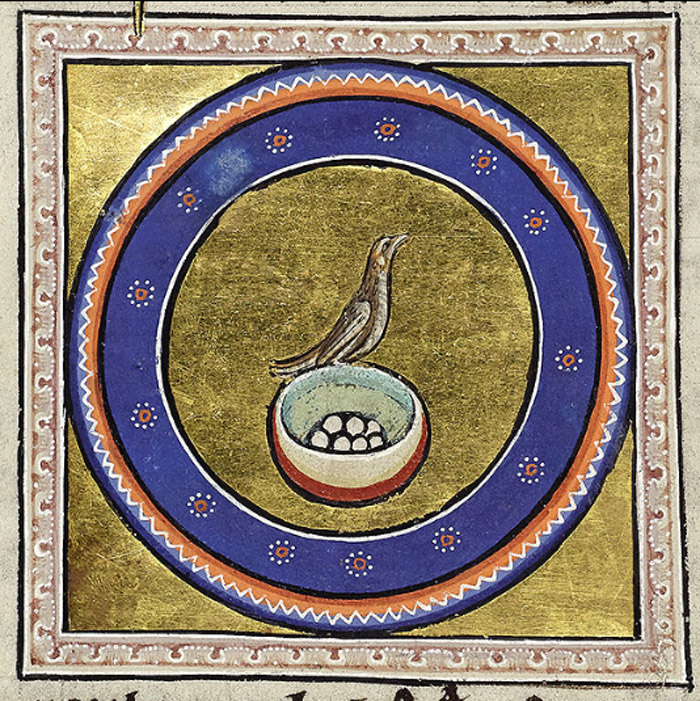
Of the nightingale The nightingale is so called because it signals with its song the dawn of the new day; a light-bringer, lucenia, so to speak. It is an ever-watchful sentinel, warming its eggs in a hollow of its body, relieving the sleepless effort of the long night with the sweetness of its song. It seems to me that the main aim of the bird is to hatch its eggs and give life to its young with sweet music no less than with the warmth of its body. The poor but modest mother, her arm dragging the millstone around, that her children may not lack bread, imitates the nightingale, easing the misery of her poverty with a night-time song, and although she cannot imitate the sweetness of the bird, she matches it in her devotion to duty.
Folio 52v – the jay, continued. De lucinia; Of the nightingale.

Ahmed Rabbani, “Untitled (Binoculars Pointing at the Moon)” (2016) is one of the works by present and former Guantanamo detainees that could be impacted. (image courtesy Art from Guantánsmo Bay exhibition).
3. Guantánamo Inmates: We can’t imagine a more awful position for someone to be in, but the US government is adding to the humiliation of indefinite detentions without trial by deciding that Guantanamo inmates no longer own the art they create, and they will probably destroy it. Hard to see what good could come of this.
Hyperallergic has their list of the powerless up, and unsurprisingly, the bar just gets lower, as in the case of those people detained at Guantanamo. As always, some people maintain their position on the list of the powerless:
5. Female Artists: Most of the stories were anecdotal before, but now studies are reinforcing what we knew already, namely that art made by women sells for almost half their male counterparts. Analyzing auction data and experiments with thousands of respondents, researchers found that the perception of an artist’s gender consistently affects how their work is valued. Now that we have the data, how do we remedy this?
This amazing eye chart was put together by George Mayerle, in 1907.
This fantastic eye chart — measuring 22 by 28 inches with a positive version on one side and negative on the other — is the work of German optometrist and American Optometric Association member George Mayerle, who was working in San Francisco at end of the nineteenth century, just when optometry was beginning to professionalise. The chart was a culmination of his many years of practice and, according to Mayerle, its distinctive international angle served also to reflect the diversity and immigration which lay at the heart of the city in which he worked. At the time it was advertised as “the only chart published that can be used by people of any nationality”. Stephen P. Rice, from the National Library of Medicine (who house this copy presented here), explains just how throughly thought through the different aspects of the chart were as regards the aim to be as inclusive as possible:
Running through the middle of the chart, the seven vertical panels test for acuity of vision with characters in the Roman alphabet (for English, German, and other European readers) and also in Japanese, Chinese, Russian, and Hebrew. A panel in the center replaces the alphabetic characters with symbols for children and adults who were illiterate or who could not read any of the other writing systems offered. Directly above the center panel is a version of the radiant dial that tests for astigmatism. On either side of that are lines that test the muscular strength of the eyes. Finally, across the bottom, boxes test for color vision, a feature intended especially (according to one advertisement) for those working on railroads and steamboats.
You can also see and download this wonderful chart here. Via The Public Domain.

Bibliothèque Municipale de Troyes, MS 177, Folio 154v. A multi-colored jay with a crest on its head.
Text Translation:
[Of the jay] Rabanus says of the jay: ‘The jay gets is name from its talkativeness, garrulitas; not, as some would have it, because jays fly in flocks, gregatim; clearly, they are named for the cry they give. It is a most talkative species of bird and makes an irritating noise, and can signify either the empty prattle of philosophers or the harmful wordiness of heretics.’ More can be said of the nature of the jay. For jays signify both gossips and gluttons. For those who devote themselves to gluttony take pleasure, after eating, in repeating gossip and in lending an ear to slander. The jay lives in the woods and flies chattering from one tree to another, as a talkative man ceaselessly tells others about his neighbours, even the shameful things he knows about them. When the jay sees someone pass, it chatters, and if it finds anyone hiding from the world, it does the same, just as a talkative man slanders not only worldly men but also those hidden whom a religious house conceals.

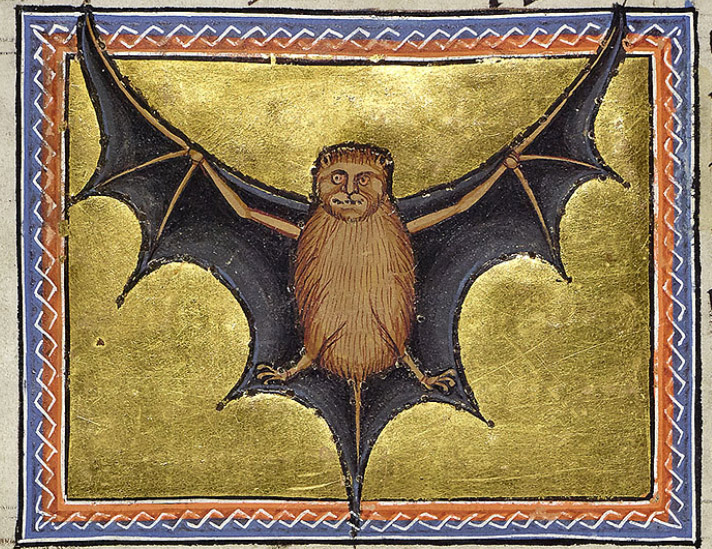
Portrait of the bat. Compared with many other bestiary illustrations, this is a fairly accurate ventral view of a bat whose wings are shown as a membrane stretching from its three fingers down to its toes and tail. Its furry face has the typically uncanny human look. The artist has realised that the flight membrane joins the fingers, legs and tail even though there should be five fingers with four supporting the wing. It is classified as a bird because of its wings rather than as a mammal because of its fur.
Text Translation:
[Of the bat] The bat, a lowly animal, gets its name from vesper, the evening, when it emerges. It is a winged creature but also a four-footed one, and it has teeth, which you would not usually find in birds. It gives birth like a quadruped, not to eggs but to live young. It flies, but not on wings; it supports itself by making a rowing motion with its skin, and, suspended just as on wings, it darts around. There is one thing which these mean creatures do, however: they cling to each other and hang together from one place looking like a cluster of grapes, and if the last lets go, the whole group disintegrate; it a kind of act of love of a sort which is difficult to find among men.
This is just too cool!
Yuki Tatsumi was working as a waiter in a restaurant when one day, as he was cleaning up a table, he noticed that a customer had intricately folded up the paper chopstick sleeve and left it behind. Japan doesn’t have a culture of tipping but Tatsumi imagined that this was a discreet , subconscious method of showing appreciation. He began paying attention and sure enough noticed that other customers were doing the same thing. Tatsumi began collecting these “tips” which eventually led to his art project: Japanese Tip.
Since 2012 Tatsumi has not only been collecting his own tips but he’s reached out to restaurants and eateries all across Japan communicating his concept and asking them to send him their tips. The response has been enormous. He’s collected over 13,000 paper sculptures that range from obscure and ugly to intricate and elaborate.
Earlier this month Tatsumi staged an exhibition in Tokyo where he displayed 8000 of some of the most interesting sculptures sourced from all 47 prefectures around Japan. “Japanese Tip is a project between restaurants and customers,” says Tatsumi, “to communicate the ‘appreciation for food’ and ‘appreciation of the service’ by using the most common material used at any Japanese restaurant.”
The exhibition has since closed but you can see some of the paper sculptures on his website and you can follow the initiative on Facebook.
Such a cool and thoughtful thing to do. You can read and see more at Spoon & Tamago.

Hoopoe in a roundel. The hoopoe has a comb-like crest and startling black and white bars across its body. The crest illustrated is more like a peacock’s crest. Compare the totally different version of the hoopoe on f. 36v.
Text Translation:
[Of the hoopoe] The Greeks call the bird by this name because it roosts in human ordure and feeds on stinking excrement. The filthiest of birds, it is capped with a prominent crest. It lives in burial places amid human ordure. If you rub yourself with its blood on your way to bed, you will have nightmares about demons suffocating you. On this subject, Rabanus says: ‘This bird signifies wicked sinners, men who continually delight in the squalor of sin.’ The hoopoe is said to take pleasure in grief, as the sorrow of this world brings about the death of the spirit; for this reason those who love God should ‘rejoice evermore, pray without ceasing and in every thing give thanks’ (see 1 Thessalonians, 5:16-18) ‘for the fruit of the Spirit is joy’ (see Galatians, 5:22).
In addition, Physiologus says of the hoopoe that when it grows old and cannot fly, its offspring come and pull out the oldest feathers from its body and constantly care for it, until it has recovered its strength as before and can fly. The young hoopoes provide, therefore, an example to those evil men who, when their parents grow old, throw them out of their home; who refuse to support, when they are weak, the parents who raised them when they were still in their infancy. Let man, who is endowed with reason, learn his duty to his mother and father, from the way in which this creature, which lacks reason, provides (as we have already shown) for its parents’ needs when they are old.
Then there’s a bit more on the Night Owl:
Of the night-owl The night-owl, noctua, is so called because it flies at night and cannot see in the daytime. For its sight is dimmed by brightness of the sun when it has risen. The night-owl, noctua, is not the same as the owl, bubo, which is bigger. But the night-crow, nicticorax, is the same as the night-owl, because it loves the night. For it is a bird which shuns the light and cannot bear to see the sun. This bird symbolises the Jews who, when the Lord our Saviour came to save them, rejected him, saying: ‘We have no king but Caesar’ (John, 19:15); and ‘loved darkness rather than light’ (John, 3:19). Then our Lord turned to us, the Gentiles, and gave us light as we sat in darkness and the shadow of death; of the Gentiles it is said: ‘A people which I knew not shall serve me’ (Samuel 2, 22:44; Psalms, 18:44); and in another prophet: ‘I will call them my people, which were not my people; and her beloved, which was not beloved’ (Romans, 9:25; see Hosea, 2:23). Of the people of the Jews, the sons of strangers etc.
Folio 50v – the owl, continued. [De hupupa] ; Of the hoopoe.